Everything Can Be 'Semaglutide-ized': Efficiency Above All, Prediction Markets, the Spectacle Economy, and War

marsbitPublished on 2026-03-29Last updated on 2026-03-29

Abstract

Kyla Scanlon critiques modern society's obsession with "optimization" as a form of escapism, arguing that it turns bodies, identities, and beliefs into tradable assets. This culture promotes quick fixes—like Ozempic for weight loss or biohacking for longevity—without addressing systemic root causes. She identifies a shift from collective infrastructure to individualized, privatized solutions, driven by financial nihilism and a desperate desire for control in an unstable economy. This leads to "faith markets" (e.g., prediction markets, crypto) where narratives trump fundamentals, exploiting fear and despair. Examples include the "manosphere," where influencers monetize loneliness and insecurity, and even government communication that prioritizes memes over substantive action. Scanlon emphasizes that true agency requires addressing structural issues—affordability, functional institutions—rather than pursuing superficial, personal optimizations. The article calls for a shift from despair-driven consumption to hope-based, collective solutions.

Author: kyla scanlon, Macro Analyst

Compiled by: Felix, PANews

Macro analyst Kyla Scanlon recently published a lengthy article, pointing out that the "optimization" narrative being peddled by today's society is essentially escapism. It turns the body, the self, and beliefs into tradable assets, creating a dependency on "quick fixes" while never addressing the systemic root causes. Details below.

I had to start trying an "elimination diet" because my gut is essentially eating itself, and this is apparently also destroying my thyroid, making it impossible to absorb any nutrients. To fix this, I had to stop eating wheat, dairy, corn, eggs, tomatoes, peanuts, coffee, soy, cocoa, sugar, and many other things (this isn't like a juice cleanse or anything fun; it's a necessary action to stop my body from attacking itself). I have to log what I eat and how I feel, and then assess what I can eat from that.

If there was a quick fix (like an injection), I would try it. I don't really know what's wrong with me, I just know I had many vials of blood drawn, and modern science tells me that some things inside my body are very wrong.

But the funny thing is, part of the problem is that I always wanted to take shortcuts. Last year, I was traveling for 40 weeks, and some days, I survived on granola bars and about 14 cups of coffee. I would also run frantically, work frantically, and sleep very little because I felt completely invincible. After all, I was an "efficiency machine."

For a while, I was. But then I wasn't. It turns out I wasn't really optimizing anything; I was just逃避 (escaping) what I really should have been doing, like sleeping. What I needed wasn't to push myself harder but to start figuring out what was making me sick. This is the exact opposite of what we've been taught.

"Semaglutide-ization" (Ozempicization)

Americans love optimization. So when something promises to let us optimize further, offering a near-instant quick fix, it's hard to resist. Our identity is almost built around being "efficient."

The desire for control is very strong right now, and this desire permeates every corner of the digital and physical worlds.

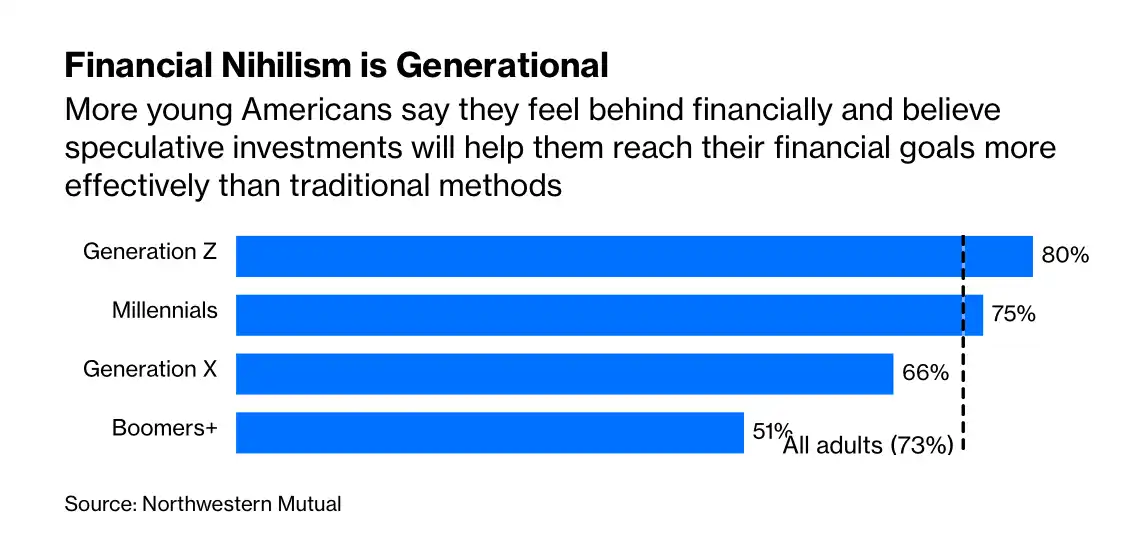
  • I think this is actually a response to a kind of financial nihilism. People no longer believe the underlying economy will work for them, so they turn to speculation or other seemingly quick paths to stability.
  • According to a Northwestern Mutual survey, 80% of Gen Z and 75% of Millennials feel behind, and this feeling drives them to speculate.
  • The same goes for social media: if you struggle to form connections in real life, the online world offers a substitute form, but people are increasingly uneasy about the collective reliance on social media.

Subsequently, industries have sprung up to monetize this nihilism by offering the promised solutions. But the solutions never arrive because the nihilism and the relinquishing of spirit must persist for these products to survive. This aligns with the views in Ivan Illich's book "Medical Nemesis." Ivan pointed out that the medical system itself creates illness because it makes people dependent on professional intervention rather than focusing on maintaining health. This effect exists in all optimization tools; they create a dependency on the "fix" rather than solving the root cause. The "optimization economy" cannot bring a sense of control because "despair" itself is the condition for its market operation, and the pursuit of control through optimization is itself a form of losing control.

Our tools are also too focused on the individual. As Raymond Williams wrote in his 1975 book "Television: Technology and Cultural Form":

  • The earlier period of public technology, represented by the railroad and urban lighting, is being replaced by a technology that has not yet found a satisfactory name: a technology that serves a lifestyle that is both mobile and home-centered: a form of mobile privatization.

Williams described the shift from infrastructure serving everyone to technology built around the mobile, private individual. The shift from railroads to peptides is the shift from "we build for everyone" to "you can buy it for yourself."

A truly effective example of a personal optimization tool is Ozempic (semaglutide, a weight loss/diabetes drug). Some people need it for medical reasons, while others openly admit to using it for aesthetics. To be clear, Ozempic is an excellent technology; it does solve real problems faced by individuals, but it doesn't address collective issues like the food system and healthcare accessibility.

This also marks a shift. We can truly control certain aspects *inside* the human body through time and resources. What we have is the optimization of everything in the "Ozempic" style, or "Ozempicization." We now have a suite of peptides and other various forms of "magic injections" that can save you the effort, discomfort, and complexity. Everything can be optimized. Everything can be controlled.

Controlling the Body

The body has always been a site of control because it is a system that still reacts to external inputs. And nowadays, various systems are hostile. The economy and institutions often ignore individual plights, but the body does not.

It's no surprise that Bryan Johnson's multi-million dollar "forever young" experiment garners widespread attention. Bryan Johnson has what everyone craves – complete control over outcomes. The appeal of "immortality" lies in this sense of control: control over your nutrition, supplements, lifespan. And for the audience, that's its appeal: in an era where everything feels out of control, the body becomes an object that can be mastered.

This pattern is common. Personally, in college, when my father was seriously ill, I developed a severe eating disorder and tried to regain control over everything. When all external factors become unmanageable, control over the body becomes the last line of defense (regardless of gender). Throughout humanity, many people ultimately resort to body control. And this method of control is gradually becoming a form of content consumption.

Clavicular is a recently rising streamer, famous for "bone smashing" and "looksmaxxing," who exists in his own WWE-like universe that he's pieced together. His universe has its own language; it's a battle for the "number one alpha male" (determined by online leaderboards). He is obsessed with his appearance and obsessed with control.

"Looksmaxxing" itself simulates a value (status, appeal) that these people might not be able to attain economically. It's a form of control over the body to compensate for their lack of economic control. This phenomenon also appears in wellness culture, peptide drugs, plastic surgery, and various enhancements. It serves the individual's desire to become healthier or stronger, but it also serves an economic purpose; it's another means of control.

The hot word in Silicon Valley right now is "agency," which is really just a euphemism for the desire for control. Optimization is the process, control is the goal, and "agency" is the branding. In the startup world, the meaning of "agency" is ambiguous, but it certainly implies that someone will somehow force the world to bend to their will.
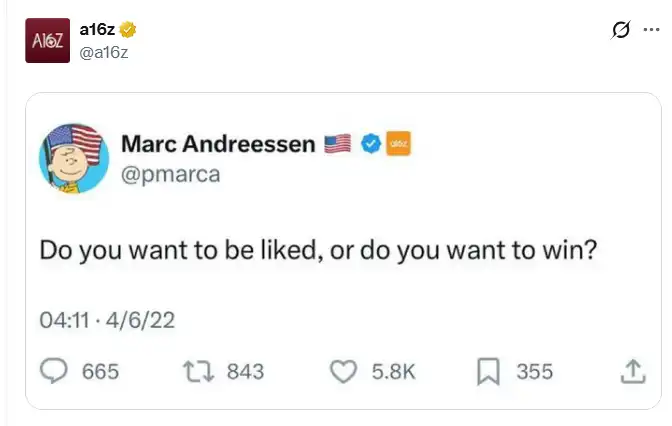
Cluely is a company that wholeheartedly embraces this philosophy, the final boss of the "startup economy." Their initial idea was "scamming" (later pivoted to AI notes) and they have raised millions. For them, "scamming" is "agentic," as Sam Kriss wrote in the article "Child's Play," it is indeed "Silicon Valley's hottest commodity":

  • The future will belong to those with specific personality traits and psychosexual disorders. AI might code faster than you, but humans still have one advantage, and that's agency, or high agency. Highly agentic people are those who are highly action-oriented.

They act out of fear of permanently becoming the underclass and becoming useless in the age of AI. Apparently, the way to avoid both is to "constantly chase clout online."

Bryan Johnson's approach is highly agentic and highly online. He constantly experiments on himself with supplements and psychedelics, adhering strictly to diet and exercise regimens. This is perhaps the maximum degree of control (or agency?) anyone can have over their own body. In fact, he tries to gain so much control that he almost plays a kind of God.

People have to ask themselves:

  • Do I believe his claims that we can live forever?
  • Do I believe his body is the proof of concept?
  • Do I believe his constant content creation is enough to validate the project?

This quickly evolves into a market of belief, and Bryan Johnson becomes an asset. So does Cluely; investment is based on belief, a belief in control and agency. But once the body (or, in terms of agency, the mind) becomes an object to be optimized, the self becomes an asset class. It's primarily driven by narrative, and once that happens, you've already fallen into the logic of the belief market.

The Belief Market

Prediction markets and cryptocurrencies follow the same logic: betting on narratives rather than fundamentals, gaining a sense of agency through participation. Belief markets promise an escape from limitations (whether physical or financial). They monetize the fear of being left behind, manifesting as:

  • I died while others lived
  • I didn't cheat while others did
  • I became poor while others got rich

All of this signals a shift that is occurring:

  • Old capitalism valued productive capacity, the ability to make things.
  • Financial capitalism valued cash flow rights, claims on future earnings.
  • What we might call belief capitalism values narrative attachment, getting enough people invested in a story for long enough that it holds sway.

Belief markets need to foster the illusion of easy participation to survive. The product they sell is "you can do it too." Coinbase's Brian Armstrong thinks similarly to Bryan Johnson. He is also keen on longevity and biohacking (and prediction markets) and believes that aging should be avoidable in the future.

This philosophy is also reflected in his product. Coinbase's prediction market pitch is, bluntly, "take back control." Its prediction market competitor Kalshi's slogan is "make your descendants proud."
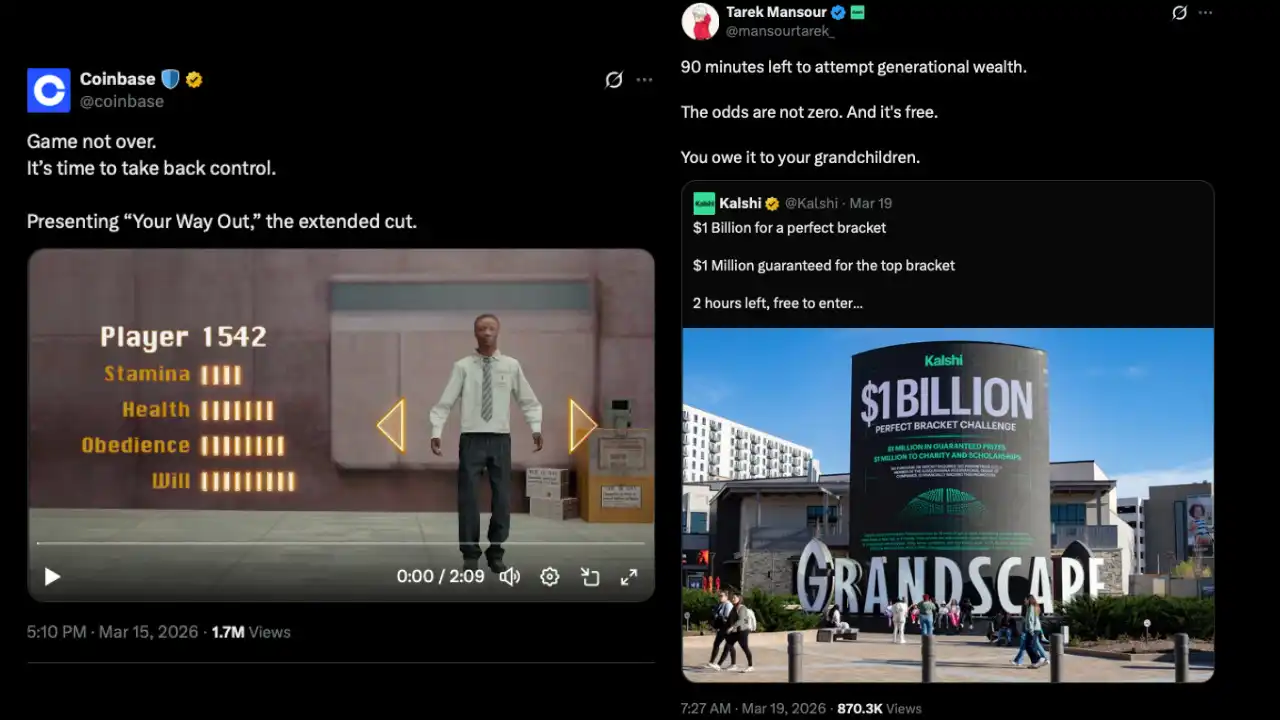
Control your future with a friendly neighborhood betting app. The founder of another prediction market app, Novig, once said only 20% of their users make money, claiming this is far higher than the industry average. That doesn't sound like control, or much of a future.

Everyone is chasing the gold. Everyone is trying to get rich quick and easy, as Allison Schrager wrote, "catch the next wave, and pray for good luck."
The widespread lack of rules, combined with the promise of regaining control that fails to materialize, is the exploitative nature of belief markets. There's a vast chasm between the promise of participation (gaining freedom) and the actual outcome (massive losses, even less freedom than before).
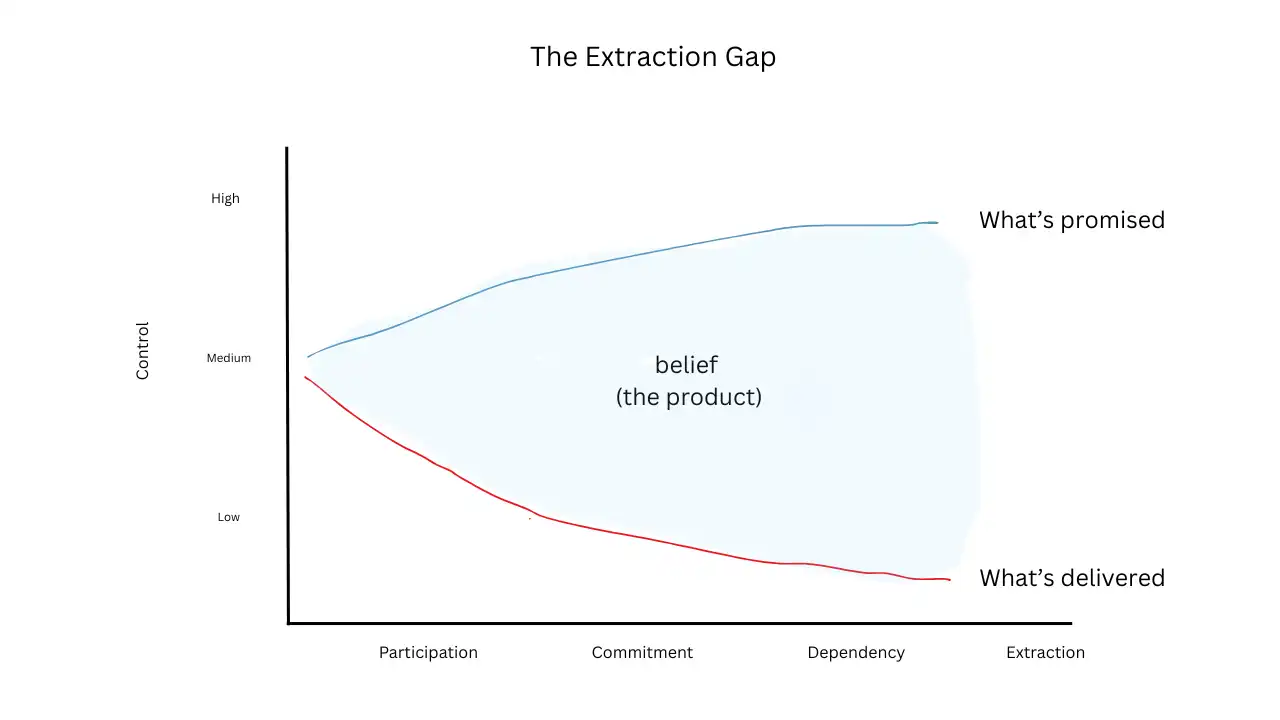
More illustrative than mathematical

Every solution promising control over "systemic failure" is packaged as a product that traps you deeper in the predicament you were trying to escape.

The "Manosphere" Case Study

The extractive logic of belief markets migrates to anywhere there are desperate people, and the "manosphere": this online world promoting masculinity, is an epitome of that desperation. I think the audience for the "manosphere" is actually smaller than perceived, but it vividly illustrates the desire for control, belief markets and their subsequent extraction, and the spectacle economy.

Louis Theroux's documentary "Inside the Manosphere" captures these belief markets in a thought-provoking way. It shows the paranoia of broadcasting one's personal life to thousands. The men featured fear being seen as small, poor, weak, and unattractive, so they create imaginary enemies in their minds (Louis himself became one), and obsess over escaping the "matrix."

"Manosphere" (and other spheres) streamers are essentially like zoo exhibits. People throw snacks into their "cages," demanding they dance (e.g., on Twitch and Kick, streamers receive tens or even hundreds of dollars to answer questions, do backflips, etc.).

This leads to the emergence of "vice signaling" (catering to our darkest impulses), as the audience demands crazier things, and the streamers respond with crazier behavior. This crazy content gets clipped, posted, and shared, aiming for virality. Sometimes these clips are out-of-context interviews, rage-bait content, or worse, and then everyone angrily shares them, they go viral, and society further unravels at the edges. You can even make millions easily just from these video clips.

"Manosphere" influencers are essentially MLM leaders. They recruit young men and women into their trading courses or brokerages, taking a cut of the profits, monetizing their pain and desperation.

Prediction market Polymarket is doing something similar with its new referral program. Prediction market influencers get rewarded for bringing new users to the platform, receiving a share of the fees generated by those new users. Polymarket has also adopted the messaging tactics of the "manosphere." As Stuart Thompson, David Yaffe-Bellany, and Mike Isaac wrote in The New York Times, they "amplify unsubstantiated claims and baseless conspiracy theories from the Trump administration" to "attract young men who are highly likely to become paying users."

They teach people it's easy, it's simple, just watch the crude oil price chart, see if there's a "triple witching day" (PANews Note: Refers to the day when stock index futures, stock index options, and stock options all expire simultaneously in the US stock market; market volatility typically increases significantly around "triple witching days"), or bet on snowfall, or bet on the Oscars, and most importantly, bet on yourself, and you can become a millionaire like me. Yeah, you must have it all easily, because everything is easy now. But it's not. As Benjamin Fogel wrote about "manosphere" leader Andrew Tate:

  • He represents a new kind of capitalism that has no illusions about progress. For Tate and his fans, the whole system is a scam, and the only way to succeed is to push others down and climb your way to the top.

Tate is a central figure in the "manosphere," and he never pretends to do anything beneficial. He embraces his "predation, exploitation, and ruthless pursuit of fame and fortune" because it's all a scam. And he has a point. Fogel also notes:

  • The decade of slow growth following the financial crisis gave rise to the "hustle economy," characterized by precarious gig work. This economic model was marketed as empowerment but was really just a way to subsidize low incomes. Now, "hustling" has become completely egalitarian. From Amazon drop-shipping to crypto day trading, anyone can get involved.

So, can you really condemn the "manosphere" saying "it's all a scam, the strong prey on the weak," while cheering for excessive stock buybacks or leveraged buyouts (which extract value by loading acquired companies with debt and firing employees)? Is the "manosphere" strategy: extract value from the weak, take no responsibility, and move on; really that different from the private equity model: identify undervalued assets, improve operational efficiency, and return capital to shareholders?

Chaos and nihilism are products of this regressive world, not symptoms. Those peddling "agency" profit in a world where no one trusts institutions because that distrust is the market condition that makes their product necessary. Tate needs the system to be a scam, Polymarket needs uncertainty to be the norm; the worse things are, the more their pitch works.

The "manosphere" fans Theroux interviewed had heartbreaking experiences (as did some of the creators), experiencing homelessness, losing fathers, and unemployment, filled with pain. They watch people like HSTikkyTokky because they want to emulate him, they want to get rich.

The behavior is just a performance, but the message works. People believe it because they are primed to look for quick and easy solutions to these huge, scary problems. As Fogel wrote:

  • This has nothing to do with the progressive vision of capitalism, which sees it as a system that can increase productivity through labor-saving technology or by producing actual goods. What it peddles is indebted, anxious, lonely consumerism.

Anxious and lonely people, craving control. The "manosphere" uses spectacle to extract value from despair. AI does the same thing, but it doesn't need a desperate person performing for an audience of the desperate. It replaces reality itself with synthetic feeling. We move from "extraction via spectacle" to "simulation via spectacle"

Spectacle and War

We tend to seek control in all aspects of life, including access to information. Amanda Mull once wrote an article about "monitoring the situation": people (apparently including me) are glued to screens, trying to piece together information. And there is a lot of information to sift through: wars, government partial shutdowns, unstable fiscal policy, a weak labor market, high prices, etc. Scrolling through platforms like Twitter, reading open-source intelligence (OSINT) information, feeling informed, is comforting. As Mull aptly wrote:

  • If you can perfectly algorithmize your feed, you might achieve a kind of complete "witnessing" that makes you feel involved, even in control. After all, there is ample evidence that the people dropping the bombs are monitoring the same feeds you are.

We monitor the situation because monitoring itself feels like participation, and governments leverage this, replacing real situations with spectacle. Throughout the war, the White House communicated almost exclusively using AI-generated memes, memes resembling "Fruit Love Island" (a TikTok account where AI-generated fruits act out plotlines of shows), combining video game footage with bombing footage. As Politico reported, a senior White House official expressed a similar sentiment:

  • "Bro, we've been over here just making banger memes."

First as farce, then as tragedy, or something like that.

But just as individuals use various means to simulate control, institutions are increasingly using spectacle to simulate the stability they can no longer guarantee. Spectacle is the solution because seriousness requires accountability, accountability requires consequences, and consequences require institutions willing to enforce them. Currently, such institutions do not seem to exist.

The Fed is on hold, doing what it can in the current situation. The government is half-shut down. Corruption is seeping from the sewers, overflowing from the vents. Diplomacy has been replaced by memes. Iran and the US have been conducting this war via Twitter. The Speaker of the Iranian Parliament tweeted:

  • We know what's happening in the paper oil market, including the companies hired to influence oil futures. We also see the broader propaganda campaign. But let's see if they can turn this into "actual fuel" at the gas station, or print gasoline molecules!

This is a jab at American financialization and Trump's handling of the war (don't fight during trading hours, fight big on weekends, endless performance). He's right: you can't win a war by posting memes (though the markets seem largely indifferent to all of it so far).

As Juliette Kayyem wrote in The Atlantic regarding the long TSA lines and the plane crash at New York's LaGuardia Airport:

  • These two crises seem separate, but they are linked: they are both the result of a style of governance that neglects governance. [...] The Trump administration, in this term, has focused on manufacturing fake threats while ignoring many real ones, such as the continued degradation of the departments and systems meant to protect people, including air travelers.

  • Public safety is not a given—Americans are slowly realizing that they can no longer take public safety for granted.

This administration only focuses on fake threats. Baudrillard, Debord, Postman, and others foresaw all of this. People see it coming too. But now, the real crises are here. This is an economic war, with 25% of global oil trade and nearly half of urea (agricultural fertilizer) at risk. Oil prices could spike to $200 a barrel, triggering another inflationary spiral worse than the COVID one. And all for what? People are dying. Such immense risk, seemingly just for... engagement?

In such a world, what can people do but try to control what they can, pursue optimization, exhibit "agency"? When uncertainty is the dominant force and the path to a different direction is unclear, people naturally seek quick fixes and simple solutions. What else can they do?

Return

It feels like if Trump had an "Ozempic" for geopolitics, he would have injected it by now. But, we don't have a "peptide cocktail" for the economy, at least not yet. Faced with this multi-year instability, the cultural response of seeking quick solutions that seem like optimization but are actually逃避 (escape) from the root problems is understandable.

  • These solutions only address the symptoms (I feel out of control),
  • without touching the root causes ((broken economic ladder).

​​The pain driving people into the "manosphere," prediction markets, and speculation is real. But the entire model is built on nihilistic foundations.

Raymond Williams wrote in 1961: "Every aspect of our personal lives is affected by the quality of our common life," yet we insist on seeing problems in purely individual terms. The so-called "personal control" is not real control. Real control would be supra-individual, meaning affordability, functioning institutions, and as Kayyem said, a government that actually governs. What is being sold instead is a sense of personal control through gambling, hacking, feeds, subscriptions, optimization.

The reason we can't solve the problems isn't a lack of tools or information, but because the method (adding, optimizing, measuring) is not suited to the problem (finding the source of the poisoning). Do the slow, boring work, don't presume omnipotence. Perhaps the economy (like the human body) needs more of an "elimination diet." People are trying this, like NYC's Mamdani Chief Savings Officer. What can we cut to function more healthily?

Williams also wrote that the true radical is making hope possible, rather than making despair convincing. Despair is very convincing right now, and very profitable. Hope is the opposite: it works without requiring you to feel despair.

Related reading: Goldman Sachs interprets "How long will the Iran war last": The market has only traded "inflation," not yet "recession"


Related Questions

QWhat is the term used in the article to describe the modern obsession with optimization and quick fixes, and what does it imply?

AThe term is 'Ozempicization' or '司美格鲁肽化'. It implies a societal shift towards seeking immediate, superficial solutions (like the drug Ozempic for weight loss) that optimize individual aspects of life (body, self, beliefs) without addressing the underlying systemic root causes of problems. It represents a culture of efficiency and control that fosters dependency on 'quick fixes'.

QAccording to the author, what is the core driver behind the rise of 'faith markets' like prediction markets and cryptocurrency?

AThe core driver is financial nihilism and a profound lack of belief that the underlying economy will work for people. This feeling of being left behind (cited in surveys showing 80% of Gen Z and 75% of millennials feel this way) creates a desperate desire for control and stability, leading people to gamble on narratives rather than fundamentals in search of a quick path to wealth and agency.

QHow does the article connect the concept of 'agency', as promoted in Silicon Valley, to the broader 'optimization economy'?

AThe article posits that 'agency' is a branded term that sanitizes a raw desire for control. In the optimization economy, optimization is the process, control is the goal, and 'agency' is the marketing. It represents the belief that one can force the world to conform to their will, often through self-optimization (e.g., biohacking, peptides) or participation in speculative faith markets, turning the self into an asset class driven by narrative.

QWhat parallel does the author draw between the 'manosphere' and traditional financial systems like private equity?

AThe author argues that the 'manosphere's strategy of extracting value from the vulnerable (e.g., recruiting followers for paid schemes) and avoiding accountability is not fundamentally different from the private equity model, which involves identifying undervalued assets, often loading them with debt and cutting jobs, to extract value for shareholders. Both are seen as exploitative systems that operate on a premise that the system is a 'scam' where success comes from preying on others.

QWhat is the author's proposed alternative to the 'optimization' and 'quick fix' mentality for solving systemic issues, both in the economy and the human body?

AThe author suggests an 'elimination diet' approach, analogous to the medical exclusion diet they themself must follow. Instead of adding more optimizations or quick fixes, the solution is to do the 'slow, boring work' of identifying and removing the poisonous root causes. For the economy, this means focusing on fundamental governance, affordability, and functional institutions rather than speculative gambling and superficial personal control.

Related Reads

Utexo Partners with x402 to Provide Near-Instant USDT Settlement for the Agent Economy

Utexo, a Bitcoin-native stablecoin payment execution and settlement layer, has partnered with x402 to integrate USDT compatibility into the x402 payment protocol. This collaboration enables near-instant settlement for agent-to-agent transactions, with speeds as fast as 50 milliseconds. x402 is an open protocol that uses the HTTP 402 "Payment Required" status code to embed payment functionality directly into HTTP requests. This allows applications, APIs, and autonomous systems to pay for services in real-time without requiring pre-funded accounts. The integration expands x402’s initial USDC support to include USDT, one of the most widely used stablecoins globally. Utexo’s infrastructure is designed for high-frequency, low-latency transactions, making it well-suited for machine-driven payments. According to Utexo CEO Viktor Ihnatiuk, supporting USDT within the x402 framework significantly broadens access and provides developers the performance needed for real-time agent-based systems. Kevin Leffew of x402 at Coinbase added that expanding stablecoin access improves performance and accelerates developer adoption. This partnership supports growing use cases where software systems autonomously conduct transactions—such as paying for API calls, accessing data on-demand, and coordinating services across platforms without human intervention. By combining x402’s protocol with Utexo’s settlement infrastructure, the collaboration enables a payment model where transactions are as fast and efficient as the requests that trigger them.

marsbit2h ago

Utexo Partners with x402 to Provide Near-Instant USDT Settlement for the Agent Economy

marsbit2h ago

Trading

Spot
Futures

Hot Articles

What is LINON

Linde plc Tokenized Stock (Ondo): Revolutionizing Traditional Equity Access Through Blockchain Innovation The emergence of Linde plc Tokenized Stock (Ondo), represented by the ticker $LINON, signifies a monumental shift in the fusion of traditional financial structures and decentralized finance (DeFi). This innovative financial instrument showcases the tremendous potential of blockchain technology to democratize access to traditional equity markets while ensuring the security and regulatory compliance necessary for institutional-grade financial products. Through Ondo Finance's pioneering tokenization platform, $LINON provides a seamless pathway for global investors to engage with one of the world's leading industrial gas companies, Linde plc, creating a blockchain-native representation of the underlying equity. Introduction to Linde plc Tokenized Stock The landscape of financial markets is witnessing a groundbreaking transformation through the tokenization of real-world assets. Linde plc Tokenized Stock (Ondo) epitomizes this revolutionary approach by bridging the gap between conventional stock ownership and blockchain-enabled financial infrastructure. The $LINON token allows investors to gain exposure to one of the prominent industrial companies worldwide through decentralized technology. Operating within Ondo Finance's comprehensive ecosystem, $LINON symbolizes a practical application of tokenization technology that enhances accessibility, efficiency, and global connectivity in traditional financial markets. By leveraging blockchain infrastructure, this tokenized stock enables international investors to participate in U.S. equity markets, overcoming traditional barriers associated with cross-border investing. The significance of $LINON goes beyond technological innovation; it represents a fundamental shift in asset structuring, distribution, and trading in the digital age. This tokenized stock maintains all the economic benefits associated with traditional Linde plc shares while offering improved liquidity, programmable compliance features, and seamless integration with decentralized finance protocols. The development of $LINON indicates a growing acceptance of blockchain technology as a viable means for traditional finance, exemplifying how even well-established assets like Linde plc can integrate into blockchain systems. This approach preserves the core attributes that appeal to investors while introducing advanced capabilities that enhance the overall investment proposition. Project Overview and Objectives Linde plc Tokenized Stock (Ondo) encapsulates a strategic effort to democratize access to traditional equity markets through advanced blockchain technologies. The primary objective of $LINON is to provide approved global investors seamless access to the economic exposure associated with Linde plc shares, furthering an effort to create a more inclusive financial ecosystem. Beyond the digital representation of traditional assets, $LINON endeavors to eliminate barriers of geography and time zones that limit investor participation. Its design ensures that blockchain technology can elevate traditional investment vehicles without undermining the security or compliance requirements expected by investors. Key goals of the project include enhanced liquidity provision, programmable compliance mechanisms, and interoperability with other blockchain networks. Each $LINON token is fortified by actual Linde plc securities housed at U.S.-registered broker-dealers, allowing holders to reap economic advantages akin to traditional stockholders, such as dividend reinvestment. Furthermore, $LINON aims to establish new industry standards for institutional-grade tokenized securities, paving the way for traditional assets to embrace blockchain technology while remaining compliant with regulatory frameworks. By associating itself with a company as reputable as Linde plc, the project opens avenues for exploring tokenized equities catering to both conservative institutional players and daring retail investors. Project Creator and Development Team The vision for Linde plc Tokenized Stock (Ondo) comes from Nathan Allman, founder and CEO of Ondo Finance. His background in traditional finance coupled with expertise in blockchain technology positions him uniquely to navigate the complexities of asset tokenization. Allman's academic journey began at Brown University, focusing on Economics and Biology, equipping him with valuable analytical skills. His time at Goldman Sachs in the Digital Assets division strengthened his understanding of the interplay between financial institutions and emerging technologies, laying the groundwork for his later endeavors in alternative investment strategies. Under Allman's guidance, Ondo Finance has emerged as a leader in asset tokenization, launching $LINON as a flagship example of the company's larger mission towards revolutionizing traditional financial systems using blockchain technology. His commitment to leveraging blockchain for creating institutional-grade financial products has shaped the landscape of real-world asset tokenization. Investment and Funding Structure The growth of Ondo Finance, the platform powering Linde plc Tokenized Stock (Ondo), is bolstered by robust financial backing from prestigious venture capital firms and strategic investors. This strong investment foundation underpins the development of the key infrastructure essential for compliant tokenized securities like $LINON. In August 2021, Ondo Finance secured $4 million in seed funding led by a major venture capital firm, which enabled the company to commence platform development and establish the necessary regulatory processes for tokenizing real-world assets. This early investment cemented Ondo Finance's credibility within the industry. The Series A funding round followed, garnering $20 million with participation from renowned firms committed to transformative technology companies. This backing demonstrated substantial institutional confidence in Ondo Finance's vision, allowing it to hone its approach to asset tokenization through mechanisms that ensure compliance and accessibility. Noteworthy contributors, including institutional investors and experienced partners, have added significant value to Ondo Finance’s development efforts. Their involvement underscores the confidence across sectors in Ondo Finance's approach to bridging traditional finance with blockchain innovations. Technical Infrastructure and Innovation The technical architecture that underpins Linde plc Tokenized Stock (Ondo) represents a sophisticated melding of traditional finance systems and cutting-edge blockchain technology. The architecture's foundation is built on the Ethereum network, renowned for its security and programmability—both critical for intricate financial instruments. The $LINON tokenization process comprises creating a blockchain-native representation of Linde plc shares that preserves economic benefits while augmenting investor capabilities. Each token corresponds to actual shares held at U.S.-registered broker-dealers, creating a compliant custody structure that legitimizes the asset's existence and value. Automated compliance systems are integrated into the tokenization process, managing critical components such as know-your-customer (KYC) verification and anti-money laundering (AML) protocols. This incorporation of programmable compliance empowers $LINON to uphold regulatory standards essential for institutional proliferation. Cross-chain interoperability characterizes the advanced technical features of $LINON. While initially deployed on Ethereum, the framework is designed for expansion to other networks such as Solana and BNB Chain. This adaptability enhances liquidity and accessibility, allowing investors to select their preferred blockchain ecosystems. Historical Timeline and Development Crafting the history of Linde plc Tokenized Stock (Ondo) unfolds in parallel with the evolution of Ondo Finance's tokenization platform. The timeline's inception dates back to March 2021 when Nathan Allman laid the foundations for creating institutional-grade financial products on blockchain infrastructure. The initial funding round in August 2021 provided crucial resources for developing the platform and establishing partnerships necessary for effective tokenization. By January 2023, Ondo Finance launched its tokenized treasury products, establishing mechanisms that would facilitate future tokenized equities such as $LINON. A pivotal milestone arose in February 2025 when Ondo Chain—a Layer 1 blockchain designed specifically for asset tokenization—was introduced. This infrastructure enhances capabilities vital for institutional markets, demonstrating Ondo Finance's long-term commitment to tokenization. Subsequently, the launch of Ondo Global Markets in September 2025 marked the official debut of $LINON. This milestone showcased the successful transition from development to active trading, enabling investors around the world to access American financial markets seamlessly. Ongoing development plans include a targeted expansion of available tokenized assets to over 1,000 by the end of 2025, pointing to a bright future for Ondo Finance's ecosystem and its mission to broaden tokenized equity accessibility. Regulatory Compliance and Legal Framework The legal architecture governing Linde plc Tokenized Stock (Ondo) emphasizes a sophisticated approach to regulatory compliance, allowing tokenized securities to be implemented within a blockchain-based framework. The legal structure governing $LINON spans multiple jurisdictions while maintaining a robust legal footing. Compliance systems ensure that only eligible investors can access the token, enforced through automated verification that aligns with international regulations. This innovative regulatory technology promises real-time enforcement of complex requirements, considerably enhancing efficiency in operating within the regulatory landscape. The custody framework undergirding $LINON ensures that the underlying shares are securely held at U.S.-registered broker-dealers, complying with necessary regulations while delivering blockchain-driven access to investors. The token maintains its economic equivalency and security through this carefully structured custody arrangement. KYC and AML compliance systems are embedded within the smart contract architecture, ensuring integrity and adherence to regulatory practices while fostering transparency for investors. The jurisdictional restrictions mark a commitment to navigating the evolving landscape of international securities laws. Market Impact and Industry Significance The advent of Linde plc Tokenized Stock (Ondo) holds profound implications for the broader financial landscape, symbolizing a clear shift towards blockchain-enabled markets. $LINON serves as a proof-of-concept for integrating traditional companies into blockchain ecosystems, showcasing the potential benefits such as broader accessibility and improved efficiency. The market's response to $LINON indicates a growing acceptance of tokenization among institutional investors, contributing to the emergence of an expanding sector wherein traditional assets can be interconnected with blockchain innovations. The success of $LINON further solidifies market confidence, indicating an overarching shift towards recognizing asset tokenization as a transformative force in finance. Future Development and Expansion Plans The future trajectory for Linde plc Tokenized Stock (Ondo) centers around the expansion of the tokenization ecosystem and enhanced infrastructure supporting blockchain-enabled financial services. Plans for cross-chain integration usher in new opportunities for liquidity and flexibility within the investment framework, with existing capabilities poised for continuous enhancement. With the introduction of Ondo Chain, Ondo Finance aims to transition $LINON to an optimized blockchain environment specifically designed for asset tokenization. This new infrastructure heralds exciting prospects for the development of institutional-grade financial products, ensuring ongoing compatibility with contemporary investment strategies. Further integration with decentralized finance protocols signifies a commitment to empowering $LINON holders through advanced financial strategies. The anticipated expansion of available tokenized assets promises to broaden investor access, enhancing the utility and appeal of the platform. In alignment with ambitions for regulatory expansion, ongoing efforts to secure approvals for new jurisdictions will enhance investor access, further positioning $LINON at the forefront of the burgeoning tokenization market. Conclusion Linde plc Tokenized Stock (Ondo), as represented by the $LINON token, stands at the intersection of traditional finance and blockchain innovation. It embodies a transformative milestone in how financial assets are structured, distributed, and engaged within modern investment ecosystems. The technical sophistication behind $LINON, combined with its regulatory compliance framework, illustrates that asset tokenization can improve financial infrastructure rather than simply digitizing existing products. This pioneering effort not only enhances investor access to U.S. equity markets but also signifies an evolution of how traditional financial services can integrate blockchain technology. As the asset tokenization market grows exponentially, with prospects suggesting significant valuation increases, $LINON paves the way for a future where tokenized securities become standard fixtures in the financial landscape. The trajectory of $LINON will undoubtedly influence how traditional finance adapts to a transformed, blockchain-powered world.

2.0k Total ViewsPublished 2025.12.05Updated 2025.12.05

What is LINON

What is CRMON

Salesforce Tokenized Stock (Ondo): Revolutionising Traditional Equity Access Through Blockchain Innovation The emergence of Salesforce Tokenized Stock (CRMON) marks a pivotal advancement in integrating traditional financial markets with blockchain technology. This innovative approach offers investors unprecedented access to equity exposure through tokenisation. Developed by Ondo Finance, CRMON provides tokenholders with economic exposure equivalent to holding Salesforce stock (CRM) while automatically reinvesting dividends. This effectively bridges the gap between conventional equity markets and decentralised finance (DeFi). Introduction and Comprehensive Overview of Salesforce Tokenized Stock In recent years, the financial landscape has dramatically transformed due to blockchain technology, fundamentally altering how investors access and interact with traditional assets. The development of Salesforce Tokenized Stock (CRMON) is a prime example of this evolution, representing a sophisticated fusion of conventional equity markets with cutting-edge distributed ledger technology. CRMON is a tokenised version of Salesforce stock, emerging from the innovative work of Ondo Finance, a leading platform in the real-world asset tokenisation sector that positions itself as a bridge between traditional finance and decentralised systems. Designed to provide tokenholders with economic exposure that mirrors the performance of the underlying Salesforce stock, CRMON incorporates automatic dividend reinvestment mechanisms. This eliminates many traditional barriers associated with international equity investment, such as complex brokerage relationships, currency conversion challenges, and restricted trading hours. The tokenisation process reimagines stock ownership as a blockchain-native asset while maintaining its economic equivalence with the underlying security, offering enhanced portability and integration capabilities within decentralised finance ecosystems. CRMON transcends its individual utility as an investment instrument to represent a fundamental shift in how financial markets can operate in an increasingly digital world. By maintaining full backing through U.S.-registered broker-dealers and implementing robust compliance frameworks, CRMON demonstrates that tokenised securities can achieve the regulatory standards necessary for institutional adoption while delivering the technological advantages of blockchain infrastructure. Understanding Tokenized Real-World Assets and CRMON's Strategic Position Tokenised real-world assets signify one of the most significant innovations in modern finance, fundamentally reimagining how traditional securities are represented, traded, and utilised within digital ecosystems. CRMON operates as a tokenised equity instrument correlating directly with Salesforce stock while optimising accessibility and efficiency. This aligns with Ondo Finance's broader mission to democratise access to institutional-grade financial products through innovative tokenisation strategies. The tokenisation process guarantees complete economic equivalence with the underlying Salesforce equity. Each CRMON token represents a proportional claim on Salesforce stock held by qualified custodians, with dividend payments automatically reinvested to maintain continuous exposure to total return performance. This structure simplifies dividend management and ensures that tokenholders receive the full economic benefit of their equity exposure, encompassing both capital appreciation and income generation. Ondo Finance's strategy in tokenising Salesforce stock demonstrates its expertise in creating compliant, institutional-grade products that meet traditional financial markets' stringent requirements. The platform’s focus on merging regulatory compliance with blockchain benefits positions it at the forefront of decentralised finance, captivating both institutional and retail investors seeking blockchain-native solutions. The Technology and Innovation Framework Behind CRMON The technological infrastructure supporting CRMON integrates blockchain technology with traditional financial mechanisms, delivering institutional-grade security and compliance while maintaining the operational advantages of decentralised systems. Built on the Ethereum blockchain, CRMON utilises robust smart contract capabilities to ensure transparent, secure operations. The smart contract architecture incorporates layered security and compliance mechanisms, enabling automated compliance checks and real-time asset backing verification. Integration with oracle services maintains accurate pricing and dividend information, ensuring CRMON reflects the underlying Salesforce stock's accurate performance. This architecture delivers automated dividend reinvestments and other corporate actions, eliminating manual processing requirements and directly enhancing tokenholder benefits. Ondo Finance ensures CRMON's security structure includes daily third-party verification of holdings, independent collateral agents, and a multiple-layer custody system through partnerships with established financial institutions. This framework safeguards tokenholder interests against operational risks while providing robust asset backing. The user interface enhances integration capabilities, allowing seamless interaction between CRMON and various decentralised finance protocols, as well as cryptocurrency exchanges. This interoperability enables users to leverage their tokenised equity across multiple platforms, creating sophisticated investment strategies that marry traditional equity characteristics with blockchain-native innovation. Leadership and Corporate Structure of Ondo Finance The leadership team behind CRMON and Ondo Finance blends expertise from traditional finance and blockchain technology, presenting a robust combination of skills essential for successfully bridging conventional markets with decentralised finance. Nathan Allman, the founder and CEO, emerged from a distinguished financial background before establishing Ondo Finance in 2021. Allman's experience includes notable roles at major financial institutions, including significant contributions to developing cryptocurrency market services. His insights into regulatory compliance were paramount in developing products like CRMON that successfully unify traditional securities with blockchain technology. With a team of professionals boasting substantial experience in both conventional finance and blockchain sectors, Ondo Finance's leadership comprises diverse expertise that covers every aspect of tokenised asset development. Justin Schmidt serves as President and COO, contributing unique operational expertise, while Chris Tyrell brings essential compliance knowledge. Investment Landscape and Funding History The investment landscape surrounding Ondo Finance reflects significant institutional confidence in its mission to tokenise real-world assets. The company has raised substantial funds through various investment rounds, attracting leading venture capital firms and strategic investors that recognise the transformative potential of tokenised securities like CRMON. Notably, Ondo Finance completed a successful Series A funding round in 2022, led by well-known venture capital firms. This funding success validates Ondo Finance's innovative approach to creating compliant, institutional-grade tokenised products. In total, Ondo Finance has successfully secured substantial funding, raising significant capital for product development and market expansion, including a noteworthy token sale that reinforced its governance structure through the establishment of the ONDO token. The diverse composition of investors reflects broad market confidence in Ondo Finance's business model, demonstrating support from both traditional and blockchain-native organisations. Operational Mechanics and Technical Implementation The operational framework supporting CRMON exemplifies sophisticated integration of traditional financial mechanisms with blockchain technology. The technical implementation introduces multiple layers of security, compliance, and operational efficiency to meet institutional standards while enhancing accessibility. The tokenisation process begins by acquiring actual Salesforce stock through U.S.-registered broker-dealers, ensuring each CRMON token maintains direct correlation with the underlying equity performance. Smart contracts automate operational processes, including dividend reinvestment and corporate action processing, facilitating a streamlined user experience. The Minting and redemption processes allow authorised participants to manage CRMON tokens effectively. During U.S. trading hours, institutions can mint new tokens by depositing stablecoins that are used to purchase corresponding Salesforce equity. This structure maintains a tight correlation with underlying assets, enhancing liquidity and price discovery. Additionally, the infrastructure supports twenty-four-hour token transfer capabilities, providing CRMON holders with operations outside traditional market hours. This represents a significant advantage over conventional securities ownership, thus promoting integration with decentralised finance applications. Plans for cross-chain compatibility through partnerships signal further ambitions for CRMON's market reach. By expanding to other blockchain networks, Ondo Finance aims to enhance accessibility and user engagement with tokenised equity products. Timeline and Historical Development of Tokenized Equity Innovation The timeline of CRMON's development and Ondo Finance's broader tokenised capabilities demonstrates a systematic innovation process beginning with the company's founding in 2021. 2021: Ondo Finance is founded by Nathan Allman and co-founders, launching initial products focused on structured vault offerings on the Ethereum blockchain. 2022: The company completes substantial funding rounds—both equity and token sales—totaling significant capital and launching initial tokenised U.S. Treasury products. 2023-2024: Ondo Finance experiences substantial growth, establishing partnerships with major financial institutions while expanding its product offerings beyond fixed-income securities. February 2025: Ondo Global Markets is announced, marking the transition into equity tokenisation with plans for accessing over one hundred U.S. stocks and ETFs. September 2025: The official launch of Ondo Global Markets includes CRMON alongside other tokenised equity offerings, marking a significant evolution in Ondo Finance's product ecosystem. This timeline highlights the organisation's rapid growth and its capability to adapt its technological and compliance frameworks to accommodate different asset classes effectively while maintaining security and regulatory integrity. Regulatory Framework and Compliance Approach Ondo Finance's regulatory framework showcases a sophisticated compliance strategy, essential for achieving institutional adoption in the tokenised securities market. The company's strong partnerships with U.S.-registered broker-dealers promote adherence to Securities and Exchange Commission regulations and apply robust investor protections. Acquisitions, such as Oasis Pro—a registered broker-dealer—significantly enhance Ondo Finance's compliance capabilities, ensuring thorough alignment with existing regulatory structures. The company employs independent verification procedures that foster transparency, aiming for a solid performance standards reputation. Furthermore, Ondo Finance's commitment extends to international regulatory compliance, ensuring token access remains restricted to eligible investors while adhering to pertinent cross-border securities regulations. Comprehensive attention to tax implications and reporting requirements fortifies the security and compliance landscape of CRMON, ensuring that investor obligations remain manageable. Future Prospects and Market Positioning The forward-looking landscape for CRMON and Ondo Finance illustrates substantial growth opportunities driven by institutional adoption of blockchain technology and escalating demand for efficient alternatives to conventional securities ownership. Market projections indicate the tokenised asset sector could value multiple trillion dollars by 2030. With plans to scale CRMON offerings significantly and integrate it with a dedicated blockchain infrastructure—Ondo Chain—Ondo Finance aims to elevate its institutional-grade tokenised asset operations. Additionally, the development of strategic partnerships enhances distribution capabilities while establishing the company's credibility in the financial market. Furthermore, the integration of tokenised equity with decentralised finance protocols offers new potential for innovative financial products and strategies previously impossible with traditional securities. These factors underscore CRMON's positioning to effectively capture increased market share and deliver innovative solutions for international investment exposure. Conclusion Salesforce Tokenized Stock (CRMON) symbolises a transformative development within financial markets, successfully bridging traditional equity ownership with blockchain technology to create unprecedented accessibility for global investors. Through Ondo Finance's sophisticated tokenisation framework, CRMON provides complete economic exposure to Salesforce equity performance while enhancing operational advantages that exceed traditional ownership. The launch of CRMON reflects the broader evolution of financial markets towards blockchain infrastructures that maintain regulatory compliance while delivering increased efficiency. Ondo Finance's extensive approach to regulatory adherence, institutional-grade security, and technological innovation solidifies CRMON as a model for future tokenised securities, delivering access previously unattainable in conventional brokerage structures. As the tokenised asset sector continues to develop, CRMON is well-positioned to address historical inefficiencies in capital markets while providing investors with innovative solutions for accessing traditional securities. The outlook for CRMON looks exceptionally promising, supported by ambitious expansion plans, technological innovations, and strategic partnerships, thereby representing a pioneering model of modern financial infrastructure evolving through blockchain integration.

2.0k Total ViewsPublished 2025.12.05Updated 2025.12.05

What is CRMON

What is SHOPON

Shopify Tokenized Stock (Ondo): A Comprehensive Analysis of Real-World Asset Tokenization in Web3 This article delves into the Shopify Tokenized Stock (Ondo), recognised by its ticker symbol $SHOPON, exploring its implications at the intersection of traditional finance and blockchain technology. As a part of Ondo Finance's tokenized securities platform, Shopify’s tokenized stock exemplifies advancements in democratizing access to global capital markets through innovative digital assets. Introduction and Overview of Shopify Tokenized Stock (Ondo) Shopify Tokenized Stock (Ondo), or $SHOPON, portrays a pivotal innovation in the realm of tokenized securities, allowing investors to gain economic exposure akin to directly owning shares of Shopify Inc. This token, developed under the umbrella of Ondo Finance, not only provides investors with the ability to hold digital representations of the company’s stock but also integrates features such as automatic reinvestment of dividends. This advancement represents a substantial shift in the landscape of decentralized finance (DeFi), linking conventional equity markets with blockchain solutions designed to enhance accessibility, transparency, and liquidity. By eliminating geographical barriers and enabling 24/7 trading capabilities, $SHOPON is positioned as a bridge connecting traditional financial instruments and the emerging Web3 ecosystem. What is Shopify Tokenized Stock (Ondo), $SHOPON? The $SHOPON token serves as a digital manifestation of Shopify Inc.'s shares, engineered to provide a direct correlation to the underlying asset's performance. Through the utilization of blockchain technology, the token gives holders a mechanism to participate in the economic benefits associated with equity ownership, including capital appreciation and dividend distribution. The unique aspect of $SHOPON lies in its automatic dividend reinvestment mechanism, which allows returns to compound without necessitating active management by the investor. This feature inherently enhances its attractiveness as an investment vehicle, particularly for individuals seeking passive income growth alongside exposure to high-performing equities. The tokenization process is facilitated by the custody of actual Shopify shares through regulated intermediaries, ensuring that every $SHOPON token is verifiably backed by real equity. This structure empowers investors with the dual advantages of both traditional financial characteristics and the innovative benefits tied to blockchain technology. Who is the Creator of Shopify Tokenized Stock (Ondo)? The creator of Shopify Tokenized Stock (Ondo), Nathan Allman, is an experienced figure in the finance sector, formerly associated with Goldman Sachs. His rich background includes significant expertise in digital asset development, bridging the gap between traditional finance and cryptocurrencies. Allman’s educational journey, marked by studies at Brown University, provided him with a deep understanding of economics and biology, equipping him with analytical skills that inform his strategic vision. In 2021, he founded Ondo Finance, committing to developing tokenized securities that meet institutional-grade standards while leveraging blockchain's transformative capabilities. Under Allman's leadership, Ondo Finance has focused on creating compliant and innovative financial products that empower a diverse investor base. Who are the Investors of Shopify Tokenized Stock (Ondo)? The investment landscape surrounding Shopify Tokenized Stock (Ondo) is notably robust, underpinned by significant institutional support. Primarily, Pantera Capital stands out as a strategic partner through the Ondo Catalyst initiative, a $250 million commitment aimed at accelerating the development of on-chain capital markets. This partnership not only signifies institutional confidence in the potential of tokenized assets but also reinforces Ondo Finance's operational capabilities and market positioning. The funding pathways have included earlier rounds that amassed millions in seed funding and further structural investments, solidifying relationships with both venture capital firms and private investors. Moreover, the financial framework is complemented by strategic partnerships with established financial institutions and technology companies, enhancing Ondo’s infrastructure and operational expertise. How Does Shopify Tokenized Stock (Ondo), $SHOPON Work? At the core of $SHOPON's operational framework is a sophisticated system integrating traditional finance mechanisms with blockchain technology. The custody of actual Shopify shares ensures that token holders retain authentic economic exposure, safeguarding their investments in line with recognized legal structures. The smart contracts employed in managing $SHOPON handle various functions, including automatic dividend reinvestment and ownership transfer, offering instant settlement and increased liquidity, marking a significant departure from conventional trading systems plagued by multi-day settlement delays. By providing interoperability with other decentralized finance applications, $SHOPON empowers holders with potentially lucrative opportunities for advanced investment strategies, including lending and automated market making. This complex integration presents a unique value proposition, catering to both traditional and crypto-native investors. The innovative structure of $SHOPON also allows for real-time settlements and transactions documented on the blockchain, delivering unparalleled transparency and security—a major advancement over standard equity trading practices. Timeline of Shopify Tokenized Stock (Ondo) March 2021: Nathan Allman establishes Ondo Finance, initially focusing on decentralized finance yield optimization. August 2021: Completion of a $4 million seed funding round led by Pantera Capital. January 2023: Launch of initial tokenized treasury security products, laying the groundwork for future equity tokenization. July 2025: Announcement of the Ondo Catalyst initiative, a strategic investment program valued at $250 million, aimed at propelling the development of tokenization in capital markets. September 3, 2025: Launch of Ondo Global Markets featuring over 100 tokenized U.S. stocks and ETFs, including $SHOPON. Technical Implementation and Blockchain Infrastructure Shopify Tokenized Stock (Ondo) operates on a technical architectural framework that marries blockchain protocols with traditional financial custody arrangements. The ecosystem leverages Ethereum's smart contract capabilities, providing seamless transaction management while ensuring compliance with regulatory standards through established financial custodians. Central to this architecture are security measures and transparent transaction records that affirm the legitimacy of each tokenholder's economic stake. With automated features managed by intricate smart contracts, $SHOPON not only streamlines ownership transfers but also allows for the tactical reinvestment of dividends—a hallmark of modern investment strategies. Moreover, the incorporation of LayerZero technology facilitates cross-chain interoperability, making $SHOPON accessible across multiple blockchain environments while preserving its functional robustness. This forward-thinking technical design positions $SHOPON as an adaptable asset within the larger DeFi milieu. Regulatory Framework and Compliance Architecture $SHOPON's regulatory framework is built upon the meticulous navigation of existing financial regulations that govern securities. The custody arrangements for the underlying Shopify shares are managed by U.S.-regulated broker-dealers, ensuring compliance and protection for investors. By maintaining a separation between the blockchain tokenization process and traditional custody, $SHOPON adheres to legal requirements while offering innovative functionalities that challenge conventional constraints. This dual-layered compliance approach enhances investor confidence and underscores Ondo Finance's commitment to regulatory integrity. Notably, the availability of $SHOPON is tailored to international investors from regions such as Asia-Pacific, Europe, and Africa, as regulatory parameters in the U.S. and U.K. present challenges in accessing tokenized securities. Market Access and Global Distribution Strategy The distribution strategy of $SHOPON is keenly designed to optimize global access while conforming to regulatory standards. The platform aims to establish comprehensive coverage for eligible investors across multiple regions, effectively dismantling traditional barriers through the implementation of blockchain technology. Integration with various cryptocurrency wallets and exchanges also promotes user-friendliness and accessibility, establishing a streamlined experience for investors to manage their holdings. Moreover, the 24/7 trading capabilities afforded by the tokenized model allow participants to react promptly to market shifts, fundamentally transforming how global equities are accessed and traded. Technology Integration and Cross-Chain Functionality The remarkable technological underpinnings of $SHOPON propagate its multi-chain functionality, set to expand its reach beyond Ethereum to networks such as Solana and BNB Chain. Such cross-chain capabilities allow users flexibility when navigating between blockchains, concurrently leveraging distinct network attributes to optimize their trading experience. LayerZero serves as the backbone for ensuring decentralized transfers between networks while providing the requisite security and speed, quintessential for maintaining investor trust. This comprehensive interoperability illustrates $SHOPON's commitment to being a versatile, user-centric asset in the evolving investment landscape. Ecosystem Integration and DeFi Compatibility Incorporating $SHOPON into broader DeFi protocols signifies its potential beyond traditional stock ownership. Token holders can leverage their holdings for various sophisticated strategies and applications, enhancing investment returns and liquidity management. By establishing a presence in lending protocols and automated trading systems, $SHOPON effectively democratizes access to advanced financial strategies previously limited to institutional investors. Such integration contributes to a more competitive and dynamic financial landscape, where individual investors can capitalize on tools typically reserved for larger entities. Risk Management and Security Framework Security remains paramount in the operational infrastructure of $SHOPON. The tokenization framework employs multiple layers of protection—beginning with regulated custody of the underlying Shopify shares. The operational protocols establish rigorous auditing, key management, and transaction monitoring standards, thus safeguarding against potential vulnerabilities. Moreover, meticulous adherence to evolving regulatory requirements provides an extra layer of security, fortifying investor protections and institutional compliance. Market Impact and Industry Implications The introduction of Shopify Tokenized Stock (Ondo) heralds a transformative shift in how financial markets operate, emphasizing the potential of tokenized securities to reshape traditional investment paradigms. The successful integration of $SHOPON encapsulates the efficiencies inherent in blockchain technology and opens avenues for new user demographics previously barred from extensive market participation. The impact extends beyond the immediate benefits to token holders, indicating broader trends that may challenge the status quo of investment services, particularly in addressing geographic restrictions and operational costs typically associated with traditional brokerage platforms. Undeniably, $SHOPON encapsulates the potential for traditional institutions to innovate further, leveraging the increasing demand for seamless blockchain access to complement existing financial infrastructure. Future Development Roadmap and Strategic Vision As Ondo Finance looks forward, the trajectory of $SHOPON rests on ambitious goals aimed at broadening the spectrum of available tokenized assets significantly. Over the next few years, plans are in place to expand to more than 1,000 tokenized securities, further enhancing market participation and investment options for individuals worldwide. Continued integration with traditional financial actors, development of specialized institutional products, and enhancements in automated trading capabilities will ensure that $SHOPON maintains its position at the forefront of financial innovation. Regulatory collaboration will also remain a focal point, establishing a framework that not only supports the compliance requirements but also promotes a healthy environment for tokenized asset proliferation. Conclusion and Market Significance In summary, Shopify Tokenized Stock (Ondo), represented by the ticker $SHOPON, is more than merely a tokenized equity offering; it embodies the innovation possible when traditional finance collides with modern blockchain applications. With a robust technical architecture, a commitment to compliance, and a clear strategic vision, $SHOPON exemplifies the potential for tokenized assets to enhance liquidity, accessibility, and functionality in capital markets. As the global investment landscape evolves, the transformative implications of $SHOPON extend beyond individual investors to revolutionize how financial instruments are perceived, traded, and utilized within both traditional and decentralized frameworks.

2.1k Total ViewsPublished 2025.12.05Updated 2025.12.05

What is SHOPON

Discussions

Welcome to the HTX Community. Here, you can stay informed about the latest platform developments and gain access to professional market insights. Users' opinions on the price of WAR (WAR) are presented below.

活动图片