Even Satoshi Nakamoto Would Kowtow to the God of Wealth

深潮Published on 2025-12-25Last updated on 2025-12-25

Abstract

On the fifth day of the Lunar New Year, the author visits a temple in Hangzhou and observes a surprising number of cryptocurrency insiders—KOLs, community builders, and tech elites—praying for wealth, abandoning algorithmic consensus for incense and devotion. The piece notes the rising influence of metaphysics in crypto circles, where traditional analysis is increasingly supplanted by astrology, face-reading, and feng shui. A trader’s astrological prediction warns of Bitcoin’s “darkest hour” in 2026, while a VC partner admits that assessing founders’ facial traits is now part of due diligence. Anecdotes illustrate this trend: a listed company CEO’s devotion to feng shui reportedly led to massive Bitcoin gains, while a frog-avatar KOL ignored his advisor’s warning and lost everything trading futures. The author frames this not as mere superstition but as a psychological response to extreme volatility. Just as maritime cultures turned to deities like Mazu for safety in uncertain seas, crypto participants seek spiritual anchors amid market chaos. When tweets from figures like Musk or Trump can swing prices 50% in a day, belief systems—whether in code or cosmology—become a necessary comfort. The question isn’t whether the God of Wealth understands blockchain, but whether faith helps traders sleep at night.

Author: Xiaobing, Deep Tide TechFlow

Every year on the fifth day of the Lunar New Year, Xiaobing wakes up early to visit the Number One Temple of Wealth at Beigao Peak in Hangzhou.

I thought I would be jostling with aunties and uncles, but when I arrived, the scene was filled with familiar faces amidst the swirling incense smoke.

To the left was a well-known爆料KOL, to the right someone involved in community schemes, and a few tech elites who usually preach "decentralization" were devoutly kowtowing with loud thuds. In that moment, algorithmic consensus and Federal Reserve moves were no match for the three sticks of incense in their hands.

Over the past two years, mysticism has become the "mainstream study" in the crypto world. If you’re still looking at K-line charts, you’re a classical rookie; the real OGs are now reading birth charts.

A crypto trader familiar with various macro indicators eventually turned to mysticism, recently calculating Bitcoin’s八字 (Bazi). The result was alarming: Fire clashes with the wealth vault, making 2026 (Bingwu Year) Bitcoin’s darkest hour. I quickly checked my wallet—good thing there were no coins in it anyway.
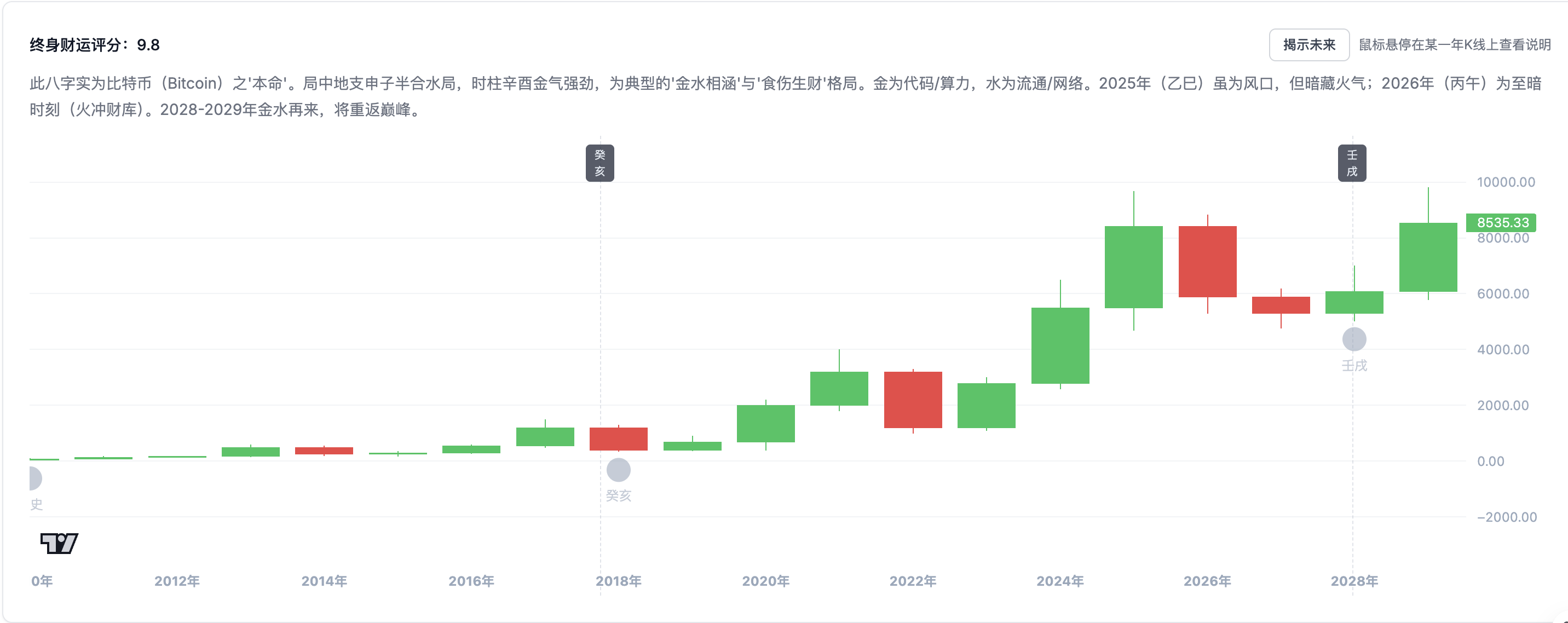
Remember when Alen, a crypto VC at y2z Ventures, bluntly stated that one of their fund’s core competitive edges was "reading面相" (face reading)? Due diligence (DD) used to involve code audits and business models, but now it’s different. First, check if the founder has a "wealth-draining face," then see if the project’s name clashes with风水 (Feng Shui).

On a recent trip to Shenzhen, I noticed that traders and KOLs’ standard setup isn’t data terminals—they all have a "Feng Shui consultant" backing them.

Don’t laugh; this actually works in the crypto world. Xiaobing knows a listed company boss in Hong Kong who is a devout believer in Feng Shui, donating real money to temples—possibly more than the company’s R&D budget.

And the result? Call it Feng Shui bringing noble help, but starting in 2023, he began buying Bitcoin, made hundreds of millions from hoarding, and later caught the wave of the DAT (Crypto Treasury Reserve) narrative, doubling the company’s stock price... Although everyone knows this is "survivorship bias," you can’t argue with the fact that he really made a fortune.

There are counterexamples too. A frog-avatar爆料KOL also had a Feng Shui consultant who advised him not to trade recently, but he couldn’t resist playing with contracts and ended up getting liquidated.

This isn’t entirely superstition.

Our traditional land-based civilization emphasizes farming—sow one seed in spring, reap ten thousand in autumn—focusing on certainty. But what does maritime civilization face? Storms and unknown waters.

Why do people in the southeastern coastal areas worship Mazu? Not out of ignorance, but because on the vast, unpredictable ocean, besides experience and technology, you need something else.

The crypto world is essentially a modern version of the "Age of Exploration." It faces deep, unfathomable waters and sudden storms. Humans are like this: the greater the randomness and volatility, the more we seek supernatural spiritual anchors.

When K-line charts fail, and a single tweet from Musk, Trump, or CZ can sway the market, Feng Shui becomes the last psychological defense. This isn’t ignorance; it’s an instinctive stress response to massive wealth fluctuations.

After all, when your assets can swing 50% in a day, you have to believe in something to sleep at night. As for whether the God of Wealth understands blockchain—does it really matter?


Related Questions

QWhat is the main theme of the article regarding the crypto community's behavior?

AThe article highlights that mysticism and fortune-seeking practices, like worshipping the God of Wealth and using feng shui, have become prevalent in the crypto community as a psychological anchor amidst extreme market volatility and uncertainty.

QHow does the article describe the crypto space in comparison to historical contexts?

AIt compares the crypto space to the 'Age of Exploration' or maritime civilizations, where people face vast unknowns and storms, leading them to seek supernatural beliefs for stability and mental comfort.

QWhat example does the article give to show the effectiveness of feng shui in crypto success?

AIt mentions a Hong Kong-listed company boss who devoutly donated to temples and followed feng shui, leading to massive profits from Bitcoin investments and a surge in his company's stock price during the DAT narrative wave.

QWhat counterexample is provided about ignoring mystical advice in the crypto world?

AA frog-avatar KOL ignored his feng shui advisor's warning to avoid trading, engaged in contracts, and ended up getting liquidated.

QWhy does the article suggest crypto traders turn to mysticism instead of traditional analysis?

ABecause extreme market randomness, influenced by factors like tweets from figures such as Musk or Trump, makes traditional analysis like K-line charts less reliable, leading traders to seek psychological comfort through superstition.

Related Reads

If the AI Bubble Is Already Bursting, Who Will Truly Survive?

If the AI Bubble is Bursting, Who Will Remain? The debate over an AI bubble is intensifying, with figures like Ray Dalio warning of high levels and Jensen Huang seeing immense, early-stage opportunity. Both views hold truth: a speculative bubble in capital markets likely exists, mirroring the dot-com era, but the underlying technological shift is real and transformative. History shows that while bubbles burst—wiping out overvalued companies and speculative capital—they often leave behind critical physical and digital infrastructure. The dot-com bust, for instance, eliminated many firms but left the global fiber optic networks and data centers that enabled the rise of Amazon, Netflix, and cloud computing. Today's massive AI infrastructure investments (projected at trillions by 2030) in data centers, power, cooling, and GPUs may follow a similar path, creating the foundation for future applications. A key divergence from past bubbles is the "Jevons Paradox" effect in AI. As the cost of AI inference has plummeted by over 99.7% since 2023, enterprise spending on AI has skyrocketed. Cheap "tokens" have unlocked vast, previously uneconomical use cases, moving AI from simple chatbots into core business workflows—code generation, legal document review, scientific simulation, and financial analysis. The market is now in a phase of self-correction, weeding out superficial "API-wrapper" startups, but this cleansing process strengthens the ecosystem. The long-term trajectory is clear. The value is gradually shifting from capital expenditure (CapEx) on hardware to operational expenditure (OpEx) on transformative applications. As AI becomes a utility, the winners will be firms that deeply integrate it to solve vertical industry problems in law, healthcare, finance, and manufacturing. The泡沫 will recede, but the foundational shift towards an AI-powered era across all sectors is irreversible. The underlying productive force of AI contains no bubble.

marsbit30m ago

If the AI Bubble Is Already Bursting, Who Will Truly Survive?

marsbit30m ago

If the AI Bubble Is Already Bursting, Who Will Truly Remain?

**Summary: If the AI Bubble is Bursting, What Will Remain?** The debate around an AI bubble is intensifying, with figures like Ray Dalio warning of high valuations while Jensen Huang sees immense opportunity. This echoes the dot-com bubble, which saw massive wealth destruction but ultimately left behind critical infrastructure like undersea cables and broadband, enabling future giants like Amazon and Netflix. Similarly, today's AI boom involves trillions invested in data centers, power, cooling, and GPUs, while application-layer revenue remains comparatively modest. This investment-disparity signals a bubble. However, the core technological progress is real and accelerating. AI inference costs have plummeted by over 99.7% since 2023, making intelligence increasingly cheap and accessible. This cost collapse is unlocking vast new demand. Instead of reducing spending, enterprises are tripling their AI cloud expenditure. Cheap "tokens" enable AI to move beyond simple chatbots into complex workflows—automating code writing, legal document review, financial analysis, and scientific research. This follows "Jevons's paradox": improved efficiency leads to greater total consumption. The market is now undergoing a necessary purification, weeding out "API-wrapper" startups with no real moat. The deeper evolution involves a shift from capital expenditure (CapEx) on infrastructure to operational expenditure (OpEx) on value-creation in applications. While hardware vendors currently profit most, long-term value will migrate to AI-native firms solving vertical industry problems. Ultimately, a market correction will cleanse speculative excess but will not reverse the AI+ trend. The massive physical and algorithmic infrastructure being built will endure, becoming a cheap, utility-like foundation. Just as the internet became indispensable to all industries post-2000, AI is poised to empower and redefine every sector, moving society irreversibly toward an intelligence-augmented era. The bubble may burst, but the underlying productive momentum is solid.

链捕手36m ago

If the AI Bubble Is Already Bursting, Who Will Truly Remain?

链捕手36m ago

Microsoft CEO: In the AI Era, How Do You Define a Company's Moat?

Microsoft CEO Satya Nadella argues that in the AI era, a company's true competitive edge, or "moat," is not determined by choosing the single most powerful model, but by its ability to build a continuous "learning loop." This system integrates and evolves by connecting human workflows, domain expertise, organizational judgment, and employee experience. He posits that future companies will accumulate two types of capital: Human Capital (employee knowledge, judgment, creativity) and "Token Capital" (a firm's own built and owned AI capabilities). Importantly, AI amplifies rather than devalues human capital. Human direction is essential to guide progress, as computational power alone is aimless. The core opportunity lies in creating a closed-loop system where human and token capital reinforce each other in a compound, self-improving cycle. A company must be able to preserve its unique institutional knowledge—its "company veteran" expertise—even if it switches underlying general-purpose AI models. This requires private evaluation benchmarks, reinforcement learning environments based on internal data, and queryable knowledge bases. Nadella warns against a future where economic value is concentrated by a few dominant models that commoditize entire industries' knowledge. Instead, the priority should be building a broad "frontier ecosystem" where every company, industry, and nation can own its learning loop. This allows organizations to retain control of their intellectual property, amplify employee capabilities, and ensure the economic value created by AI is captured within their own businesses and communities. True corporate sovereignty in the AI age comes from turning organizational knowledge into a compounding system that creates enduring, defensible value.

marsbit1h ago

Microsoft CEO: In the AI Era, How Do You Define a Company's Moat?

marsbit1h ago

ETFs Are Just the Ticket: The True Institutionalization of Bitcoin Is Happening Where You Can't See It

Beyond the Bitcoin ETF spotlight, a deeper institutionalization is underway, leveraging Bitcoin as a foundational financial primitive. Institutions are using Bitcoin for purposes long reserved for assets like U.S. Treasuries and gold: as collateral for loans, insurance reserves, and the backbone of rated bonds. Examples include a Barbados-based insurer capitalizing with $40M in Bitcoin reserves and Ledn's $188M securitization of Bitcoin-backed loans, which received the first-ever investment-grade rating (BBB-) from S&P for a digital asset-backed security. This structure was stress-tested during a 27% price drop in early 2026, triggering automatic liquidations that functioned as designed but revealed the systemic risk of synchronized selling across leveraged positions. Infrastructure is evolving to support this, with platforms like Anchorage Digital's Atlas network enabling secure, institutional-grade settlement and collateral management. Strategies like basis trades and corporate treasuries (exemplified by companies like MicroStrategy issuing billions in equity and debt to fund Bitcoin acquisitions) further integrate Bitcoin into financial mechanics. While ETFs solved "how to own" Bitcoin, these developments answer "what to do with it," embedding the asset into the working machinery of finance—as collateral upon which loans, derivatives, and structured products are built. The real, enduring institutional shift is happening in these largely invisible plumbing and financing systems.

marsbit1h ago

ETFs Are Just the Ticket: The True Institutionalization of Bitcoin Is Happening Where You Can't See It

marsbit1h ago

ZEC Co-Founder Responds to Orchard Vulnerability: No Signs of Theft, Orchard Pool to Be Sealed

ZEC Co-Founder Addresses Orchard Vulnerability: No Signs of Theft, Plans to Sunset Orchard Pool A security vulnerability was recently discovered in Zcash's Orchard shielded pool, raising key concerns. The primary questions are whether the flaw was exploited, if user funds are safe, whether users can verify the total ZEC supply, and if other similar vulnerabilities exist. Analysis suggests the vulnerability was likely not exploited prior to its discovery. It was found proactively by a researcher using specialized tools, not due to an active breach. The development team and mining pools acted quickly to contain the issue. Typical financially-motivated attacks would likely have left visible on-chain evidence, which has not been observed. User funds in Orchard are considered safe and should be recoverable, assuming no prior exploitation. If the flaw was never used, all legitimate funds can be withdrawn. The article outlines risks associated with moving funds to transparent addresses or other pools, but concludes that leaving assets in place is a reasonable option. Currently, users cannot independently verify that the total ZEC supply hasn't been inflated due to this bug. However, the planned Ironwood network upgrade is designed to resolve this. It will permanently close the Orchard pool to new deposits and internal transfers, allowing only withdrawals. This mechanism will cap total withdrawals at the amount of legitimately deposited funds, enabling anyone to cryptographically verify the supply post-upgrade. Multiple teams, including Shielded Labs, have conducted extensive audits focused on counterfeiting vulnerabilities, assisted by advanced AI tools. No additional flaws of this type have been found so far, increasing confidence that no other similar undisclosed vulnerabilities exist. In summary, evidence indicates the Orchard bug was probably not used, user funds are secure, and no other counterfeiting flaws are currently known. The upcoming Ironwood upgrade will restore users' ability to independently verify the total ZEC supply, closing this chapter.

Foresight News1h ago

ZEC Co-Founder Responds to Orchard Vulnerability: No Signs of Theft, Orchard Pool to Be Sealed

Foresight News1h ago

Trading

Spot
Futures
活动图片




