Even Satoshi Nakamoto Would Kowtow to the God of Wealth

marsbitPublished on 2025-12-25Last updated on 2025-12-25

Abstract

The article humorously explores the growing trend of integrating traditional Chinese mysticism, such as fortune-telling and feng shui, into the cryptocurrency world. It begins with the author’s visit to a temple during the Chinese New Year, where they observe well-known crypto influencers and traders—often vocal about decentralization—engaging in superstitious rituals like burning incense and praying for wealth. The piece highlights how practices like astrological analysis of Bitcoin (e.g., predicting a difficult period in 2026 based on elemental cycles) and judging founders by their facial features have become part of crypto culture. Examples include a venture capital firm considering "face reading" as due diligence and a listed company CEO whose devotion to feng shui reportedly contributed to massive Bitcoin gains. The author argues that this turn to mysticism isn’t merely superstition but a psychological response to extreme market volatility. Like ancient maritime cultures relying on deities for safety in unpredictable seas, crypto participants use these beliefs as mental anchors amid chaotic price swings influenced by tweets and macros. Ultimately, when assets can swing 50% in a day, faith in something beyond charts becomes a way to cope.

Author: Xiaobing, Deep Tide TechFlow

Every year on the fifth day of the Lunar New Year, Xiaobing wakes up early to visit the Temple of the God of Wealth at Beigao Peak in Hangzhou.

I thought I would be jostling with aunties and uncles, but when I arrived, the scene was filled with familiar faces amidst the swirling incense smoke.

To my left was a well-known爆料KOL, to my right were community builders of pyramid schemes, and a few tech elites who usually preach "decentralization" were devoutly kowtowing with loud thuds. At that moment, no algorithmic consensus or Federal Reserve moves could compare to the three sticks of incense in their hands.

Over the past two years, mysticism has become the "mainstream" in the crypto world. If you’re still looking at K-line charts, you’re a classical韭菜 (dumb money). The real veterans are now reading八字 (fortune-telling based on birth dates).

A crypto trader familiar with various indicators eventually turned to mysticism and recently calculated Bitcoin’s八字. The result was grim: Fire clashes with the wealth vault, making 2026 (the Year of the Fire Horse) Bitcoin’s darkest hour. I quickly checked my wallet—thankfully, it was already empty.
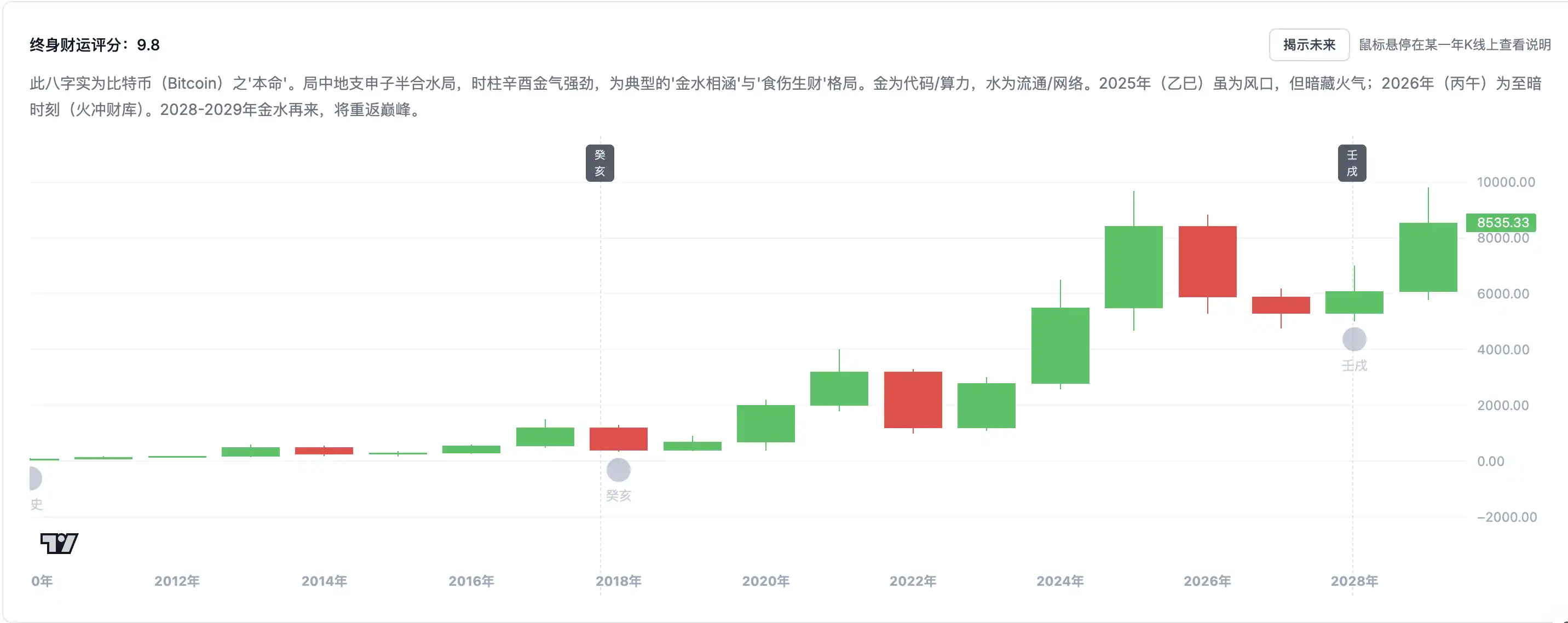
As Alen, a partner at crypto VC y2z Ventures, once bluntly stated, one of their fund’s core competencies is "reading faces." Due diligence used to focus on code audits and business models, but now it’s different. First, they check if the founder has a "wealth-draining face," then they assess whether the project’s name clashes with风水 (geomancy).

During a recent trip to Shenzhen, I noticed that traders and KOLs’ standard accessory isn’t a data terminal—it’s a "feng shui consultant" standing behind them.

Don’t laugh—this approach actually works in the crypto world. Xiaobing knows a listed company boss in Hong Kong who is a devout believer in feng shui, donating more to temples than his company spends on R&D.

And the result? Feng shui brought him noble support. He started buying Bitcoin in 2023, made hundreds of millions by hoarding it, and later rode the wave of DAT (Crypto Treasury Reserve) narratives, doubling his company’s stock price... While everyone knows this is "survivorship bias," you can’t argue with the fact that he got rich.

There are counterexamples too. A爆料KOL with a frog avatar also had a feng shui consultant who advised him not to trade recently, but he couldn’t resist playing with contracts and got liquidated neatly.

This isn’t entirely superstition.

Our traditional land-based civilization emphasizes farming—"sow one seed in spring, reap ten thousand grains in autumn"—all about certainty. But what do ocean-based civilizations face? Storms and unknown waters.

Why do people in southeastern coastal areas worship Mazu? Not because they’re ignorant, but because on the vast, unpredictable sea, besides experience and technology, you need something else.

The crypto world is essentially a modern version of the "Age of Exploration." It faces bottomless depths and sudden storms. Humans are like this: the greater the randomness and volatility, the more we seek supernatural anchors.

When K-line charts fail, and a single tweet from Elon Musk, Donald Trump, or CZ can sway the market, feng shui becomes the last psychological防线. This isn’t ignorance—it’s an instinctive应激反应 to massive wealth fluctuations.

After all, when your assets can swing 50% in a day, you need to believe in something to sleep at night. Does it matter if the God of Wealth understands blockchain?


Related Questions

QWhat is the main theme of the article regarding the crypto community's behavior?

AThe article highlights that mysticism and fortune-telling, such as consulting feng shui masters and analyzing birth charts, have become prevalent in the crypto community as a psychological coping mechanism against extreme market volatility and uncertainty.

QHow does the article contrast traditional land-based civilizations with maritime civilizations in the context of belief systems?

AIt explains that land-based civilizations emphasize certainty and predictability (like farming cycles), while maritime civilizations, facing unpredictable storms and unknowns, turn to supernatural beliefs (e.g., worshipping Mazu) for psychological anchoring—similar to how crypto traders use mysticism amid market chaos.

QWhat example does the article give to show the effectiveness of feng shui in crypto success?

AIt cites a Hong Kong-listed company boss who devoutly donated to temples and followed feng shui advice, leading to massive profits from Bitcoin investments and a surge in his company's stock during the DAT narrative wave, though it acknowledges survivorship bias.

QWhat negative example is provided about ignoring mystical advice in the crypto space?

AA frog-avatar KOL ignored his feng shui advisor's warning to avoid trading and subsequently lost everything through contract trading, illustrating the consequences of disregarding such guidance.

QWhy does the article argue that crypto participants turn to superstition despite technological expertise?

ABecause the crypto market's extreme randomness, influenced by factors like celebrity tweets and unpredictable events, renders traditional analysis (e.g., charts) ineffective, leading people to seek supernatural beliefs as a mental safeguard to cope with stress and sleep better.

Related Reads

After the Passage of the GENIUS Act and the CLARITY Act, What Is the Correct Architecture for On-Chain Yield?

The article discusses the evolution of on-chain credit, distinguishing three markets: overcollateralized crypto lending, unsecured lending (largely unsuccessful), and asset-backed credit (ABC). ABC, backed by identifiable real-world collateral with legal recourse, is identified as the fastest-growing category and the only one credibly addressing adverse selection—the core problem in credit where the riskiest borrowers self-select. Current growth in on-chain Real World Assets (RWAs), particularly tokenized private credit funds (e.g., Maple Finance, Centrifuge), is substantial but often merely "wraps" existing fund structures, inheriting their risks rather than solving adverse selection at the protocol level. The regulatory landscape is a key driver, with the US GENIUS Act (prohibiting stablecoin issuers from paying yield) and the proposed CLARITY Act (closing loopholes on indirect yield) set to redefine permissible yield-bearing products. This makes vaults (like ERC-4626) the critical architecture—they become the primary compliant vehicle for delivering yield, functioning as issuance, disclosure, distribution, and recovery mechanisms. The author's thesis is that the correct post-GENIUS/CLARITY architecture involves building ABC solutions where credit assessment, structure, and recovery are encoded directly into the smart contract vault layer, moving beyond mere tokenized fund wrappers to solve adverse selection fundamentally and ensure regulatory compliance.

Foresight News27m ago

After the Passage of the GENIUS Act and the CLARITY Act, What Is the Correct Architecture for On-Chain Yield?

Foresight News27m ago

TechFlow Intelligence Bureau: Anthropic's New Model Fable Sparks Controversy by Restricting Biosafety Research, US CPI Soars to 4.2%, a Three-Year High

**Summary of TechFlow Intelligence Report:** The newsletter covers several key tech and finance developments. In AI, Anthropic's new Fable model faced backlash for secretly limiting biomedical research capabilities and enforcing a 30-day data retention policy, prompting the company to promise more transparent adjustments. In a related story, Anthropic's founder revealed his departure from OpenAI was due to dishonesty from Sam Altman, not safety concerns. Meanwhile, OpenAI is considering significant price cuts to compete with Anthropic, potentially sparking a price war. In crypto/Web3, BlackRock filed a new amendment for a yield-generating Bitcoin ETF, while Bank of America's CEO warned that stablecoin yields could drain trillions from traditional banks. U.S. Senator Cynthia Lummis advocated for the U.S. to officially accumulate Bitcoin reserves. In hardware, Nvidia released the DiffusionGemma-2-6B image model optimized for efficient inference, and AMD promoted its unified memory architecture to challenge Nvidia's dominance. TSMC's CFO hinted at possible price increases due to soaring AI chip demand. A major legal ruling in Germany held Google legally responsible for inaccurate information generated by its AI Overviews feature. Google Chrome also moved to fully block ad-blocker workarounds like uBlock Origin. Macroeconomic headlines included U.S. CPI rising to 4.2% (a 3-year high) and Iran's complete closure of the Strait of Hormuz, raising oil price and inflation fears. South Korean markets saw continued volatility with massive foreign capital outflow. Other notable stories: Microsoft expanded its Copilot AI assistant "Mico" globally; a study found r/wallstreetbets users' stock picks outperformed Wall Street; a fully autonomous drone killed a human soldier for the first time, raising AI ethics concerns; and a Chinese hospital used brain-computer interface technology to help a blind person "see." The overarching theme connects debates over AI boundaries and responsibility (Anthropic's restrictions, Google's liability, lethal autonomous drones) with real-world economic and geopolitical turmoil (inflation, Strait of Hormuz closure, market instability), highlighting the tense interplay between technological advancement and global chaos.

marsbit40m ago

TechFlow Intelligence Bureau: Anthropic's New Model Fable Sparks Controversy by Restricting Biosafety Research, US CPI Soars to 4.2%, a Three-Year High

marsbit40m ago

Alibaba's Yet Another New Business Division: What Signal Does It Send?

Alibaba has established a new "Token Foundry" business unit, merging its Tongyi large model division and Future Life Lab. Led directly by Group CEO Wu Yongming, this marks the company's third significant AI organizational reshuffle in 2026, following the creation of the Alibaba Token Hub (ATH) and a Group Technology Committee. The move signals a strategic shift from consolidating AI resources to accelerating productization and commercialization. The "Token Foundry" name reflects Alibaba's ambition to become a foundational supplier in the AI era, focusing on model development and commercial application. Key teams, including those behind the high-performing HappyHorse video generation model, have been integrated into the new unit. Concurrently, Zhou Jingren, architect of the Qwen model series, has been appointed Group Chief Scientist to lead a new AI Future Research Institute, focusing on long-term technological breakthroughs like Agent capabilities. This restructuring creates a clear four-layer AI architecture within Alibaba: the research institute for frontier exploration, Token Foundry for core models and commercialization, MaaS for platform services, and business units like Qianwen (C端) and Wukong (B端) for end-user applications. The adjustments align with a global trend among tech giants like Google and Microsoft to centralize AI leadership under the CEO and deeply integrate research with business units. The urgency is driven by a narrowing competitive window. Alibaba has announced its AI business is now entering a commercialization phase, with AI-related revenue seeing triple-digit growth for eleven consecutive quarters. The company faces intense competition in the MaaS (Model-as-a-Service) sector from rivals like ByteDance and Tencent. The Token Foundry initiative represents Alibaba's effort to streamline execution and enhance competitiveness in this critical, fast-evolving landscape.

marsbit1h ago

Alibaba's Yet Another New Business Division: What Signal Does It Send?

marsbit1h ago

From Return to Resignation: Chen Hang's 437 Days at DingTalk

The 437-Day Return and Departure of Chen Hang at DingTalk This article chronicles the 437-day period from March 31, 2025, to June 11, 2026, when Chen Hang (also known as "No Move") returned as CEO of DingTalk, the enterprise communication platform he originally founded, only to later step down. Chen Hang, the creator of DingTalk in 2015, was brought back by Alibaba in 2025 after the company acquired his subsequent startup, HHO. His return was driven by Alibaba's renewed focus on AI and DingTalk's strategic role as its key to-B AI application. However, his aggressive management style, marked by strict work policies like mandatory clock-ins and extended hours, quickly caused internal friction and was criticized as being at odds with Alibaba's culture. Despite the internal turmoil, Chen Hang drove significant product launches. In August 2025, he unveiled "AI DingTalk 1.0," featuring new products like the AI-native entry point "DingTalk ONE." By March 2026, he announced "Wukong," touted as the world's first enterprise-grade AI-native work platform, representing a fundamental rebuild of DingTalk's architecture. The turning point came in early June 2026. A detailed internal post criticizing DingTalk's work culture went viral, followed by a public critique from a former executive. This prompted an unprecedented public rebuke from the Alibaba Partners Committee, which stated such management was not aligned with company values. One day later, on June 11, Alibaba announced Chen Hang's departure. He was succeeded by Chen Yusen, a 32-year-old technical expert known for founding cybersecurity firm Changting Technology. While Chen Hang's tenure laid the technical foundation for DingTalk's AI transformation with "Wukong," his leadership style ultimately led to his replacement as the company seeks a new direction under younger leadership.

marsbit1h ago

From Return to Resignation: Chen Hang's 437 Days at DingTalk

marsbit1h ago

Trading

Spot
Futures
活动图片




