Ethereum Whales Loses Nearly 25% Of Their Holdings Amid Market Shift

bitcoinistPublished on 2026-05-09Last updated on 2026-05-09

Abstract

Ethereum whales, defined as addresses holding between 1,000 and 10,000 ETH, have sharply reduced their holdings by approximately 21.5% (from 15.95 million to 12.52 million ETH) between October 2025 and May 2026. This sell-off, flagged as a supply overhang by analyst Ali Charts, indicates fading bullish sentiment among major investors and raises questions about short-term market stability. It contrasts with a previous accumulation phase and recent buying sprees, suggesting Ethereum's price may struggle to reach $3,000 without new institutional or retail demand. Concurrently, Ethereum's utility is growing, with tokenized U.S. treasuries on its network surpassing $8 billion, highlighting its role in traditional finance despite current price struggles below $2,300.

With the crypto market turning slightly bearish, the Ethereum price has lost the $2,300 mark, raising questions about the stability of its recent upswing. Amid this sideways price action, a report shows that a fading bullish sentiment among Ethereum whales is evidenced by a significant decline in their holdings.

Large ETH Players’ Portfolio Shrinks Sharply

After examining Ethereum whales‘ holdings, Ali Charts, a seasoned market expert and trader, revealed that these key investors are exhibiting a trend not seen in over a year. While ETH’s price is slowly losing its upside momentum, a major wave of selling has rattled the ETH market.

This heightened selling activity was observed among large investors or whales holding between 1,000 ETH and 10,000 ETH as they dump nearly a quarter of their holdings in the face of uncertainty. Such a trend underscores a major decrease in exposure, which raises questions about confidence and short-term market stability.

Since October 6, 2025, Ethereum holders between 1,000 and 10,000 ETH have undergone a notable regime shift in their market activity. Prior to the shift, the cohort was spotted in a steady accumulation phase. During the period, these investors’ ETH portfolio saw a rise from 12.95 million ETH in April 2025 to a peak of 15.95 million ETH by October 6, 2025. Fast forward to May 2026, and this behavior has flipped again.
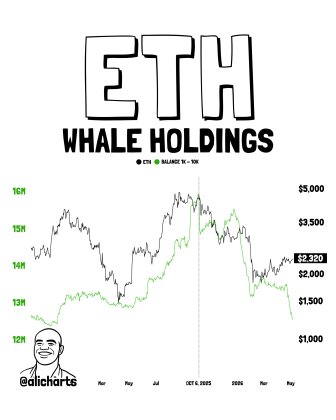
Source: Chart from Ali Charts on X

As seen in the chart shared by Ali Charts, the amount of ETH held by these mid-tier whales has dropped from 15.95 million to about 12.52 million, which represents an approximately 21.5% decrease in their total position. This simply implies a dramatic change in positioning from some of the network’s largest investors.

Ali Charts have flagged this development as a supply overhang. According to the expert, this suggests that the road to the $3,000 may require a fresh wave of demand from institutional or retail investors to offset whale distribution.

It is worth noting that a few days ago, ETH whales went on a buying spree. During the period, over 140,000 ETH, valued at around $322 million, were scooped up by these key players. When high-net-worth holders are buying more, it is a sign that smart money is positioning for a breakout.

Tokenized Treasuries Surges On The ETH Network

Even with the Ethereum price still significantly down from its all-time high, this drop has not hindered institutional adoption, which is currently accelerating. Coin Bureau has reported a surge in tokenized treasuries across the leading network.

The chart shows that the ETH network just surpassed $8 billion in tokenized US treasuries for the first time in its history. The rise in blockchain-based sovereign debt instruments underscores Ethereum’s growing relevance as a foundation for actual financial assets.

In addition, the week experienced the expansion of Stripe’s BRIDGE stablecoins to Celo and plans for Canada’s first regulated stablecoin on Ethereum. Despite the growth, ETH’s price continues to struggle to break key short-term resistance.

ETH trading at $2,279 on the 1D chart | Source: ETHUSDT on Tradingview.com

Related Questions

QAccording to the article, what has happened to the holdings of Ethereum whales in the range of 1,000 to 10,000 ETH?

ATheir holdings have dropped sharply, decreasing by approximately 21.5% from 15.95 million ETH in October 2025 to about 12.52 million ETH by May 2026.

QWhat does market expert Ali Charts suggest is needed for Ethereum's price to reach $3,000?

AAli Charts suggests that reaching $3,000 may require a fresh wave of demand from institutional or retail investors to offset the distribution pressure from whale selling.

QWhat positive development regarding institutional adoption is reported on the Ethereum network despite the price drop?

ATokenized US treasuries on the Ethereum network have surged, surpassing $8 billion for the first time in its history, indicating growing institutional adoption for real financial assets.

QHow did the behavior of the 1,000-10,000 ETH whale cohort change in early October 2025?

ATheir behavior shifted from a steady accumulation phase, where holdings grew from 12.95 million ETH in April to a peak of 15.95 million ETH, to a significant selling phase starting around October 6, 2025.

QWhat was the approximate value and amount of ETH that whales reportedly bought in a recent buying spree mentioned in the article?

ADuring the recent buying spree, whales scooped up over 140,000 ETH, which was valued at around $322 million at the time.

Related Reads

SpaceX, OpenAI, Anthropic: The Three AI Giants Racing for IPO, Which One Is Worth Betting On?

SpaceX, OpenAI, and Anthropic are poised for historic IPOs within weeks, potentially raising a combined $180 billion—a sum exceeding the entire internet bubble's fundraising. The hosts of the Limitless Podcast argue this isn't just individual company financing but an unprecedented capital concentration for AI infrastructure, driven by an insatiable need for compute, data centers, power, and chips. SpaceX's IPO is notable for reportedly changing market index rules to allow faster inclusion, potentially funneling trillions in passive retirement funds into its stock, despite its unproven space-based data center business model. In contrast, Anthropic demonstrates explosive growth, with ARR reportedly hitting $45 billion and approaching profitability, fueled by strong enterprise adoption of products like Claude Code. Google's separate $80 billion raise highlights the immense capital pressure, even for giants. The discussion acknowledges bubble risks but leans optimistic. The hosts contend the massive spending is building essential physical infrastructure for the next technological era. A key bottleneck isn't capital but the real-world limits of chip manufacturing and construction speed. As long as demand for AI compute outstrips supply, this investment cycle represents a foundational build-out rather than a purely financial bubble. All three companies are seen as foundational bets on the future, with Anthropic often cited as the most immediately compelling due to its proven revenue trajectory.

marsbit2h ago

SpaceX, OpenAI, Anthropic: The Three AI Giants Racing for IPO, Which One Is Worth Betting On?

marsbit2h ago

From 'Old Guys' to 'New Favorites': How AI Is Revaluing Old Infrastructure from Dell to Nokia?

From "Vintage Tech" to "New AI Darlings": How AI Revalues Old Infrastructure One year ago, tech giants like Dell, Nokia, Cisco, and Western Data were seen as slow-growth, low-valuation stories, far from the AI spotlight dominated by players like Nvidia. Now, these legacy tech stocks are gaining market attention, sparking debate on whether this is genuine industry revaluation or a temporary narrative. As AI moves from model parameters to real-world data centers, the market is recognizing companies with proven delivery and infrastructure capabilities. This shift marks a change in the AI investment thesis: from pure model and GPU focus to the complex systems engineering required for deployment. Companies like Dell, HPE, and Corning are being revalued not for being "sexy" AI innovators, but for their decades of accumulated expertise in supply chains, enterprise delivery, and infrastructure—assets that have become critical in the AI buildout phase. The revaluation is unfolding across three key infrastructure lines: 1. **Servers & System Integration:** Dell and HPE are emerging as crucial system integrators or "general contractors" for AI data centers, translating GPU orders into complete, deployable server racks integrated with power, cooling, and networking. 2. **Networking & Connectivity:** AI's scale demands robust high-speed connections. Corning (fiber optics), Nokia (AI-RAN, 6G), and Cisco (data center switches) are gaining importance for enabling efficient data transfer within and between AI clusters. 3. **Storage:** Beyond high-speed memory (HBM/DRAM), the AI data explosion is driving demand for high-capacity hard drives (HDDs) from companies like Western Digital and Seagate to handle training data, logs, and cold storage cost-effectively. For this revaluation to be substantive and not just a narrative, three criteria are key: 1) Concrete AI-related order and revenue growth (e.g., Dell's AI server sales), 2) Upward revisions to company financial guidance, and 3) Sustainable improvements in profit quality, not just top-line revenue spikes. In essence, AI's transition to a real construction phase is re-pricing "old assets" against "new demand." The opportunity, however, is selective. Only those legacy firms that are demonstrably integrated into the capital expenditure chains of data center and enterprise AI deployment are likely to experience a true "logic re-rating" rather than just a temporary valuation bounce.

marsbit2h ago

From 'Old Guys' to 'New Favorites': How AI Is Revaluing Old Infrastructure from Dell to Nokia?

marsbit2h ago

Trading

Spot
Futures

Hot Articles

Discussions

Welcome to the HTX Community. Here, you can stay informed about the latest platform developments and gain access to professional market insights. Users' opinions on the price of ETH (ETH) are presented below.

活动图片