Ethereum Vs. Solana: Why BlackRock’s Former Crypto Head Is Betting On ETH

bitcoinistPublished on 2026-01-27Last updated on 2026-01-27

Abstract

In a comparison between Ethereum and Solana, Joseph Chalom, former BlackRock digital assets head and current SharpLink CEO, argues that Ethereum is the clear choice for high-value institutional use cases. He emphasizes that while Solana offers speed and low fees, Ethereum’s superior trust, security, and liquidity make it the preferred platform for serious financial applications like asset tokenization and large-scale settlements. Chalom points to market data showing that over 65% of stablecoin and tokenized asset activity occurs on Ethereum—roughly ten times more than on Solana—and notes this gap is widening. He acknowledges Solana’s strengths in areas like memecoins and gaming, where lower security and higher speed are acceptable. However, for institutional-grade applications requiring reliability, he states that "people are voting with their feet" by building on Ethereum. Notably, SharpLink itself holds significant Ethereum reserves, with public records showing around 864,840 ETH (approx. $2.5B).

SharpLink CEO Joseph Chalom, who previously led BlackRock’s digital assets strategy, framed the Ethereum-versus-Solana debate as a mismatch between narrative and actual institutional behavior: TradFi firms may praise speed and low fees, but the highest-value financial use cases are gravitating to networks optimized for trust, security, and liquidity.

Why Ethereum Beats Solana

Speaking with CoinDesk’s Jennifer Sanasie on Jan. 26, Chalom said he would avoid positioning his view as opinion and instead point to what he called observable market signals. “Maybe I’ll just share facts,” he said. “The fact is that Ethereum has been around for 10 years. It’s the secure, trusted, and liquid ecosystem. And I talk about both the layer 1 mainnet as well as the long set of layer 2s who help do that rollup strategy.”

That longevity, in his telling, matters because institutions aren’t selecting chains the way consumers pick apps. They’re selecting settlement rails for moving money, tokenizing assets, and representing ownership, workflows where operational failure and security assumptions are existential. Solana, Chalom acknowledged, has carved out a reputation for performance. But he drew a hard line on reliability. “Solana has been fast and cheap but it has not been secure. It has had downtime,” he said, arguing that downtime risk is disqualifying for “high value projects.”

Chalom’s thesis is that when the use case is “tokenizing assets” and “moving money,” the decision criteria compress into three buckets. “The real institutions who care only about three things,” he said, are “trust, security, and liquidity.” On that basis, he argued, “they’re building on Ethereum for high value projects,” adding: “It’s happening on Ethereum.”

He also anchored the comparison in stablecoin and tokenized-asset activity, citing a sharp share gap as evidence of where the market is allocating serious volume. “More than 65% of stablecoins and tokenized assets are happening there,” Chalom said, describing that as “10x what you see on Salana.” He reinforced the directional claim immediately after: “Ethereum leads in high quality assets in DeFi, tokenization, and stable coins by a factor of 10 to one over Salana. And that gap is only getting larger.”

Still, Chalom did not argue for a single-chain world. Instead, he mapped Ethereum and Solana to different product surfaces based on security tolerance. “I do think there’s a role for cheap, fast, less secure chains,” he said, and suggested Solana’s comparative advantage shows up where finality speed and cost trump institutional-grade assurances. “I think Solana will win in the memecoin, maybe the gaming space where actually security matters a lot less and speed matters more.”

The subtext is a segmentation story: Ethereum as the default rail for high-value, regulated, reputation-sensitive flows; Solana as the venue for high-throughput consumer and speculative activity where users accept different risk tradeoffs. Chalom insisted this is not about persuasion so much as migration patterns. “It’s not my perspective,” he said. “People are voting with their feet.”

Notably, SharpLink Gaming (Nasdaq: SBET) has emerged as one of the largest corporate ETH holders, with public trackers putting its holdings at roughly 864,840 ETH (about $2.5B at recent marks).

At press time, ETH traded at $2,921.
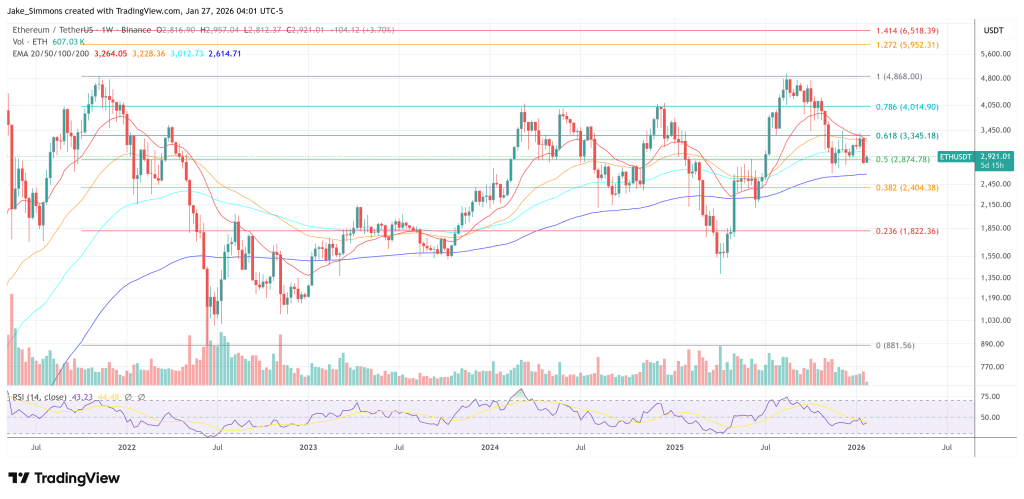
ETH recover back above the 0.5 Fib, 1-week chart | Source: ETHUSDT on TradingView.com

Related Questions

QAccording to Joseph Chalom, what are the three key criteria that institutions prioritize when selecting a blockchain for high-value projects?

ATrust, security, and liquidity.

QWhat percentage of stablecoins and tokenized assets does Chalom claim are happening on Ethereum, and how does this compare to Solana?

AMore than 65% are on Ethereum, which he describes as 10 times the volume seen on Solana.

QWhat specific use cases does Chalom believe Solana is better suited for, despite its perceived shortcomings in security?

AMemecoin and gaming, where speed and low cost are more important than institutional-grade security.

QHow does Chalom frame the fundamental difference in how institutions choose a blockchain versus how consumers choose applications?

AInstitutions are selecting settlement rails for moving money and tokenizing assets, where operational failure is an existential risk, not just picking apps based on features.

QWhat is the evidence provided in the article that SharpLink Gaming is putting its money behind its thesis on Ethereum?

ASharpLink Gaming is one of the largest corporate ETH holders, with public trackers showing holdings of roughly 864,840 ETH (worth about $2.5 billion).

Related Reads

The Value Distribution of Stablecoins

**Summary: The Value Distribution of Stablecoins** The article argues that stablecoins are evolving from mere trading tools into broader channels for dollar access. It divides the stablecoin ecosystem into four layers to analyze how value is distributed: 1. **Issuance Layer:** Mints stablecoins, holds reserve assets, and captures the spread between reserve yield and user costs (e.g., Tether, Circle). This layer currently earns the largest profit margin. 2. **Infrastructure Layer:** Connects stablecoins to the traditional financial system, handling fiat on/off-ramps, banking integration, compliance (KYC/AML), and asset management (e.g., Bridge, BVNK). This is the "unglamorous" but critical work, building the essential bridges between crypto and real-world finance. 3. **Acquiring/Distribution Layer:** Integrates stablecoins into merchant systems, manages payment flows, and provides enterprise financial software (e.g., Stripe, Coinbase). They act as the access point for businesses. 4. **Application Layer:** The end-users and businesses that ultimately use stablecoins for payments, settlements, or as a store of value. They benefit from convenience but have little pricing power. The core thesis is that while the issuance layer currently dominates profits, the often-overlooked **infrastructure layer holds significant long-term potential**. The real challenge and barrier to mass adoption is not the on-chain transfer of stablecoins (which is simple), but the complex "last mile" integration into existing business workflows, banking systems, and regulatory frameworks across different countries. Companies in this layer are currently in a "land grab" phase, investing heavily to build networks, secure bank partnerships, and establish compliance pathways. While their position is currently pressured by the profitable issuers above and distribution platforms below, the article suggests that if stablecoins become a default financial rail for businesses, the infrastructure providers who have done the hard work of integration will ultimately gain strong pricing power and become entrenched, essential players.

marsbit4h ago

The Value Distribution of Stablecoins

marsbit4h ago

The Value Distribution of Stablecoins

The Value Distribution of Stablecoins The article argues that stablecoins are evolving from a mere trading tool into a broad "dollar channel." It analyzes the industry's value chain through four layers: 1. **Issuance Layer (e.g., Tether, Circle):** The top layer that mints stablecoins, holds reserve assets, and captures the thickest interest rate spread. 2. **Infrastructure Layer (e.g., Bridge, BVNK):** Connects stablecoins to the traditional financial system, handling critical but complex "dirty work" like fiat on/off-ramps, banking integration, compliance (KYC/AML), and cross-border settlement. 3. **Acquiring/Distribution Layer (e.g., Stripe, Coinbase):** Embeds stablecoins into merchant systems, manages payment flows, and integrates with enterprise software. 4. **Application Layer:** End-users and businesses that ultimately use stablecoins for payments, settlement, or storing value. The author posits that while the issuance layer currently captures the most profit, the most overlooked and potentially critical layer is infrastructure. The core challenge for stablecoin adoption isn't the on-chain transfer (which is simple), but bridging the gap between blockchain and the real-world financial system. This involves solving practical problems for businesses: fiat conversion, reconciliation, tax handling, and user onboarding. Infrastructure companies are currently in a difficult "land-grab" phase—building networks, securing banking relationships, and achieving compliance country-by-country. They face pressure from both the profitable issuance layer above and distribution platforms below. However, the author suggests this layer is building a crucial moat. Once stablecoins become a default business rail, the infrastructure players who have done the hard work of integration may gain significant, durable value and pricing power.

链捕手4h ago

The Value Distribution of Stablecoins

链捕手4h ago

How to Do Research Well: Deliberately Practice the Real Skills That Matter

No one truly teaches you how to do research. You're often given a desk, a pre-selected problem, and vague instructions to "create something new." Consequently, many people reverse-engineer the job based on visible outputs—papers, posts, announcements—learning only how to *appear* like a researcher rather than how to *become* one. True research capability is built from stacking small, trainable skills, nearly all of which can be developed through deliberate practice. **Pick Your Own Problem:** Most researchers absorb problems from advisors or trends, lacking the underlying reasoning. Choosing a problem you genuinely care about, as John Schulman advises, leads to original work. Develop "taste" like a muscle: predict experiment outcomes, guess paper results from methods, and track which findings remain important over time. **Upgrade Your Inputs:** Relying on shared reading lists (arXiv hot lists, filtered group chats) leads to unoriginal conclusions. Undervalued old literature often holds crucial insights (e.g., MoE, LSTM, backpropagation). Richard Sutton's "The Bitter Lesson" or Claude Shannon's 1952 talk on creative thinking are more predictive than lengthy modern surveys. Breadth matters as much as depth: draw from neuroscience, mechanism design, hardware knowledge, and honest statistics. Read papers directly, especially appendices and limitations sections. **Write Everything Down:** As Paul Graham noted, writing exposes flaws in seemingly mature ideas. Writing is the cheapest defense against self-deception. Following Feynman's principle, Darwin programmatically wrote down facts contradicting his theory to combat memory bias. Maintain a detailed log of hypotheses, setups, predictions, results, and updated understandings. Reviewing past logs fosters essential humility.

marsbit6h ago

How to Do Research Well: Deliberately Practice the Real Skills That Matter

marsbit6h ago

Trading

Spot
Futures

Hot Articles

Discussions

Welcome to the HTX Community. Here, you can stay informed about the latest platform developments and gain access to professional market insights. Users' opinions on the price of ETH (ETH) are presented below.

活动图片