Ethereum Shows Early Accumulation Signals As Binance Buy Pressure Intensifies

bitcoinistPublished on 2026-01-03Last updated on 2026-01-03

Abstract

Ethereum has surpassed the $3,000 level, offering short-term relief after a period of consolidation. On-chain data indicates early accumulation signals, with Binance’s Taker Buy/Sell Ratio reaching 1.005—its highest since July—suggesting growing bullish sentiment among derivatives traders. This increase in aggressive buy orders reflects early positioning rather than reaction to strong upward momentum. However, derivatives-driven optimism alone is insufficient for a sustained rally. Confirmation from stronger spot demand, higher resistance breaks, and on-chain activity is critical to validate a trend reversal. Without broader market support, derivatives-led price moves may fade.

Ethereum has managed to push above the psychologically important $3,000 level, offering a brief sense of relief after weeks of compression and indecision. While this move marks a constructive short-term development, price action remains far from the technical thresholds required to fully reestablish a broader uptrend.

Against this backdrop, on-chain and derivatives data are beginning to show subtle but notable changes. A CryptoQuant analysis reveals that Ethereum’s 14-day moving average of the Taker Buy/Sell Ratio on Binance has climbed to 1.005, its highest reading since July. A ratio above 1 indicates that aggressive market buy orders are outweighing sell orders, pointing to growing bullish intent among derivatives traders.

The report explains that ETH remains significantly below its prior cycle highs, meaning this increase in aggressive buying is not a reaction to strong upside momentum. Instead, it suggests early positioning or accumulation behavior, where market participants are entering ahead of a potential directional move rather than chasing price.

Still, derivatives-driven optimism alone is not sufficient to confirm a trend reversal. For Ethereum to transition from recovery to sustained upside, this improving aggression must be accompanied by stronger spot demand and a decisive reclaim of higher resistance levels.

Derivatives Aggression Builds, but Confirmation Remains Critical

The analysis adds that, historically, sustained periods in which Ethereum’s Taker Buy/Sell Ratio remains above 1—particularly when reinforced by a rising moving average—have often aligned with phases of increasing bullish volatility or early attempts at trend reversals.

This behavior reflects a growing sense of urgency among buyers who are willing to execute at market prices rather than wait for pullbacks, a dynamic typically associated with improving sentiment and shifting expectations.
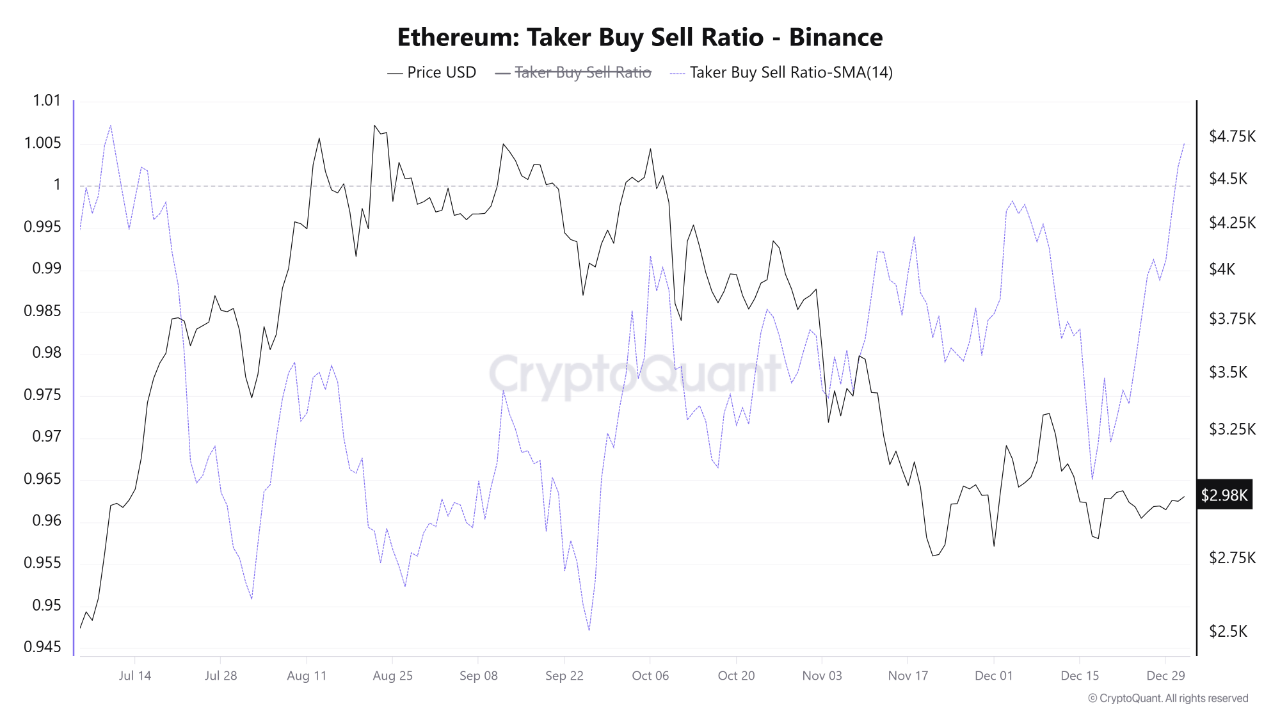
Ethereum Taker Buy Sell Ratio | Source: CryptoQuant

However, this signal carries important caveats. The Taker Buy/Sell Ratio is primarily a derivatives-focused metric, and elevated buy pressure in leveraged markets does not automatically translate into a durable rally.

Without confirmation from the spot market—such as rising spot volumes, net exchange outflows, or sustained on-chain accumulation—price reactions driven by derivatives activity can fade quickly. In past instances, leverage-heavy positioning has produced brief upside moves that were later unwound when real capital inflows failed to materialize.

At present, the structure suggests that aggressive buying pressure is indeed building within Ethereum’s derivatives market. This increases the probability of a recovery attempt, particularly if traders continue to position proactively rather than reactively.

Still, confirmation will depend on price follow-through above key resistance levels and alignment with broader indicators across spot demand, on-chain activity, and overall market liquidity.


Related Questions

QWhat does a Taker Buy/Sell Ratio above 1 indicate on Binance's derivatives market for Ethereum?

AA Taker Buy/Sell Ratio above 1 indicates that aggressive market buy orders are outweighing sell orders, pointing to growing bullish intent among derivatives traders.

QAccording to the CryptoQuant analysis, what is the significance of Ethereum's current aggressive buying pressure?

AThe aggressive buying pressure suggests early positioning or accumulation behavior, where market participants are entering ahead of a potential directional move rather than chasing price, as ETH remains significantly below its prior cycle highs.

QWhat additional confirmation is needed for Ethereum to transition from recovery to sustained upside beyond derivatives-driven optimism?

AFor a sustained upside, the improving aggression in derivatives must be accompanied by stronger spot demand, such as rising spot volumes, net exchange outflows, or sustained on-chain accumulation, and a decisive reclaim of higher resistance levels.

QWhat historical pattern is associated with sustained periods of Ethereum's Taker Buy/Sell Ratio remaining above 1?

AHistorically, sustained periods where Ethereum's Taker Buy/Sell Ratio remains above 1—especially with a rising moving average—have often aligned with phases of increasing bullish volatility or early attempts at trend reversals.

QWhy can derivatives-driven price reactions fade quickly without confirmation from the spot market?

AWithout confirmation from the spot market, price reactions driven by derivatives activity can fade quickly because leverage-heavy positioning may produce brief upside moves that unwind when real capital inflows fail to materialize.

Related Reads

From Robinhood to Polymarket: Is the Era of Integrating All Assets on a Single Platform Coming?

From Robinhood to Polymarket: The Era of All-in-One Asset Platforms Is Coming Asset classes are rapidly converging. Platforms that once specialized in single categories—such as stocks, cryptocurrencies, or prediction markets—are now moving toward offering all three. Robinhood pioneered this model, starting with equities, adding crypto in 2018, and prediction markets in 2025. This strategy has proven resilient: when crypto revenues fell, other segments like options and stocks filled the gap. Now, prediction market leaders Polymarket and Kalshi are moving in the same direction, both announcing perpetual futures trading on April 21, 2026, pending regulatory approval. These futures will cover assets like Bitcoin, gold, and stocks such as Nvidia. This trend mirrors the consolidation seen in consumer tech, like smartphones replacing dedicated cameras and MP3 players. Younger users, accustomed to interacting with multiple asset types from an early age, will increasingly demand unified platforms. A key competitive advantage in prediction markets is collateral utilization—idle assets locked during betting periods. Polymarket’s move into perpetuals may be a strategy to generate yield from that capital, similar to earlier DeFi integrations like PolyAave. As the regulatory landscape evolves, traditional finance is also likely to incorporate crypto and prediction markets, further accelerating this convergence.

marsbit13m ago

From Robinhood to Polymarket: Is the Era of Integrating All Assets on a Single Platform Coming?

marsbit13m ago

OpenAI Goes Left, DeepSeek Goes Right

On April 24, 2026, DeepSeek released V4, a Chinese large language model offering a free "million-token context window," enabling it to process vast amounts of data like entire books or years of corporate documents in one go. In contrast, OpenAI’s GPT-5.5, released around the same time, is more powerful but significantly more expensive, charging up to $180 per million output tokens. DeepSeek’s strategy represents a shift from a pure AI research firm to a heavy-infrastructure player, building data centers in Inner Mongolia’s Ulanqab to bypass U.S. chip export restrictions. This move, supported by Huawei’s Ascend chips and China’s cheap green electricity, highlights a fundamental divergence in AI development models: U.S. firms focus on high-cost, high-margin services, while Chinese players like DeepSeek prioritize accessibility and affordability. Facing intense talent poaching from tech giants, DeepSeek is seeking a $44 billion valuation funding round to retain researchers and scale infrastructure. Meanwhile, Chinese manufacturers are compressing AI models to run on smartphones, making AI accessible offline and across the Global South. Through open-source models and localized solutions, Chinese AI is empowering non-English speakers and low-income users, driving a form of "digital equality." While Silicon Valley builds walled gardens, DeepSeek and others are turning AI into a public utility—like tap water—flowing freely to those previously left behind.

marsbit40m ago

OpenAI Goes Left, DeepSeek Goes Right

marsbit40m ago

$292 Million KelpDAO Cross-Chain Bridge Hack: Who Should Foot the Bill?

On April 18, 2026, an attacker stole 116,500 rsETH (worth ~$292M) from KelpDAO’s cross-chain bridge in 46 minutes—the largest DeFi exploit of 2026. The stolen assets were deposited into Aave V3 as collateral, causing $177–200M in bad debt and triggering a cascade of losses across nine DeFi protocols. Aave’s TVL dropped by ~$6B overnight. This legal analysis argues that KelpDAO and LayerZero Labs share concurrent liability, with fault apportioned 60%/40%. KelpDAO negligently configured its bridge with a 1-of-1 decentralized verifier network (DVN)—a single point of failure—despite LayerZero’s explicit recommendation of a 2-of-3 setup. LayerZero, which operated the compromised DVN, failed to secure its RPC infrastructure against a known poisoning attack vector. Both protocols’ terms of service cap liability at $200 (KelpDAO) or $50 (LayerZero), but these limits are likely unenforceable due to unconscionability, gross negligence exceptions, and potential securities law invalidation (if rsETH is deemed a security under the Howey test). Aave’s governance also faces fiduciary duty claims for raising rsETH’s loan-to-value ratio to 93%—far above competitors’ 72–75%—without adequately assessing bridge risks, amplifying the systemic fallout. Practical recovery targets include LayerZero Labs (a registered Canadian entity), KelpDAO’s founders, auditors, and identifiable Aave governance delegates. The incident underscores escalating legal risks for DeFi protocols, infrastructure providers, and governance participants.

marsbit1h ago

$292 Million KelpDAO Cross-Chain Bridge Hack: Who Should Foot the Bill?

marsbit1h ago

Trading

Spot
Futures

Hot Articles

Discussions

Welcome to the HTX Community. Here, you can stay informed about the latest platform developments and gain access to professional market insights. Users' opinions on the price of ETH (ETH) are presented below.

活动图片