Ethereum Sees Spike In Daily Transactions While Price Momentum Gradually Fades

bitcoinistPublished on 2026-04-14Last updated on 2026-04-14

Abstract

Ethereum's daily transactions have reached a record high of over 3.6 million, marking the strongest on-chain activity in the network's history, despite ETH's price volatility and a 55% drop from its all-time high. This divergence between robust network engagement and struggling price action suggests underlying fundamental strength that may not yet be reflected in valuation. Reports indicate Ethereum is thriving as a settlement layer for on-chain finance, with stablecoin supply hitting a new all-time high of over $180 billion—a 150% increase in three years. Ethereum currently holds a 60% market share in stablecoins, with projections suggesting it could secure nearly $850 billion in new stablecoin supply by 2030.

Ethereum network activity is not being influenced or shaped by the current price action of the altcoin, which has been steadily battling with volatility. Even as the price of ETH has fallen sharply from its new peak, user activity on the leading blockchain network is experiencing robust growth, with more operations being carried out on a daily basis.

Rising On-Chain Activity Contrasts With Declining Price

In a highly uncertain and volatile cryptocurrency environment, the Ethereum network appears to be thriving, experiencing robust interest and engagement. ETH’s current network strength is evident, particularly in the number of transactions processed on the blockchain each day.

The daily transaction counts on the network have exploded while price action continues to struggle to regain bullish momentum. This mismatch between market performance and fundamentals often indicates underlying strength that may not yet be represented in valuation.

Reports from Everstake, the largest global non-custodial staking infrastructure provider, revealed that the Ethereum network is making history, recording over 3.6 million transactions on April 12, 2026. As of today, this figure marks the strongest daily activity on the network since its existence.

What makes this quite interesting is the fact that ETH’s price is still trading about 55% below its all-time high. The increase in on-chain activity indicates that consumers are still actively participating in the network despite the lack of price change.
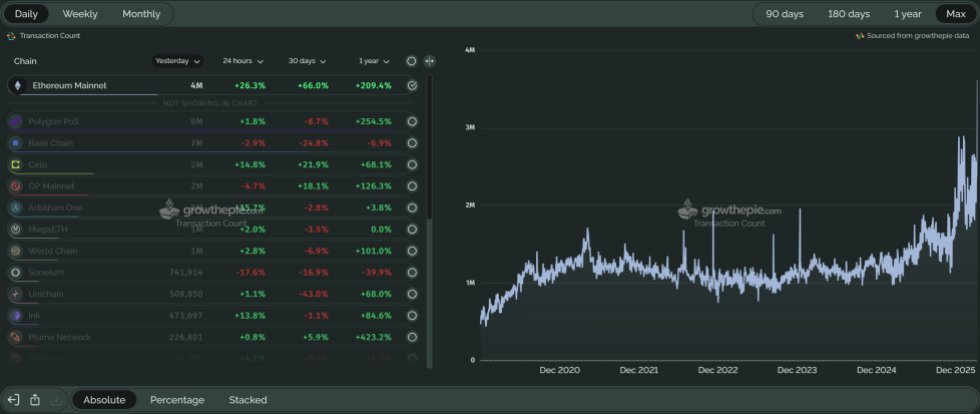
Source: Chart from Everstake on X

EverstaKe added that this trend creates a notable divergence because network activity is at peak levels in the absence of complete price strength. In the past, such gaps have demonstrated a tendency to narrow over time.

Adding to the network growth, the platform highlighted that Ethereum is now one of the strongest foundations it has ever had. Since choosing ETH, there have been record levels of usage, a deeply established ecosystem, and continued progress in scaling and development.

In many ways, this progress highlights a simple dynamic where price typically follows fundamentals, not the other way around. Meanwhile, Everstake stated that the fundamentals are already in place.

Ethereum Sees Stablecoin Supply Peak

As the financial sector grows, the Ethereum network is steadily emerging as the major settlement layer for on-chain finance activity. The stablecoin supply managed on the leading network is rising at a significant rate over the years.

In an X post, Leon Waidmann, a researcher and optimist, shared that stablecoin supply on ETH has reached a new all-time high. Data shows over $180 billion has been added to the network over the past 3 years, representing a 150% increase within the period.

Currently, Ethereum controls about 60% market share in stablecoins. In the next 4 years, an additional $1.7 trillion is set to go on-chain, and ETH could dominate this revenue. Even if Ethereum’s market share eventually drops from 60% to 50%, it still means that by 2030, the ETH network will secure almost $850 billion in new stablecoin supply.

ETH trading at $2,371 on the 1D chart | Source: ETHUSDT on Tradingview.com

Related Questions

QWhat is the current trend in Ethereum's daily transaction count despite its price volatility?

AEthereum's daily transaction count is experiencing robust growth and has reached a record high, with over 3.6 million transactions on April 12, 2026, even as its price struggles with volatility.

QAccording to the article, what does the mismatch between Ethereum's market performance and its fundamentals often indicate?

AThe mismatch between market performance and fundamentals often indicates an underlying strength in the network that may not yet be reflected in its valuation.

QWhat significant milestone did the stablecoin supply on the Ethereum network achieve, as mentioned in the article?

AThe stablecoin supply on the Ethereum network reached a new all-time high, with over $180 billion added over the past 3 years, representing a 150% increase.

QWhat is Ethereum's current market share in the stablecoin sector, and what is its projected share of new supply by 2030?

AEthereum currently controls about 60% of the stablecoin market share. It is projected that by 2030, the network could secure almost $850 billion in new stablecoin supply, even if its market share drops to 50%.

QWhich company reported the record-breaking transaction count on the Ethereum network and highlighted the divergence between network activity and price?

AEverstake, the largest global non-custodial staking infrastructure provider, reported the record transaction count and highlighted the divergence between peak network activity and the lack of complete price strength.

Related Reads

Understanding Hash in One Article: The "Browser Miner" on Ethereum

Hash is an Ethereum-based ERC-20 token described as a "browser-minable post-quantum token." Its key features include enabling browser-based GPU mining without specialized hardware, a fixed supply cap of 21 million tokens, immutable and permissionless smart contracts with no team allocation or pre-mining, and an emphasis on post-quantum security using Keccak256 hashing. The mining mechanism is a simplified on-chain proof-of-work where miners solve unique challenges tied to their wallet address. Key design elements prevent answer theft, with epochs resetting every 100 blocks (~20 minutes) and a per-block minting limit. Emission follows a Bitcoin-like halving schedule every 100,000 mints, starting at 100 tokens per mint. Projections suggest all tokens could be mined within approximately 294 days if a target rate of one mint per minute is sustained. Hash emphasizes "post-quantum" security by leveraging hash-based primitives like Keccak256, which are considered more resistant to quantum attacks compared to elliptic-curve cryptography. While not a fully post-quantum asset, it aligns with Ethereum's broader post-quantum research narrative. The project completed its Genesis sale at $0.03 and began trading on Uniswap, with its price reaching around $0.19. The initial circulating supply is small, with 5% sold in Genesis and 5% allocated to liquidity. The majority (47.6% of total supply) is allocated to early-stage mining, leading to a front-loaded emission schedule. This structure, combined with low initial liquidity, makes Hash a high-volatility, high-risk project dependent on sustained miner participation and market demand to absorb new supply.

marsbit10m ago

Understanding Hash in One Article: The "Browser Miner" on Ethereum

marsbit10m ago

OpenAI's Largest Internal Wealth Creation: 600 People Cash Out a Total of $6.6 Billion, 75 Take Home the Maximum $30 Million Each

A Wall Street Journal report reveals OpenAI's unprecedented pre-IPO wealth creation. In a single employee stock sale last October, over 600 current and former employees sold shares, collectively cashing out approximately $6.6 billion. Due to high investor demand, the company tripled the individual sale cap to $30 million, with about 75 employees selling the maximum amount. This event represents the largest such transaction in tech industry history for a private company. OpenAI's valuation was $500 billion for this tender offer. Employees with over two years of tenure were eligible, allowing many post-ChatGPT hires their first liquidity event. The company's stock has reportedly grown over 100-fold in seven years. Following a restructuring, employees collectively hold about 26% of OpenAI. The scale of executive wealth is also staggering. In court testimony related to Elon Musk's lawsuit, President and co-founder Greg Brockman confirmed his OpenAI stake is worth around $30 billion. Analysis indicates about 165 current and former employees hold a combined ~$164.9 billion in equity, averaging nearly $1 billion per person in paper wealth. OpenAI's per-employee stock-based compensation is estimated to be 34 times the average of major tech firms before their IPOs. OpenAI continues its rapid ascent, closing a $122 billion funding round at an $852 billion valuation in March. With monthly revenue hitting $2 billion, over 900 million weekly ChatGPT users, and plans for a potential trillion-dollar IPO in late 2026, this wealth-creation engine shows no signs of stopping.

链捕手32m ago

OpenAI's Largest Internal Wealth Creation: 600 People Cash Out a Total of $6.6 Billion, 75 Take Home the Maximum $30 Million Each

链捕手32m ago

Trading

Spot
Futures

Hot Articles

Discussions

Welcome to the HTX Community. Here, you can stay informed about the latest platform developments and gain access to professional market insights. Users' opinions on the price of ETH (ETH) are presented below.

活动图片















