Ethereum secures 58% of $16.5B RWA market – Will ETH prices follow?
ambcryptoPublished on 2026-03-28Last updated on 2026-03-28
Abstract
Ethereum is consolidating its role as a capital and settlement hub, with $163.3 billion in stablecoin supply and a dominant 58% share of the $16.5 billion RWA market. While user activity is fragmenting across L2s—evidenced by a declining L2-to-L1 daily active user ratio—liquidity remains strongly anchored to the base layer due to its superior security and finality. This is further reinforced by institutional demand, as seen in substantial ETF inflows and growing RWA adoption. However, softer fee generation and minimal ETH burn suggest that if capital remains passive and user activity continues migrating to L2s, it may not directly translate to stronger ETH price performance.
Activity across Ethereum’s [ETH] ecosystem is shifting, as L2 usage cools while value remains anchored on the base layer. The L2 to L1 Daily Active Users (DAU) ratio fell to 1.12 in February 2026, down sharply from 2025 highs, showing fragmented user growth.
As execution spreads across L2s, the base layer still secures settlement and liquidity, which preserves structural dominance. Stablecoin supply near $163.3 billion on mainnet confirms capital continues to concentrate where finality and security remain strongest.
Fee dynamics reinforce this divergence, with base fees averaging 12.6 gwei and only 267 ETH burned weekly, reflecting softer demand. As L2s contribute minimal burn, economic value stays tied to L1.
This shift suggests Ethereum is consolidating as a capital hub, where liquidity concentrates even as user activity disperses.
Ethereum reclaims liquidity dominance
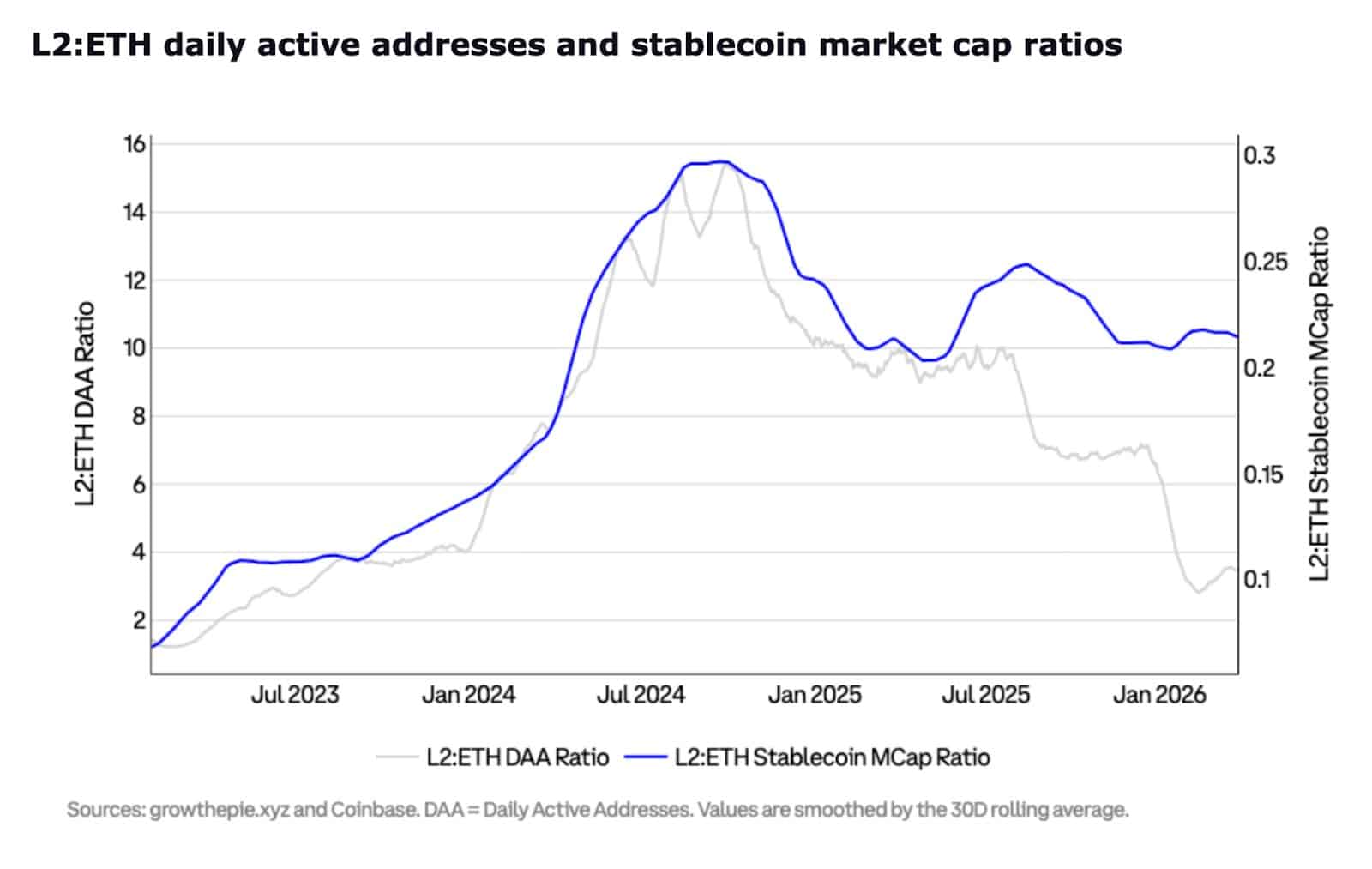
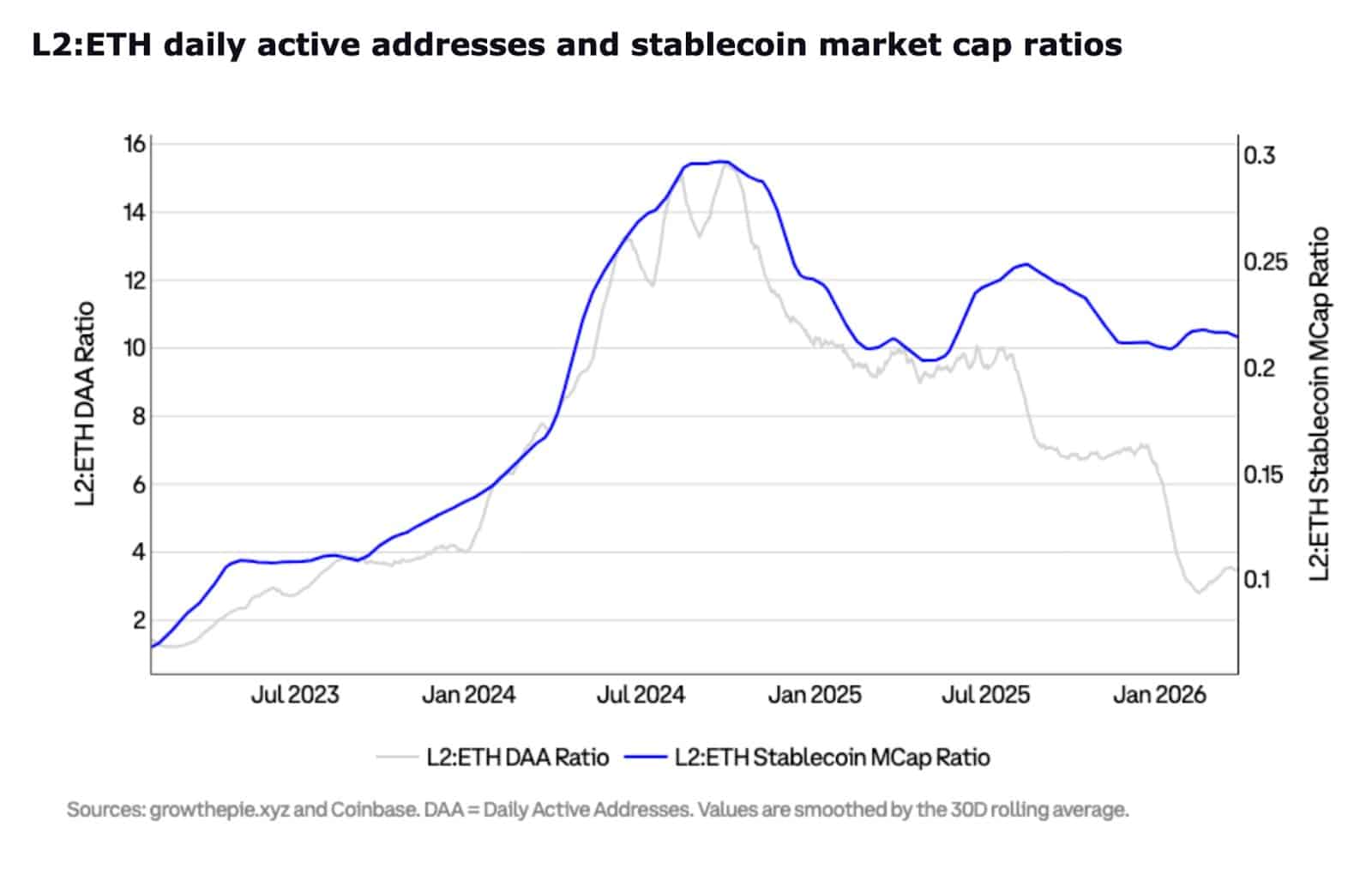
This shift becomes clearer as user activity and liquidity stop moving together across layers. The L2-to-ETH Daily Active Addresses (DAA) ratio rose from about 2 in early 2023 to over 15 by mid-2024, showing users moved quickly to L2s for cheaper transactions.
However, this growth did not last, as the ratio dropped to around 10–11 by 2026, showing user activity has slowed. This decline suggests L2 usage is weakening rather than expanding.
Source: X
Capital shows a different trend, as the L2-to-ETH stablecoin ratio peaked near 0.30 before settling around 0.20–0.22, meaning that liquidity is holding better than user activity.
This imbalance implies value is staying where security and flexibility are strongest. As a result, Ethereum remains the main layer for liquidity, even as activity spreads across L2s.
Ethereum’s role as a settlement layer
The trend is further supported by changes in regulations that are influencing capital flows. To illustrate the preference for regulated assets, Ethereum has gained roughly $9.6 billion, or 58% of the $16.5 billion RWA market, thanks to institutions looking for compliant systems and dependable settlement.
As this demand grows, capital remains on the base layer because high-value transactions require strong security and finality. This explains why liquidity holds steady even as user activity spreads across cheaper L2 networks.
ETF flows support this trend, with spot ETH products attracting $9.9 billion in inflows through 2025 and AUM exceeding $12 billion into 2026. This steady growth shows rising institutional trust.
This pattern indicates that Ethereum is solidifying its position as the primary layer for large-scale value settlement.
All in all, if this capital continues to build, Ethereum can strengthen its role, allowing ETH to gain value as more activity settles on L1. However, if users remain on L2s while capital stays passive, growth may not translate into stronger price performance.
Final Summary
Ethereum sees capital concentrated on L1 with $163.3 billion in stablecoins and a 58% RWA share, while L2 activity weakens.
ETH now relies on active capital use, as L1 flows support strength, while passive liquidity may limit price gains.
Related Questions
QWhat percentage of the $16.5 billion RWA market has Ethereum secured according to the article?
AEthereum has secured 58% of the $16.5 billion RWA market.
QHow has the L2 to L1 Daily Active Users (DAU) ratio changed as of February 2026?
AThe L2 to L1 Daily Active Users (DAU) ratio fell to 1.12 in February 2026, down sharply from 2025 highs.
QWhat is the current stablecoin supply on Ethereum's mainnet mentioned in the article?
AThe stablecoin supply on Ethereum's mainnet is near $163.3 billion.
QWhat trend does the article highlight regarding Ethereum's role in capital settlement?
AThe article indicates Ethereum is solidifying its position as the primary layer for large-scale value settlement, with capital concentrating on L1 due to security and finality.
QHow much inflow did spot ETH ETFs attract through 2025 according to the report?
ASpot ETH ETFs attracted $9.9 billion in inflows through 2025, with AUM exceeding $12 billion into 2026.
Manyu is a Meme token issued on Ethereum that delivers decentralized cultural and entertainment value through viral social media influence and community-driven engagement.
48.2k Total ViewsPublished 2025.11.27Updated 2025.11.27
As a major evolution of Ethereum’s account system, AA is designed to address the fundamental security and experience bottlenecks of the “private key equals account” model in the EOA era.
4.0k Total ViewsPublished 2025.12.18Updated 2025.12.18
Ordinals/Runes continue to drive block fee revenue and developer activity, and are seen as the starting point for Bitcoin's "native asset issuance".
24.4k Total ViewsPublished 2026.04.29Updated 2026.04.29
Discussions
Welcome to the HTX Community. Here, you can stay informed about the latest platform developments and gain access to professional market insights. Users' opinions on the price of ETH (ETH) are presented below.