Ethereum Remains The Top Network For Tokenized Assets As Adoption Grows

bitcoinistPublished on 2026-03-18Last updated on 2026-03-18

Abstract

Ethereum continues to lead as the dominant network for tokenized assets, holding over 61% of the market share with approximately $200 billion in value settled on its Layer 1 blockchain. Despite recent sideways price movement, the network has seen robust adoption and performance, driven by its well-established infrastructure, deep liquidity, and strong security. According to market experts, institutions prefer Ethereum for tokenizing real-world assets due to its battle-tested ecosystem. Additionally, technical analysis suggests Ethereum's bearish trend may be ending, with key indicators turning bullish and the price reclaiming the $2,200 support level. The next critical resistance levels are identified at $2,400 and $2,600.

While its price action has been trending sideways over the past few weeks, Ethereum has been seeing robust network performance and adoption. Recent updates are showing that the ETH network is now at the forefront of tokenized assets as the sector experiences substantial growth.

Tokenized Asset Boom On The Ethereum Network

Tokenized assets are becoming the order of the day in the ever-evolving blockchain sector, with the Ethereum network turning up at the center of the development. As the market for tokenized assets keeps growing, Ethereum has remained the top blockchain network driving this quickly expanding industry.

Leon Waidmann, a market expert and head of research at Lisk, shared this development on X, which suggests that the leading network is witnessing a strong wave of demand and interest. Developers and institutions are rapidly using ETH’s well-established infrastructure and substantial liquidity for everything from tokenized real-world assets to blockchain-based financial instruments.

Looking at the chart, the Ethereum mainnet is clearly dominating the tokenized assets market, controlling more than 61% of the entire market share. The chart shows that the current value of tokenized assets settling on the ETH Layer 1 blockchain has reached approximately $200 billion.
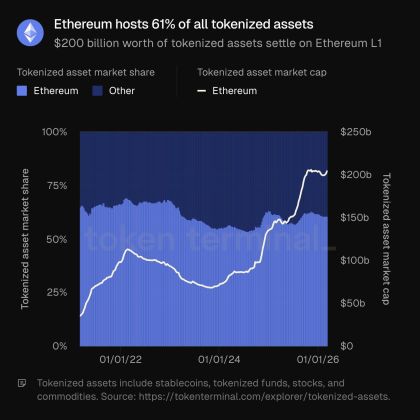
Source: Chart from Leon Waidmann on X

After falling to about 50% during the multi-chain expansion phase, Ethereum’s share has been increasing since the middle of 2024. This dominance is a result of both the network’s strong ecosystem of decentralized apps and its early-mover advantage.

Offering insights into why the tokenized market is climbing again, the expert claims that this is because when institutions tokenize real value, they often pick the chain with the deepest liquidity. Other things they look out for are the strongest security guarantees and the most battle-tested infrastructure, especially in a bear market.

Has ETH’s Downward Trend Come To An End?

After a period of downward action, the price of Ethereum may be approaching the end of the bearish phase. Ali Martinez, a seasoned technical analyst, revealed that ETH just flashed a signal that the downward trend is potentially nearing its end. This implies that bearish momentum is gradually weakening, with buyers stepping back into the market.

Market indicators and shifting price structure are key indicators of the development. For the first time since September, the SupperTrend indicator has transitioned from Sell to Buy. The setup could spur an upward move, as observed in the last two scenarios, which triggered moves of 52% and 174%.

Currently, a major shift is developing under the surface. ETH has experienced a reclaim of the $2,200 level as support after a 39% decline below it. At the same time, demand has picked up pace, with ETFs accumulating over 83,000 ETH valued at roughly $193 million, in the last 3 weeks. Given that ETH has survived the volatile market conditions from September 2025 to March 2026, Martinez predicts that the next key levels to reclaim are $2,400 and $2,600.

ETH trading at $2,325 on the 1D chart | Source: ETHUSDT on Tradingview.com

Related Questions

QWhat is the current market share of Ethereum in the tokenized assets sector according to the article?

AEthereum controls more than 61% of the entire tokenized assets market share.

QWhat is the approximate total value of tokenized assets currently settling on the Ethereum Layer 1 blockchain?

AThe current value of tokenized assets on Ethereum Layer 1 has reached approximately $200 billion.

QAccording to the expert Leon Waidmann, what are the main reasons institutions choose a specific blockchain for tokenizing real-world assets?

AInstitutions primarily look for the chain with the deepest liquidity, the strongest security guarantees, and the most battle-tested infrastructure, especially in a bear market.

QWhat key technical indicator for Ethereum has recently changed from 'Sell' to 'Buy' for the first time since September?

AThe SupperTrend indicator has transitioned from Sell to Buy for the first time since September.

QWhat are the next key price levels that analyst Ali Martinez predicts Ethereum needs to reclaim?

AThe next key levels to reclaim are $2,400 and $2,600.

Related Reads

How Many Tokens Away Is Yang Zhilin from the 'Moon Chasing the Light'?

The article explores the intense competition between two leading Chinese AI companies, DeepSeek and Kimi (Moon Dark Side), and the mounting pressure on Yang Zhilin, the founder of Kimi. While DeepSeek re-emerged after 15 months of silence with its powerful V4 model—boasting 1.6 trillion parameters and low-cost, long-context capabilities—Kimi has been focusing on long-context processing and multi-agent systems with its K2.6 model. Yang faces a threefold challenge: technological rivalry, commercialization pressure, and investor expectations. Despite Kimi’s high valuation (reaching $18 billion), its revenue heavily relies on a single product with low paid conversion rates, while DeepSeek’s strategic silence and open-source influence have strengthened its market position and valuation prospects, now targeting over $20 billion. Both companies reflect broader trends in China’s AI ecosystem: Kimi aims for global influence through open-source contributions and agent-based advancements, while DeepSeek prioritizes foundational innovation and hardware independence, notably shifting to Huawei’s chips. Their competition is seen as vital for China’s AI progress, with the gap between top Chinese and U.S. models narrowing to just 2.7% on the Elo rating scale. Ultimately, the article argues that this rivalry, though anxiety-inducing for leaders like Zhilin, is essential for driving innovation and solidifying China’s role in the global AI landscape.

marsbit8h ago

How Many Tokens Away Is Yang Zhilin from the 'Moon Chasing the Light'?

marsbit8h ago

Trading

Spot
Futures

Hot Articles

Discussions

Welcome to the HTX Community. Here, you can stay informed about the latest platform developments and gain access to professional market insights. Users' opinions on the price of ETH (ETH) are presented below.

活动图片















