Ethereum Founder Buterin Slams Elon Musk As Anti-Europe Attacks Ignite

bitcoinistPublished on 2025-12-10Last updated on 2025-12-10

Abstract

Ethereum founder Vitalik Buterin has publicly criticized Elon Musk, accusing his platform X of enabling aggressive, coordinated attacks against Europe rather than fostering free speech. Buterin acknowledged EU flaws like excessive bureaucracy and criticized policies like Chat Control, but argued the rhetoric on X has become unhinged and resembles a delegitimization campaign. He directly warned Musk that using X for "coordinated hate sessions" harms free speech and could provoke major backlashes. Buterin hinted at possible Russian involvement in the anti-EU discourse and reaffirmed his support for the EU as a valuable, though imperfect, institutional experiment. His comments follow Musk's outburst against the EU, which included calls to abolish the bloc after it fined X €120 million for DSA breaches.

Ethereum founder Vitalik Buterin has issued a sharp public warning to Elon Musk over how X is being used to direct increasingly aggressive rhetoric at Europe, arguing that the platform is drifting from a free-speech ideal toward orchestrated hostility.

Ethereum Founder Calls Out Elon Musk

In a series of posts on X, Buterin said that “the attacks on Europe I’ve seen here the last couple of days, including from people I’ve generally considered interesting and sophisticated, have been getting unhinged.”

He acknowledged that the European Union has serious shortcomings, listing “GDPR clickthroughs are dumb, Chat Control is awful, they need to be less bureaucratic and supportive toward entrepreneurs,” and criticizing what he called Europe’s selective moral stance, noting that its “kindness toward Ukraine often doesn’t extend well to Gaza or Sudan or other places.” He also described “people saying mean things about criminals getting longer sentences than the criminals” as “just crazy.”

Despite that, the Ethereum founder argued that the way some users on X are talking about Europe has moved well beyond legitimate criticism. He described “the apocalyptic attitude about the issues, evoking imagery of barbarians pillaging Rome etc,” as “really over the top” and said it “feels more like a coordinated attempt to delegitimize than constructive criticism.”

He rejected the idea that the real target is only Brussels-based institutions, writing: “I don’t believe the line that ‘the target is not Europe, it’s the EU’: I’ve seen many instances of London specifically being targeted in the hate session, so no, much of it is an attack on Europe.” This, he argued, does not match his experience from “spending an average of two months every year there for the last decade.”

The central confrontation came in a direct reply to Musk. Addressing the X owner’s self-positioning as a defender of free speech, the Ethereum founder wrote: “I think you should consider that making X a global totem pole for Free Speech, and then turning it into a death star laser for coordinated hate sessions, is actually harmful for the cause of free speech. I’m seriously worried that huge backlashes against values I hold dear are coming in a few years’ time.”

Buterin Hints At Russian Involvement

The thread sparked pushback from some users who argued that his framing underplays European complicity in current conflicts. One critic responded that “’not extending kindness’ is an incredible way to frame funding, arming and politically backing a genocide,” and claimed that it is “hilarious to think the US doesn’t suffer from many of the same things or worse that Americans say about the EU.”

The Ethereum founder replied that Europe is “a genuinely mixed bag,” emphasizing that “different countries in Europe have very different policies,” and pointing out that the continent “also hosts ICC, which is under a lot of pressure (see: judges being financially deplatformed).”

Other replies widened the lens to geopolitics. Commenting on a suggestion that the current discourse looks like “a coordinated campaign due to the Kremlin liking the new US ‘going back to Monroe’ global security policy,” Buterin answered “yeah basically” and added that “a lot of powerful people really like the vision that the world should just be 5–20 adults who have their spheres and sometimes get together in a room to hash out any differences, and everyone else can be shut out because they are annoying and inconvenient.”

At the same time, Buterin restated his support for the European project as an institutional experiment. “I have a lot of respect for the idea of EU, as an experiment in trying to get the benefits of a superstate, without the homogenization, becoming an aggressive ‘great power’, and other downsides,” he wrote, while stressing that “the experiment does need to be adjusted in a lot of ways; eg. we see not enough unity in its external policy and too much unity on top-down bureaucracy and surveillance at the same time.” If improved, he argued, “it’s a model that could set a really good example for the world.”

On the technical side, the Ethereum founder used the debate over “gdpr clickthroughs” to propose a different approach to online control, calling for “more sophisticated user-side software (browsers, local LLMs...) that helps the user navigate the internet and make intelligent decisions about what requires confirmations from the user.” In contrast to the centralized dynamics he criticizes on X, he is effectively pointing back to user-empowering, decentralized tools as the way to reconcile regulation, usability and free expression.

Musk Vs. The European Union

Notably, Musk’s anti-EU outburst comes after the Commission has issued a fine of €120 million to X for breaching its transparency obligations under the Digital Services Act (DSA). Musk wrote via X that “The ‘EU’ imposed this crazy fine not just on @X, but also on me personally, which is even more insane!” and says it would be “appropriate to apply our response not just to the EU, but also to the individuals who took this action against me.”

In subsequent posts he escalated further, declaring that “The EU should be abolished and sovereignty returned to individual countries,” calling to “Dissolve the EU and return power to the people,” and even asserting that “The EU commissars are responsible for the murder of Europe.”

At press time, Ethereum traded at $3,316.
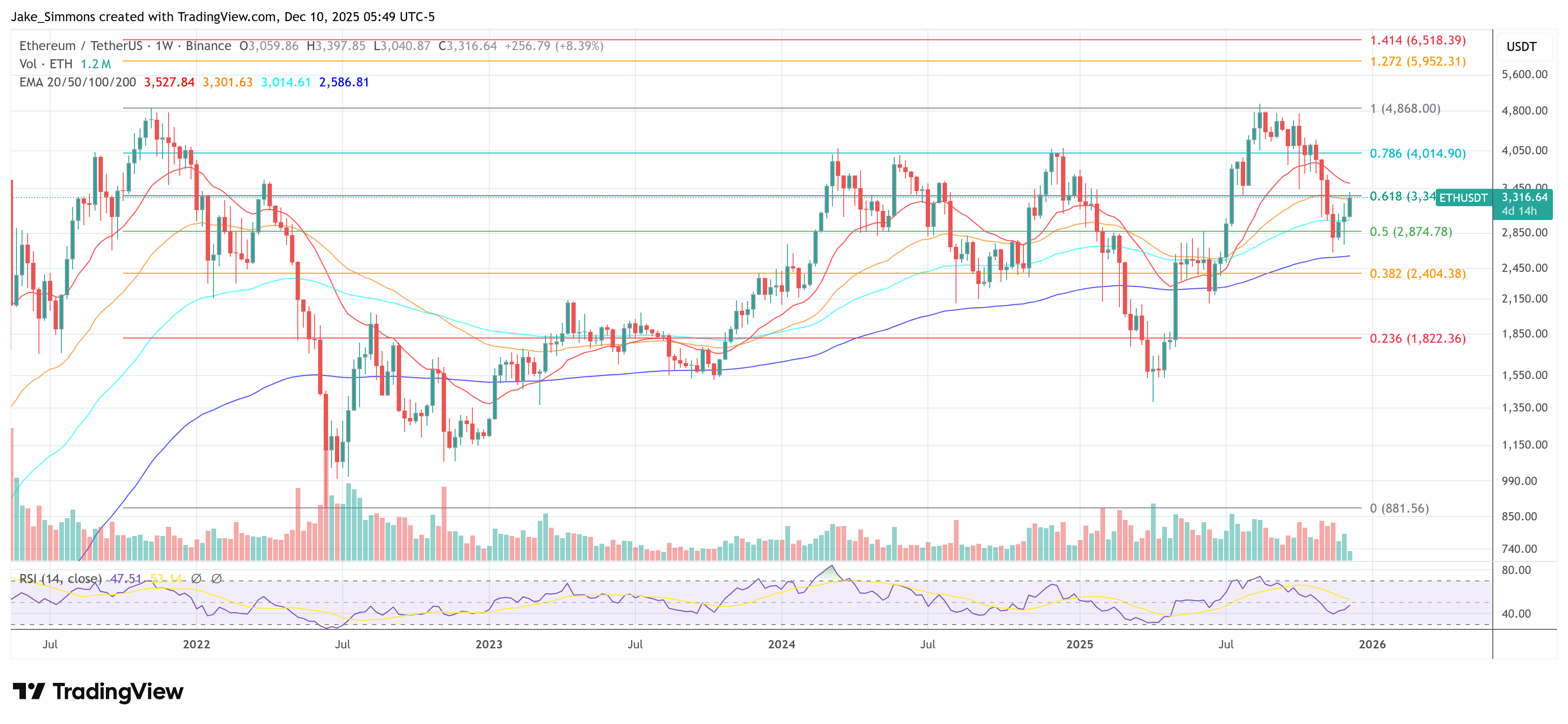
Ethereum hovers below the 0.618 Fib, 1-week chart | Source: TOTAL on TradingView.com

Related Reads

WSJ: Unveiling the Secret Jury That Controls Disputes on Polymarket

Last month, Garrick Wilhelm lost a $567 bet on the Polymarket prediction platform about whether a ceasefire would be reached with Hezbollah. When a truce was announced, some traders argued it counted, but Wilhelm disagreed. The dispute was settled not by Polymarket, but by a decentralized group of UMA token holders who vote on such disagreements. As trading surges, resolving ambiguous outcomes is a growing challenge for prediction markets. Unlike competitors like Kalshi that decide internally, Polymarket outsources dispute resolution to UMA. Its token holders, mostly anonymous and with voting power weighted by holdings, arbitrate cases. Critics argue this system is prone to manipulation, as voters can also bet on the same markets they judge. A Wall Street Journal analysis found that over the past year, at least 60% of active UMA voters had corresponding Polymarket accounts and held positions in disputes they voted on. Voting power is also concentrated among a few large holders. Polymarket says only 0.2% of bets go to UMA and that the system disperses authority. Its founder has acknowledged flaws and promised fixes. UMA's backers deny any proven manipulation, dismissing critics as sore losers. The platform penalizes voters in the minority to incentivize "correct" outcomes. Disputes are rising, covering topics from a streamer's pregnancy announcement to Iran. This model also helps Polymarket argue it's an offshore platform outside U.S. regulation, a shift made after a 2022 settlement with the CFTC. Some losing traders have formed groups to protest, targeting entities like UMA.rocks, which aggregates votes. Its founder says traders often blame UMA for their own mistakes. A recently ousted committee member, Scout, admitted to both betting and voting but argued involved voters research more thoroughly. He highlighted the dilemma: "Either you have conflicted traders deciding, or you have uninformed outsiders voting. There is no perfect answer right now."

marsbit7m ago

WSJ: Unveiling the Secret Jury That Controls Disputes on Polymarket

marsbit7m ago

China's AI Circle Has Just Established a Pecking Order, and Capital Is Already Changing the Rules Again

The article describes how the valuation logic for major Chinese AI model companies has undergone three dramatic shifts between 2022 and 2026, driven by capital's changing priorities. The first phase (around 2022) was **technology-driven valuation**, where funding was based on model performance and benchmark scores. This logic was disrupted when DeepSeek's R1 model demonstrated that comparable capabilities could be achieved at a fraction of the cost, challenging the notion of technical superiority as an unassailable moat. The second phase shifted to **IPO window-driven valuation**. Following favorable listing conditions in Hong Kong, capital flowed to companies like Zhipu and MiniMax with the clearest path to a public listing. However, this focus on liquidity over fundamentals became apparent as their Annual Recurring Revenue (ARR) lagged far behind international peers like Anthropic. The third and current phase is **national strategy-driven valuation**. This shift was marked by the state-backed "Big Fund" leading a major investment in DeepSeek, signaling that leading domestic AI models are now viewed as strategic national assets comparable to semiconductor manufacturing. This new logic, combined with soaring US valuation benchmarks (e.g., OpenAI at $850B), propelled the combined valuation of China's top AI firms ("The Four Dragons"/"Five Strong") past 1 trillion RMB. The article presents a "pricing leap model": each shift is triggered by a key event that invalidates the old logic, leading to rapid capital reallocation under a new narrative before its flaws (particularly the gap in fundamental ARR metrics) become evident. It concludes that the next major test for these valuations will be a return to scrutinizing core business fundamentals, specifically ARR growth, suggesting a fourth pricing shift is imminent.

marsbit32m ago

China's AI Circle Has Just Established a Pecking Order, and Capital Is Already Changing the Rules Again

marsbit32m ago

'Stock God' Trump's 3,642 Trades Disclosed: The 'Perfect Closed Loop' of Policy and Portfolio

Summary: Donald Trump's First Quarter stock trades, totaling 3,642 transactions, have been disclosed. While the White House maintains the trades were managed by an advisor and complied with disclosure laws, they reveal a portfolio heavily aligned with his policy agenda. The trades show a rotation away from major tech stocks like Microsoft, Amazon, and Meta, and into semiconductor and AI hardware companies such as NVIDIA, AMD, Broadcom, Dell, and Intel. Notably, Trump's account purchased Dell stock before he publicly praised the company, after which its stock rose. The Dell family also pledged funds to a Trump-affiliated policy project. A critical case is Intel. The Trump administration converted $8.9 billion in CHIPS Act subsidies into a 9.9% equity stake, making the U.S. government Intel's largest shareholder. Months later, Trump's personal account also bought Intel stock. This intertwines national industrial policy with potential personal financial interest. Unlike typical insider trading concerns, this situation creates a "closed loop": policy decisions (e.g., subsidies, tariffs, crypto regulation) can boost the value of his holdings, and those holdings may, in turn, influence future policy directions. This blending of presidential power and personal portfolio, while legally disclosed, raises profound questions about conflicts of interest that current rules do not address.

marsbit48m ago

'Stock God' Trump's 3,642 Trades Disclosed: The 'Perfect Closed Loop' of Policy and Portfolio

marsbit48m ago

Dialogue with Figure Robotics Founder: Behind the $39 Billion Valuation Lies Ambition to Mass-Produce Millions of Units

Title: Figure's Founder on the $39B Valuation and the Ambition to Mass Produce a Million Humanoid Robots In a Sourcery podcast interview, Figure founder and CEO Brett Adcock discusses the rapid rise of his humanoid robotics company. With a valuation that surged 15x in 18 months to $39 billion, Figure aims to create general-purpose humanoid robots for work in factories and homes. Adcock states that the company's primary goal is to make robots that perform real, paid work autonomously. He shares Figure's aggressive scaling plan: producing thousands of robots this year, with an ultimate ambition to reach one million units annually. Adcock explains Figure's vertically integrated strategy, designing its own motors, sensors, and joints to control its supply chain and destiny. He details the challenges, including achieving long-term, reliable, end-to-end autonomous operation—a feat no one has yet accomplished. The biggest risk is executing this complex vision at scale, but Adcock believes the potential market is enormous, representing a significant portion of global GDP. The interview also covers his departure from OpenAI, citing that Figure's internal AI team eventually surpassed OpenAI's capabilities for robotics applications. Adcock concludes by highlighting his focus for the year: large-scale commercial deployment of robots and advancing toward a "general robot" capable of any human task, potentially seeing the first signs of AGI (Artificial General Intelligence) in the physical world at Figure.

marsbit48m ago

Dialogue with Figure Robotics Founder: Behind the $39 Billion Valuation Lies Ambition to Mass-Produce Millions of Units

marsbit48m ago

Trading

Spot
Futures

Hot Articles

How to Buy ELON

Welcome to HTX.com! We've made purchasing Dogelon Mars (ELON) simple and convenient. Follow our step-by-step guide to embark on your crypto journey.Step 1: Create Your HTX AccountUse your email or phone number to sign up for a free account on HTX. Experience a hassle-free registration journey and unlock all features.Get My AccountStep 2: Go to Buy Crypto and Choose Your Payment MethodCredit/Debit Card: Use your Visa or Mastercard to buy Dogelon Mars (ELON) instantly.Balance: Use funds from your HTX account balance to trade seamlessly.Third Parties: We've added popular payment methods such as Google Pay and Apple Pay to enhance convenience.P2P: Trade directly with other users on HTX.Over-the-Counter (OTC): We offer tailor-made services and competitive exchange rates for traders.Step 3: Store Your Dogelon Mars (ELON)After purchasing your Dogelon Mars (ELON), store it in your HTX account. Alternatively, you can send it elsewhere via blockchain transfer or use it to trade other cryptocurrencies.Step 4: Trade Dogelon Mars (ELON)Easily trade Dogelon Mars (ELON) on HTX's spot market. Simply access your account, select your trading pair, execute your trades, and monitor in real-time. We offer a user-friendly experience for both beginners and seasoned traders.

2.9k Total ViewsPublished 2024.03.29Updated 2025.03.21

How to Buy ELON

Discussions

Welcome to the HTX Community. Here, you can stay informed about the latest platform developments and gain access to professional market insights. Users' opinions on the price of ELON (ELON) are presented below.

活动图片