Ethereum Exodus Continues: Supply On Crypto Exchanges Dries Up To Years-Long Low

bitcoinistPublished on 2026-03-04Last updated on 2026-03-04

Abstract

Ethereum's supply on cryptocurrency exchanges has plummeted to a multi-year low, with only 16 million ETH remaining, down from 23 million in 2023. This significant withdrawal indicates that holders are choosing to hold or stake their assets rather than sell, despite recent price declines. This trend reduces immediate sell pressure and suggests a silent accumulation phase, potentially setting the stage for a supply shock. Concurrently, Ethereum's network activity has surged to record highs, with daily transactions nearing 3 million, driven by increased DeFi usage, stablecoin transfers, and NFT interactions. This heightened on-chain demand points to substantial utility growth and adoption, even as the price hovers around $2,000.

With the Ethereum price slowly demonstrating bullish traction after reclaiming the $2,000 mark, sentiment is turning positive once again. During this price action, investors are choosing to hold the leading altcoin rather than sell, which is indicated by a significant drop in crypto exchanges’ reserves.

Available Ethereum On Exchanges Hits New Lows

Following the bounce in Ethereum’s price, the supply of ETH sitting on cryptocurrency exchanges has experienced a sharp decline. According to the report, the number of the coin available on crypto exchanges has fallen to new lows, signaling a notable shift in market structure and sentiment.

As per the chart shared by Leon Waidmann, an optimist and the head of research at Lisk, the metric is currently sitting at a multi-year low. As coins continue to migrate from trading platforms into private wallets or long-term storage, the amount of liquid accessible for instant sale is gradually decreasing.

Currently, over 16 million ETH is left on cryptocurrency exchanges, falling from about 23 million ETH in 2023. Even though the price of ETH has declined sharply from a new all-time high, holders kept withdrawing their coins from platforms. This is considered a positive development for Ethereum as fewer ETH reserves on exchanges means less immediate sell pressure on the altcoin.
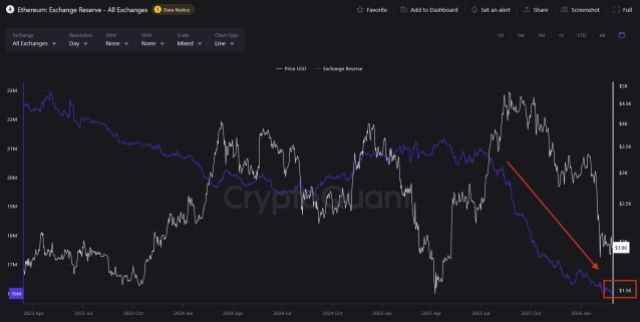
Source: Chart from Leon Waidmann on X

When reserves drop during a price crash, this is an interesting trend as it implies that holders are not panic-selling. Waidmann highlighted that these holders are deliberately moving ETH off cryptocurrency exchanges to staking contracts, cold storage, and Decentralized Finance (DeFi).

These investors are making an active choice to hold, and this is historically how supply shocks are started without a price pump. While everyone else is preoccupied with the red candles, there is a silent accumulation. The market may be scared currently, but on-chain data is telling a different story.

ETH Is Attracting A Massive Wave Of Adoption

Ethereum adoption is picking up pace at a significant rate, as evidenced by its mainnet activity. The network’s activity has spiked to unprecedented levels, with its daily transactions climbing to an all-time high despite the bear market. The milestone shows a significant rise in on-chain demand, which is fueled by increased DeFi activity, stablecoin transfers, NFT interactions, and the emergence of AI and real-world asset protocols.

Data shows that the mainnet transactions per day have surged to nearly 3 million. This is a notable number when compared to levels seen in previous cycles, especially during a bull run. Waidmann noted that the current number of daily transactions is more than the ones seen in the 2021 bull run and in the 2023 recovery.

Despite the fact that the price of ETH is down, the network is experiencing its busiest period, signaling sustained engagement beneath the surface. Record-breaking transaction counts frequently indicate increasing utility rather than being pure speculation.

ETH trading at $1,995 on the 1D chart | Source: ETHUSDT on Tradingview.com

Related Questions

QWhat is the current trend in Ethereum supply on cryptocurrency exchanges and why is it significant?

AThe supply of Ethereum on cryptocurrency exchanges has dropped to a multi-year low, with only over 16 million ETH left, down from about 23 million in 2023. This is significant because it indicates that investors are choosing to hold rather than sell, reducing immediate sell pressure and potentially signaling the start of a supply shock.

QAccording to Leon Waidmann, where are Ethereum holders moving their coins instead of keeping them on exchanges?

AAccording to Leon Waidmann, Ethereum holders are deliberately moving their ETH off exchanges to staking contracts, cold storage, and Decentralized Finance (DeFi) protocols.

QHow does the current on-chain activity on the Ethereum network compare to previous market cycles?

AThe Ethereum network is experiencing unprecedented on-chain activity, with daily transactions surging to nearly 3 million. This number is higher than the levels seen during the 2021 bull run and the 2023 recovery, indicating sustained engagement and increasing utility.

QWhat does a decrease in exchange reserves during a price crash typically suggest about investor behavior?

AA decrease in exchange reserves during a price crash suggests that investors are not panic-selling. Instead, they are actively choosing to hold and withdraw their coins to long-term storage, which is a bullish signal for the asset.

QWhat are the main factors driving the increased demand and transaction activity on the Ethereum network?

AThe increased demand and transaction activity on the Ethereum network are fueled by heightened DeFi activity, stablecoin transfers, NFT interactions, and the emergence of AI and real-world asset protocols.

Related Reads

Stuck Polymarket: The Real Test After Riding the Traffic Boom Has Arrived

Polymarket, a leading prediction market platform, is facing significant technical challenges as its growth outpaces its current infrastructure on Polygon. Users are experiencing laggy transactions, unresponsive orders, and delayed confirmations, severely impacting the trading experience. In response, DeFi Engineering VP Josh Stevens outlined a comprehensive engineering overhaul. The plan includes reducing on-chain data delays, fixing order cancellation issues, rebuilding the central limit order book (CLOB), improving website performance, and developing a unified SDK and API. A major revelation was the ongoing "chain migration," indicating a potential move away from Polygon. The core issue is that Polymarket has evolved from a simple prediction market into a high-frequency trading platform, making Polygon's limitations—such as block space, gas fees, and block time—a ceiling for further growth. The migration is not just a simple chain switch but a fundamental rebuild of its trading system to support more complex products like perpetual contracts (Perps). This announcement has sparked competition among chains like Solana, Sui, and Algorand, all vying to host Polymarket. For Polygon, losing this key application, which contributes significantly to its gas fee revenue, would be a major setback. The real test for Polymarket is no longer attracting users but proving it can provide a stable, reliable trading environment that retains them.

Odaily星球日报1h ago

Stuck Polymarket: The Real Test After Riding the Traffic Boom Has Arrived

Odaily星球日报1h ago

Trading

Spot
Futures

Hot Articles

Discussions

Welcome to the HTX Community. Here, you can stay informed about the latest platform developments and gain access to professional market insights. Users' opinions on the price of ETH (ETH) are presented below.

活动图片















