Ethereum Exchange Outflows Signal Supply Is Stepping Back

bitcoinistPublished on 2026-01-17Last updated on 2026-01-17

Abstract

Ethereum is struggling to stabilize above $3,300 amid ongoing market uncertainty. Despite the recent rebound, analysts note that a sustained recovery requires further confirmation. A key observation from CryptoQuant data shows persistent ETH outflows from exchanges during price dips, while inflows during rallies remain limited. This pattern suggests holders are not selling aggressively into weakness, indicating a reduction in sell-side pressure. This disciplined supply environment could support sharper upside moves if demand returns, as fewer coins are available on exchanges to meet new buying interest. However, the market remains cautious, and a definitive breakout depends on broader conditions aligning with improved demand.

Ethereum is struggling to push above critical supply levels after a brief surge above $3,300, as the market attempts to stabilize following weeks of sustained selling pressure. While the rebound has sparked renewed optimism, price action remains fragile, with bulls still needing clear confirmation before a broader recovery can take hold. Still, the fact that ETH is holding near key levels has led some analysts to start calling for higher prices, arguing that the market may be entering a new phase after the recent downtrend.

Supporting this view, a CryptoQuant analyst highlighted Ethereum Exchange Netflow spot data showing persistent ETH outflows from spot exchanges during price pullbacks, while inflows during upward moves remain relatively limited. This pattern suggests a more disciplined supply environment, where holders are reluctant to sell into weakness and are not aggressively distributing during rallies.

In other words, sell-side pressure appears to be easing, even as Ethereum remains capped below major resistance. If demand returns, this type of netflow structure can support sharper upside moves, as fewer coins are available on exchanges to meet new buying interest. For now, Ethereum is caught between fading fear and unfinished recovery, with the next breakout attempt likely to define the short-term trend.

Ethereum’s recent Exchange Netflow behavior suggests that the latest pullbacks have been met with holding and accumulation rather than broad-based distribution. Instead of rushing to send ETH onto exchanges during weakness, many participants appear willing to sit through volatility, reducing the immediate sell pressure that typically accelerates downtrends. This supports the idea that supply is gradually stepping back, even as price remains capped below key resistance zones and market sentiment stays cautious.
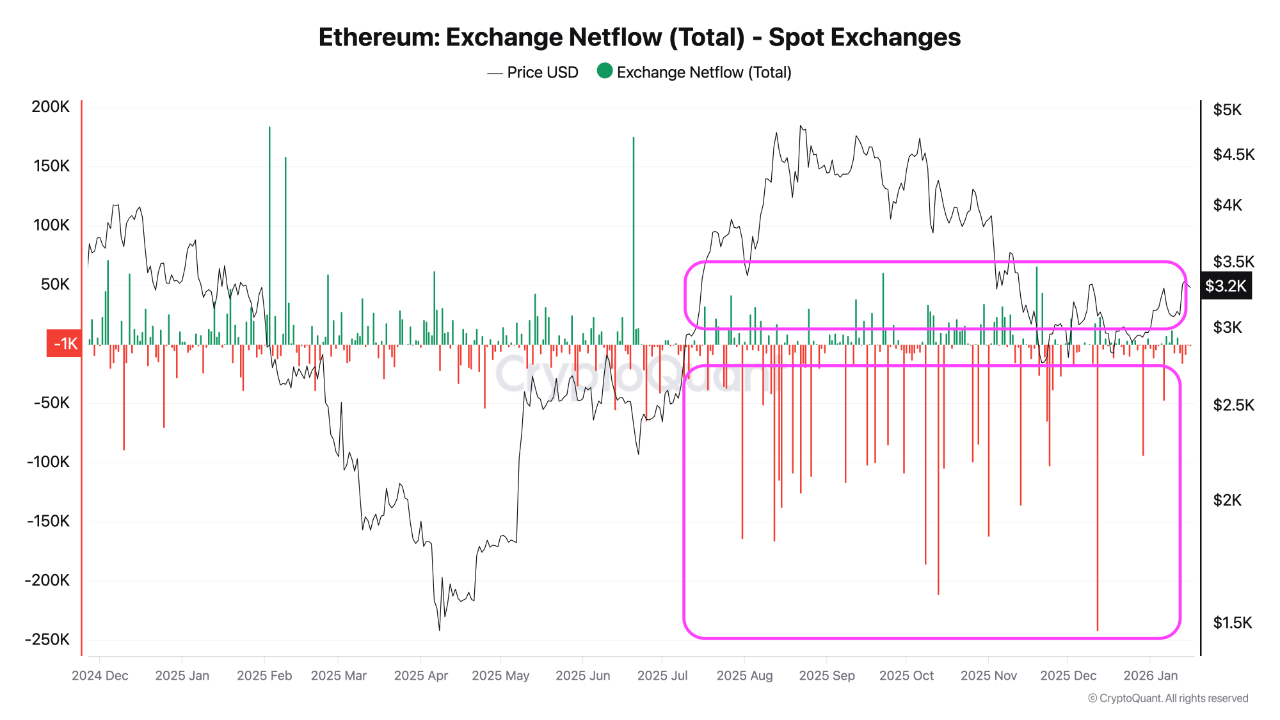
Ethereum Exchange Netflow | Source: CryptoQuant

However, Exchange Netflow alone is not enough to define direction. A favorable supply structure can still fail if demand remains weak, or if macro conditions deteriorate and force investors back into risk-off positioning. In that scenario, downside continuation cannot be ruled out, even if exchange balances remain constrained.

That said, in the absence of major systemic stress, the current netflow profile offers a constructive backdrop for upside. The lack of supply expansion during drawdowns and the restrained profit-taking during rebounds imply that sellers are not in control. If demand rotates back into Ethereum, price could respond more efficiently because there is less readily available liquidity sitting on exchanges.

In this sense, the on-chain data is not signaling an immediate breakout. Instead, it highlights a market structure that appears increasingly prepared for upward price action once broader conditions align and buyers regain conviction.


Related Questions

QWhat does the persistent Ethereum outflows from exchanges during price pullbacks indicate, according to the CryptoQuant analyst?

AIt indicates a more disciplined supply environment where holders are reluctant to sell into weakness and are not aggressively distributing during rallies, suggesting sell-side pressure is easing.

QHow can the current Ethereum netflow structure support sharper upside moves if demand returns?

AIt can support sharper upside moves because fewer coins are available on exchanges to meet new buying interest, as the supply is stepping back.

QWhat is the main limitation of using Exchange Netflow data alone to predict market direction?

AExchange Netflow alone is not enough because a favorable supply structure can still fail if demand remains weak or if macro conditions deteriorate, forcing investors into risk-off positioning.

QWhat does the recent Exchange Netflow behavior suggest about how participants are responding to price pullbacks?

AIt suggests that participants are responding with holding and accumulation rather than broad-based distribution, as they are willing to sit through volatility instead of rushing to sell.

QWhat is the overall implication of the on-chain data for Ethereum's price action, according to the article?

AThe on-chain data highlights a market structure that is increasingly prepared for upward price action once broader conditions align and buyers regain conviction, though it does not signal an immediate breakout.

Related Reads

Cook's Curtain Call and Ternus Takes the Helm: The Disruption and Reboot of Apple's 4 Trillion Dollar Empire

Tim Cook has officially announced he will step down as CEO of Apple in September, transitioning to executive chairman after a 15-year tenure during which he grew the company’s market value from around $350 billion to nearly $4 trillion. He will be succeeded by John Ternus, a 50-year-old hardware engineering veteran who has been groomed for the role through increasing public visibility and internal responsibility. Ternus’s appointment signals a strategic shift toward hardware and engineering leadership, with Johny Srouji—head of Apple Silicon—taking on an expanded role as Chief Hardware Officer. This consolidation aims to strengthen Apple’s core technological capabilities. However, Cook’s departure highlights a significant unresolved issue: Apple’s delayed and fragmented approach to artificial intelligence. Despite early efforts, such as hiring John Giannandrea from Google in 2018, Apple’s AI initiatives—particularly around Siri—have struggled with internal restructuring and reliance on external partnerships, including with Google. The transition comes at a critical moment as Apple faces paradigm shifts with the rise of artificial general intelligence (ASI). The company’s closed ecosystem of hardware, software, and services—once a major advantage—now presents challenges in adapting to an AI-centric world where intelligence may matter more than the device itself. Ternus must quickly articulate a clear AI strategy, possibly starting at WWDC, to reassure markets and redefine Apple’s role in a new technological era. His task is not only to maintain Apple’s operational excellence but also to reinvigorate its capacity to innovate and lead in the age of AI.

marsbit44m ago

Cook's Curtain Call and Ternus Takes the Helm: The Disruption and Reboot of Apple's 4 Trillion Dollar Empire

marsbit44m ago

Trading

Spot
Futures

Hot Articles

Discussions

Welcome to the HTX Community. Here, you can stay informed about the latest platform developments and gain access to professional market insights. Users' opinions on the price of ETH (ETH) are presented below.

活动图片