Ether price trend forecasts triple-digit rally as ETH ETF inflows resume

cointelegraphPublished on 2025-12-11Last updated on 2025-12-11

Abstract

Ether (ETH) price is consolidating near $3,200 after facing resistance between $3,350 and $3,650, a zone aligned with the 200-day EMA. Despite this pullback, spot ETH ETF inflows have shown early signs of recovery, rising 28% from $16.8 billion to $21.5 billion since November 21. Net taker volume, while still negative at –$138 million, has improved significantly from October’s –$500 million, indicating reduced selling pressure and a potential shift in market structure. If this trend continues, it could signal a bullish breakout, reminiscent of early 2025 before ETH’s 3x rally. However, ETH is currently testing key support between $3,100–$3,180. A hold above this level could lead to a rebound toward $3,450 and possibly $3,900, while a breakdown might trigger a retest of $3,000. Derivatives data shows neutral but fragile sentiment, with mildly positive funding rates and near-neutral bid/ask ratios. The next major price move depends on whether improving ETF inflows and taker activity translate into sustained buying pressure.

Ether’s (ETH) price action cooled this week after a sharp rejection from the $3,650 to $3,350 supply zone, with the altcoin now hovering near $3,200. The rejection aligned with the 200-day exponential moving average (EMA), reinforcing overhead resistance just as spot exchange-traded funds (ETFs) flows began showing early signs of recovery.

Key takeaways:

  • Spot Ether ETF flows have risen from $16.8 billion to $21.5 billion since Nov. 21, a 28% increase.

  • Net taker volumes rose, signaling that aggressive sellers are weakening while taker buyers slowly return.
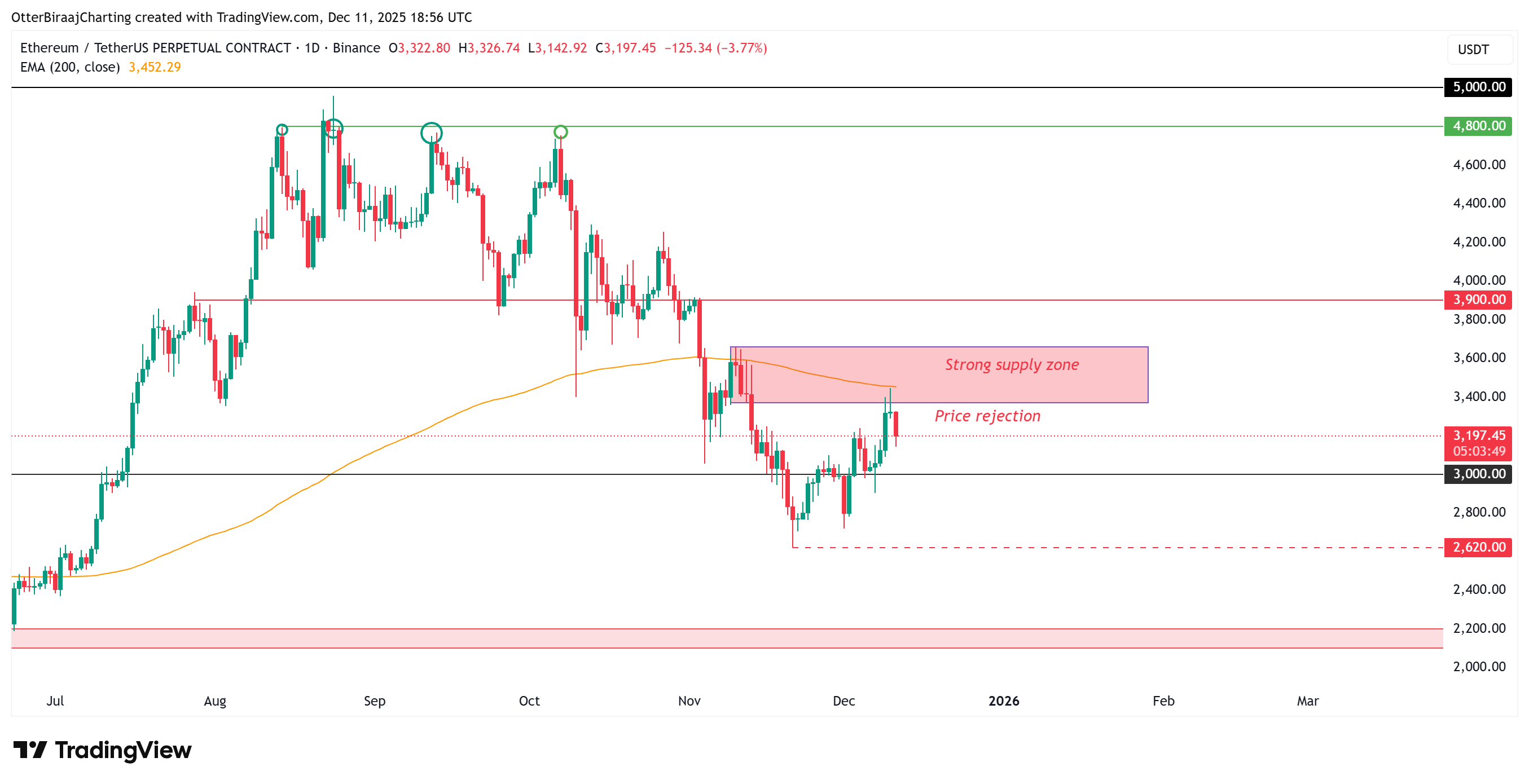
Ethereum one-day chart. Source: Cointelegraph/TradingView

ETF inflows resume, but ETH charts reflect traders’ fear

According to Glassnode, spot ETH ETFs are finally showing “the first signs of life” after several weeks of outflows. A 28% recovery since Nov. 21 in total net ETF assets hints at improving demand into year-end.

However, the rebound is still modest compared to the $32 billion peak in early October, suggesting that institutional conviction has not fully returned.
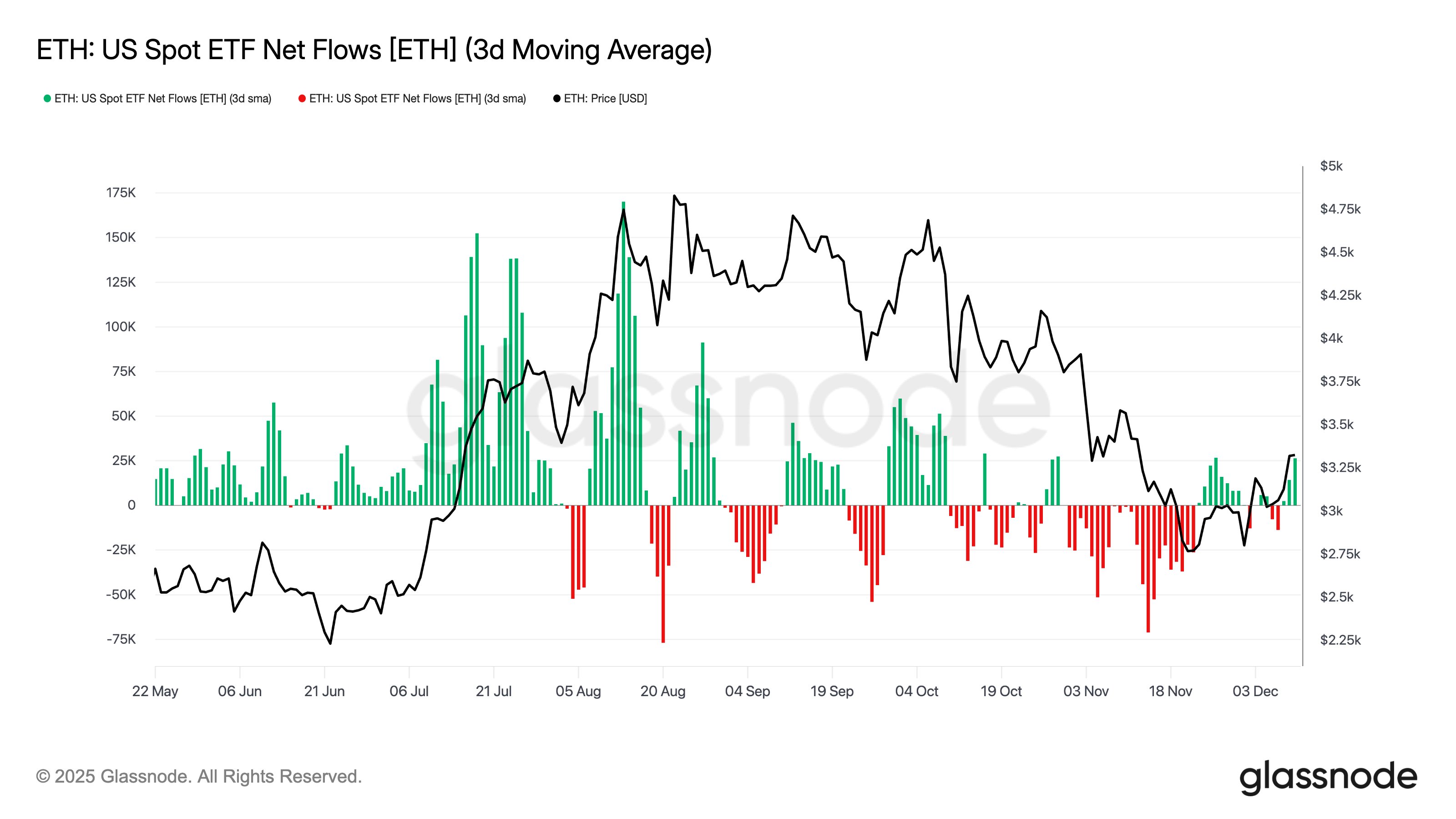
Spot ETH ETF net flows. Source: Glassnode

Data from CryptoQuant strengthened this narrative. The net taker volume remained negative at –$138 million, yet the improvement from October’s –$500 million extreme marks a structural shift. Aggressive sellers dominated the market during the September–October drawdown, but that dynamic is slowly fading.

The 30-day moving average of net taker volume also shows an ascending pattern in its lows, a structure last seen in early 2025, just before ETH launched a 3X rally and printed a new all-time high.

If the current trajectory holds, a positive flip in taker volume activity could be a high-probability trigger for another bullish breakout phase for ETH in the coming weeks.
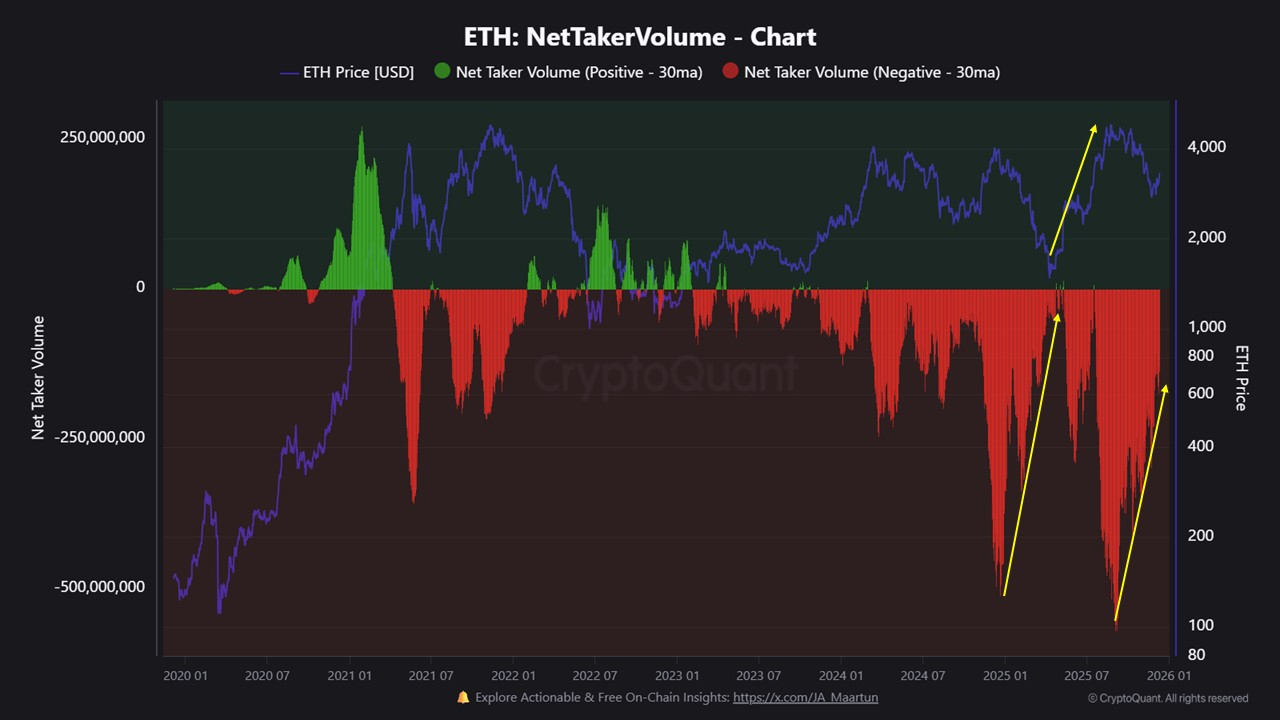
Ether Net taker volume data. Source: CryptoQuant

Related: Ether vs. Bitcoin: ETH price poised for 80% rally in 2026

ETH price compresses at support as derivatives cool off

Ether is currently testing the $3,100–$3,180 order block on the four-hour chart, a region that could serve as a demand zone. ETH price continued to respect its ascending channel, but momentum is clearly cooling. The market is now at a structural crossroads.
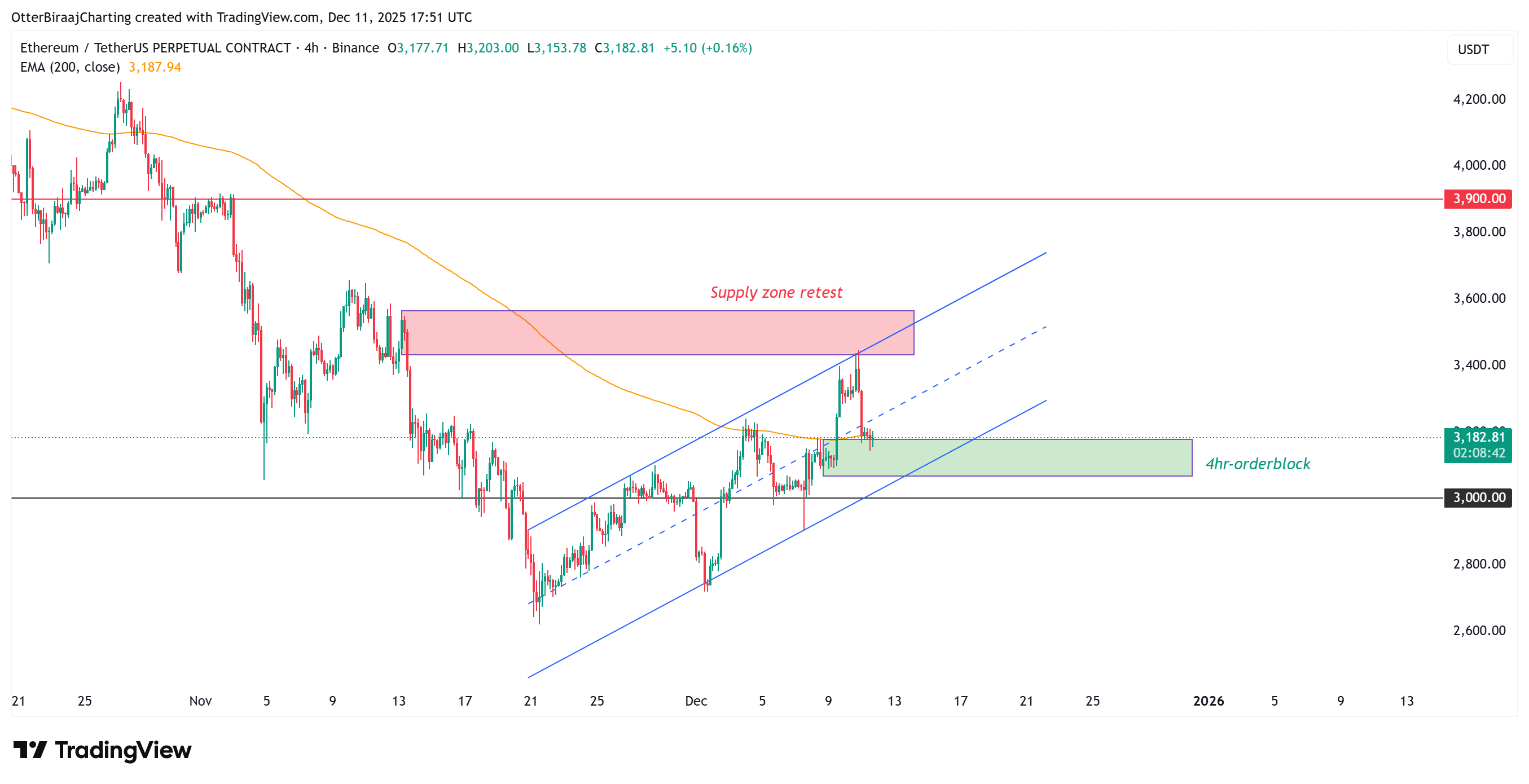
Ether four-hour chart. Source: Cointelegraph/TradingView

In a bullish scenario, holding the demand block and channel support would allow ETH to rebound toward the daily 200-EMA. A clean break above $3,450 would invalidate the rejection and reopen the path toward $3,900 resistance.

However, from a bearish standpoint, a breakdown below the ascending channel support exposes a bearish confirmation and a possible retest of $3,000, a key support level.

Data from Hyblock indicated that Ether derivatives support the neutral but fragile thesis. Aggregated open interest (OI) has unwound slightly after the rejection. The funding rate is mildly positive but not stretched, and the bid/ask ratio remains close to neutral, showing spot takers are not yet leaning aggressively bullish.
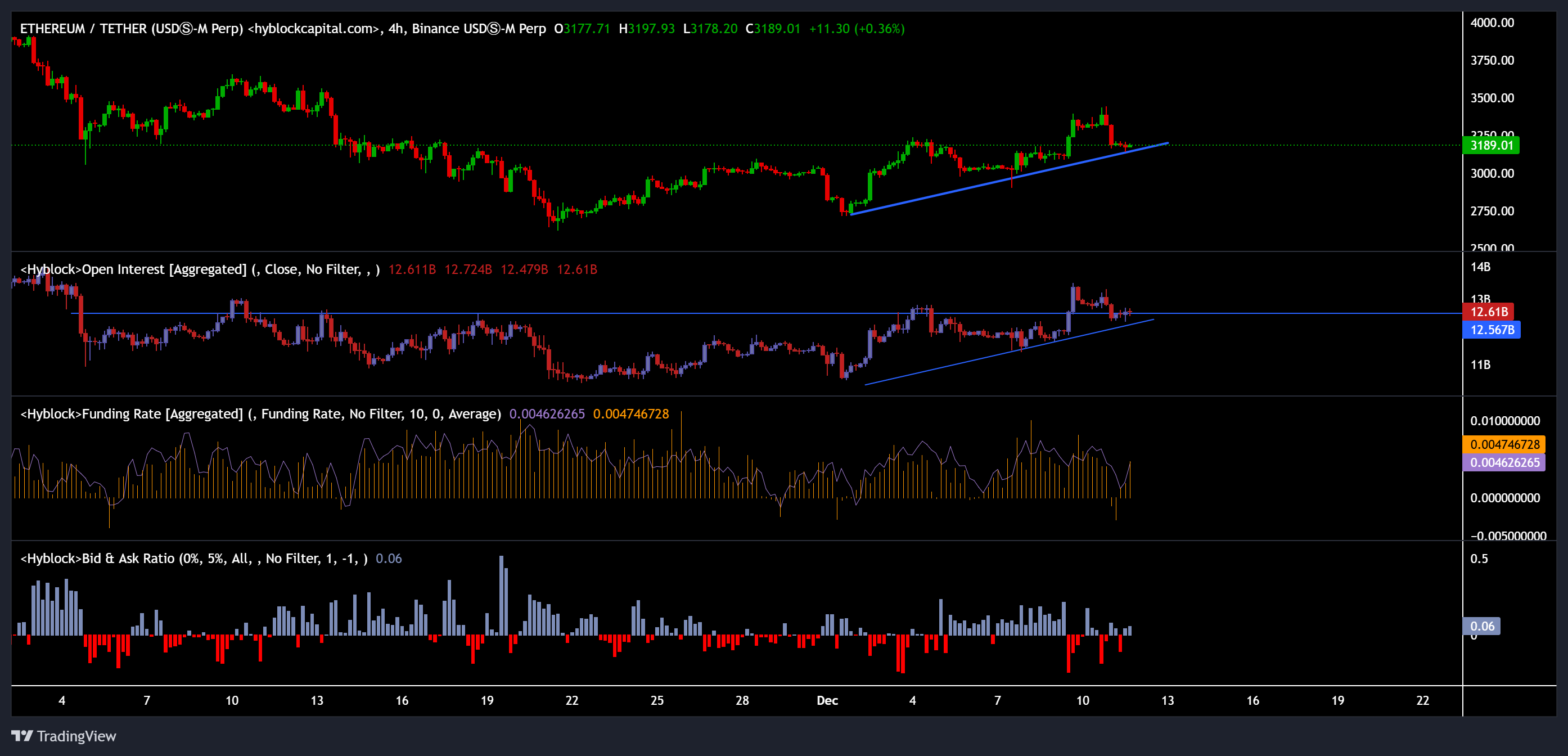
Ether futures data analysis. Source: Hyblock Capital

ETH’s next major move now depends on whether bulls can defend the demand zone long enough for improving taker flows and ETF demand to translate into sustained upside pressure.

Related: Bitcoin rallies fail at $94K despite Fed policy shift: Here’s why

This article does not contain investment advice or recommendations. Every investment and trading move involves risk, and readers should conduct their own research when making a decision. While we strive to provide accurate and timely information, Cointelegraph does not guarantee the accuracy, completeness, or reliability of any information in this article. This article may contain forward-looking statements that are subject to risks and uncertainties. Cointelegraph will not be liable for any loss or damage arising from your reliance on this information.


Related Reads

You Bet on the News, the Pros Read the Rules: The True Cognitive Gap in Losing Money on Polymarket

The article explains that the key to profiting on Polymarket, a prediction market platform, lies not just predicting real-world events correctly, but in meticulously understanding the specific rules that govern how each market will be resolved. It illustrates this with examples, such as a market on Venezuela's 2026 leader, where the official rules defining "officially holds" the office overruled the intuitive answer of who was in practical control. Other examples include debates over the definition of a "token" or what constitutes an "agreement." The core argument is that a "reality vs. rules" gap creates pricing discrepancies that savvy traders ("车头" or "whales") exploit. The platform has a formal dispute resolution process managed by UMA token holders to settle ambiguous outcomes. This process involves proposal submission, a challenge window, a discussion period, and a final vote. However, the article highlights a critical flaw in this system compared to a traditional court: the lack of separation between the arbiters (UMA voters) and the interested parties (traders with financial stakes in the outcome). This conflict of interest undermines the discussion phase, leads to herd mentality, and results in opaque final decisions without explanatory rulings. Consequently, the system lacks a body of precedent, making it difficult for users to learn from past disputes. The ultimate takeaway is that success on Polymarket requires a lawyer-like scrutiny of the rules to identify and capitalize on the cognitive gap between how events appear and how they are contractually defined for settlement.

marsbit31m ago

You Bet on the News, the Pros Read the Rules: The True Cognitive Gap in Losing Money on Polymarket

marsbit31m ago

Will the Fed Still Cut Interest Rates? Tonight's Data Is Crucial

The core debate surrounding the Federal Reserve's potential interest rate cuts is intensifying amid geopolitical conflict and rebounding inflation. The key question is whether high energy prices will cause persistent inflation or weaken consumer demand enough to force the Fed to cut rates. Citigroup presents a bullish case for cuts, arguing that oil supply disruptions from the Strait of Hormuz are temporary and will not lead to lasting inflationary pressure. They point to receding bond yields and oil prices as evidence the market is pricing in a short-lived shock. Citi's data also shows tightening financial conditions, a stabilizing labor market, and healthy tax returns, supporting their view that the path to lower rates remains open. Conversely, Deutsche Bank offers a starkly contrasting, more hawkish outlook. They argue the Fed's current policy is already neutral and expect rates to remain unchanged indefinitely. Their view is based on stalled disinflation progress and a shift toward more hawkish rhetoric from key Fed officials like Waller, who cited risks from prolonged Middle East conflict and tariffs. Other officials, including Williams and Hammack, signaled rates would likely stay on hold for a "considerable time." The market pricing has shifted dramatically, now forecasting zero cuts in 2026. The imminent release of the March retail sales "control group" data is highlighted as a critical test. This metric, which excludes gas station sales, will reveal if high gasoline prices are eroding consumer spending in other areas. A weak reading could support the case for imminent rate cuts, while a strong one would bolster the argument for the Fed to hold steady. This data is pivotal for determining the near-term policy path.

marsbit52m ago

Will the Fed Still Cut Interest Rates? Tonight's Data Is Crucial

marsbit52m ago

Trading

Spot
Futures

Hot Articles

Discussions

Welcome to the HTX Community. Here, you can stay informed about the latest platform developments and gain access to professional market insights. Users' opinions on the price of ETH (ETH) are presented below.

活动图片