ENI Officially Announces Completion of Strategic Brand Upgrade: Evolving from Underlying Protocol to Global Institutional-Grade Financial Infrastructure

marsbitPublished on 2026-04-22Last updated on 2026-04-22

Abstract

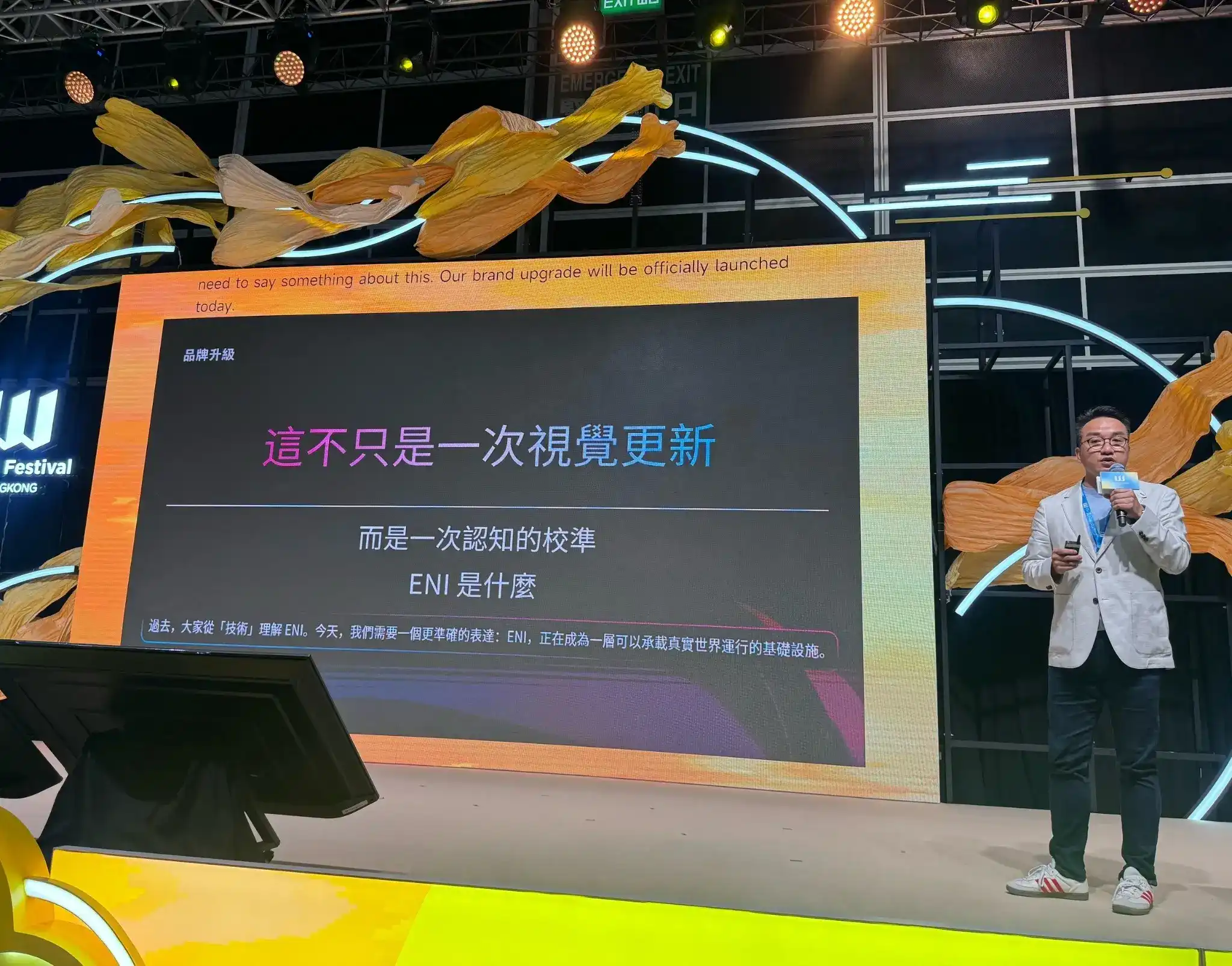
ENI Announces Strategic Brand Upgrade: Evolving from Underlying Protocol to Global Institutional-Grade Financial Infrastructure At the Hong Kong Web3 Festival on April 20, 2026, ENI founder and CEO Arion Ho announced the completion of a comprehensive brand, website, and visual system upgrade. This marks a significant shift from being an "underlying public chain" to an enterprise-grade Blockchain-as-a-Service (BaaS) platform, positioning ENI as a key infrastructure provider bridging traditional finance (TradFi) and Web3. The rebranding emphasizes precision and professionalism, reflected in a refined visual identity featuring a 25-degree tilt and a 1:4 golden ratio in its design elements. This aesthetic upgrade, led by a top-tier design team with experience from Hermès and ByteDance, underscores ENI’s commitment to institutional-grade trust and global sophistication. ENI now functions as a bridge between technological innovation and real-world business applications. It offers tailored architecture solutions for large institutions and standardized, low-friction BaaS tools for SMEs, enabling seamless integration of Web3 capabilities into existing business models. The announcement in Hong Kong, a global financial hub, signals ENI’s matured, global-ready approach to supporting the commercial adoption of Web3. By providing a stable, standardized platform, ENI aims to facilitate the secure migration of real-world assets and operations into the digital economy.

On April 20, 2026, at the Hong Kong Web3 Carnival venue, ENI founder and CEO Arion Ho delivered a keynote speech titled "Bridging Traditional Finance and Web3: Building the Infrastructure for the Real-World Financial System." During the speech, Arion officially announced that ENI has comprehensively completed the simultaneous update of its brand, official website, and visual system. This is not merely an aesthetic leap but also a milestone signaling ENI's transition from an "underlying technology public chain" to a "Blockchain-as-a-Service (BaaS) platform for enterprise onboarding." It signifies that ENI is redefining its role in the next phase of Web3 commercialization in a more mature and globalized manner.

The Beauty of Mathematics: Defining "Precision in Fine-Tuning" with a 25-Degree Obsession

In this brand upgrade, ENI exemplifies what it means to achieve "precision through fine-tuning." For infrastructure projects pursuing "institutional-grade" trust, this precision is not only a visual requirement but also the foundation of professionalism.

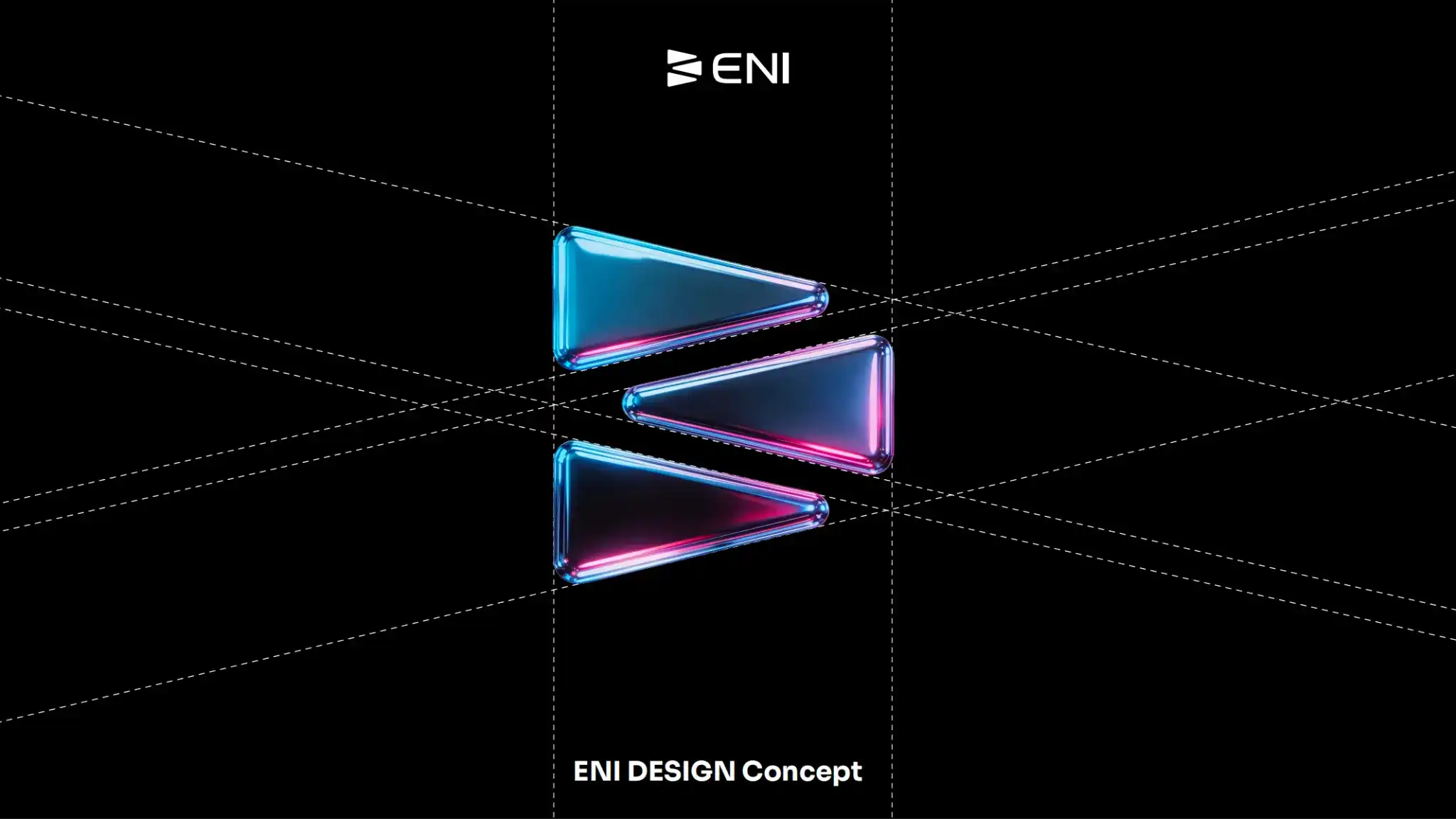
While retaining the basic triangular module, the design team created a more visually proportional symmetrical form by tilting the original straight lines by 25 degrees. The spacing and height between the main elements are strictly fixed at a golden ratio of 1:4. The numerical echo of 25% and the 25-degree angle together form a minimal modular order under advanced aesthetics. This extreme control over proportion and geometric logic is backed by a design team comprising top graduates from Harvard, the University of Pennsylvania, London College of Art, Parsons School of Design, and other prestigious institutions. These multinational talents, who have previously served international brands like Hermès and ByteDance, have infused ENI with an international and trustworthy visual foundation by merging elite global aesthetics with the logic of financial engineering.
From Public Chain to System: Building a Bridge Connecting Technology and Commercial Reality

The core of this transformation lies in ENI moving beyond the realm of a mere "underlying protocol" and evolving toward a comprehensive system standard. Arion emphasized that ENI is not just providing foundational technology but aims to become a bridge—a bridge connecting technological concepts with commercial reality, and a bridge linking traditional finance (TradFi) with Web3.

In practical implementation, ENI adopts differentiated approaches to bridge the gap in business adoption: For large institutions, ENI offers deeply customized architectural solutions, ensuring that Web3 capabilities can be precisely integrated into complex business logic and organizational processes, achieving a leap from point solutions to system-level operational structures; for small and medium-sized enterprises, standardized BaaS matrices and low-loss integration technologies enable "one-click" on-chain deployment and efficient collaboration. This model, which accurately maps to different business scales, is significantly reducing the friction for global enterprises entering Web3, allowing complex commercial realities to seamlessly migrate to efficient on-chain systems.
Global Signal: Leading Web3 Commercialization with a Mature Stance

Announcing the completion of the upgrade in Hong Kong, a financial hub connecting East and West, precisely signals ENI's entry into a globalized and institutionalized phase. As the Web3 industry shifts from technological fervor to commercial implementation, institutional users' requirements for infrastructure have evolved from "usable" to "stable and standardized."

ENI's simultaneous evolution of its brand and visual system is precisely aimed at meeting these institutional-grade standards. Through more logical design language and a comprehensive BaaS matrix, ENI is acting as the chief architect, providing reliable on-chain support for global enterprises. As Arion conveyed in his speech, ENI will serve as the standard bridge for enterprise onboarding, escorting the steady migration of real-world assets and businesses into the next-generation digital economic system.


Related Questions

QWhat major announcement did ENI's founder and CEO Arion Ho make at the Hong Kong Web3 Carnival?

AArion Ho announced that ENI has completed a comprehensive strategic brand upgrade, transitioning from an underlying protocol to a global institutional-grade financial infrastructure, including updates to its official website and visual identity system.

QHow did ENI incorporate mathematical precision into its brand redesign?

AENI's design team applied a 25-degree tilt to the original straight lines, creating a more symmetrical visual form with intervals and heights strictly fixed at a 1:4 golden ratio. The 25-degree angle and 25% numerical echo together form a minimal modular order under advanced aesthetics.

QWhat is ENI's new strategic positioning after the brand upgrade?

AENI has evolved from being an underlying public chain to an enterprise blockchain-as-a-service (BaaS) platform, aiming to serve as a bridge connecting traditional finance (TradFi) with Web3 and enabling businesses to migrate seamlessly to efficient on-chain systems.

QHow does ENI tailor its services for different types of businesses?

AFor large institutions, ENI offers deeply customized architecture solutions to embed Web3 capabilities into complex business logic. For small and medium enterprises, it provides standardized BaaS matrices and low-loss integration technologies for one-click on-chain deployment.

QWhy did ENI choose Hong Kong as the location to announce its brand upgrade?

AHong Kong is a financial hub connecting East and West, making it an ideal location to signal ENI's entry into a new phase of globalization and institutionalization, aligning with the industry's shift from technological enthusiasm to commercial adoption.

Related Reads

Bloomberg Uncovered: How Do China's Wealthy Circumvent the Annual $50,000 Limit to Transfer Assets?

**Summary: How Wealthy Chinese Circumvent $50,000 Annual Foreign Exchange Limits** Despite China's strict capital controls, including an annual $50,000 per person foreign exchange quota, an estimated $150 billion in funds still leaves the country annually via various gray and underground channels. This report outlines the evolution of China's "capital wall" and the methods used to bypass it. **The Evolving Capital Controls:** * **Foundation (1994):** The system of "current account convertibility with strict capital account controls" was established. * **Quota Set (2007):** The $50,000 individual annual forex purchase limit was formalized. * **Crackdown Begins (2015-2017):** Following market volatility, enforcement tightened. Banks were required to scrutinize transactions, and channels like using UnionPay cards for Hong Kong insurance premiums or buying overseas property were blocked. * **Digital & Legal Upgrades (2024-2026):** Enhanced algorithms now flag suspicious patterns (e.g., "smurfing"). The Common Reporting Standard (CRS) provides Chinese tax authorities with data on citizens' offshore accounts. Unlicensed cross-border brokers have been targeted. **Five Primary Methods for Moving Capital:** 1. **Underground Banking / "Hawala" (Duiqiao):** The largest-scale method. No money crosses borders. Clients pay RMB to a domestic account; an overseas associate deposits equivalent foreign currency into the client's offshore account. Risks include high fees, account freezes, and legal penalties. 2. **"Smurfing" or "Ant Moving":** Using multiple individuals' $50,000 quotas to pool funds for one offshore recipient. Increasingly detected by anti-money laundering algorithms. 3. **Trade Invoice Manipulation:** Businesses over-invoice imports or under-invoice exports via offshore shell companies, creating a pretext to transfer excess funds abroad under the guise of trade. 4. **Channel Migration:** After a crackdown on internet brokers, funds flow toward more compliant but costly channels like major banks' cross-border wealth management services or Qualified Domestic Institutional Investor (QDII) quotas. 5. **Structural Arrangements:** High-net-worth individuals use complex, high-cost legal structures involving offshore trusts, insurance, and investment migration programs to transfer asset ownership. **Regulatory Response: Focusing on People, Not Just Money** The current strategy extends oversight from enterprises to **individual residents**. Tools like CRS allow retroactive visibility into offshore assets. Cryptocurrencies, once seen as a potential loophole, are now actively monitored and prosecuted as an illegal channel. The underlying driver remains: with significant wealth concentrated among millions of affluent households seeking diversification amid domestic economic shifts, the incentive to move assets offshore persists despite regulatory barriers.

marsbit22m ago

Bloomberg Uncovered: How Do China's Wealthy Circumvent the Annual $50,000 Limit to Transfer Assets?

marsbit22m ago

Ethereum's Ballmer Moment: As Everyone Is Bearish, the Circulating Supply Is Disappearing

"Ethereum's Ballmer Moment: Circulation Shrinks Amid Bearish Sentiment" Amid widespread bearish sentiment, with prominent figures like Bankless founder David Hoffman selling ETH and young developers flocking to Solana, some argue Ethereum is entering its "Ballmer era"—akin to Microsoft's perceived stagnation under Steve Ballmer. While surface-level criticisms about slow protocol development, cautious leadership, and competitive pressure are valid, underlying fundamentals tell a different story. Approximately 30% of ETH is staked, major holders like BitMine are accumulating, and spot ETFs continue to absorb supply. Regulatory clarity, including the SEC/CFTC's March ruling on staking rewards and the potential passage of the CLARITY Act, is transforming crypto from a regulatory threat into a legitimized framework. This institutionalization, alongside a shrinking circulating supply (with net issuance around 0.23% annually), creates significant buy-side pressure independent of fee-based value capture. The broader crypto total addressable market is expanding through regulated stablecoins, tokenized assets, and institutional adoption. While public chains face competition from permissioned alternatives, the winning model appears to be permissioned assets settling on public chains like Ethereum and Solana. The author advocates a non-maximalist, barbell strategy: holding ETH for its institutional role and supply squeeze, SOL for consumer/throughput trends, BTC as a macro hedge, and a basket of next-gen L1s. Key bullish drivers for ETH include rapid circulation shrinkage, potential Q2 staked ETF approvals, regulatory tailwinds solidifying its role as a default settlement layer, and the optionality of an eventual "Satya moment" leadership shift. Despite bearish consensus, the current setup—where crypto is "not hot" and regulatory groundwork is being laid—presents a compelling investment opportunity. The crypto cycle's focus may have shifted to AI, but blockchain infrastructure is gaining a legal and institutional foothold precisely while attention is elsewhere.

marsbit22m ago

Ethereum's Ballmer Moment: As Everyone Is Bearish, the Circulating Supply Is Disappearing

marsbit22m ago

Claude Code Introduces Dynamic Workflows: Enabling AI to Form Teams and Collaborate

Claude Code introduces dynamic workflows, enabling AI to coordinate teams of specialized agents for complex tasks. This transforms Claude from a code assistant into a programmable workbench. Workflows address key limitations of single-agent systems: agentic laziness (premature task completion), self-preferential bias (favoring own outputs), and goal drift (losing sight of original objectives). The system allows Claude to dynamically create execution frameworks using JavaScript. It can split tasks, dispatch parallel agents for isolated work (e.g., in separate worktrees), implement adversarial validation, run tournaments, and synthesize results. This multi-agent approach is valuable for tasks requiring deep research, factual verification, code migration, root cause analysis, large-scale triage, and qualitative sorting. Key patterns include: classify-and-route, fan-out-and-synthesize, adversarial verification, generate-and-filter, tournaments, and loop-until-done. While token usage is higher, workflows excel where tasks resemble programming—needing problem decomposition, isolated context, hypothesis testing, and handling many details. They extend Claude Code's utility beyond technical work to areas like business plan review, resume screening, and naming brainstorm. The feature is not a universal solution but points to a future where AI tool competitiveness depends on organizing reliable, reusable, and auditable execution flows for complex goals.

marsbit1h ago

Claude Code Introduces Dynamic Workflows: Enabling AI to Form Teams and Collaborate

marsbit1h ago

Trading

Spot
Futures

Hot Articles

How to Buy AR

Welcome to HTX.com! We've made purchasing Arweave (AR) simple and convenient. Follow our step-by-step guide to embark on your crypto journey.Step 1: Create Your HTX AccountUse your email or phone number to sign up for a free account on HTX. Experience a hassle-free registration journey and unlock all features.Get My AccountStep 2: Go to Buy Crypto and Choose Your Payment MethodCredit/Debit Card: Use your Visa or Mastercard to buy Arweave (AR) instantly.Balance: Use funds from your HTX account balance to trade seamlessly.Third Parties: We've added popular payment methods such as Google Pay and Apple Pay to enhance convenience.P2P: Trade directly with other users on HTX.Over-the-Counter (OTC): We offer tailor-made services and competitive exchange rates for traders.Step 3: Store Your Arweave (AR)After purchasing your Arweave (AR), store it in your HTX account. Alternatively, you can send it elsewhere via blockchain transfer or use it to trade other cryptocurrencies.Step 4: Trade Arweave (AR)Easily trade Arweave (AR) on HTX's spot market. Simply access your account, select your trading pair, execute your trades, and monitor in real-time. We offer a user-friendly experience for both beginners and seasoned traders.

10.8k Total ViewsPublished 2024.03.29Updated 2026.06.02

How to Buy AR

Discussions

Welcome to the HTX Community. Here, you can stay informed about the latest platform developments and gain access to professional market insights. Users' opinions on the price of AR (AR) are presented below.

活动图片