Encrypted ETF Weekly Report | Last Week, US Bitcoin Spot ETF Net Outflow $9.95 Billion; US Ethereum Spot ETF Net Outflow $255 Million

链捕手Published on 2026-05-18Last updated on 2026-05-18

Abstract

Last week, U.S. Bitcoin spot ETFs saw significant net outflows totaling $995 million over three days, with a major contribution of $317 million from BlackRock's IBIT. Their total net asset value (NAV) stands at $104.2 billion. U.S. Ethereum spot ETFs also experienced net outflows of $255 million over five days, largely from BlackRock's ETHA ($186 million out), bringing their total NAV to $12.93 billion. In Hong Kong, Bitcoin spot ETFs recorded a net outflow of 24.91 BTC, reducing their NAV to $323 million. Hong Kong's Ethereum spot ETFs saw no inflows, with an NAV of $68.13 million. U.S. Bitcoin spot ETF options showed increased activity, with a total nominal trading volume of $797 million and a put/call trading ratio of 1.63, indicating a bullish market sentiment. The total open interest reached $23.08 billion. Key developments include VanEck and Grayscale simultaneously filing amended proposals for BNB ETFs, signaling potential SEC review progress. Grayscale also filed for the first U.S. privacy coin ETF (Zcash). Avenir Group remains Asia's largest institutional holder of Bitcoin ETFs. 21Shares launched an actively managed crypto ETF (TKNS), and Bitwise's Hyperliquid ETF (BHYP) is set to list on the NYSE. Institutional activity varied: JPMorgan dramatically increased its Bitcoin ETF holdings (IBIT up 174%), while Jane Street significantly reduced its exposure (IBIT down 71%). Dartmouth College disclosed holdings of $7.7M in Bitcoin ETF and $3.4M in a Solana ETF.

Compiled by: Jerry, ChainCatcher

Last Week's Performance of Cryptocurrency Spot ETFs

US Bitcoin Spot ETF Net Outflow of $9.95 Billion

Last week, US Bitcoin Spot ETFs experienced net outflows for three days, with a total net outflow of 9.95 billion dollars, and total assets under management (AUM) reached $104.29 billion.

Six ETFs were in a net outflow state last week, with the main outflow coming from BlackRock's IBIT, which saw a net outflow of $317 million.
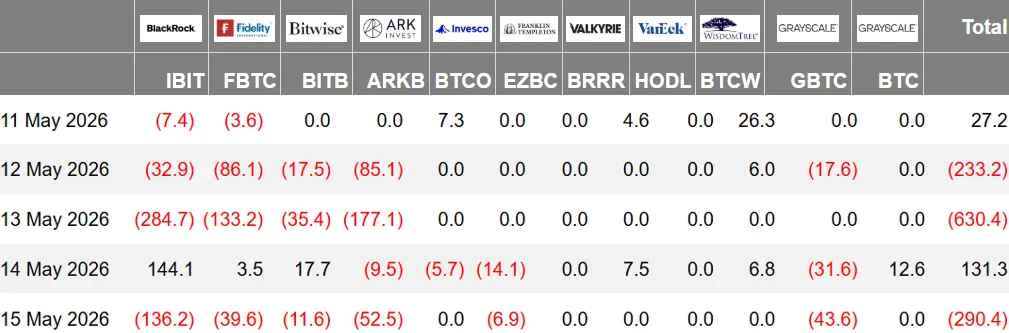
Data Source: Farside Investors

US Ethereum Spot ETF Net Outflow of $255 Million

Last week, US Ethereum Spot ETFs experienced net outflows for five days, with a total net outflow of 2.55 billion dollars, and total AUM reached $12.93 billion.

The main outflow last week came from BlackRock's ETHA, with a net outflow of $186 million. Four Ethereum spot ETFs were in a net outflow state.
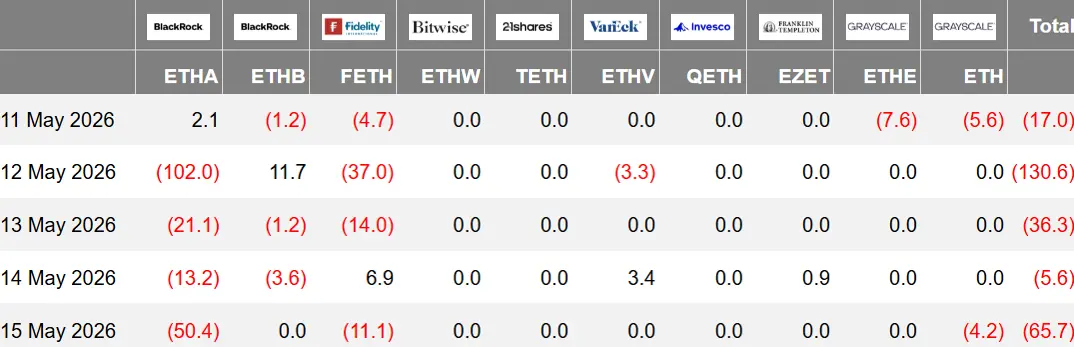
Data Source: Farside Investors

Hong Kong Bitcoin Spot ETF Net Outflow of 24.91 Bitcoins

Last week, Hong Kong Bitcoin Spot ETFs had a net outflow of 24.91 Bitcoins, with an AUM of $323 million. Among them, issuer Harvest Bitcoin's holdings dropped to 210.92 coins, and ChinaAMC's holdings dropped to 2,570 coins.

Hong Kong Ethereum Spot ETFs had no fund inflows, with an AUM of $68.13 million.
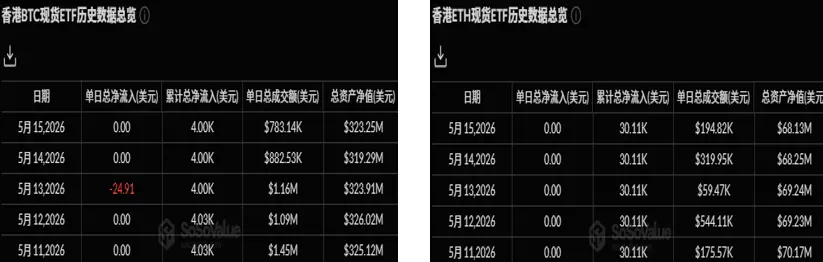
Data Source: SoSoValue

Performance of Cryptocurrency Spot ETF Options

As of May 14, the total notional trading volume for US Bitcoin Spot ETF options was $797 million, with a notional total long/short trading ratio of 1.63.

As of May 14, the total notional open interest for US Bitcoin Spot ETF options reached $23.08 billion, with a notional total long/short ratio of 1.45.

Market trading activity for Bitcoin Spot ETF options has increased in the short term, with overall sentiment leaning bullish.

Additionally, the implied volatility stands at 41.82%.

Data Source: SoSoValue

Overview of Last Week's Cryptocurrency ETF Dynamics

VanEck and Grayscale File BNB ETF Amendments on Same Day

According to The Block, VanEck submitted the fifth amendment to its BNB ETF registration statement to the US Securities and Exchange Commission on Friday (May 15), while Grayscale also submitted the second amendment to its Grayscale BNB ETF prospectus on the same day.

Bloomberg ETF analyst James Seyffart stated that the synchronized actions suggest both issuers are responding to feedback from the US SEC and may be planning a launch in the near future. James Seyffart speculates that BNB might be the next crypto asset to pass SEC scrutiny and have the potential to list in the US.

Meanwhile, Canary Capital separately filed an amendment to its proposal for a staked TRX ETF, which would bundle Tron's staking rewards into a regulated framework.

Grayscale Submits Revised BNB ETF S-1 Again, Possibly Paving Way for US Spot ETF Advancement

Bloomberg ETF analyst James Seyffart stated on platform X that Grayscale has submitted the second revised version of its S-1 filing for its BNB ETF to the US Securities and Exchange Commission (SEC).

He said this revision is likely based on adjustments in response to SEC feedback, suggesting the product may be accelerating its launch process.

Avenir Group Maintains Position as Asia's Largest Institutional Holder of Bitcoin ETF, Ranking First in Region for Eight Consecutive Quarters

The latest disclosed SEC filings show that as of March 31, 2026, Avenir Group holds 18,276,100 shares of BlackRock's iShares Bitcoin Trust (IBIT). Based on the quarter-end closing price, the position value is approximately $702 million, a slight decrease of about 0.061% compared to Q4 2025. Avenir Group has maintained its position as Asia's largest institutional holder of Bitcoin ETFs for eight consecutive quarters since Q2 2024.

Since 2026, Avenir Group has been advancing the integration of TradFi and Crypto, including strategic investments in CoinRoutes, leading a $20 million seed round for Inference Research, and signing an MOU for cooperation with Tiger Brokers, AMINA Bank, and CoinRoutes during Consensus Hong Kong 2026 to promote next-generation institutional-grade trading infrastructure development.

Data: US Dartmouth College Discloses Holding $7.7 Million in Bitcoin ETF and $3.4 Million in SOL ETF

According to MacroScope monitoring, in its submitted 13F filing, US Dartmouth College disclosed that as of March 31, it holds approximately 201,531 shares of BlackRock's Bitcoin ETF "IBIT," valued at $7.7 million, with no change in holdings from the previous quarter.

The college also reported a new position: holdings of Bitwise Solana Staking ETF valued at $3.4 million (304,803 units).

21Shares Announces Launch of Actively Managed Crypto ETF TKNS

According to an official announcement, 21Shares has announced the launch of an actively managed crypto ETF, ticker TKNS. The fund is managed by a professional team, aiming to capture market opportunities and outperform passive index funds. Portfolio managers will adjust holdings based on market conditions to balance long-term goals with short-term opportunities. The fund operates like a standard stock ETF, with simplified tax reporting, and is currently tradable on select brokerage platforms.

Bitwise Hyperliquid ETF to List on New York Stock Exchange This Friday

The Bitwise Hyperliquid ETF will begin trading on the New York Stock Exchange this Friday under the ticker BHYP. Previously, 21Shares' Hyperliquid ETF (THYP) launched this Tuesday, with a first-day trading volume of approximately $1.8 million. BHYP will be the first US fund to offer Hyperliquid staking rewards, with related staking operations to be conducted through Bitwise's subsidiary, Bitwise Onchain Solutions. 21Shares also stated it plans to stake the majority of its HYPE holdings. Hyperliquid is currently a leading on-chain perpetual contract exchange, gradually expanding into tokenized commodities and spot crypto trading. Its native token HYPE is used for platform fee payments and is consistently among the top 15 crypto assets by trading volume.

JPMorgan Chase Significantly Increased Bitcoin ETF Holdings in Q1, IBIT Position Surges 174%

According to a Cointelegraph report, 13F filings show that JPMorgan Chase significantly increased its Bitcoin ETF holdings in the first quarter. Its holdings in BlackRock iShares Bitcoin Trust (IBIT) grew from approximately 3 million shares to 8.3 million shares, an increase of 174%.

Additionally, JPMorgan Chase also significantly increased holdings of other Bitcoin spot ETFs like Fidelity's FBTC and Bitwise's BITB, and slightly increased its holdings of MicroStrategy (MSTR).

Regarding altcoin ETFs, JPMorgan Chase's actions varied: it initiated a position in Bitwise Solana Staking ETF (BSOL), increased holdings of Ethereum-related ETFs, while completely exiting its position in an XRP ETF.

Jane Street Q1 Significantly Reduced Bitcoin ETF Exposure, IBIT Holdings Down 71% QoQ

The latest 13F filing submitted by quantitative giant Jane Street to the US SEC discloses a significant reduction in its Bitcoin ETF exposure for Q1 2026. Its holdings of IBIT decreased approximately 71% quarter-over-quarter to 5,872,212 shares, valued at approximately $225.6 million. Its holdings of FBTC decreased approximately 60% to 1,954,174 shares, valued at approximately $115 million.

Additionally, its holdings of MSTR also decreased approximately 78% quarter-over-quarter to 209,833 shares, valued at approximately $26.18 million.

Grayscale Files First Privacy Coin Spot ETF Application, Multicoin Capital Discloses It Has Accumulated ZEC

Grayscale has filed an application for a Zcash spot ETF, seeking to convert its existing Zcash trust into a spot product, becoming the first privacy coin ETF seeking to list in the US. Concurrently, Multicoin Capital disclosed it has been accumulating ZEC since February, with co-founder Tushar Jain linking the investment thesis to proposed US wealth tax legislation, suggesting that government expansion of surveillance over private financial holdings will drive structural demand for assets shielded from regulatory scrutiny at a mathematical level.

However, this application also raises institutional custody challenges: approximately 30% of Zcash's supply is in shielded address pools, a historical high, but ETF custody would almost certainly need to use transparent address pools to meet audit and balance proof requirements. Previously, the SEC ended its long-term review of Zcash in January 2026 without enforcement action, significantly reducing regulatory uncertainty.


Related Questions

QWhat was the net outflow for U.S. Bitcoin spot ETFs last week, and which fund was the largest contributor?

ALast week, U.S. Bitcoin spot ETFs had a net outflow of $995 million. The primary contributor to this outflow was BlackRock's IBIT, with a net outflow of $317 million.

QHow did the U.S. Ethereum spot ETFs perform in terms of net flow last week?

AU.S. Ethereum spot ETFs experienced a net outflow of $255 million over five days last week, with the total assets under management reaching $12.93 billion.

QWhat significant ETF filing news was reported involving VanEck and Grayscale?

AVanEck and Grayscale both submitted amended filings for their respective BNB ETF proposals on the same day (May 15). Analysts believe this synchronized action indicates both issuers are responding to SEC feedback and potentially preparing for a near-term launch.

QWhich institution maintains the title of Asia's largest Bitcoin ETF institutional holder, and for how long?

AAvenir Group maintains the title of Asia's largest Bitcoin ETF institutional holder. As of March 31, 2026, it held over 18.2 million shares of BlackRock's IBIT, a position it has held for eight consecutive quarters since Q2 2024.

QWhat is the significance of the new ETF application filed by Grayscale mentioned in the article?

AGrayscale filed an application to convert its existing Zcash Trust into a spot ETF, marking the first application for a privacy-focused cryptocurrency ETF in the United States.

Related Reads

Will the Next Crypto Bull Run Start with On-Chain Trading of SpaceX?

This article presents a scenario-based forecast for the crypto industry from 2026 to 2029, arguing that the next major cycle will be driven not by technological narratives but by legal access to real-world assets. The author predicts that by mid-2026, pre-IPO perpetual contracts for top private companies like SpaceX, OpenAI, and Anthropic on platforms like Hyperliquid will become the primary gateway for accessing quality assets, as most crypto-native tokens fail to capture real value. The much-hyped AI x Crypto intersection largely fails except for prediction markets, which thrive on betting on AI model supremacy. By 2027, public blockchain foundations are forced to choose between catering to retail speculation or building compliant infrastructure for institutions, with many opting for the latter. Growth in stablecoins and tokenized private credit/equity hits a "triple ceiling" due to regulatory and political uncertainty rather than market demand. The pivotal shift is forecast for 2028. A major liquidation event in pre-IPO perpetuals exposes the structural flaw of synthetic markets lacking a real underlying asset anchor. In response, regulatory changes finally allow the public solicitation of private securities resales to verified accredited investors. This creates a legitimate secondary market for real company equity, which then becomes the core asset class of the new bull market, relegating synthetic perps to a niche role. By 2029, the industry becomes "boring" but foundational. Tokens without claims on real cash flows or assets cease trading. Stablecoin growth is steady but politically capped. Crypto infrastructure fades from view as it gets absorbed into traditional finance backends. The article's central thesis is that the key bottleneck for crypto's next phase is legal and regulatory channels for real asset ownership, not technology.

marsbit8m ago

Will the Next Crypto Bull Run Start with On-Chain Trading of SpaceX?

marsbit8m ago

The Value Distribution of Stablecoins

**Summary: The Value Distribution of Stablecoins** The article argues that stablecoins are evolving from mere trading tools into broader channels for dollar access. It divides the stablecoin ecosystem into four layers to analyze how value is distributed: 1. **Issuance Layer:** Mints stablecoins, holds reserve assets, and captures the spread between reserve yield and user costs (e.g., Tether, Circle). This layer currently earns the largest profit margin. 2. **Infrastructure Layer:** Connects stablecoins to the traditional financial system, handling fiat on/off-ramps, banking integration, compliance (KYC/AML), and asset management (e.g., Bridge, BVNK). This is the "unglamorous" but critical work, building the essential bridges between crypto and real-world finance. 3. **Acquiring/Distribution Layer:** Integrates stablecoins into merchant systems, manages payment flows, and provides enterprise financial software (e.g., Stripe, Coinbase). They act as the access point for businesses. 4. **Application Layer:** The end-users and businesses that ultimately use stablecoins for payments, settlements, or as a store of value. They benefit from convenience but have little pricing power. The core thesis is that while the issuance layer currently dominates profits, the often-overlooked **infrastructure layer holds significant long-term potential**. The real challenge and barrier to mass adoption is not the on-chain transfer of stablecoins (which is simple), but the complex "last mile" integration into existing business workflows, banking systems, and regulatory frameworks across different countries. Companies in this layer are currently in a "land grab" phase, investing heavily to build networks, secure bank partnerships, and establish compliance pathways. While their position is currently pressured by the profitable issuers above and distribution platforms below, the article suggests that if stablecoins become a default financial rail for businesses, the infrastructure providers who have done the hard work of integration will ultimately gain strong pricing power and become entrenched, essential players.

marsbit6h ago

The Value Distribution of Stablecoins

marsbit6h ago

The Value Distribution of Stablecoins

The Value Distribution of Stablecoins The article argues that stablecoins are evolving from a mere trading tool into a broad "dollar channel." It analyzes the industry's value chain through four layers: 1. **Issuance Layer (e.g., Tether, Circle):** The top layer that mints stablecoins, holds reserve assets, and captures the thickest interest rate spread. 2. **Infrastructure Layer (e.g., Bridge, BVNK):** Connects stablecoins to the traditional financial system, handling critical but complex "dirty work" like fiat on/off-ramps, banking integration, compliance (KYC/AML), and cross-border settlement. 3. **Acquiring/Distribution Layer (e.g., Stripe, Coinbase):** Embeds stablecoins into merchant systems, manages payment flows, and integrates with enterprise software. 4. **Application Layer:** End-users and businesses that ultimately use stablecoins for payments, settlement, or storing value. The author posits that while the issuance layer currently captures the most profit, the most overlooked and potentially critical layer is infrastructure. The core challenge for stablecoin adoption isn't the on-chain transfer (which is simple), but bridging the gap between blockchain and the real-world financial system. This involves solving practical problems for businesses: fiat conversion, reconciliation, tax handling, and user onboarding. Infrastructure companies are currently in a difficult "land-grab" phase—building networks, securing banking relationships, and achieving compliance country-by-country. They face pressure from both the profitable issuance layer above and distribution platforms below. However, the author suggests this layer is building a crucial moat. Once stablecoins become a default business rail, the infrastructure players who have done the hard work of integration may gain significant, durable value and pricing power.

链捕手6h ago

The Value Distribution of Stablecoins

链捕手6h ago

Trading

Spot
Futures
活动图片