Earning Bounty with a Forehead Tattoo? pump.fun Keeps Memes Alive Through 'Bounties'

Foresight NewsPublished on 2026-06-08Last updated on 2026-06-08

Abstract

The article discusses the launch of pump.fun's new bounty platform "Pump.fun GO," which allows meme coin holders to lock funds as rewards for completing specific, often outrageous, marketing tasks to promote their tokens. Examples include a $50,000 bounty to skydive into a World Cup match in a mascot costume and a bounty for getting a forehead tattoo (with a typo) of a token name. The platform has sparked controversy for its perceived copycat nature compared to existing Web3 bounty platforms and its "crazy" tasks, while also granting pump.fun unilateral authority to approve or reject submissions. The move is analyzed as a strategic effort by pump.fun to revive declining platform revenue and meme coin engagement, following a pattern from its earlier, chaotic live-streaming feature. The core logic is that meme coins, lacking fundamentals, rely on manufactured attention and events, with GO formalizing this by outsourcing promotional stunts to bounty hunters, all aimed at boosting token visibility and price.


Written by: angelilu, Foresight News


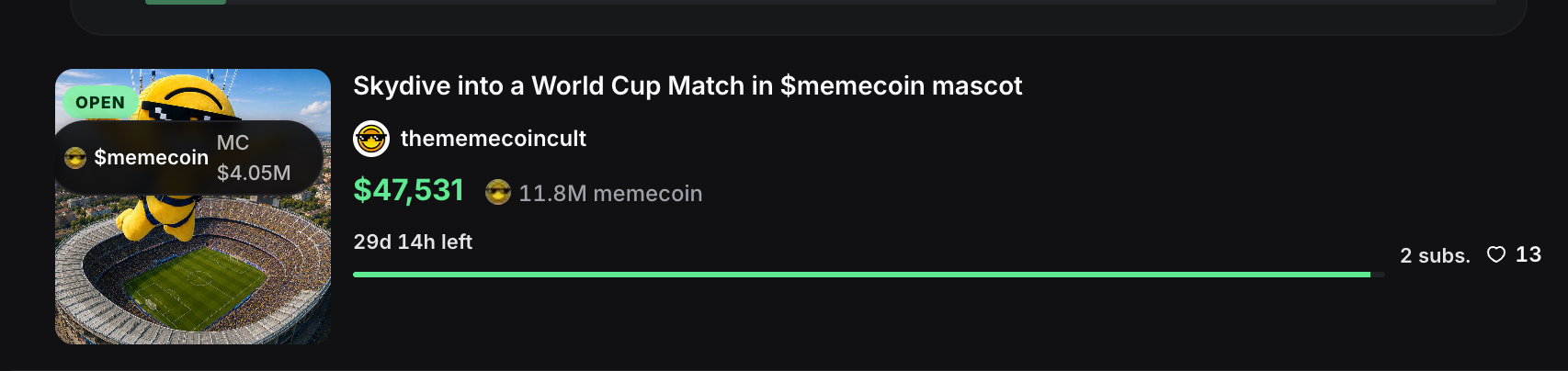
If someone offered you $50,000 to skydive into a World Cup stadium while wearing bizarre costumes to attract the attention of the entire crowd, would you do it?


Most people wouldn't, because in most countries, unauthorized entry into an ongoing sports event constitutes trespassing and can lead to imprisonment. The request is as absurd as a joke, or at least a marketing stunt. But this was precisely the highest-bounty task on the first day of pump.fun's newly launched bounty platform, "Pump.fun GO."


Mechanism of Pump.fun GO


Pump.fun GO attempts to shift the competition for attention around Meme assets from passive dissemination to active output via a task economy. The mechanism of GO isn't complex: an issuer (often a holder of a particular Meme coin) connects a wallet, locks the bounty into an escrow smart contract, and posts a bounty for completing a specific task; a task-taker completes the task, submits proof, and receives the payment after pump.fun's approval. The minimum bounty is $5, with no upper limit. The official launch copy grandly states: "Pay anyone to do anything."


Each task issuer holds a certain Meme coin—the task is a customized marketing campaign for their coin, and the bounty is the promotion fee drawn from their holdings. The coin comes first, the task follows; GO is not a "simple" task platform but an outsourced tool for marketing existing Meme coins.


However, the community's response to this new product is also highly contentious. Firstly, the Web3 bounty platform space already has established professional players like Dework, Gitcoin, and Layer3, leading to accusations that pump.fun is yet another clumsy "copycat." Secondly, the tasks currently listed on the platform often have a "touch of madness," and event adjudication is entirely at the platform's discretion—the terms state: the platform reserves the right to approve, reject, modify, or cancel any task and any submission, with decisions being final and non-appealable.


Why Launch GO Now


But to understand why pump.fun is launching GO now, we must first look at some numbers.


In January 2025, the platform's daily revenue peak exceeded $15 million, with annual cumulative revenue nearing $1 billion. However, by August 2025, daily revenue once fell below $300,000 and has recently hovered around $1 million.


The PUMP token has fallen from its issuance high of $0.006 to today's $0.0016, and SOL has also declined over 55% from its $150 high this year.
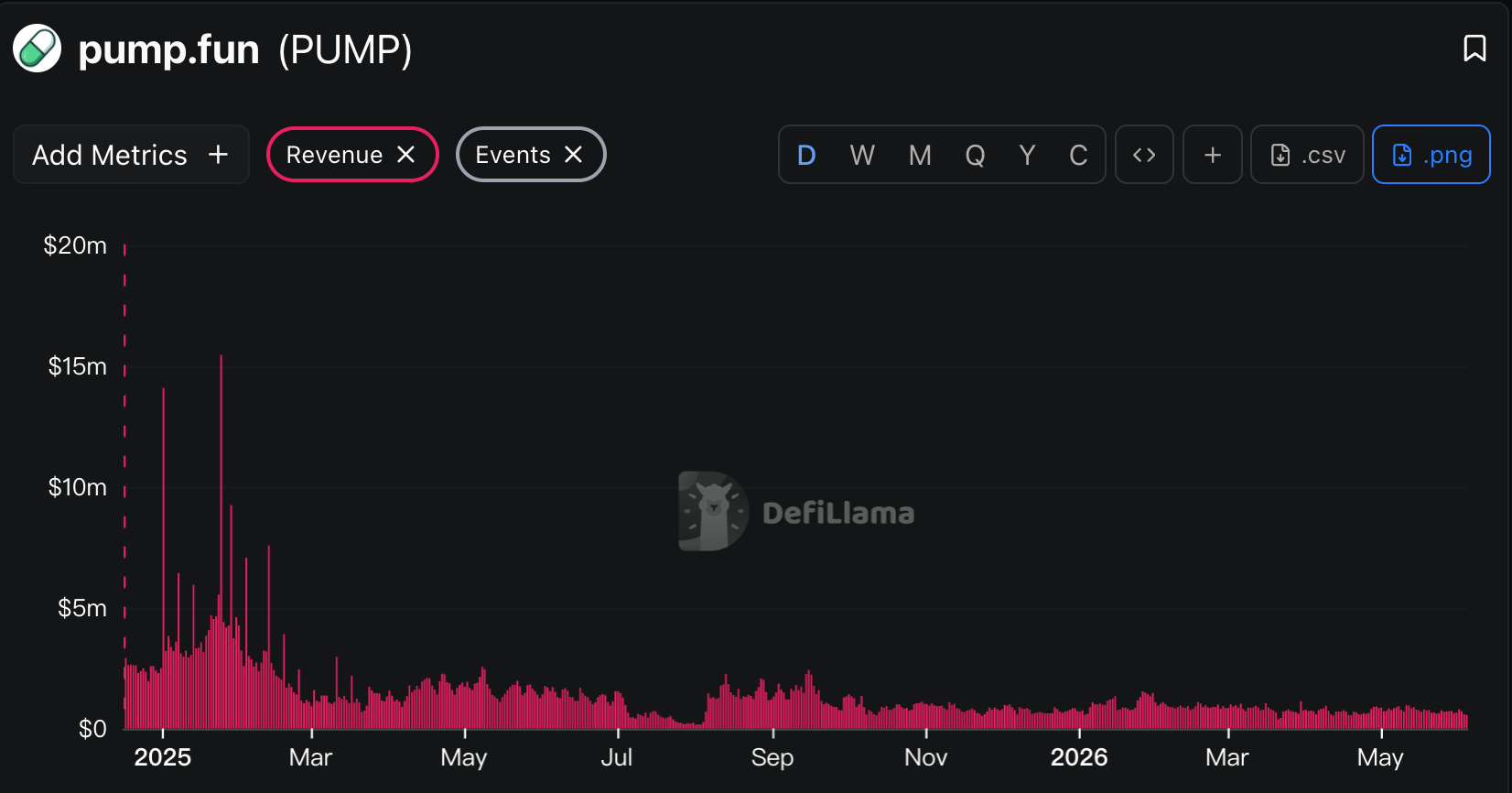


Meanwhile, in April of this year, pump.fun changed its "all revenue used for PUMP buyback and burn" policy to a 50/50 split—half continues for buybacks, and the other half is reserved for product development, hiring, and marketing. GO is the first project funded by this budget allocation.


Hot Content on GO


A closer look at the GO task list reveals that most content is "quite entertaining."


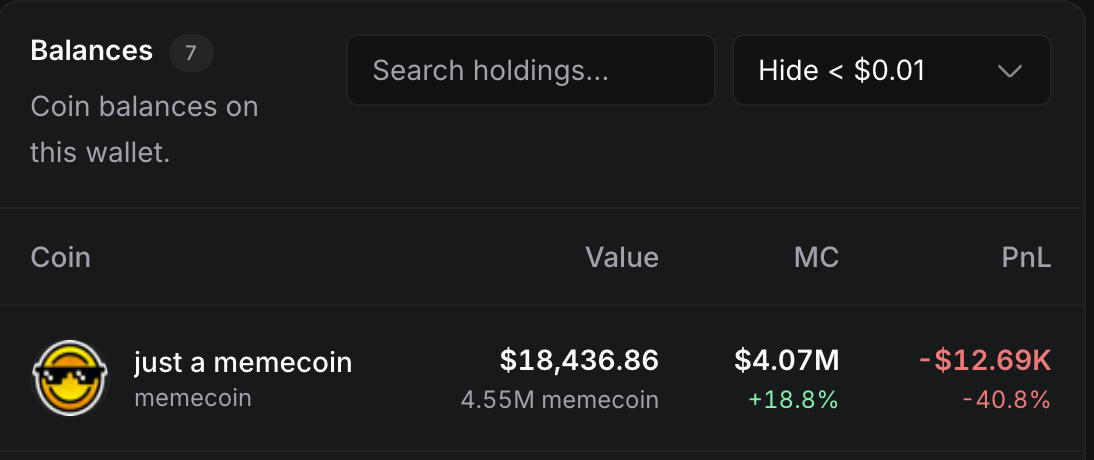
As of writing, the task "requiring the taker to skydive into the World Cup match venue while wearing the memecoin mascot costume throughout" might be "too sensitive" and is no longer displayed on the page. Perhaps related to topping the GO task list that day, the price of the related memecoin rose 18.8% on the day the task was posted, with its market cap exceeding $4 million; its current market cap is $3.73 million.


The bounty issuer "thememecoincult" also posted two other "sensational" tasks: wearing the same mascot costume to break the world record in long-distance running; and spraying the token code and logo on a car while wearing their mascot costume.


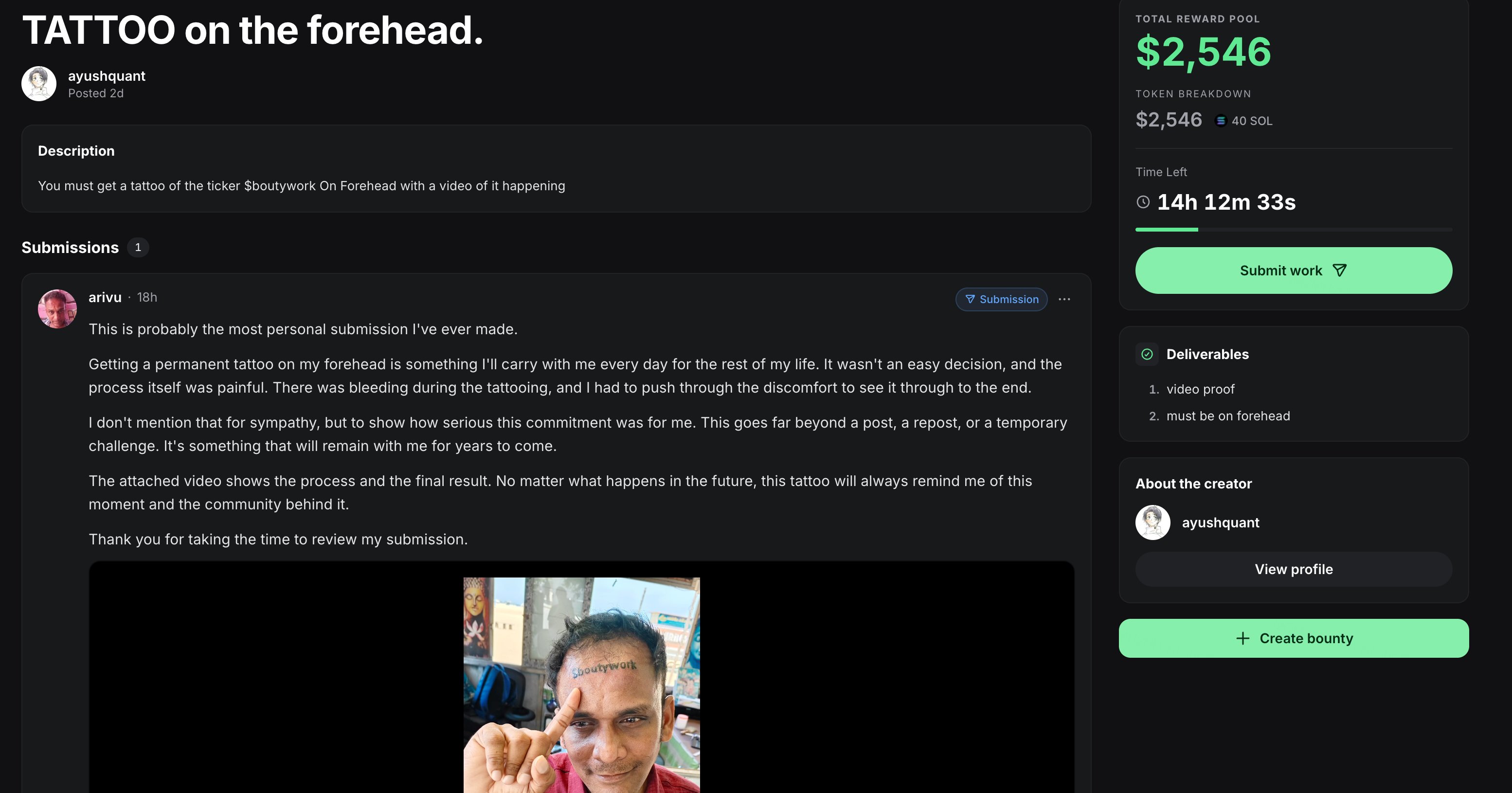
But some are indeed willing to do "crazy" things for the bounty. An Indian man named arivu accepted a bounty task worth 40 SOL (approximately $2,640) to get "$boutywork" tattooed on his forehead as required by the issuer, documenting the entire process in a video. However, there is a missing 'n' compared to the correct spelling "$bountywork." This typo sparked debate over the validity of the reward. Some claimed he wouldn't get a penny, while the issuer side opened a new bounty task for him to correct the tattoo. Ultimately, it's up to the platform to decide whether he receives the bounty after the task concludes.


The story doesn't end there. After the photos and video circulated, the community spontaneously launched a Meme coin featuring the man's photo as its logo. Its current market cap is $220,000, and he reportedly earned $15,000 from transaction fees.


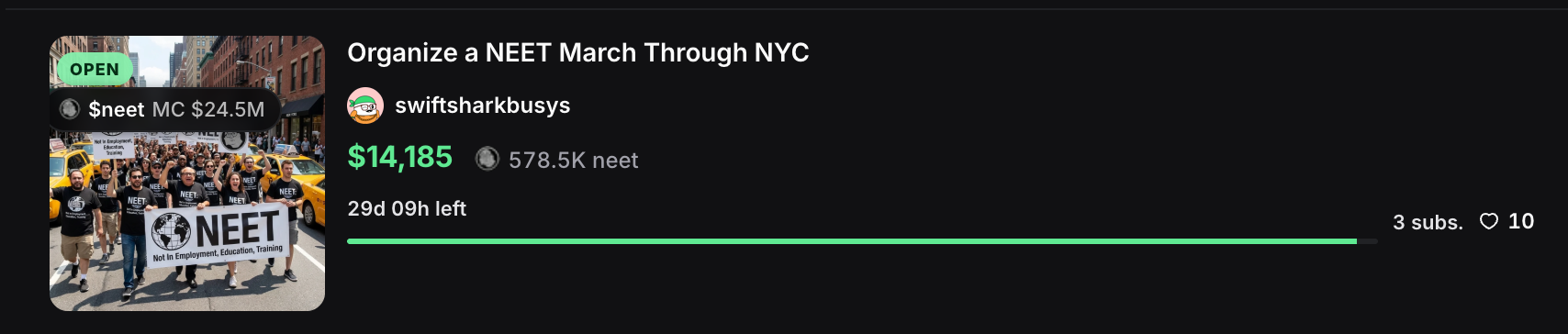
Other popular tasks include: someone offering a $13,728 bounty to "organize a NEET parade through New York City." The logic is to convert on-chain money into offline crowds and signs, film it into a video, bring it back on-chain, and boost the NEET coin price, completing the loop. The related token NEET currently has a market cap of $25.4 million, with 7 submissions.


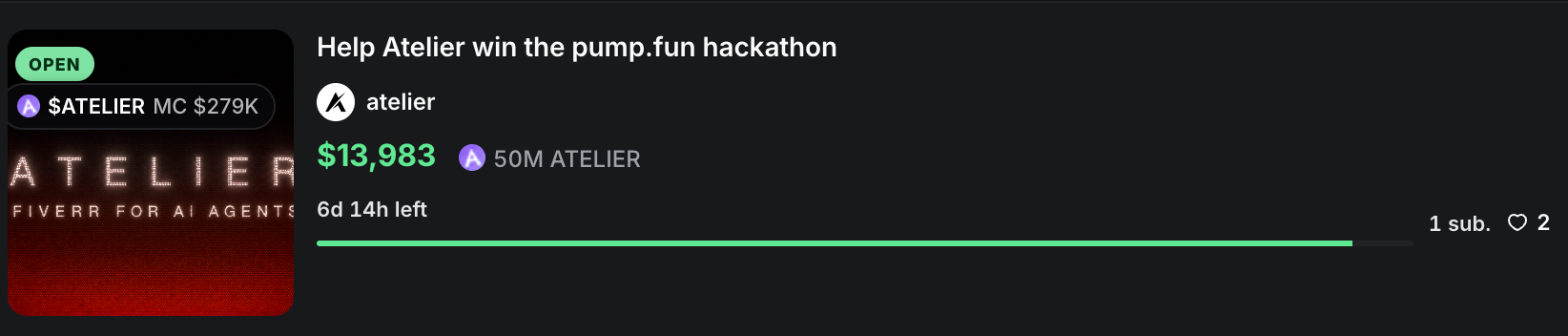
There's also the Atelier project winning pump.fun's hackathon—meaning using pump.fun's own product on its own platform to hire people to win a competition hosted by pump.fun itself.


These tasks lay bare the survival logic of Meme coins. These assets have no fundamentals; their survival depends on sustained attention. Attention comes from events, events need to be created by people, but project teams either can't or dare not do it themselves. GO formalizes this long-implicit chain: lock money into a contract, post a bounty, and wait for someone in the world to claim it.


Here, the employers are a group of token holders, and the takers complete tasks with the goal of making the token more widely known. Ultimately, all proceeds point to the same thing: stop this thing from falling further.


From Livestreams to Bounties


This logic is something pump.fun has already run through once. In 2024, the platform launched a livestreaming feature, which quickly turned into an uncontrolled content experiment: people livestreamed drug use, threatened self-harm, claimed to broadcast from prison, and used Russian roulette to pump prices. The sole purpose was to make the Meme coin rise. In November 2024, livestreaming was urgently taken offline; five months later, it quietly returned with new content moderation policies.


Livestreaming was about getting users to perform voluntarily on stage; GO is about paying people to perform. The underlying logic is exactly the same.


And this time, pump.fun cannot use "too much content to review" as an excuse. Every GO task requires manual platform approval to go live, and every bounty payout requires the platform's nod. What pump.fun learned from "the livestream shutdown" was clearly not "don't do this kind of thing," but rather "continue doing it with a different structure."


Related Questions

QWhat is the core function of the new 'Pump.fun GO' platform, and how is it different from a general task bounty system?

AThe core function of 'Pump.fun GO' is to serve as a marketing outsourcing tool for existing memecoins. It's not a general task platform. Project holders lock a bounty in a smart contract to create tasks that promote their specific memecoin. The goal is to generate attention and events to sustain or increase the coin's value, differing from platforms that fund general projects or development work.

QAccording to the article, what are two main reasons for the community's controversy surrounding 'Pump.fun GO'?

AFirst, it is seen as a copy of established Web3 bounty platforms like Dework, Gitcoin, and Layer3. Second, the tasks often have a 'senseless' or extreme nature (e.g., illegal trespassing), and the platform has unilateral, non-appealable authority to approve, reject, or modify any task and its submissions.

QWhat significant change did pump.fun make to its revenue distribution policy in April, and how is 'GO' related to this change?

AIn April, pump.fun changed its policy from using 100% of revenue to buy back and burn the PUMP token to a 50/50 split. Half continues for buybacks, and the other half is allocated for product development, hiring, and marketing. 'Pump.fun GO' is the first major initiative funded from this new marketing and development budget.

QDescribe the example of the Indian man 'arivu' and the bounty task. What unexpected outcome did his action lead to?

AA man named arivu from India accepted a 40 SOL (~$2,640) bounty to tattoo '$boutywork' (missing an 'n') on his forehead to promote a memecoin. The spelling error sparked debate about the reward's validity. Subsequently, the community autonomously created a new memecoin using his photo as the logo, which reached a $220,000 market cap, earning him $15,000 in fees from that new coin.

QHow does the article connect the logic behind 'Pump.fun GO' to pump.fun's previous 'live streaming' feature, and what key lesson did the platform learn from the streaming experience?

ABoth features share the same underlying logic: generating attention/events to pump memecoin prices. Live streaming relied on users voluntarily performing extreme acts. GO formalizes this by paying people to perform marketing tasks. The lesson learned from the streaming shutdown wasn't to stop such activities, but to 'change the structure and continue.' GO introduces platform pre-approval for tasks and payouts to maintain more control.

Related Reads

Different Choices After the Plunge: Institutions Buy the Dip, Traders Shift to US Stocks

Title: Diverging Strategies After the Crash: Institutions Buying the Dip, Traders Shifting to US Stocks Following a sharp decline where Bitcoin briefly fell below $60,000 on June 6th, market sentiment remains "extreme fear" despite a partial recovery. This has led to varied responses from major market participants. Several institutional figures and analysts present a cautiously optimistic long-term view for Bitcoin. Glassnode's co-founder identifies $46k-$54k as a probable key bottom range based on historical on-chain models, while a Standard Chartered executive suggests the bottom is nearly formed. Strive's CEO points to Bitcoin touching its 200-week moving average as a historically reliable buy signal. Analysts highlight metrics like MVRV ratio and the "Power Law" model indicating Bitcoin is in an extremely undervalued zone. Conversely, some traders are exiting the crypto space. One trader cited a more attractive risk/reward profile and deeper research opportunities in US stocks, particularly with AI-related equities outperforming and capital rotating away from crypto. This shift is partly attributed to perceived ongoing risks, including those related to Strategy's Bitcoin sales. Market prediction data suggests a high probability (72%) of Bitcoin falling below $55,000, but lower odds for a deeper crash below $35k-$40k. The overall picture is one of division: institutions and long-term analysts see a accumulating opportunity, while some active traders are seeking alpha elsewhere amidst the volatility and shifting capital flows.

marsbit2m ago

Different Choices After the Plunge: Institutions Buy the Dip, Traders Shift to US Stocks

marsbit2m ago

Tech Stocks in the Midst of Deleveraging: Rather Than Rushing to Buy the Dip, Wait for the Macro Environment to Stabilize First

"Technology Stocks in Deleveraging Phase: Wait for Macro Stability Before Buying the Dip" The current sell-off in tech/AI stocks is primarily driven by macro headwinds, not a breakdown in AI fundamentals. After a parabolic rise, the market faced a perfect storm: an overcrowded trade, a massive SpaceX IPO draining liquidity, pre-CPI/PPI/FOMC hedging, and strong jobs data renewing "higher-for-longer" rate fears. This triggered a concentrated deleveraging in hot tech names. Key historical context: Unlike the December 2023 sell-off focused on AI capex returns, the current correction centers on the "denominator" – rising concerns over rates, inflation, the Fed, geopolitics, and liquidity. Leading memory stocks like Micron have seen ~20% pullbacks, significant but not yet at panic levels seen in March. The intense selling wave may be largely over, but a quick V-shaped recovery is unlikely. The market will likely churn in high volatility, awaiting clarity. The immediate catalyst needed for a sustainable reversal is a "stop-bleeding" signal from macro conditions. This doesn't require a major positive shock (like the April Iran ceasefire), but simply a halt to further deterioration: CPI not surprising hotter, Treasury yields stabilizing, the Fed not turning more hawkish, and post-SpaceX IPO liquidity easing. Once macro pressure plateaus, the intact AI investment thesis – centered on persistent compute/memory shortages and accelerating commercialization – can quickly regain market focus. The strategy is clear: prioritize monitoring macro stabilization over rushing to bottom-fish individual AI stories. Patience is key.

marsbit9m ago

Tech Stocks in the Midst of Deleveraging: Rather Than Rushing to Buy the Dip, Wait for the Macro Environment to Stabilize First

marsbit9m ago

South Korean Stocks Plunge, Global Funds Liquidate: Has the Semiconductor Fundamentals Really Changed?

South Korean stocks experienced their sharpest decline of the year, with the KOSPI index plunging nearly 9% on Monday, triggering a market circuit breaker. Leading semiconductor firms Samsung Electronics and SK Hynix were heavily sold off, raising questions about whether the AI-driven bull market has reached an inflection point. This sell-off was largely triggered by a significant drop in the U.S. semiconductor sector late last week. Concurrently, NVIDIA CEO Jensen Huang visited Seoul over the weekend, meeting with top executives from SK Group, Samsung, LG, and NAVER. He announced a new multi-year partnership with SK Hynix to co-develop next-generation memory products for AI data centers. Huang emphasized that AI infrastructure build-out remains in its early stages, creating a stark contrast between market panic and ongoing, strengthened industry collaboration. The article argues that South Korea has become one of the most sensitive markets for global AI-related capital flows, functioning like a large AI memory ETF due to the heavy weighting of its chipmakers. The current market turmoil reflects a shift in investor focus: from simply betting on overall AI growth to scrutinizing which companies will actually capture the profits from that growth. This "profit pool reassessment" phase is causing high volatility based on supply chain news and earnings guidance. Ultimately, the direction of the Korean market will be determined by external factors—NVIDIA's orders, HBM supply-demand dynamics, and capital expenditures from cloud service providers—rather than domestic conditions. The disconnect between sharp price corrections and continued strong signals from the industry core leaves the market at a crossroads, awaiting clearer data on the durability of AI infrastructure demand.

marsbit47m ago

South Korean Stocks Plunge, Global Funds Liquidate: Has the Semiconductor Fundamentals Really Changed?

marsbit47m ago

Trump in Talks with AI Companies Over Profit Sharing, A Narrative Pressure of Industrial Revolution Scale Begins

In recent AI market discussions, a new dimension beyond growth and profits has emerged: the question of how the immense wealth potentially generated by AI should be shared with the wider public. Triggered by reports of White House officials discussing "voluntary equity transfers" with top AI firms, similar to models like Alaska's Permanent Fund, the conversation focuses on public wealth funds. OpenAI's own whitepaper proposes such funds, allowing households without direct tech stock ownership to benefit from AI gains. More radical proposals, like Bernie Sanders' call for high public equity stakes and board seats, represent an extreme end of the spectrum. Currently, these are early-stage policy probes, not enacted laws. OpenAI's initiative is seen as an attempt to secure "social license" for its future expansion, mitigating risks of public backlash, stricter regulation, or anti-trust actions as AI's economic impact grows. The core market implication is the introduction of a "policy discount" to AI valuations, particularly for private model companies like OpenAI, Anthropic, and xAI. Investors must now consider not just future earnings but also what portion might be allocated to public mechanisms. The impact varies greatly based on the mechanism. A small, voluntary transfer of non-voting economic rights (e.g., 5%) acts as a quantifiable long-term cost. Government acquisition of economic rights via warrants tied to support differs from direct equity with governance power. The most disruptive scenario would be forced high-percentage public ownership affecting control and innovation incentives. Key signals to watch include whether other AI companies follow suit, if the White House formalizes proposals, related disclosures in future IPO documents, and any market price reactions. For now, this represents a shift from pricing pure AI growth to pricing its potential distribution. A manageable, voluntary economic share is akin to an insurance cost for societal acceptance, while a forced shift toward control and governance would fundamentally alter valuation logic.

marsbit51m ago

Trump in Talks with AI Companies Over Profit Sharing, A Narrative Pressure of Industrial Revolution Scale Begins

marsbit51m ago

From Record Highs to a Two-Week Low: Why Did AI Concept Stocks Suddenly Pull Back?

From Record Highs to Two-Week Lows: Why Did AI Stocks Suddenly Pull Back? U.S. stock indices, led by the tech-heavy Nasdaq 100, fell sharply to two-week lows. This marked a reversal from earlier in the week when AI infrastructure and semiconductor stocks had propelled major indices to record highs. Investors are rotating out of these previously high-flying tech sectors into other areas. The sell-off was driven by profit-taking and concerns that the AI rally had become overextended, exacerbated by chipmaker Broadcom's sales outlook falling short of lofty market expectations. The decline accelerated following a stronger-than-expected U.S. May nonfarm payrolls report, which showed 172,000 jobs added versus an estimated 88,000. This data sparked a jump in bond yields, with the 10-year Treasury yield rising to 4.553%, as it reinforced market speculation that the Federal Reserve's next move could be a rate hike rather than a cut. Globally, equities also declined, with European and Asian markets falling. Within the U.S. market, chip and AI-related stocks like Super Micro Computer and Arm Holdings led the losses, dropping over 7%. Cryptocurrency-linked stocks and mining shares also fell sharply amid drops in Bitcoin and commodity prices. While the overall Q1 earnings season remained solid, with 83% of S&P 500 companies beating estimates, the weakness was concentrated in tech. Excluding the tech sector, Q1 earnings growth was around 3%, the weakest in two years.

marsbit51m ago

From Record Highs to a Two-Week Low: Why Did AI Concept Stocks Suddenly Pull Back?

marsbit51m ago

Trading

Spot
Futures
活动图片




