Earning $100,000 in 10 Days: An Interview with OpenClaw's Practical Experience in Prediction Markets

Odaily星球日报Published on 2026-03-16Last updated on 2026-03-16

Abstract

In an interview with Odaily Planet Daily, Kevin, a former ERP architect and Web3 investor, shares how he used OpenClaw to generate a profit of approximately $100,000 in just 10 days, turning a $30,000 investment into over $130,000 at its peak (currently around $112,000). Kevin began his crypto journey during the "inscription summer" of 2023, earning his first significant returns from ORDI. He later transitioned to prediction markets, specifically Polymarket, in mid-2025, attracted by its improved liquidity and user experience. Initially, he used self-developed algorithmic strategies for arbitrage, primarily in sports betting markets, doubling a $100,000 investment over several months. Since integrating OpenClaw in late February, Kevin adopted a hybrid approach: 60% of his strategy remains automated arbitrage, while 40% uses OpenClaw for predictive betting. OpenClaw helps gather and analyze factors like smart money movements, public sentiment, team lineups, and player conditions—even identifying new influencing variables. It also automates backtesting, strategy discovery, and execution, making it effective in Polymarket due to its AI-friendly API. While currently focused on sports markets with limited automated capital ($1,000 per test account), Kevin plans to expand into other domains and may later offer paid OpenClaw "Skills" based on his methodology.

Original | Odaily Planet Daily (@OdailyChina)

Author | Golem (@web 3_golem)

Currently, "raising lobsters" is no longer difficult, but how to master OpenClaw and actually use it to make money still puzzles many lobster farmers.

Last week, I spoke with some deep users of OpenClaw in the crypto space. Some mentioned that OpenClaw's heartbeat mechanism and scheduled tasks can improve the efficiency of news trading, but more interviewees believed that using OpenClaw to trade cryptocurrencies for profit is still challenging.(Related reading:Odaily Editorial Tea Party)

However, where there's a will, there's a way. A trader named Kevin , with the assistance of OpenClaw, turned a $30,000 principal into 4 times its value in 10 days, achieving a net profit of $100,000 (currently slightly retraced to $82,000). Kevin himself stated that this was initially just an experiment, but he didn't expect to actually make money.
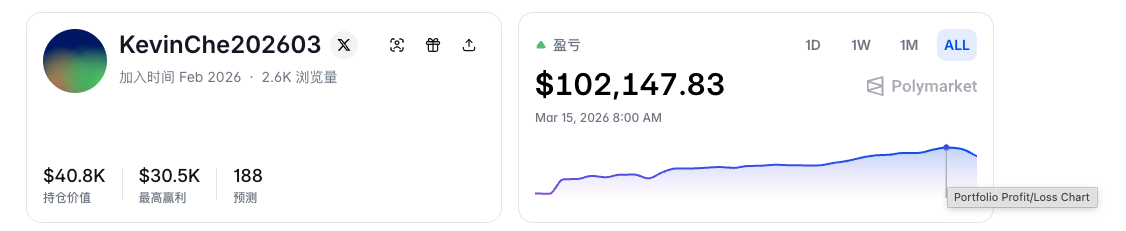
So how did Kevin transform OpenClaw from a toy that only burns tokens into a money-making machine? Odaily Planet Daily spoke with Kevin, who shared his personal crypto journey and how he leveraged OpenClaw in prediction markets, hoping readers can gain some inspiration.

Transition from "Scientist" to "Prophet"

Kevin's early career primarily involved designing ERP architectures for enterprises. He later joined a Top 3 domestic internet giant to build a sports event betting software system from scratch. This professional background laid the foundation for Kevin's current achievements in prediction markets. After 2018, Kevin entered the Web3 investment sector, mainly incubating and accelerating startups.

However, Kevin's first real windfall came five years after entering the crypto space. In 2023, ordi emerged, ushering in the "Inscription Summer" for the crypto market. With a background in computers and code, Kevin became one of the highly sought-after "scientists" at that time(Odaily Note: Scientists refer to those who could write programs and code to quickly participate in new asset deployments during the inscription craze).

"The period when ordi was listed on Binance was when my account assets reached their peak. I ultimately pocketed about over 2 million RMB," Kevin said, noting that he was also among the first batch of people to participate in the ordi launch, with a cost of less than 1 RMB per token, subsequently enjoying a thousand-fold increase.

After inscriptions completely cooled down, Kevin began searching for other opportunities and finally started seriously researching and participating in the prediction market Polymarket in the summer of 2025. "I had played Polymarket before, but the liquidity was poor, so I ignored it," Kevin said. For someone who had worked in traditional sports betting, the early Polymarket's trading depth was completely insufficient.

However, after Polymarket successfully predicted Trump becoming the 47th President of the United States in 2025, Kevin's attention returned to Polymarket. "After 2025, Polymarket's reputation grew, its liquidity could handle large orders, and more importantly, deposits and withdrawals became very convenient," so Kevin began experimenting with algorithms on Polymarket, becoming a "prophet".

Kevin's journey in prediction markets is divided into two stages: before using OpenClaw assistance and after using OpenClaw assistance. For clarity, Odaily Planet Daily has condensed Kevin's sharing as follows, enjoy~

How to Play Prediction Markets Before Using OpenClaw

Odaily Planet Daily: When you started playing Polymarket in the summer of 2025, how much money did you invest, and what was the final profit?

Kevin: I invested a total of about $100,000 at that time, and the total profit by this year is approximately double the principal.

Odaily Planet Daily: What strategy did you mainly use?

Kevin: I don't bet directly; instead, I wrote programs for automated arbitrage to make money. My previous experience building sports event betting systems in a Web3 internet company, which also involved order book design, was very helpful in understanding Polymarket's order book. Therefore, I used programs to capture spreads between order books, especially in sports events, where a lot of emotional arbitrage can be done.

Odaily Planet Daily: Do you have a dedicated team, and is anyone providing you with funds?

Kevin: I'm doing this alone; AI assistance is enough. Initially, I was afraid Polymarket might hinder withdrawals, so I ran dozens of accounts. But later, I found the deposit and withdrawal process very smooth, so I reduced the number of accounts. I mainly use my own money to run strategies, but indeed, some people provide funds for me to run strategies for them, but this is just one way to make money.

How to Play Prediction Markets After Using OpenClaw

Odaily Planet Daily: So when did you start using OpenClaw to play prediction markets?

Kevin: At the end of February. This was itself an experiment to see how much money OpenClaw could make at the trading level, but I didn't expect it to actually make money. For example, the account KevinChe202603, I used $30,000 in capital and made up to $100,000 at its peak, all within just 10 days.

Odaily Planet Daily: So what is your specific strategy?

Kevin: Frankly, this account's strategy is mixed. Currently, 60% is still running the previous automated arbitrage algorithm, and 40% is using the "Lobster" (OpenClaw) for subjective betting. Compared to market making arbitrage, betting is a complex decision, requiring consideration of the prediction market's smart money, sentiment, lineups, player form, etc. OpenClaw's role here is to actively collect various factors that determine the outcome of a match and turn them into an indicator. After several training sessions, it can also find other influencing factors that I might overlook, saving me a lot of time and mental effort.

Odaily Planet Daily: But isn't this just AI predicting matches? Conversational AI can do that too, and some developers have even specifically created AI prediction tools for matches. What's special about OpenClaw?

Kevin: Having an information advantage is just one of OpenClaw's strengths. It can also mine new strategies by itself, conduct its own backtesting, and perform automated betting in matches. If the strategy is good, we just need to give the money to OpenClaw; everything else is automated, which AI prediction tools cannot do. For example, it can actively discover some smart money addresses and fool addresses, either following the smart money's bets or using the fool addresses as a counter-indicator.

Additionally, this is why Polymarket, among all prediction markets, integrates particularly well with OpenClaw—because Polymarket's API is the most AI-friendly, making data access very convenient for AI.

Odaily Planet Daily: In which areas is OpenClaw primarily betting now? Is it fully automated already?

Kevin: Based on my areas of expertise, OpenClaw is currently also experimenting mainly in the sports competition领域. But once mature, I will consider expanding OpenClaw to other areas. Right now, I give OpenClaw small amounts of capital for automated betting, around $1000. I still don't dare to put too much money in a fully automated account.

Odaily Planet Daily: Is your strategy replicable? Or will you write a Skill for the market in the future?

Kevin: Also trying. Because there is indeed user demand for this, to see if my methodology can be combined to allow everyone to build a money-making Lobster. Later, I also plan to package some Skills for the market to use, which will certainly be paid.


Related Questions

QWhat was Kevin's initial investment and profit using OpenClaw in the prediction market?

AKevin started with a $30,000 investment and achieved a peak profit of $100,000 within 10 days, though it later retraced to $82,000.

QWhat was Kevin's professional background before using OpenClaw in prediction markets?

AKevin initially designed ERP systems for enterprises, then worked at a top-three internet company in China to build sports betting systems from scratch, and later moved to Web3 investment to incubate startups.

QHow did Kevin use OpenClaw to assist in his prediction market strategy?

AKevin used OpenClaw to collect various factors influencing game outcomes, transform them into indicators, and automate betting. It also helped identify smart money addresses and automate strategies, with 40% of his account using OpenClaw for subjective betting.

QWhat was Kevin's strategy in prediction markets before using OpenClaw?

ABefore OpenClaw, Kevin used automated arbitrage programs to profit from spreads between different market makers, particularly in sports events, leveraging emotional arbitrage without personally gambling.

QWhy does Kevin believe Polymarket is well-suited for integration with OpenClaw?

AKevin believes Polymarket is ideal for OpenClaw integration because it has user-friendly APIs that make data access easy for AI, good liquidity for large orders, and smooth deposit and withdrawal processes.

Related Reads

After the Passage of the GENIUS Act and the CLARITY Act, What Is the Correct Architecture for On-Chain Yield?

The article discusses the evolution of on-chain credit, distinguishing three markets: overcollateralized crypto lending, unsecured lending (largely unsuccessful), and asset-backed credit (ABC). ABC, backed by identifiable real-world collateral with legal recourse, is identified as the fastest-growing category and the only one credibly addressing adverse selection—the core problem in credit where the riskiest borrowers self-select. Current growth in on-chain Real World Assets (RWAs), particularly tokenized private credit funds (e.g., Maple Finance, Centrifuge), is substantial but often merely "wraps" existing fund structures, inheriting their risks rather than solving adverse selection at the protocol level. The regulatory landscape is a key driver, with the US GENIUS Act (prohibiting stablecoin issuers from paying yield) and the proposed CLARITY Act (closing loopholes on indirect yield) set to redefine permissible yield-bearing products. This makes vaults (like ERC-4626) the critical architecture—they become the primary compliant vehicle for delivering yield, functioning as issuance, disclosure, distribution, and recovery mechanisms. The author's thesis is that the correct post-GENIUS/CLARITY architecture involves building ABC solutions where credit assessment, structure, and recovery are encoded directly into the smart contract vault layer, moving beyond mere tokenized fund wrappers to solve adverse selection fundamentally and ensure regulatory compliance.

Foresight News23m ago

After the Passage of the GENIUS Act and the CLARITY Act, What Is the Correct Architecture for On-Chain Yield?

Foresight News23m ago

TechFlow Intelligence Bureau: Anthropic's New Model Fable Sparks Controversy by Restricting Biosafety Research, US CPI Soars to 4.2%, a Three-Year High

**Summary of TechFlow Intelligence Report:** The newsletter covers several key tech and finance developments. In AI, Anthropic's new Fable model faced backlash for secretly limiting biomedical research capabilities and enforcing a 30-day data retention policy, prompting the company to promise more transparent adjustments. In a related story, Anthropic's founder revealed his departure from OpenAI was due to dishonesty from Sam Altman, not safety concerns. Meanwhile, OpenAI is considering significant price cuts to compete with Anthropic, potentially sparking a price war. In crypto/Web3, BlackRock filed a new amendment for a yield-generating Bitcoin ETF, while Bank of America's CEO warned that stablecoin yields could drain trillions from traditional banks. U.S. Senator Cynthia Lummis advocated for the U.S. to officially accumulate Bitcoin reserves. In hardware, Nvidia released the DiffusionGemma-2-6B image model optimized for efficient inference, and AMD promoted its unified memory architecture to challenge Nvidia's dominance. TSMC's CFO hinted at possible price increases due to soaring AI chip demand. A major legal ruling in Germany held Google legally responsible for inaccurate information generated by its AI Overviews feature. Google Chrome also moved to fully block ad-blocker workarounds like uBlock Origin. Macroeconomic headlines included U.S. CPI rising to 4.2% (a 3-year high) and Iran's complete closure of the Strait of Hormuz, raising oil price and inflation fears. South Korean markets saw continued volatility with massive foreign capital outflow. Other notable stories: Microsoft expanded its Copilot AI assistant "Mico" globally; a study found r/wallstreetbets users' stock picks outperformed Wall Street; a fully autonomous drone killed a human soldier for the first time, raising AI ethics concerns; and a Chinese hospital used brain-computer interface technology to help a blind person "see." The overarching theme connects debates over AI boundaries and responsibility (Anthropic's restrictions, Google's liability, lethal autonomous drones) with real-world economic and geopolitical turmoil (inflation, Strait of Hormuz closure, market instability), highlighting the tense interplay between technological advancement and global chaos.

marsbit36m ago

TechFlow Intelligence Bureau: Anthropic's New Model Fable Sparks Controversy by Restricting Biosafety Research, US CPI Soars to 4.2%, a Three-Year High

marsbit36m ago

Alibaba's Yet Another New Business Division: What Signal Does It Send?

Alibaba has established a new "Token Foundry" business unit, merging its Tongyi large model division and Future Life Lab. Led directly by Group CEO Wu Yongming, this marks the company's third significant AI organizational reshuffle in 2026, following the creation of the Alibaba Token Hub (ATH) and a Group Technology Committee. The move signals a strategic shift from consolidating AI resources to accelerating productization and commercialization. The "Token Foundry" name reflects Alibaba's ambition to become a foundational supplier in the AI era, focusing on model development and commercial application. Key teams, including those behind the high-performing HappyHorse video generation model, have been integrated into the new unit. Concurrently, Zhou Jingren, architect of the Qwen model series, has been appointed Group Chief Scientist to lead a new AI Future Research Institute, focusing on long-term technological breakthroughs like Agent capabilities. This restructuring creates a clear four-layer AI architecture within Alibaba: the research institute for frontier exploration, Token Foundry for core models and commercialization, MaaS for platform services, and business units like Qianwen (C端) and Wukong (B端) for end-user applications. The adjustments align with a global trend among tech giants like Google and Microsoft to centralize AI leadership under the CEO and deeply integrate research with business units. The urgency is driven by a narrowing competitive window. Alibaba has announced its AI business is now entering a commercialization phase, with AI-related revenue seeing triple-digit growth for eleven consecutive quarters. The company faces intense competition in the MaaS (Model-as-a-Service) sector from rivals like ByteDance and Tencent. The Token Foundry initiative represents Alibaba's effort to streamline execution and enhance competitiveness in this critical, fast-evolving landscape.

marsbit1h ago

Alibaba's Yet Another New Business Division: What Signal Does It Send?

marsbit1h ago

From Return to Resignation: Chen Hang's 437 Days at DingTalk

The 437-Day Return and Departure of Chen Hang at DingTalk This article chronicles the 437-day period from March 31, 2025, to June 11, 2026, when Chen Hang (also known as "No Move") returned as CEO of DingTalk, the enterprise communication platform he originally founded, only to later step down. Chen Hang, the creator of DingTalk in 2015, was brought back by Alibaba in 2025 after the company acquired his subsequent startup, HHO. His return was driven by Alibaba's renewed focus on AI and DingTalk's strategic role as its key to-B AI application. However, his aggressive management style, marked by strict work policies like mandatory clock-ins and extended hours, quickly caused internal friction and was criticized as being at odds with Alibaba's culture. Despite the internal turmoil, Chen Hang drove significant product launches. In August 2025, he unveiled "AI DingTalk 1.0," featuring new products like the AI-native entry point "DingTalk ONE." By March 2026, he announced "Wukong," touted as the world's first enterprise-grade AI-native work platform, representing a fundamental rebuild of DingTalk's architecture. The turning point came in early June 2026. A detailed internal post criticizing DingTalk's work culture went viral, followed by a public critique from a former executive. This prompted an unprecedented public rebuke from the Alibaba Partners Committee, which stated such management was not aligned with company values. One day later, on June 11, Alibaba announced Chen Hang's departure. He was succeeded by Chen Yusen, a 32-year-old technical expert known for founding cybersecurity firm Changting Technology. While Chen Hang's tenure laid the technical foundation for DingTalk's AI transformation with "Wukong," his leadership style ultimately led to his replacement as the company seeks a new direction under younger leadership.

marsbit1h ago

From Return to Resignation: Chen Hang's 437 Days at DingTalk

marsbit1h ago

Trading

Spot
Futures
活动图片




