Duan Yongping's Bottom-Fishing in CoreWeave Is Turning into a Battleground for Bulls and Bears

marsbitPublished on 2026-05-11Last updated on 2026-05-11

Abstract

CoreWeave's Q1 2026 earnings report has intensified the ongoing bull-bear battle over the AI infrastructure stock. While revenue doubled year-over-year to $2.08B and the firm's remaining performance obligation (RPO) surged to nearly $100B, its net loss more than doubled to $740M. The critical point of contention is profitability: while adjusted EBITDA margin was a robust 56%, the adjusted operating margin collapsed to just 1% due to soaring infrastructure and sales costs. A weaker-than-expected Q2 revenue guidance further triggered an 11.4% single-day stock drop. The bull thesis hinges on CoreWeave's massive order backlog, deep strategic ties with NVIDIA (as a customer, investor, and key supplier), and a diversified client base now including Anthropic and Meta. The bear case focuses on the "scale at all costs" model, where expanding revenue leads to wider losses, ballooning debt ($25B), and massive capital expenditures ($6.8B in Q1). Insider selling by executives contrasts with a notable new investor: Chinese investor Duan Yongping initiated a small position (0.12% of his portfolio) in Q4 2025 near the stock's lows. The coming Q2 report is seen as a key test for management's promise of a profit margin recovery.

Author: Deep Tide TechFlow

On May 8, AI cloud computing power supplier CoreWeave (CRWV) plunged 11.4% in a single day, closing at $114.15. This marked another "earnings day decline" since the company's IPO in March last year. However, unlike previous drops, this decline coincided with a more dramatic contrast: Duan Yongping, widely known in the Chinese-speaking community as a disciple of Warren Buffett, had just established his first position in CoreWeave in Q4 2025, with an allocation of approximately $20 million. Based on the position size and the Q4 average price, the entry point was close to CoreWeave's lowest level for the year in December 2025.

CoreWeave is currently one of the most divisive AI assets in the US stock market. On one side lies the narrative of being the "picks and shovels" seller with nearly $100 billion in order backlog and deep ties to Nvidia; on the other side is the financial reality of widening losses despite scale expansion and continuous insider selling. The Q1 earnings report acted like a prism, making this divergence exceptionally clear.

Q1 Earnings: Revenue Doubles but Losses Widen, Q2 Guidance Punctures Valuation

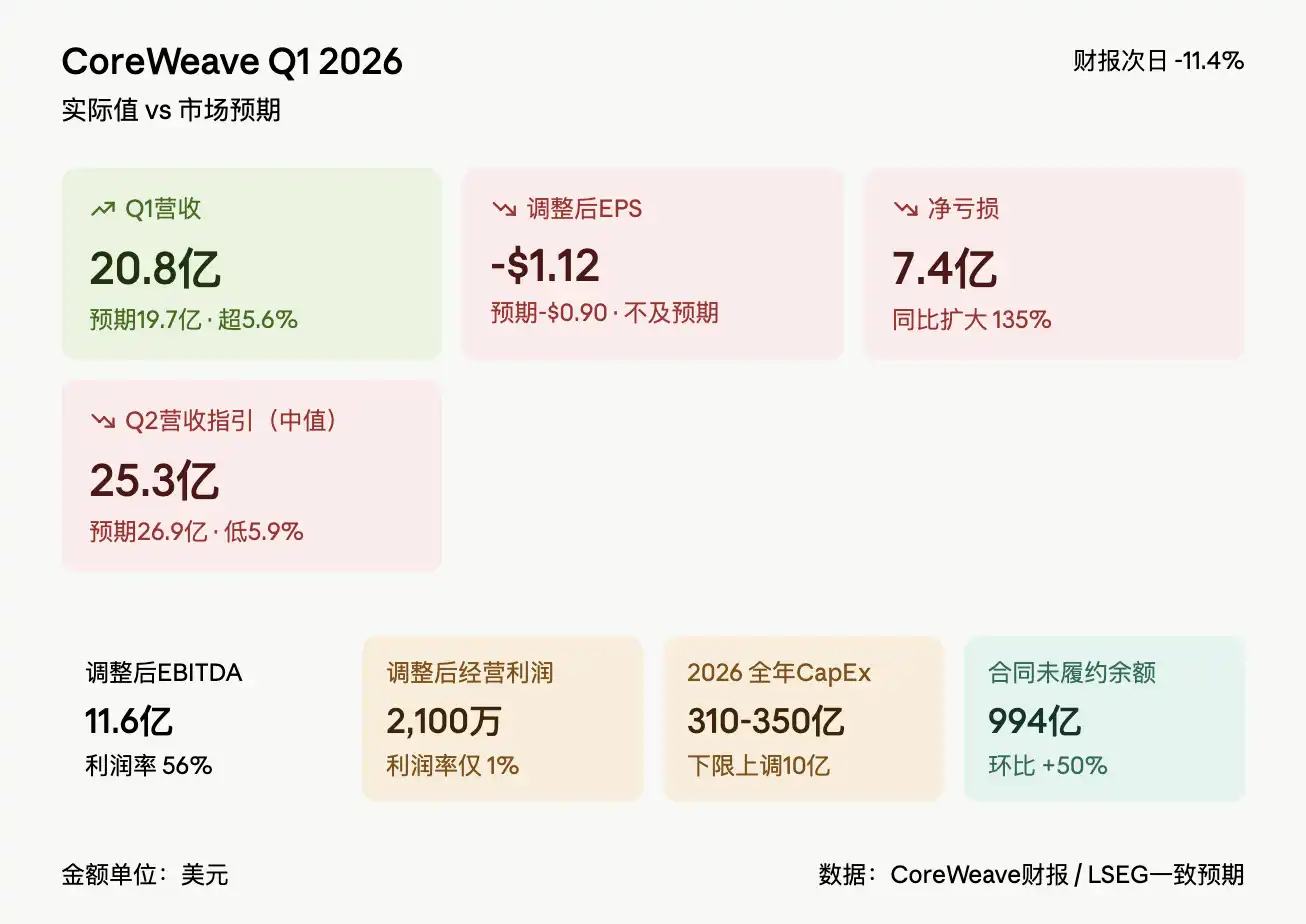
CoreWeave's Q1 revenue was $2.08 billion, a 112% year-over-year increase and a 32% sequential increase, surpassing the LSEG market expectation of $1.97 billion. However, adjusted loss per share was $1.12, worse than the expected loss of $0.90. Net loss expanded to $740 million, more than doubling from $315 million in the same period last year.

What truly ignited the sell-off was the forward guidance. The company provided a Q2 revenue range of $2.45 billion to $2.6 billion, with a midpoint of $2.53 billion, far below the market expectation of $2.69 billion. Simultaneously, the lower limit of full-year 2026 capital expenditure was raised from $30 billion to $31 billion, which CFO Nitin Agrawal attributed to rising component costs.

The fragility of the profit structure was exposed. Q1 adjusted EBITDA reached $1.16 billion (a 56% margin), seemingly impressive, but adjusted operating profit was only $21 million, with the operating margin compressed to 1%. The reason lies in technology and infrastructure costs soaring 127% year-over-year to $1.27 billion, and sales & marketing expenses skyrocketing over 6 times year-over-year to $69 million. Revenue is growing, but costs are growing faster.

CEO Michael Intrator emphasized on the earnings call: "We have reached hyperscale." He disclosed that the company now has 10 customers committed to spending over $1 billion each. Compared to 2024 when 62% of revenue relied on Microsoft as a single customer, concentration risk has significantly improved. Intrator also expects CoreWeave's annualized revenue to exceed $30 billion by the end of 2027.
Bull Narrative: $100 Billion Order Backlog, Deep Ties with Nvidia

The core supporting the bull case is the order backlog. As of the end of Q1, CoreWeave's remaining performance obligations (RPO) amounted to $99.4 billion, a net increase of approximately $33 billion sequentially and nearly quadrupling year-over-year. Intrator stated that new contracts signed in Q1 alone exceeded $40 billion.

The client list is also reshaping market perceptions. In Q1, Anthropic was added as a customer, providing computing power for its Claude series models; a $2.1 billion AI cloud agreement was signed with Meta; trading firm Jane Street committed to approximately $6 billion in orders and separately completed a $1 billion equity investment. Nvidia again purchased $2 billion worth of CoreWeave Class A common stock this quarter. This global largest GPU supplier is simultaneously an investor and a major customer of CoreWeave. This triple-role binding relationship is referred to as Nvidia's "favored son."

Regarding financing structure, CoreWeave completed an $8.5 billion investment-grade HPC (High-Performance Computing) secured delayed draw term loan (DDTL) in Q1, priced below 6%, hailed by management as "groundbreaking." Year-to-date, the company has secured over $20 billion in debt and equity financing, with the weighted average cost of debt decreasing by approximately 80 basis points. S&P Global Ratings concurrently revised CoreWeave's credit rating outlook from "stable" to "positive."

Bear Logic: Less Profitable as it Scales, Debt Snowball Growing Larger

However, another set of numbers in the earnings report is causing anxiety. Q1 capital expenditure reached $6.8 billion, and the company expects Q2 capital expenditure to further climb to between $7 billion and $9 billion. The Q2 interest expense guidance range is $650 million to $730 million, reflecting the rapid swelling of debt.

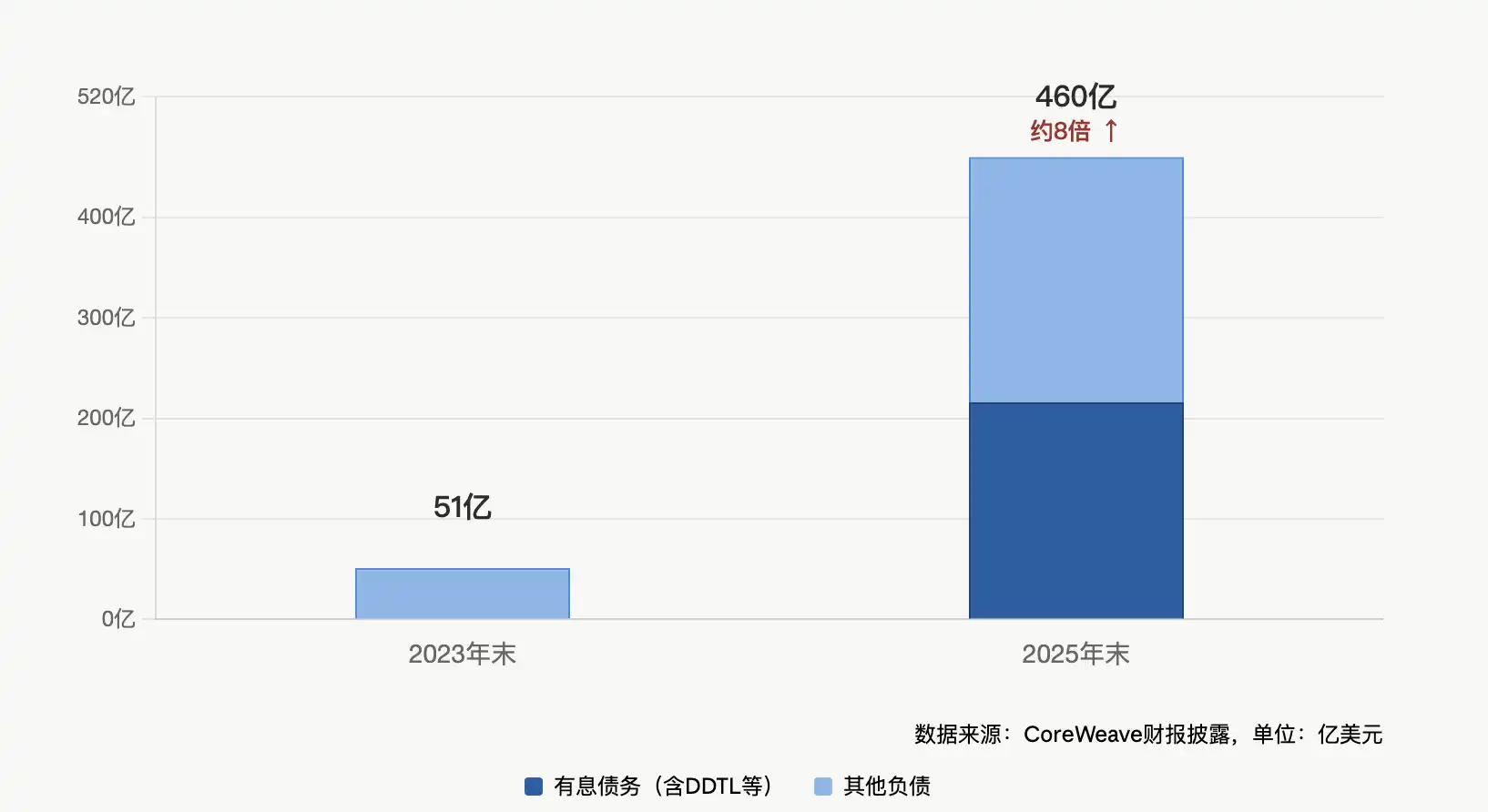
The total debt is already staggering. As of the end of Q1, CoreWeave's total debt stood at approximately $25 billion. Relative to the company's current annualized revenue level, this leverage is significantly higher than that of traditional cloud service providers. Morgan Stanley data shows that CoreWeave's debt financing for the full year 2025 amounted to about $11.8 billion, far exceeding its equity financing of about $1.5 billion. The company's core expansion tool is the DDTL, a "book first, finance later" model that uses order contracts as collateral to secure bank financing for GPU procurement.

The sharpest criticism comes from profit quality. Although management repeatedly emphasized the 56% EBITDA margin, the adjusted operating margin was only 1%. The "real" gross margin after deducting technology and infrastructure costs was about 4%, showing compression both sequentially and against market expectations. Intrator attributed this on the earnings call to the temporary effect of rapid scaling, where the dilution effect on margins from newly added capacity is immense when a company expands dramatically from a 1-gigawatt operational scale. He promised this was the "margin low point" and that margins would gradually recover in future quarters.

But the market is currently unwilling to pay for this promise. While analysts from Morgan Stanley and Jefferies gave positive reviews, CoreWeave has experienced short-term pullbacks after each earnings report previously, with this decline being one of the steeper post-earnings drops.
Insider Selling Continues, Mirroring Duan Yongping's Bottom-Fishing

Around the earnings release, CoreWeave insiders maintained their selling pace. CEO Mike Intrator sold 307,693 shares in late April; co-founders Brian Venturo and Chen Goldberg also recorded sales; institutional shareholder Magnetar Financial had previously sold over $300 million worth. Latest disclosures show that another major shareholder recently sold approximately 1.2 million shares.

This forms a stark contrast with Duan Yongping's position-building in Q4. According to a 13F filing disclosed by H&H International Investment in February 2026, Duan Yongping established his first position in CoreWeave of 299,900 shares in Q4 2025, at a time when the stock had retreated more than 65% from its highs, and market concerns over its debt structure had peaked.

It's noteworthy that CoreWeave accounts for only 0.12% of Duan Yongping's total H&H holdings, constituting a "small pilot" position. In the same quarter, Duan massively increased his stake in Nvidia by over 1110% and established new positions in Credo Technology (high-speed connectivity) and Tempus AI (AI healthcare). These three new AI positions combined account for less than 0.3% of his portfolio. This indicates Duan's true heavy bet is Nvidia itself, with CoreWeave being more like a small extension of his bet on the downstream AI computing power supply chain.

The Crucial Question Now: Inflection Point or Trap?

Intrator posed a somewhat emotional rhetorical question during the Q&A session: "I've always felt that everyone is staring at the stock price tree and missing the entire forest."

This statement aptly summarizes the current bull-bear standoff. Bulls see a forest of nearly $100 billion in contract backlog, a diversified customer base, a triple-binding relationship with Nvidia, and an upgraded credit rating. Bears see a tree of 1% operating margins, widening net losses, aggressive capital expenditures, and persistent insider selling.

CoreWeave's stock price is still up nearly 80% year-to-date and has gained over 200% since its IPO. But when the bull case for a stock rests on a distant narrative and the bear case on current numbers, every earnings report becomes a battleground for these two narratives. Duan Yongping previously stated in an interview with Fang Sanwen: "AI is a massive revolution brought about by a qualitative leap in computing power, with an impact potentially exceeding that of the internet and the industrial revolution. There is a clear AI bubble now, and 90% of companies may be eliminated, but the survivors will become the next-generation giants." His 0.12% light position itself acknowledges the uncertainty of this gamble.

The next test is already clear: the Q2 earnings report. If the operating margin does not recover as promised by management, the credibility of the "forest" narrative will face a genuine stress test.


Related Questions

QWhat were the key highlights and concerns from CoreWeave's Q1 2026 earnings report?

ACoreWeave's Q1 2026 revenue was $2.08 billion, up 112% year-over-year and exceeding expectations. However, the company's net loss widened to $740 million and it provided weaker-than-expected Q2 revenue guidance. A major concern was the adjusted operating profit margin collapsing to just 1%, despite a high adjusted EBITDA margin of 56%, due to surging technology and infrastructure costs.

QWhat are the main arguments of the bulls (optimists) and bears (pessimists) on CoreWeave?

ABulls are optimistic due to CoreWeave's massive $99.4 billion Remaining Performance Obligations (RPO), deep strategic and financial ties with NVIDIA, a diversified and growing client base including Anthropic and Meta, and recent credit rating upgrades. Bears are pessimistic because the company is scaling unprofitably, with operating margins near zero, rapidly escalating capital expenditures and debt (now ~$25 billion), and persistent insider selling by executives and major shareholders.

QWhat is the significance of Duan Yongping's (段永平) investment in CoreWeave, and how does it contrast with insider activity?

ADuan Yongping, a well-known value investor in China, initiated a small position in CoreWeave (worth ~$20 million, ~0.12% of his portfolio) in Q4 2025 when the stock was near its yearly low. This 'dip-buying' action contrasts sharply with recent and ongoing insider selling by CoreWeave's CEO, co-founders, and major institutional shareholders like Magnetar Financial. Duan's position is seen as a high-conviction, speculative bet on the AI infrastructure theme, while insider sales raise questions about near-term confidence.

QHow is CoreWeave financing its aggressive expansion, and what are the associated risks?

ACoreWeave is financing its massive GPU procurement and data center build-out primarily through debt, specifically a novel 'Delayed Draw Term Loan (DDTL)' structure secured by its customer contracts. The company raised $8.5 billion in such debt in Q1 alone. The major risk is the rapid ballooning of its total debt to approximately $25 billion, leading to high interest expenses. This 'asset-light, contract-heavy' model creates significant financial leverage, making the company highly sensitive to execution risks and potential slowdowns in AI demand.

QWhat is the critical test for CoreWeave's investment narrative according to the article?

AThe next critical test is the Q2 2026 earnings report. Management, particularly CEO Michael Intrator, has promised that Q1 represented the 'low point' for operating margins and that profitability should improve in subsequent quarters. If the Q2 report fails to show a meaningful rebound in operating profit margins, the company's long-term growth narrative (the 'forest') will face severe credibility pressure from the current poor financial metrics (the 'tree'), potentially leading to further significant stock price volatility.

Related Reads

From 'Old Guys' to 'New Favorites': How AI Is Revaluing Old Infrastructure from Dell to Nokia?

From "Vintage Tech" to "New AI Darlings": How AI Revalues Old Infrastructure One year ago, tech giants like Dell, Nokia, Cisco, and Western Data were seen as slow-growth, low-valuation stories, far from the AI spotlight dominated by players like Nvidia. Now, these legacy tech stocks are gaining market attention, sparking debate on whether this is genuine industry revaluation or a temporary narrative. As AI moves from model parameters to real-world data centers, the market is recognizing companies with proven delivery and infrastructure capabilities. This shift marks a change in the AI investment thesis: from pure model and GPU focus to the complex systems engineering required for deployment. Companies like Dell, HPE, and Corning are being revalued not for being "sexy" AI innovators, but for their decades of accumulated expertise in supply chains, enterprise delivery, and infrastructure—assets that have become critical in the AI buildout phase. The revaluation is unfolding across three key infrastructure lines: 1. **Servers & System Integration:** Dell and HPE are emerging as crucial system integrators or "general contractors" for AI data centers, translating GPU orders into complete, deployable server racks integrated with power, cooling, and networking. 2. **Networking & Connectivity:** AI's scale demands robust high-speed connections. Corning (fiber optics), Nokia (AI-RAN, 6G), and Cisco (data center switches) are gaining importance for enabling efficient data transfer within and between AI clusters. 3. **Storage:** Beyond high-speed memory (HBM/DRAM), the AI data explosion is driving demand for high-capacity hard drives (HDDs) from companies like Western Digital and Seagate to handle training data, logs, and cold storage cost-effectively. For this revaluation to be substantive and not just a narrative, three criteria are key: 1) Concrete AI-related order and revenue growth (e.g., Dell's AI server sales), 2) Upward revisions to company financial guidance, and 3) Sustainable improvements in profit quality, not just top-line revenue spikes. In essence, AI's transition to a real construction phase is re-pricing "old assets" against "new demand." The opportunity, however, is selective. Only those legacy firms that are demonstrably integrated into the capital expenditure chains of data center and enterprise AI deployment are likely to experience a true "logic re-rating" rather than just a temporary valuation bounce.

marsbit4m ago

From 'Old Guys' to 'New Favorites': How AI Is Revaluing Old Infrastructure from Dell to Nokia?

marsbit4m ago

The Merger of Codex and ChatGPT Marks the Beginning of a Major Reshuffle in Programming Tools

OpenAI is shifting its strategic focus from ChatGPT to Codex, merging them along with the browser tool Atlas into a unified desktop super-app. This move signals an internal belief that Codex, originally a programming tool, represents the next evolution of AI more than conversational models like ChatGPT. Over the past year, Codex's weekly active users have surged past 5 million. The key distinction is that while ChatGPT answers questions, Codex executes tasks. Enterprises increasingly value this ability to get work done over simply receiving advice. Consequently, Codex is attracting professionals beyond developers, including analysts, bankers, marketers, and product managers. OpenAI's reorganization and increased investment in Codex stem from recognizing that the future of AI competition lies in execution capabilities, not just conversation. The company is launching role-specific plugins (e.g., for data analysis, sales, design) to transform Codex into a broad knowledge work platform that automates and redefines white-collar workflows. Beyond being a tool, Codex reflects OpenAI's ambition to redefine software. New features like "Sites"—which generates interactive websites from documents—and collaborative "Annotations" aim to create a paradigm where the AI understands the goal and handles the tools and steps, functioning more like a digital colleague than traditional software. The ultimate goal is a unified experience where the user cares only about the completed task.

marsbit13m ago

The Merger of Codex and ChatGPT Marks the Beginning of a Major Reshuffle in Programming Tools

marsbit13m ago

Interpreting Investment Opportunities in the Age of Great Navigation, Invesco Great Wall Fund Releases '2026 Report on Chinese Enterprises Going Global'

Invesco Great Wall Fund has released its "2026 China Corporate Globalization Report," titled "The 'Great Navigation Era' of Chinese Enterprises." The report analyzes the new trends and investment opportunities as Chinese companies expand globally, moving from simple product exports to comprehensive overseas operations involving services, branding, and local production. Driven by factors like trade friction, the pursuit of higher profit margins abroad, and policy support, globalization is becoming essential for Chinese companies. The report outlines an evolution: from early product export ("Globalization 1.0") to the current "Globalization 2.0," characterized by overseas capacity, capital goods investment, consumer brand expansion, and service exports. Chinese firms' competitive advantages are highlighted, including a vast engineer talent pool, low-cost and robust infrastructure, and complete industrial clusters. Specific sectors with significant出海 potential are identified: * **Capital Goods** (e.g., engineering machinery, power equipment): Benefiting from global demand, especially in Belt & Road markets and the AI-driven power grid upgrade cycle. * **Consumer Brands**: Transitioning from cost to brand advantage, leveraging供应链 efficiency. * **Technology & Innovation**: Including AI applications, optical modules within global tech supply chains, and new energy vehicles focusing on local production. * **Pharmaceuticals**: Chinese biotech firms are becoming preferred partners for global pharma, with potential for breakthrough drugs in areas like oncology and weight loss. The report concludes that corporate globalization represents a sustained, core theme for China's capital markets, though companies must navigate challenges like geopolitics and localization.

marsbit25m ago

Interpreting Investment Opportunities in the Age of Great Navigation, Invesco Great Wall Fund Releases '2026 Report on Chinese Enterprises Going Global'

marsbit25m ago

GitHub, Transfixed by AI

On the night of February 9th, GitHub suffered a major outage caused by a simple configuration change—reducing a cache refresh interval from 12 to 2 hours—that triggered a cascade of failures. This was not an isolated event, but part of a broader pattern. In early 2026, GitHub experienced at least 8 major incidents, failing to meet its promised 99.9% availability. These outages stemmed from structural issues: explosive growth in load, tight service coupling, and insufficient protection against abnormal traffic. This unprecedented load is driven by AI Agents. In 2025, GitHub handled ~1 billion commits. By 2026, weekly commits reached 275 million, projecting to ~14 billion for the year—a 14x increase. AI tools like Claude Code now contribute 4.5% of all public repository commits, with weekly submissions surging 25x in just three months. AI-generated pull requests jumped from 4 million to 17 million per month in half a year. Unlike human developers, AI Agents work continuously, generating commits at a scale that overwhelms infrastructure designed for human rhythms. The surge also shattered GitHub's business model. Copilot's flat-rate pricing, based on assisting human developers, became unsustainable as Agentic AI sessions consumed resources worth hundreds of dollars for a few dollars in fees. In response, GitHub imposed usage limits and, by June 1st, shifted to a pay-per-use "AI Credits" system. Facing this new reality, GitHub realized a 10x scaling plan was insufficient. It announced a need to *redesign* its architecture for 30x current scale—decoupling services, adding fault isolation, and improving change management to prevent cascading failures. Other platforms like Stripe and AWS are facing similar challenges with AI Agents. Fundamentally, GitHub is transitioning from a human collaboration platform to an "exhaust pipe" for automated AI workflows. Its detailed post-mortem reports aim to maintain trust during this turbulent rebuild. The February outage was not just a technical glitch, but a signal of the software industry's entry into a new, AI-driven era.

marsbit1h ago

GitHub, Transfixed by AI

marsbit1h ago

Trading

Spot
Futures
活动图片