Dogecoin Tries to Hold $0.09370 – Is 2026 the Doge Year or Will $MAXI Take Over?

bitcoinistPublished on 2026-02-10Last updated on 2026-02-10

Abstract

Dogecoin is currently testing a critical support level at $0.09370, which is seen as a key determinant of its near-term price direction. If this level holds, analysts project a potential rally toward $0.20 by 2026, supported by oversold technical indicators and historical accumulation patterns. However, a breakdown below $0.088 could trigger a decline toward $0.060. Meanwhile, liquidity is shifting toward newer, high-risk meme tokens like Maxi Doge ($MAXI), which has raised $4.58M in its presale. $MAXI targets a high-leverage trading culture with features like holder-exclusive competitions and a dedicated treasury fund. Whale activity indicates growing interest, though the token remains a speculative play. The broader meme coin market remains sensitive to macroeconomic liquidity conditions, with Dogecoin’s performance tied to Bitcoin’s movements and central bank policies. The article highlights both the technical outlook for DOGE and the emerging appeal of narrative-driven altcoins like $MAXI for risk-seeking investors.

Trusted Editorial content, reviewed by leading industry experts and seasoned editors. Ad Disclosure

Quick Facts:

  • ➡️ Dogecoin must hold the $0.09370 support level to maintain its bullish structure and target $0.20 by 2026.
  • ➡️ A breakdown below $0.088 would invalidate the current reversal thesis, risking a drop to $0.060.
  • ➡️ Market liquidity is rotating toward thematic projects like Maxi Doge, which integrates trading competitions and leverage culture for high-risk ROI hunters.
  • ➡️ Macroeconomic shifts in global liquidity remain the primary catalyst for the next leg of the meme coin supercycle.

Dogecoin is fighting a critical battle at $0.09370.

That price point, once just a blip on the technical chart, has hardened into a psychological line in the sand for the entire meme sector. With Bitcoin stuck in consolidation, high-beta assets like DOGE are being forced to test their liquidity floors. The real question for traders isn’t just about surviving the current dip. It’s about whether this retest can trigger a parabolic run deep into 2026.

Why does this specific level matter? It aligns perfectly with historical accumulation zones where retail panic usually meets institutional buying. While volume indicators suggest ‘weak hands’ are folding, on-chain metrics reveal a quiet divergence in wallet growth.

Someone is accumulating. The market is currently trying to price in macro uncertainty alongside the hope for a ‘meme supercycle.’ If support holds, the structure points toward a reversal that could challenge year-to-date highs.

But the liquidity landscape is shifting. Legacy giants like Dogecoin are battling the law of large numbers, it takes massive capital just to move the needle 5%. Consequently, speculative cash is beginning to fragment. Traders chasing asymmetric returns are increasingly hedging major positions with newer, narrative-driven projects.

This rotation explains why assets like Maxi Doge ($MAXI) are gaining traction. They offer a totally different risk-reward profile for anyone betting on the next wave of retail euphoria.

Learn more about Maxi Doge.

Analysts Eye $0.20 Reversal if Key Support Holds

The technical case for Dogecoin hinges entirely on holding the $0.09000–$0.09370 zone. A breakdown here would be ugly—, likely triggering a cascade of long liquidations down to the $0.075 region. But a successful defense?

That confirms a ‘higher low’ macro structure (a classic reversal signal). Plus, the daily RSI is hovering in oversold territory. Historically, that’s exactly where impulsive bounces in the meme sector start.

Fundamentally, DOGE remains tied to payment narratives. Yet, what most analysts miss is the link between global liquidity cycles and meme performance. As central banks signal rate adjustments, risk-on assets react first. Liquidity usually flows into Bitcoin, then rotates into heavyweights like DOGE.

If the $0.09370 support holds through this volatility, charts point to immediate resistance at $0.12, with a medium-term target of $0.20 by early 2026.

Scenario Analysis:

  • Bull Case: DOGE reclaims the 50-day EMA, confirming $0.09370 as a cycle bottom. Buying pressure targets $0.14 initially, with a breakout to $0.22 imminent if volume holds up.
  • Base Case: The asset chops sideways between $0.090 and $0.105 for 3-5 weeks, shaking out leverage before making a decisive move.
  • Bear Case (Invalidation): A daily candle close below $0.088 invalidates the bullish thesis, exposing the asset to a retest of 2023 lows around $0.060.

$MAXI is available here.

Smart Money Rotates: $MAXI Targets High-Leverage Culture

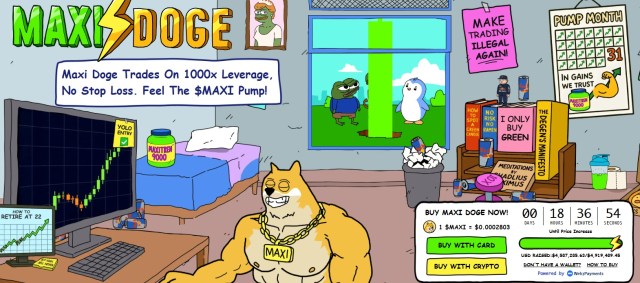
While Dogecoin relies on broad sentiment, Maxi Doge ($MAXI) is carving out a niche by targeting the aggressive trading culture defining this cycle.

Early adopters call it the ‘Left-Curve’ play. It positions itself not just as a currency, but as the embodiment of the 1000x leverage mentality. That distinction is key. While DOGE wants mass adoption, Maxi Doge targets the high-frequency trader and the ‘gym-bro’ aesthetic dominating crypto Twitter.

The project stands out with a ‘Leverage King’ ecosystem, featuring holder-only trading competitions and a ‘Maxi Fund’ treasury. The numbers seem to back the hype.

According to the presale page, Maxi Doge has raised exactly $4.58M, with tokens currently priced at $0.0002803. This influx suggests retail investors are hunting for volatility and outsized returns, gains that mature assets like $DOGE struggle to deliver these days due to their massive caps.
Smart money is watching this rotation. On-chain data from Etherscan reveals that 2 whale wallets scooped up $628K ($314K, $314K) in recent transactions.

That signals high-net-worth players are positioning themselves before the project moves to open markets. View whale activity on Etherscan.

Still, caution is required. As an ERC-20 token focused on high-octane culture, Maxi Doge carries early-stage volatility risks. The ‘never skip leg-day’ branding and competitive staking APY are attractive, sure, but this remains a high-risk allocation. It’s for those looking to diversify into speculative narratives, not safe havens.

Watch the liquidity rotation, Maxi Doge ($MAXI) presale is live here. It represents the aggressive edge of the current meme market.

Buy your $MAXI here.

The information provided in this article is for educational purposes only and does not constitute financial advice. Crypto assets, including Dogecoin and presale tokens like Maxi Doge, are highly volatile and unregulated. Always conduct your own independent research and consult a professional advisor before making investment decisions.

Editorial Process for bitcoinist is centered on delivering thoroughly researched, accurate, and unbiased content. We uphold strict sourcing standards, and each page undergoes diligent review by our team of top technology experts and seasoned editors. This process ensures the integrity, relevance, and value of our content for our readers.

patrubogdan

Follow

Full Profile

Related Posts

Government Shutdown Fears Trigger 2% Crypto Dip, But Bitcoin Hyper Remains Unshaken

US Debt Spiral Eyes $39T: Why Bitcoin Hyper ($HYPER) Is The Hedge to Watch

Crypto Exchange Backpack Targets Token Launch Soon, as BMIC Fires Up Quantum Defense

Ethereum Foundation Backs SEAL Initiative as LiquidChain L3 Protocol Gains Traction

Vitalik Buterin Outlines Ethereum’s AI Future, While SUBBD Token Targets the Creator Economy

Binance Dominates Trump’s USD1 Supply as Bitcoin Hyper Breaks Records

Related Questions

QWhat is the critical support level for Dogecoin mentioned in the article, and why is it important?

AThe critical support level for Dogecoin is $0.09370. It is important because it aligns with historical accumulation zones where retail panic often coincides with institutional buying. Holding this level is crucial for maintaining its bullish structure and targeting a price of $0.20 by 2026.

QWhat are the potential price targets for Dogecoin if the $0.09370 support holds?

AIf the $0.09370 support holds, the immediate resistance target is $0.12, with a medium-term target of $0.20 by early 2026.

QWhat is Maxi Doge ($MAXI), and how does it differentiate itself from Dogecoin?

AMaxi Doge ($MAXI) is a newer, narrative-driven project that targets high-leverage trading culture. It differentiates itself by integrating trading competitions and a 'Maxi Fund' treasury, focusing on high-risk ROI hunters and the aggressive trading mentality, unlike Dogecoin, which aims for broader mass adoption.

QWhat on-chain activity suggests smart money is interested in Maxi Doge?

AOn-chain data from Etherscan reveals that two whale wallets purchased $628K (split as $314K each) in $MAXI tokens, indicating high-net-worth players are positioning themselves before the project moves to open markets.

QWhat is the bear case scenario for Dogecoin if it fails to hold the key support level?

AThe bear case scenario involves a daily candle close below $0.088, which would invalidate the bullish thesis and expose Dogecoin to a retest of its 2023 lows around $0.060.

Related Reads

Will the Next Crypto Bull Run Start with On-Chain Trading of SpaceX?

This article presents a scenario-based forecast for the crypto industry from 2026 to 2029, arguing that the next major cycle will be driven not by technological narratives but by legal access to real-world assets. The author predicts that by mid-2026, pre-IPO perpetual contracts for top private companies like SpaceX, OpenAI, and Anthropic on platforms like Hyperliquid will become the primary gateway for accessing quality assets, as most crypto-native tokens fail to capture real value. The much-hyped AI x Crypto intersection largely fails except for prediction markets, which thrive on betting on AI model supremacy. By 2027, public blockchain foundations are forced to choose between catering to retail speculation or building compliant infrastructure for institutions, with many opting for the latter. Growth in stablecoins and tokenized private credit/equity hits a "triple ceiling" due to regulatory and political uncertainty rather than market demand. The pivotal shift is forecast for 2028. A major liquidation event in pre-IPO perpetuals exposes the structural flaw of synthetic markets lacking a real underlying asset anchor. In response, regulatory changes finally allow the public solicitation of private securities resales to verified accredited investors. This creates a legitimate secondary market for real company equity, which then becomes the core asset class of the new bull market, relegating synthetic perps to a niche role. By 2029, the industry becomes "boring" but foundational. Tokens without claims on real cash flows or assets cease trading. Stablecoin growth is steady but politically capped. Crypto infrastructure fades from view as it gets absorbed into traditional finance backends. The article's central thesis is that the key bottleneck for crypto's next phase is legal and regulatory channels for real asset ownership, not technology.

marsbit1h ago

Will the Next Crypto Bull Run Start with On-Chain Trading of SpaceX?

marsbit1h ago

The Value Distribution of Stablecoins

**Summary: The Value Distribution of Stablecoins** The article argues that stablecoins are evolving from mere trading tools into broader channels for dollar access. It divides the stablecoin ecosystem into four layers to analyze how value is distributed: 1. **Issuance Layer:** Mints stablecoins, holds reserve assets, and captures the spread between reserve yield and user costs (e.g., Tether, Circle). This layer currently earns the largest profit margin. 2. **Infrastructure Layer:** Connects stablecoins to the traditional financial system, handling fiat on/off-ramps, banking integration, compliance (KYC/AML), and asset management (e.g., Bridge, BVNK). This is the "unglamorous" but critical work, building the essential bridges between crypto and real-world finance. 3. **Acquiring/Distribution Layer:** Integrates stablecoins into merchant systems, manages payment flows, and provides enterprise financial software (e.g., Stripe, Coinbase). They act as the access point for businesses. 4. **Application Layer:** The end-users and businesses that ultimately use stablecoins for payments, settlements, or as a store of value. They benefit from convenience but have little pricing power. The core thesis is that while the issuance layer currently dominates profits, the often-overlooked **infrastructure layer holds significant long-term potential**. The real challenge and barrier to mass adoption is not the on-chain transfer of stablecoins (which is simple), but the complex "last mile" integration into existing business workflows, banking systems, and regulatory frameworks across different countries. Companies in this layer are currently in a "land grab" phase, investing heavily to build networks, secure bank partnerships, and establish compliance pathways. While their position is currently pressured by the profitable issuers above and distribution platforms below, the article suggests that if stablecoins become a default financial rail for businesses, the infrastructure providers who have done the hard work of integration will ultimately gain strong pricing power and become entrenched, essential players.

marsbit7h ago

The Value Distribution of Stablecoins

marsbit7h ago

The Value Distribution of Stablecoins

The Value Distribution of Stablecoins The article argues that stablecoins are evolving from a mere trading tool into a broad "dollar channel." It analyzes the industry's value chain through four layers: 1. **Issuance Layer (e.g., Tether, Circle):** The top layer that mints stablecoins, holds reserve assets, and captures the thickest interest rate spread. 2. **Infrastructure Layer (e.g., Bridge, BVNK):** Connects stablecoins to the traditional financial system, handling critical but complex "dirty work" like fiat on/off-ramps, banking integration, compliance (KYC/AML), and cross-border settlement. 3. **Acquiring/Distribution Layer (e.g., Stripe, Coinbase):** Embeds stablecoins into merchant systems, manages payment flows, and integrates with enterprise software. 4. **Application Layer:** End-users and businesses that ultimately use stablecoins for payments, settlement, or storing value. The author posits that while the issuance layer currently captures the most profit, the most overlooked and potentially critical layer is infrastructure. The core challenge for stablecoin adoption isn't the on-chain transfer (which is simple), but bridging the gap between blockchain and the real-world financial system. This involves solving practical problems for businesses: fiat conversion, reconciliation, tax handling, and user onboarding. Infrastructure companies are currently in a difficult "land-grab" phase—building networks, securing banking relationships, and achieving compliance country-by-country. They face pressure from both the profitable issuance layer above and distribution platforms below. However, the author suggests this layer is building a crucial moat. Once stablecoins become a default business rail, the infrastructure players who have done the hard work of integration may gain significant, durable value and pricing power.

链捕手7h ago

The Value Distribution of Stablecoins

链捕手7h ago

Trading

Spot
Futures
活动图片





