Dogecoin Targets Japan In New RWA And Adoption Push

bitcoinistPublished on 2026-01-09Last updated on 2026-01-09

Abstract

Dogecoin's corporate arm, House of Doge, has partnered with two Japan-focused firms, abc Co., Ltd. and ReYuu Japan Inc., to drive localized adoption and real-world asset (RWA) initiatives in Japan. The collaboration aims to explore gold-backed stablecoins, regulatory-compliant RWA tokenization under Japan's "green list" framework, and the establishment of a joint fund. This move signals a strategic shift for Dogecoin towards practical utility, including payments and financial products, beyond its meme-centric origins. The partnership emphasizes responsible innovation and ecosystem growth, though specific details on assets, timelines, or merchants were not disclosed. At the time of writing, DOGE was trading at $0.14276.

House of Doge, the corporate arm of the Dogecoin Foundation, says it has struck a partnership framework with two Japan-focused firms to explore localized Dogecoin adoption and real-world asset (RWA) initiatives, putting Japan at the center of its next ecosystem expansion effort.

Dogecoin Plots Japan Expansion

In a Thursday press release dated Jan. 8, House of Doge said it has agreed a tripartite cooperation framework with abc Co., Ltd. and ReYuu Japan Inc. The arrangement is framed as a roadmap for “future collaboration,” rather than a single product launch, but it spells out several lines of work that point toward regulated tokenization and payments-style integrations tailored to the Japanese market.

“This partnership reflects our continued focus on supporting thoughtful, real-world expansion of the Dogecoin ecosystem,” Marco Margiotta, CEO of House of Doge, said in the release. “Japan represents a natural and culturally aligned market for DOGE given its strong embrace of digital innovation and we are pleased to explore opportunities alongside abc and ReYuu Japan that support responsible innovation, real-world utility, and long-term ecosystem growth.”

House of Doge said the agreement outlines potential cooperation areas designed to “leverage the strengths of each party” in support of ecosystem growth. The framework highlights efforts around promoting and adopting gold asset-backed stablecoins, as well as regulatory-oriented work connected to listing RWA tokens under Japan’s “green list” framework. It also references establishing a joint fund within the Dogecoin ecosystem and pushing “next-generation Web3” through real-world use cases.

The inclusion of a “green list” pathway is notable because it foregrounds compliance and market-structure considerations rather than the meme-driven branding that has historically defined DOGE in the public imagination. At the same time, the release does not specify which assets would be tokenized, what a gold-backed stablecoin would look like in practice, or whether any on-chain issuance would be directly tied to Dogecoin versus adjacent infrastructure.

The partners are positioned as complementary: ReYuu Japan is described as supporting business development and localization in Japan, while abc is presented as bringing “token-economy design, smart-contract development, and regulatory alignment,” with a focus on RWA and compliant Web3 integration. House of Doge’s role is framed as ecosystem coordination and infrastructure investment, with the press release casting the partnership as part of a broader international strategy.

Together, the companies say they intend to support “localized and responsible” expansion of Dogecoin-related initiatives in Japan, though the release stops short of naming specific merchants, financial institutions, pilot programs, or timelines.

House of Doge used the announcement to reinforce its broader narrative: that Dogecoin’s next phase is about practical utility; payments, financial products, and tokenization rather than purely cultural relevance. “House of Doge is the official corporate arm of the Dogecoin Foundation, committed to advancing Dogecoin as a widely accepted and decentralized global currency. By investing in the necessary infrastructure to integrate Dogecoin into everyday commerce, House of Doge is building secure, scalable, and efficient systems for real-world use.”

It adds that its scope spans “payments and financial products to real-world asset tokenization and cultural partnerships,” arguing this is “the next era of crypto utility, where Dogecoin goes beyond the meme.”

At press time, DOGE traded at $0.14276.
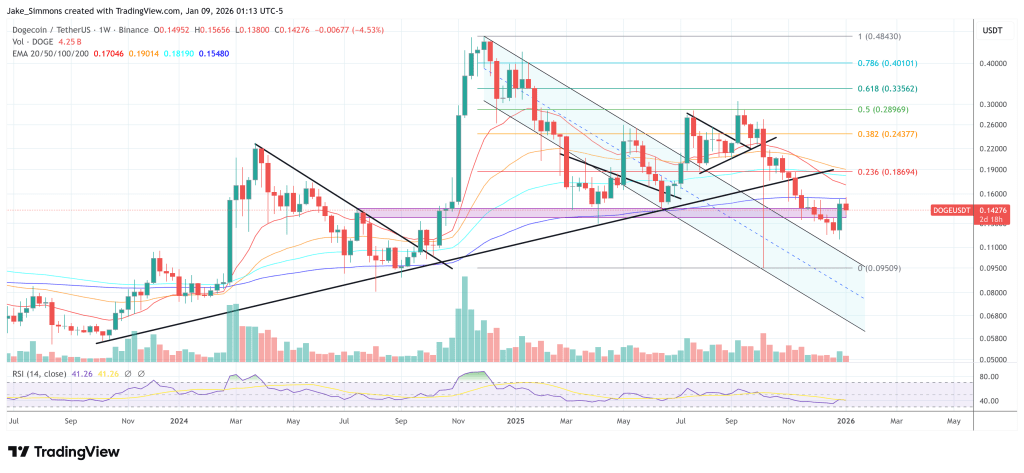
DOGE remains below the 200-week EMA, 1-week chart | Source: DOGEUSDT on TradingView.com

Related Questions

QWhat is the main focus of the partnership between House of Doge, abc Co., Ltd., and ReYuu Japan Inc. in Japan?

AThe partnership focuses on exploring localized Dogecoin adoption and real-world asset (RWA) initiatives, including promoting gold asset-backed stablecoins, regulatory work for RWA token listings, establishing a joint fund, and pushing next-generation Web3 through real-world use cases in the Japanese market.

QWhich two Japan-focused companies did House of Doge partner with for its expansion efforts?

AHouse of Doge partnered with abc Co., Ltd. and ReYuu Japan Inc. for its expansion efforts in Japan.

QWhat role does ReYuu Japan play in this partnership framework?

AReYuu Japan supports business development and localization efforts in Japan for the partnership.

QHow does House of Doge describe the next phase of Dogecoin's development in this announcement?

AHouse of Doge describes Dogecoin's next phase as being about practical utility, including payments, financial products, and tokenization, moving beyond purely cultural relevance and meme-driven branding.

QWhat specific regulatory framework in Japan is mentioned in relation to listing RWA tokens?

AThe partnership framework highlights regulatory-oriented work connected to listing RWA tokens under Japan's 'green list' framework.

Related Reads

Morning Post | Trump Media Group Releases Q1 Financial Report; Top Three DeFi Applications Return Nearly $100 Million in Revenue to Token Holders in 30 Days; Michael Saylor Shares Bitcoin Tracker Info Again

**Title: Daily Briefing | Trump Media Group Releases Q1 Report; Top 3 DeFi Apps Return Nearly $100M to Token Holders; Michael Saylor Signals Potential Bitcoin Buy** **Summary:** Key developments in the past 24 hours include: * **Economic Outlook:** Goldman Sachs has pushed back its forecast for the next two Federal Reserve interest rate cuts to December 2026 and March 2027, citing persistent inflationary pressures from energy costs. This delayed timeline is expected to tighten liquidity flow into risk assets, including cryptocurrencies. * **DeFi & Revenue:** Data from DefiLlama shows that three leading DeFi applications—Hyperliquid, Pump.fun, and EdgeX—collectively distributed $96.3 million in revenue to their token holders over the last 30 days. This trend highlights a shift in the crypto community's focus towards real protocol earnings and sustainable economic models. * **Corporate Bitcoin Moves:** Michael Saylor, founder of MicroStrategy (note: referred to as 'Strategy' in the text, likely a typographical error), has signaled potential upcoming Bitcoin purchases by posting a "Bitcoin Tracker" update, following a pattern that typically precedes the company's official disclosure of new acquisitions. * **Market Integrity:** Prediction market platform Polymarket announced updates to address platform issues, including identifying and banning clusters of accounts involved in "ghost-fill" activities and implementing measures to prevent bulk account creation. * **Regulation:** The Bank of England Governor warned that stablecoin regulation could lead to tensions between US and international regulators. In South Korea, the National Tax Service has launched a pilot program to entrust seized virtual assets to private custody firms for management. * **Meme Token Trends:** GMGN data lists the top trending meme tokens on Ethereum (e.g., HEX, SHIB), Solana (e.g., FWOG, TROLL), and Base (e.g., SKITTEN, PEPE) over the past day. **Financial Note:** Trump Media & Technology Group reported a Q1 loss of approximately $4 billion, primarily attributed to unrealized losses on its Bitcoin and other digital asset holdings.

链捕手28m ago

Morning Post | Trump Media Group Releases Q1 Financial Report; Top Three DeFi Applications Return Nearly $100 Million in Revenue to Token Holders in 30 Days; Michael Saylor Shares Bitcoin Tracker Info Again

链捕手28m ago

Telegram Takes Direct Control of TON, Social Traffic Rewrites the Public Chain Narrative

Telegram founder Pavel Durov announced that Telegram will replace the TON Foundation as the core driver and largest validator of The Open Network (TON). Key initiatives include a sixfold reduction in transaction fees, performance upgrades, and improved developer tools within the next few weeks. This marks a strategic shift from Telegram merely providing user access to deeply integrating TON into its platform's core infrastructure. The goal is to transform Telegram's massive social traffic into sustainable on-chain activity. While viral mini-apps like Notcoin have demonstrated Telegram's ability to drive user adoption, TON aims to support frequent, low-value transactions inherent to social platforms—such as tipping, in-app payments, and game rewards. Ultra-low fees and sub-second finality (0.6 seconds) are crucial to making blockchain interactions seamless and nearly invisible within the Telegram user experience. However, Telegram's increased central role raises questions about network decentralization. Durov argues that Telegram's participation will attract more large validators, thereby enhancing decentralization. TON also offers high annual staking rewards (18.8%), aiming to retain capital within its ecosystem. The fundamental challenge for TON is no longer leveraging Telegram's user base, but becoming an indispensable, seamless infrastructure layer for Telegram's everyday applications—moving from an adjacent chain to an embedded utility.

marsbit29m ago

Telegram Takes Direct Control of TON, Social Traffic Rewrites the Public Chain Narrative

marsbit29m ago

OpenAI Post-Training Engineer Weng Jiayi Proposes a New Paradigm Hypothesis for Agentic AI

OpenAI engineer Weng Jiayi's "Heuristic Learning" experiments propose a new paradigm for Agentic AI, suggesting that intelligent agents can improve not just by training neural networks, but also by autonomously writing and refining code based on environmental feedback. In the experiment, a coding agent (powered by Codex) was tasked with developing and maintaining a programmatic strategy for the Atari game Breakout. Starting from a basic prompt, the agent iteratively wrote code, ran the game, analyzed logs and video replays to identify failures, and then modified the code. Through this engineering loop of "code-run-debug-update," it evolved a pure Python heuristic strategy that achieved a perfect score of 864 in Breakout and performed competitively with deep reinforcement learning (RL) algorithms in MuJoCo control tasks like Ant and HalfCheetah. This approach, termed Heuristic Learning (HL), contrasts with Deep RL. In HL, experience is captured in readable, modifiable code, tests, logs, and configurations—a software system—rather than being encoded solely into opaque neural network weights. This offers potential advantages in explainability, auditability for safety-critical applications, easier integration of regression tests to combat catastrophic forgetting, and more efficient sample use in early learning stages, as demonstrated in broader tests on 57 Atari games. However, the blog acknowledges clear limitations. Programmatic strategies struggle with tasks requiring long-horizon planning or complex perception (e.g., Montezuma's Revenge), areas where neural networks excel. The future vision is a hybrid architecture: specialized neural networks for fast perception (System 1), HL systems for rules, safety, and local recovery (also System 1), and LLM agents providing high-level feedback and learning from the HL system's data (System 2). The core proposition is that in the era of capable coding agents, a significant portion of an AI's learned experience could be maintained as an auditable, evolving software system.

marsbit1h ago

OpenAI Post-Training Engineer Weng Jiayi Proposes a New Paradigm Hypothesis for Agentic AI

marsbit1h ago

Your Claude Will Dream Tonight, Don't Disturb It

This article explores the recent phenomenon of AI companies increasingly using anthropomorphic language—like "thinking," "memory," "hallucination," and now "dreaming"—to describe machine learning processes. Focusing on Anthropic's newly announced "Dreaming" feature for its Claude Agent platform, the piece explains that this function is essentially an automated, offline batch processing of an agent's operational logs. It analyzes past task sessions to identify patterns, optimize future actions, and consolidate learnings into a persistent memory system, akin to a form of reinforcement learning and self-correction. The article draws parallels to similar features in other AI agent systems like Hermes Agent and OpenClaw, which also implement mechanisms for reviewing historical data, extracting reusable "skills," and strengthening long-term memory. It notes a key difference from human dreaming: these AI "dreams" still consume computational resources and user tokens. Further context is provided by discussing the technical challenges of managing AI "memory" or context, highlighting the computational expense of large context windows and innovations like Subquadratic's new model claiming drastically longer contexts. The core critique argues that this strategic use of human-centric vocabulary does more than market products; it subtly reshapes user perception. By framing algorithms with terms associated with consciousness, companies blur the line between tool and autonomous entity. This linguistic shift can influence user expectations, tolerance for errors, and even perceptions of responsibility when systems fail, potentially diverting scrutiny from the companies and engineers behind the technology. The article concludes by speculating that terms like "daydreaming" for predictive task simulation might be next, continuing this trend of embedding the idea of an "inner life" into computational processes.

marsbit1h ago

Your Claude Will Dream Tonight, Don't Disturb It

marsbit1h ago

Trading

Spot
Futures

Hot Articles

How to Buy PUSH

Welcome to HTX.com! We've made purchasing Push Protocol (PUSH) simple and convenient. Follow our step-by-step guide to embark on your crypto journey.Step 1: Create Your HTX AccountUse your email or phone number to sign up for a free account on HTX. Experience a hassle-free registration journey and unlock all features.Get My AccountStep 2: Go to Buy Crypto and Choose Your Payment MethodCredit/Debit Card: Use your Visa or Mastercard to buy Push Protocol (PUSH) instantly.Balance: Use funds from your HTX account balance to trade seamlessly.Third Parties: We've added popular payment methods such as Google Pay and Apple Pay to enhance convenience.P2P: Trade directly with other users on HTX.Over-the-Counter (OTC): We offer tailor-made services and competitive exchange rates for traders.Step 3: Store Your Push Protocol (PUSH)After purchasing your Push Protocol (PUSH), store it in your HTX account. Alternatively, you can send it elsewhere via blockchain transfer or use it to trade other cryptocurrencies.Step 4: Trade Push Protocol (PUSH)Easily trade Push Protocol (PUSH) on HTX's spot market. Simply access your account, select your trading pair, execute your trades, and monitor in real-time. We offer a user-friendly experience for both beginners and seasoned traders.

3.4k Total ViewsPublished 2024.03.29Updated 2025.04.02

How to Buy PUSH

Discussions

Welcome to the HTX Community. Here, you can stay informed about the latest platform developments and gain access to professional market insights. Users' opinions on the price of PUSH (PUSH) are presented below.

活动图片