Do Not Apply Blindly: A Comprehensive Evaluation of the Eight Main Pathways to Hong Kong Residency by 2026

marsbitPublished on 2026-06-24Last updated on 2026-06-24

Abstract

Hong Kong has recently updated its talent attraction policies, offering eight mainstream pathways to residency. These include programs like the Top Talent Pass Scheme (TTPS), Quality Migrant Admission Scheme (QMAS), the newly introduced Technology Professionals Admission Scheme (TP Stream), and Vocational Professionals Admission Scheme (VPAS). Navigating these options involves understanding key details such as core eligibility criteria, employer sponsorship requirements, and the respective advantages and drawbacks of each scheme. A comprehensive comparison chart is provided to help applicants evaluate their choices and potentially save on consultancy fees. Applicants are reminded to always verify information with the official announcements from the Hong Kong Immigration Department.

Author: Biteye

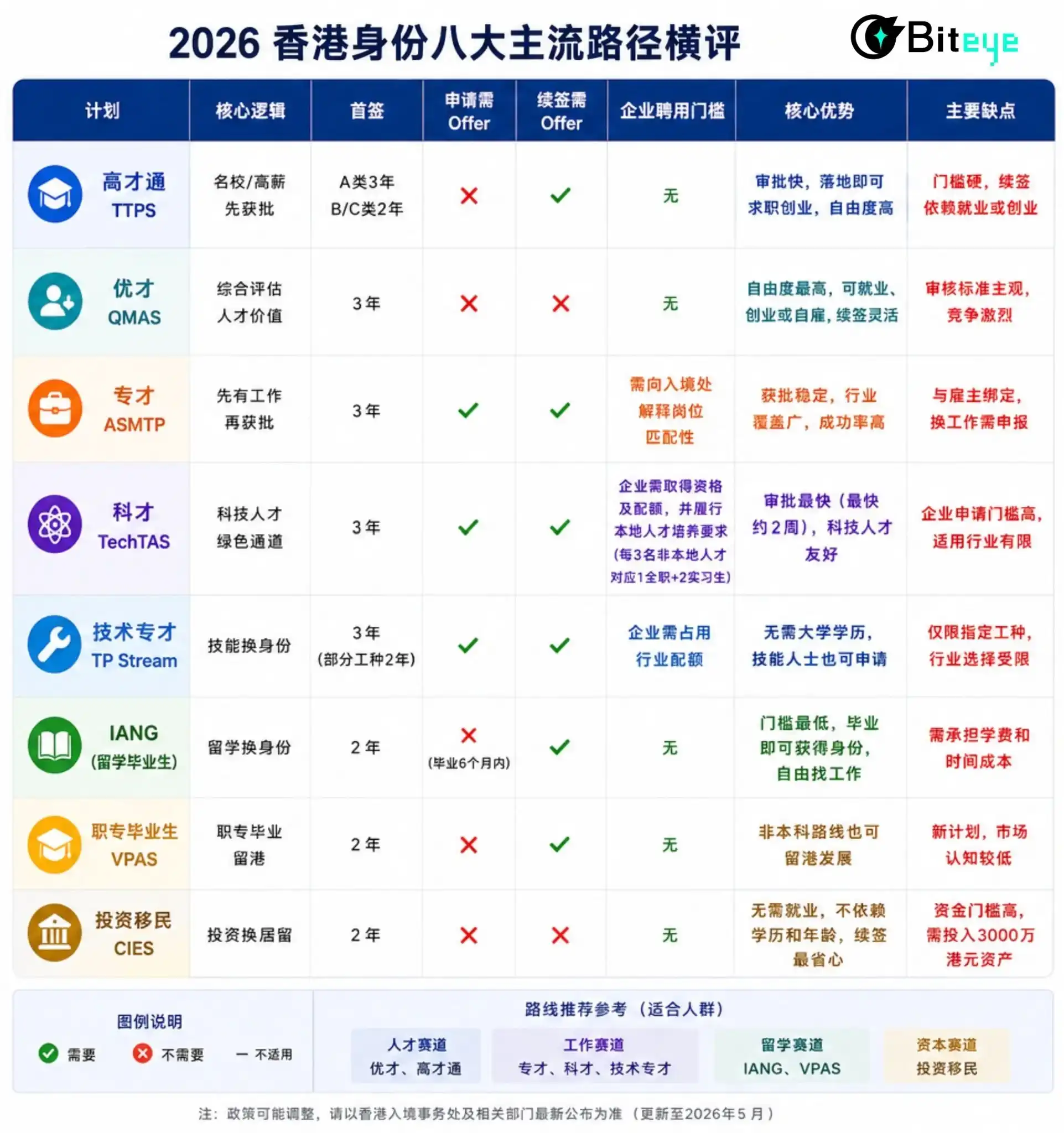
Recently, Hong Kong's talent policies have undergone intensive adjustments. From the Top Talent Pass Scheme (TTPS) and Quality Migrant Admission Scheme (QMAS) to the latest Technical Professionals Stream (TP Stream) and Vocational Professionals Admission Scheme (VPAS), there are now a total of eight mainstream pathways to obtaining residency.

There are many underlying unspoken rules regarding Hong Kong residency. Biteye has distilled the core logic, corporate sponsorship requirements, as well as the advantages and disadvantages of these eight schemes into the comprehensive comparison chart below.

This one chart can save you tens of thousands in agency fees.

(All interested individuals must remember: all information should be verified against the official announcements from the Hong Kong Immigration Department.)

Related Questions

QAccording to the article, how many main pathways are there to obtain Hong Kong residency status in 2026?

AAccording to the article, there are eight main pathways to obtain Hong Kong residency status in 2026.

QWhat does the article claim its comprehensive comparison chart can help readers save money on?

AThe article claims its comprehensive comparison chart can help readers save tens of thousands of dollars on agency or intermediary fees.

QWhich Hong Kong government department's official announcements does the article advise readers to refer to for the final authoritative information?

AThe article advises readers to refer to the official announcements of the Hong Kong Immigration Department for the final authoritative information on all policies.

QWhat are two examples of the eight Hong Kong talent schemes mentioned in the article?

ATwo examples of the eight Hong Kong talent schemes mentioned in the article are the Top Talent Pass Scheme (TTPS) and the Quality Migrant Admission Scheme (QMAS).

QWhat does the article say are the key aspects condensed into its comparison chart regarding the eight residency pathways?

AThe article states that its comparison chart condenses the core logic, employer hiring thresholds, as well as the advantages and disadvantages of each of the eight residency pathways.

Related Reads

You'll Be Surprised How Much WeChat's Architecture Differs from Telegram's

An article compares the core architectural philosophies of WeChat and Telegram, highlighting fundamental differences in data storage, monetization, and developer ecosystems. **Data Storage:** Telegram offers unlimited, synchronized cloud storage for seamless access across all devices. In contrast, WeChat stores chat history locally on each device, requiring a manual migration process for transfer and tethering desktop sessions to an active smartphone. **Features & Ecosystem:** Telegram's open Bot API allows for easy, free bot creation, while WeChat's massive ecosystem of over 4.8 million "mini-programs" operates within a closed, curated, and more regulated platform. Commenting also differs: Telegram uses integrated discussion threads for channels, whereas WeChat relies on pre-moderated comments for official accounts and separate chats for interaction. **File Sharing & Payments:** Telegram supports large file transfers (up to 4GB for Premium), while WeChat limits most files to 200MB. A key divergence is in payments: WeChat Pay is deeply integrated into daily life and commerce in China, whereas Telegram lacks a comparable built-in fiat payment system, focusing instead on third-party bots and crypto. **Analysis:** The comparison reveals two distinct models: WeChat is a tightly integrated, closed ecosystem deeply embedded in the real economy, while Telegram prioritizes open protocols, flexible data handling, and low barriers for developers. An added perspective notes that WeChat's fusion of messaging and payments in a single interface without end-to-end encryption for chats potentially broadens the attack surface, raising security questions as more functions converge.

cryptonews.ru4h ago
You'll Be Surprised How Much WeChat's Architecture Differs from Telegram's

cryptonews.ru4h ago

Trading

Spot
活动图片