Do Not Apply Blindly: A Comprehensive Evaluation of the Eight Main Pathways to Hong Kong Residency by 2026

marsbitPublished on 2026-06-24Last updated on 2026-06-24

Abstract

Hong Kong has recently updated its talent attraction policies, offering eight mainstream pathways to residency. These include programs like the Top Talent Pass Scheme (TTPS), Quality Migrant Admission Scheme (QMAS), the newly introduced Technology Professionals Admission Scheme (TP Stream), and Vocational Professionals Admission Scheme (VPAS). Navigating these options involves understanding key details such as core eligibility criteria, employer sponsorship requirements, and the respective advantages and drawbacks of each scheme. A comprehensive comparison chart is provided to help applicants evaluate their choices and potentially save on consultancy fees. Applicants are reminded to always verify information with the official announcements from the Hong Kong Immigration Department.

Author: Biteye

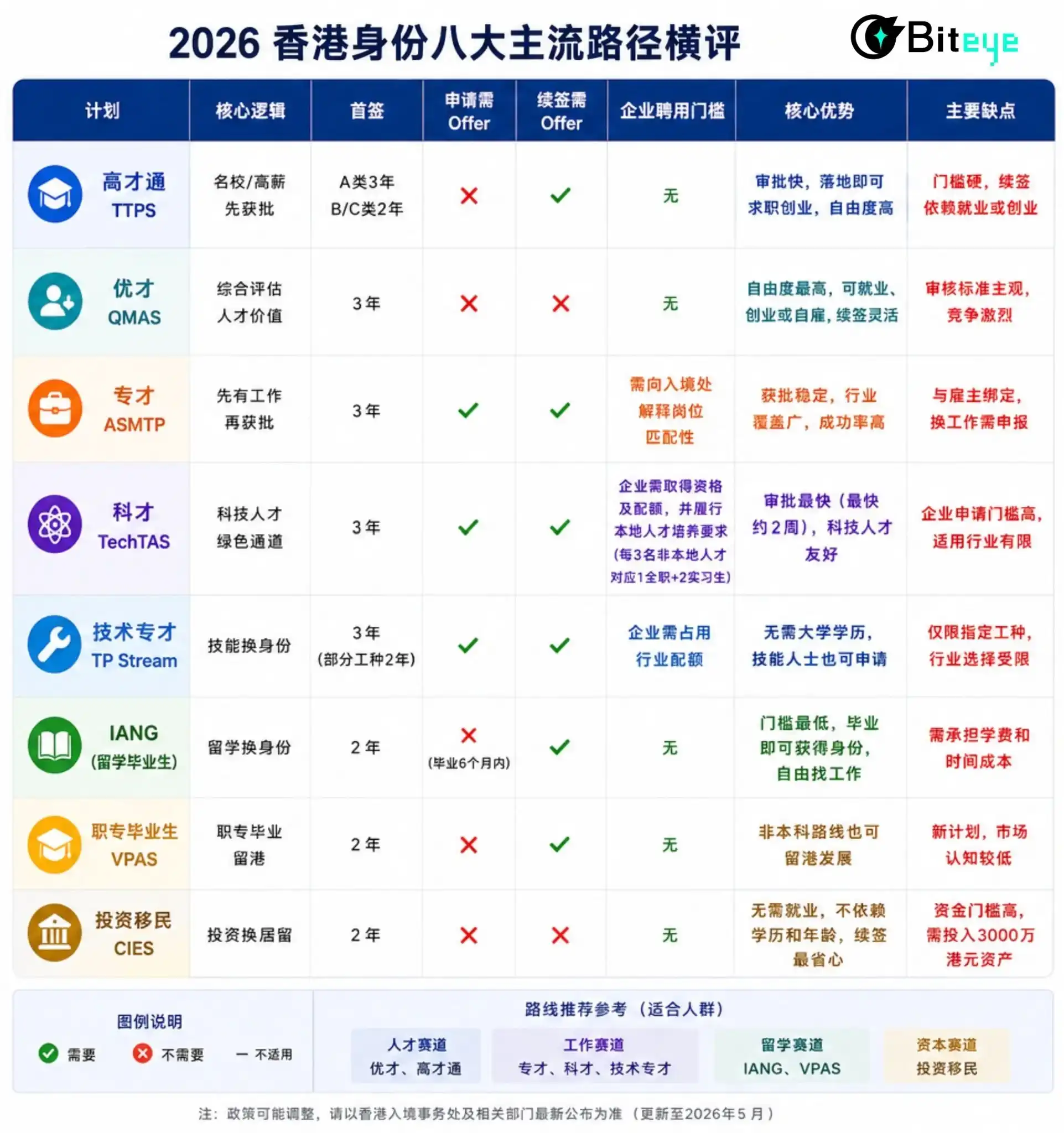
Recently, Hong Kong's talent policies have undergone intensive adjustments. From the Top Talent Pass Scheme (TTPS) and Quality Migrant Admission Scheme (QMAS) to the latest Technical Professionals Stream (TP Stream) and Vocational Professionals Admission Scheme (VPAS), there are now a total of eight mainstream pathways to obtaining residency.

There are many underlying unspoken rules regarding Hong Kong residency. Biteye has distilled the core logic, corporate sponsorship requirements, as well as the advantages and disadvantages of these eight schemes into the comprehensive comparison chart below.

This one chart can save you tens of thousands in agency fees.

(All interested individuals must remember: all information should be verified against the official announcements from the Hong Kong Immigration Department.)

Related Questions

QAccording to the article, how many main pathways are there to obtain Hong Kong residency status in 2026?

AAccording to the article, there are eight main pathways to obtain Hong Kong residency status in 2026.

QWhat does the article claim its comprehensive comparison chart can help readers save money on?

AThe article claims its comprehensive comparison chart can help readers save tens of thousands of dollars on agency or intermediary fees.

QWhich Hong Kong government department's official announcements does the article advise readers to refer to for the final authoritative information?

AThe article advises readers to refer to the official announcements of the Hong Kong Immigration Department for the final authoritative information on all policies.

QWhat are two examples of the eight Hong Kong talent schemes mentioned in the article?

ATwo examples of the eight Hong Kong talent schemes mentioned in the article are the Top Talent Pass Scheme (TTPS) and the Quality Migrant Admission Scheme (QMAS).

QWhat does the article say are the key aspects condensed into its comparison chart regarding the eight residency pathways?

AThe article states that its comparison chart condenses the core logic, employer hiring thresholds, as well as the advantages and disadvantages of each of the eight residency pathways.

Related Reads

Report: Bank of Japan Could Raise Interest Rates as Early as September, with Subsequent Pace Possibly Accelerating

According to Reuters, the Bank of Japan (BOJ) faces mounting pressure to raise interest rates, with a potential hike as early as September. Sources familiar with the internal discussions indicate the central bank is considering accelerating its tightening pace beyond the current schedule of roughly two increases per year. The September 17-18 policy meeting is now viewed as a critical juncture, with market pricing suggesting an approximately 80% probability of a rate hike. This would mark a third increase for 2024, potentially shifting expectations toward a quarterly tightening cycle. Key drivers behind this hawkish shift are multifaceted inflation risks. A persistently weak yen, near a 40-year low, continues to push up import costs. High wholesale prices at a three-year peak signal pending cost pass-through to consumers. Furthermore, inflation expectations among households, businesses, and economists are nearing or exceeding the BOJ's 2% target, raising concerns about de-anchoring. External factors, including energy price volatility from Middle East conflicts and strong global AI-related demand, add further upward pressure. Internal BOJ communications reveal a growing urgency. The July policy meeting summary showed some board members advocating for faster action to avoid "falling behind the curve." Governor Kazuo Ueda acknowledged the need to consider these heightened inflation risks, suggesting the pace of hikes could be increased if financial conditions are deemed too loose. This sentiment underscores a decisive shift within the BOJ toward preemptive monetary tightening.

marsbit11m ago

Report: Bank of Japan Could Raise Interest Rates as Early as September, with Subsequent Pace Possibly Accelerating

marsbit11m ago

To Counter Quantum Threat, Ethereum Abandons Poseidon and Switches to Traditional Hashes

On August 13th, Ethereum researcher Justin Drake announced a strategic pivot in the face of the quantum computing threat: the Ethereum Foundation will abandon the SNARK-friendly hash function Poseidon at the L1 level in favor of traditional hash functions like SHA2 or BLAKE2. This decision, informed by eight years of research, represents a major shift in Ethereum's post-quantum cryptography roadmap. Poseidon, introduced in 2019, has been favored for zkRollups and zkVMs due to its efficiency within SNARK circuits. However, its shorter cryptographic history and analysis timeline became liabilities when post-quantum security became a critical requirement. The change is enabled by breakthroughs in SNARK design, particularly the adoption of "binary field" arithmetic. This allows traditional hash functions (which rely heavily on bitwise operations) to be verified efficiently in SNARKs, with recent benchmarks achieving millions of hashes per second on a laptop. Another key driver is the accelerating timeline of the quantum threat. Reports warn that "Cryptographically Relevant Quantum Computers" (CRQCs) could break current public-key cryptography (like ECDSA) as early as the 2030s, risking trillions in on-chain assets. The enhanced cryptanalysis capabilities of AI have also weakened some post-quantum candidates, pushing Ethereum towards hash-based schemes, deemed more quantum-resistant. Ethereum's post-quantum deployment plan aims for a production-ready leanVM by 2027, followed by full deployment across the consensus, execution, and data availability layers by 2028. This leanVM will aggregate numerous large post-quantum signatures into a single compact proof per block. Other major blockchains are also preparing. Solana's core developers have independently chosen the NIST-standardized Falcon signature scheme for their post-quantum roadmap. Starknet has outlined a multi-phase plan, starting with replacing its Pedersen hash with BLAKE2. By moving from the specialized Poseidon to the battle-tested SHA2/BLAKE2, Ethereum is opting for mature, widely analyzed cryptographic primitives, prioritizing long-term security assurance in the quantum era.

marsbit38m ago

To Counter Quantum Threat, Ethereum Abandons Poseidon and Switches to Traditional Hashes

marsbit38m ago

Nomura Research Report Insights: Lumentum's Performance Confirms Continued Shortage of Optical Chips, Chinese Suppliers See Structural Opportunities

Lumentum's Q4 FY26 earnings, with revenue surging 109% YoY to $1.01B, confirm a sustained global shortage of key optical chips like EML and CW lasers. Nomura's analysis indicates this supply-demand imbalance is expected to persist through FY26-FY27, driven by explosive demand from AI data centers. This shortage creates a structural window of opportunity for Chinese suppliers. Lumentum's performance highlights strong demand across laser categories: narrow linewidth laser component shipments grew over 130% YoY, and pump laser shipments grew 80%. EML sales set a quarterly record, fueled by 100G demand, with 200G EML accelerating to over 25% of related revenue. CW lasers are dominating 1.6T silicon photonics applications, while EML is projected to regain share in the 3.2T era. The technological roadmap is clear, with NPO (Near-Packaged Optics) seen as an incremental step before CPO (Co-Packaged Optics) commercialization around 2027-2028. Furthermore, Lumentum's Optical Circuit Switch (OCS) shipments doubled quarter-over-quarter, aligning with AI data center architectural upgrades. Nomura identifies specific Chinese companies poised to benefit: chipmaker Source Photonics for global market share gains, module leader InnoLight from the 800G-to-1.6T upgrade and silicon photonics adoption, and Tianfu Communication from incremental NPO opportunities. The report issues ratings and price targets for these A-share companies. In summary, Lumentum's results signal a structural shift where AI-driven bandwidth demand is outpacing upstream optical chip supply, creating a strategic window for the Chinese optical communication supply chain.

marsbit51m ago

Nomura Research Report Insights: Lumentum's Performance Confirms Continued Shortage of Optical Chips, Chinese Suppliers See Structural Opportunities

marsbit51m ago

Trading

Spot
活动图片