Did Jane Street 'Manipulate' BTC? Deconstructing the AP System and Understanding the Pricing Power Game Behind the ETF Creation and Redemption Mechanism

marsbitPublished on 2026-02-28Last updated on 2026-02-28

Abstract

The article investigates allegations that Jane Street Capital manipulated Bitcoin prices by exploiting the ETF creation and redemption mechanism. It clarifies that the issue is not unique to Jane Street but stems from structural features of the Authorized Participant (AP) system common to all Bitcoin ETFs, including those from major firms like JPMorgan, Goldman Sachs, and Citadel. APs hold a unique regulatory exemption under Reg SHO, allowing them to create and redeem ETF shares without typical short-selling constraints like borrowing costs or hard deadlines. This creates a potential conflict: while market inefficiencies (e.g., ETF trading below NAV) should naturally attract arbitrageurs to correct prices, APs—who control the arbitrage pipeline—may delay arbitrage to profit elsewhere, such as in derivatives markets. The shift to in-kind (rather than cash) creations/redemptions further reduced structural buying pressure on Bitcoin spot markets. The core problem is not deliberate price suppression by any single AP but a systemic flaw: the AP framework, designed for traditional finance, may undermine price discovery integrity for Bitcoin. The article concludes by questioning whether existing regulatory frameworks are suitable for an asset class predicated on decentralization.

Author: Eddie Xin, Chief Analyst at OSL Group

"They were fcking us the whole time".

This expletive, circulating on Reddit and CT (Crypto Twitter) following the lawsuit, alongside an epic short squeeze with a liquidation scale exceeding $240 billion, directed the market's fury at the same target: Jane Street Capital.

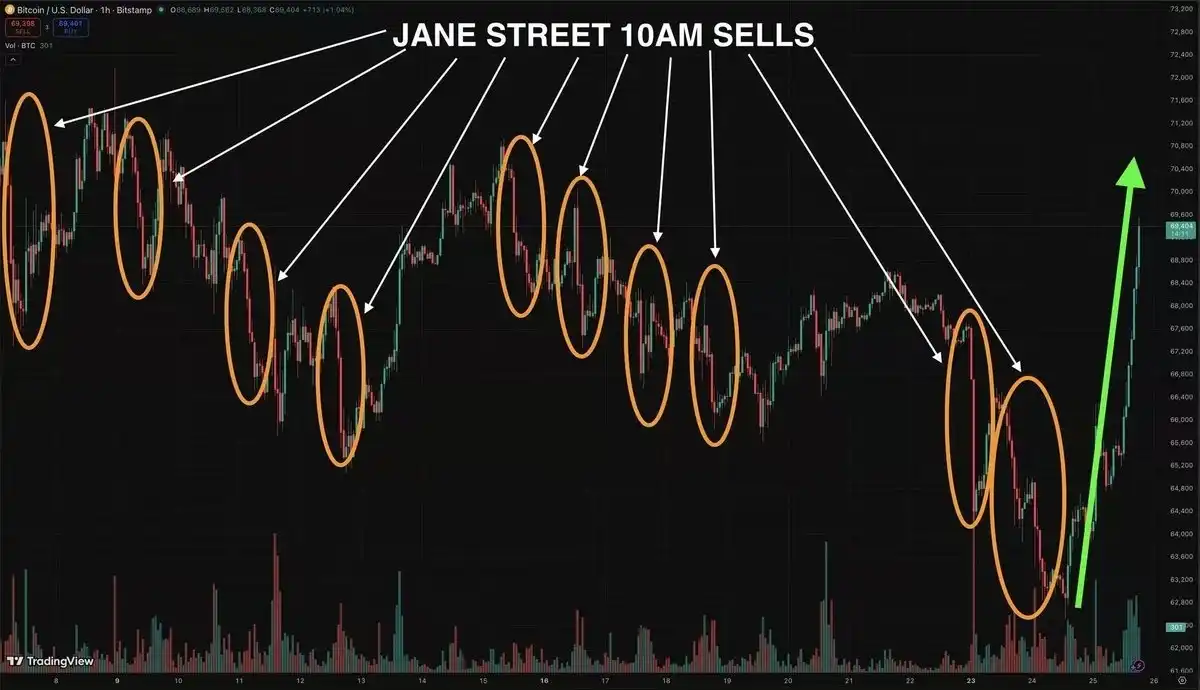
At 10 AM, the liquidity low point in the Asian market for the past few months, the tip of the iceberg was finally revealed with the U.S. Department of Justice's complaint. It all stemmed from Jane Street Capital, a top-tier market maker founded in 2000, which was accused of executing a months-long 'sleight of hand' in the spot and derivative order books by means of targeted ETF arbitrage in the market, utilizing the spot ETF creation and redemption mechanism.

It wasn't until a legal complaint pushed this controversy into the public eye that discussions around the ETF arbitrage mechanism and price discovery structure rapidly heated up, triggering a violent market rebound and an epic short squeeze with a liquidation scale exceeding $240 billion.

But was Jane Street truly the culprit that pressed the suppression button? This is a question worth at least $10 billion.
I. Did Jane Street Really Suppress the BTC Price?

This question deserves an accurate answer. The most important thing to understand first is that this isn't just a question about Jane Street.

It's a question about the structural characteristics of the Bitcoin ETF framework, which applies equally to every Authorized Participant (AP) in the ecosystem. For BlackRock's IBIT alone, this list includes Jane Street Capital, JPMorgan, Macquarie, Virtu Americas, Goldman Sachs, Citadel Securities, Citigroup, UBS, and ABN Amro.

The role of these institutions is deeply misunderstood by the outside world, even among experienced industry veterans, and this misunderstanding deserves to be corrected before drawing any conclusions.

The first thing to understand about APs is that they occupy a marginal exception within the regulatory framework of Reg SHO (the SEC's rule on naked short selling). For instance, Reg SHO requires short sellers to locate shares (locate the stock) before shorting, but APs are exempted due to their contractual right to participate in creations and redemptions.

While this sounds procedural, its practical consequences are significant. It means any AP can create shares at will—no borrowing costs, no capital commitment traditionally associated with short selling, and aside from commercially reasonable timeframes, no hard deadline to close the position.

This is the gray area: a regulatory exemption designed for orderly ETF market making is, structurally, indistinguishable from regulatory arbitrage with an unmatched duration. This exemption is not unique to any single company. It is a prerequisite for membership in the AP club.

II. What Does This AP Exemption Mean?

Normally, if IBIT is trading below its Net Asset Value (NAV), you would expect arbitrage buyers to step in, redeem shares for bitcoin, and close the discount. But any AP *is* that arbitrage buyer; they control the pipeline. This means their incentive to close this discount is different from that of a third-party trading desk without creation/redemption rights.

It sounds complex, but a simple analogy makes it clearer:

First Layer: What is Normal 'Closing the Discount'?

Imagine there's a blind box on the market (this is the IBIT ETF). Everyone knows the blind box contains a real bitcoin voucher worth $100 (this is the NAV). But today, due to market panic, the blind box is priced at $95.

Following normal logic, smart merchants (arbitrage buyers) would frantically buy the blind box for $95, then go to the official source to open it, exchange it for the $100 bitcoin, sell it, and pocket the $5 difference.

And precisely because everyone is buying the blind boxes for arbitrage, the price of the blind box is quickly pushed up by buying pressure, returning to $100. This is called "closing the discount".

Second Layer: The AP with the 'Monopoly Channel'

But in the real world of Bitcoin ETFs, ordinary trading firms and retail investors are not qualified to go to the official source to "open the blind box" (i.e., they lack creation/redemption rights). Only a few privileged Wall Street investment banks (APs) in the entire market can do this. That is, APs monopolize the only channel to exchange ETFs for real bitcoin (they control the pipeline).

Third Layer: Why Don't APs Play by the Arbitrage Rules?

If it were an ordinary third-party merchant, seeing this $5 risk-free spread, they would act immediately. But APs are different; they calculate a more shrewd account: "Since only I can open the blind box, why should I hurry? If I intentionally don't pull the price back to $100, but instead use the current illusion of a low $95 price to go short or long in another casino (like the bitcoin futures market), I might make $20!"

In summary: The market originally has an automatic correction mechanism (if the price falls too much, someone will buy for arbitrage and push the price up). However, because the "only switch" to execute this correction mechanism is held by the APs, and the APs find that "not correcting, maintaining the discount" allows them to make more money elsewhere, they have no incentive to pull the price back to normal levels.

Retail investors suffer waiting for the arbitrage army to save the price, unaware that the only arbitrage army (the APs) is right next door, using this spread to make money in other markets.

III. The Problem Isn't Jane Street, It's the AP Structure

IBIT's short exposure could in principle be hedged by going long bitcoin spot, but this is not mandatory, as long as the chosen instrument maintains a tight correlation.

The obvious alternative is BTC futures, especially given their capital efficiency. This effectively means that if the hedging instrument is futures rather than spot, then the spot is never actually bought. And because the natural arbitrage buyer chooses not to buy spot, this discount cannot be closed through the natural arbitrage mechanism.

It's worth noting that the spot/futures basis is itself the domain of the entire basis trading community, which works to keep this relationship tight. But every separation between the hedging instrument and the underlying asset introduces impure basis risk (dirty basis risk), and this risk compounds throughout the structure—and it is under stress conditions that basis risk is where market dislocation appears.

The final piece of the puzzle involves the recently SEC-approved in-kind creation and redemption. Under the previous cash-only regime, APs were required to deliver cash to the fund, and then the custodian used this cash to buy bitcoin spot. This buying action was a structural regulator—it mechanically forced the purchase of spot as a consequence of creation.

In-kind creation/redemption completely eliminates this. Now any AP can deliver bitcoin directly, and the timing and counterparty for its source can be chosen at its own discretion: OTC desks, negotiated pricing, minimizing market impact.

The broadest interpretation of this flexibility is that an AP could maintain derivative positions aimed at capturing funding rate or volatility profits during the time between establishing a short and completing the in-kind delivery—all while ensuring each individual step still fits the definition of legitimate AP activity.

And this is precisely the crux of the problem. The beginning looks like normal market making, and the end looks like normal market making. It is the middle process that is difficult to clearly categorize. This is not an indictment of any single company. Every AP on the IBIT list, and by extension every AP for every Bitcoin ETF, operates within the same structural framework, enjoys the same exemptions, and therefore possesses the same theoretical capability. Whether any of them exercised this capability in a manner that verges on coordinated activity is a question that falls squarely within the purview of the "surveillance sharing agreements" the SEC required upon ETF approval.

Whether these agreements are sufficient to capture behavior that simultaneously spans spot, futures, and ETF markets (even including cross-border trading venues) remains a truly open question.

In a nutshell, Jane Street is just in the spotlight. The real problem is buried deep in the underlying architecture of the Bitcoin ETF, designed by Wall Street veterans. No specific AP is explicitly suppressing the bitcoin price. What the AP structure can suppress is the integrity of the price discovery mechanism itself, which may have far more profound implications than the former.

Therefore, the question truly worth asking is not whether a specific company is the villain, but whether a regulatory framework built for 20th-century traditional finance is suitable for hosting an emerging 21st-century asset whose "value lies in being free from control by regulatory agencies".

This is perhaps the tuition fee the crypto market must pay to enter the "era of big institutions." After all, while we crave the liquidity irrigation from Wall Street, we do not wish to passively accept the black-box games they construct using regulatory exemptions.

This is not just the answer about Jane Street, but the ultimate question of the Bitcoin ETF era.

Related Questions

QWhat is the core allegation against Jane Street Capital in relation to Bitcoin ETFs?

AJane Street Capital is accused of exploiting the creation and redemption mechanism of Bitcoin ETFs to conduct arbitrage between spot and derivative markets, using a regulatory exemption that allows them to potentially suppress price discovery rather than correct market inefficiencies.

QWhat is an Authorized Participant (AP) in the context of Bitcoin ETFs, and what special privilege do they hold?

AAn Authorized Participant (AP) is a large financial institution, like Jane Street or J.P. Morgan, that has the exclusive right to create and redeem ETF shares. They hold a key regulatory exemption from Reg SHO, allowing them to create shares without first locating the stock, which eliminates borrowing costs and hard deadlines associated with traditional short selling.

QWhy might an AP choose not to arbitrage a price discrepancy between an ETF and its Net Asset Value (NAV)?

AAn AP might choose not to arbitrage a discount because they control the only mechanism to correct it. They can profit more by maintaining the discrepancy and using it to execute strategies in derivative markets (like futures) to earn funding rates or volatility profits, rather than simply closing the gap for a smaller, immediate gain.

QHow did the shift from cash-only to in-kind creation and redemption for Bitcoin ETFs change the market dynamics?

AThe shift to in-kind creation removed a structural market stabilizer. Under the cash-only model, APs had to deliver cash to the fund, which forced the custodian to buy Bitcoin spot, supporting its price. With in-kind creation, APs can deliver Bitcoin directly from sources like OTC desks, giving them more flexibility and eliminating the forced spot market purchases.

QAccording to the article, what is the fundamental problem, and is it specific to Jane Street?

AThe fundamental problem is not specific to Jane Street but is a structural issue inherent in the Bitcoin ETF framework. The regulatory exemptions and arbitrage mechanisms granted to all APs can suppress the integrity of the price discovery process itself, raising questions about whether a traditional financial regulatory framework is suitable for a decentralized asset like Bitcoin.

Related Reads

Trading

Spot
Futures

Hot Articles

What is $BITCOIN

DIGITAL GOLD ($BITCOIN): A Comprehensive Analysis Introduction to DIGITAL GOLD ($BITCOIN) DIGITAL GOLD ($BITCOIN) is a blockchain-based project operating on the Solana network, which aims to combine the characteristics of traditional precious metals with the innovation of decentralized technologies. While it shares a name with Bitcoin, often referred to as “digital gold” due to its perception as a store of value, DIGITAL GOLD is a separate token designed to create a unique ecosystem within the Web3 landscape. Its goal is to position itself as a viable alternative digital asset, although specifics regarding its applications and functionalities are still developing. What is DIGITAL GOLD ($BITCOIN)? DIGITAL GOLD ($BITCOIN) is a cryptocurrency token explicitly designed for use on the Solana blockchain. In contrast to Bitcoin, which provides a widely recognized value storage role, this token appears to focus on broader applications and characteristics. Notable aspects include: Blockchain Infrastructure: The token is built on the Solana blockchain, known for its capacity to handle high-speed and low-cost transactions. Supply Dynamics: DIGITAL GOLD has a maximum supply capped at 100 quadrillion tokens (100P $BITCOIN), although details regarding its circulating supply are currently undisclosed. Utility: While precise functionalities are not explicitly outlined, there are indications that the token could be utilized for various applications, potentially involving decentralized applications (dApps) or asset tokenization strategies. Who is the Creator of DIGITAL GOLD ($BITCOIN)? At present, the identity of the creators and development team behind DIGITAL GOLD ($BITCOIN) remains unknown. This situation is typical among many innovative projects within the blockchain space, particularly those aligning with decentralized finance and meme coin phenomena. While such anonymity may foster a community-driven culture, it intensifies concerns about governance and accountability. Who are the Investors of DIGITAL GOLD ($BITCOIN)? The available information indicates that DIGITAL GOLD ($BITCOIN) does not have any known institutional backers or prominent venture capital investments. The project seems to operate on a peer-to-peer model focused on community support and adoption rather than traditional funding routes. Its activity and liquidity are primarily situated on decentralized exchanges (DEXs), such as PumpSwap, rather than established centralized trading platforms, further highlighting its grassroots approach. How DIGITAL GOLD ($BITCOIN) Works The operational mechanics of DIGITAL GOLD ($BITCOIN) can be elaborated on based on its blockchain design and network attributes: Consensus Mechanism: By leveraging Solana’s unique proof-of-history (PoH) combined with a proof-of-stake (PoS) model, the project ensures efficient transaction validation contributing to the network's high performance. Tokenomics: While specific deflationary mechanisms have not been extensively detailed, the vast maximum token supply implies that it may cater to microtransactions or niche use cases that are still to be defined. Interoperability: There exists the potential for integration with Solana’s broader ecosystem, including various decentralized finance (DeFi) platforms. However, the details regarding specific integrations remain unspecified. Timeline of Key Events Here is a timeline that highlights significant milestones concerning DIGITAL GOLD ($BITCOIN): 2023: The initial deployment of the token occurs on the Solana blockchain, marked by its contract address. 2024: DIGITAL GOLD gains visibility as it becomes available for trading on decentralized exchanges like PumpSwap, allowing users to trade it against SOL. 2025: The project witnesses sporadic trading activity and potential interest in community-led engagements, although no noteworthy partnerships or technical advancements have been documented as of yet. Critical Analysis Strengths Scalability: The underlying Solana infrastructure supports high transaction volumes, which could enhance the utility of $BITCOIN in various transaction scenarios. Accessibility: The potential low trading price per token could attract retail investors, facilitating wider participation due to fractional ownership opportunities. Risks Lack of Transparency: The absence of publicly known backers, developers, or an audit process may yield skepticism regarding the project's sustainability and trustworthiness. Market Volatility: The trading activity is heavily reliant on speculative behavior, which can result in significant price volatility and uncertainty for investors. Conclusion DIGITAL GOLD ($BITCOIN) emerges as an intriguing yet ambiguous project within the rapidly evolving Solana ecosystem. While it attempts to leverage the “digital gold” narrative, its departure from Bitcoin's established role as a store of value underscores the need for a clearer differentiation of its intended utility and governance structure. Future acceptance and adoption will likely depend on addressing the current opacity and defining its operational and economic strategies more explicitly. Note: This report encompasses synthesised information available as of October 2023, and developments may have transpired beyond the research period.

363 Total ViewsPublished 2025.05.13Updated 2025.05.13

What is $BITCOIN

Discussions

Welcome to the HTX Community. Here, you can stay informed about the latest platform developments and gain access to professional market insights. Users' opinions on the price of BTC (BTC) are presented below.

活动图片