Design, Development, Legal, Sports... Polymarket Launches 'Full-Stack' Talent Grab

Odaily星球日报Published on 2026-04-15Last updated on 2026-04-15

Abstract

Polymarket, a leading prediction market platform, is aggressively expanding its team across multiple domains following competitor Kalshi's recent $22 billion valuation funding round. Key hires and strategic acquisitions are central to its growth strategy. Design remains a priority, with the design lead actively recruiting to strengthen the platform's distinctive blue-and-white branding. Engineering recruitment is also intensive, highlighted by the acquisition of API platform Dome, whose co-founders joined Polymarket, and the hiring of a former Aave engineering VP. Multiple senior engineering roles are currently open. For its US platform, Polymarket is bolstering legal and compliance expertise, adding a former RBC Capital Markets veteran as Legal Counsel. In a significant move, it hired a former Fanatics CBO to lead sports business development, which sparked a non-compete lawsuit from Fanatics, revealing complex industry entanglements. Further hires include a former Coinbase institutional product lead to handle institutional liquidity sales, a marketing head from MrBeast's team, and a Citadel veteran for exchange upgrades. Polymarket is also recruiting for HR and a Head of Markets, indicating the talent competition in the prediction market space is far from over.

Original|Odaily Planet Daily(@OdailyChina)

Author|Wenser(@wenser 2010 )

After Kalshi completed a new funding round in March with a valuation of $22 billion, Polymarket, one of the two giants in the prediction market, couldn't sit still.

Apart from the news that it was previously seeking funding with a $20 billion valuation, Polymarket has also been busy recruiting new team members recently for platform development and business expansion. From the list of new team members joining Polymarket, we might get a glimpse of the focus and突围 directions of this former prediction market霸主, now the "perennial runner-up".

Odaily Planet Daily will provide a梳理 and analysis based on Polymarket's recruitment information in this article.

Design Remains a Top Priority: Design Lead Posted Recruitment Plan in January

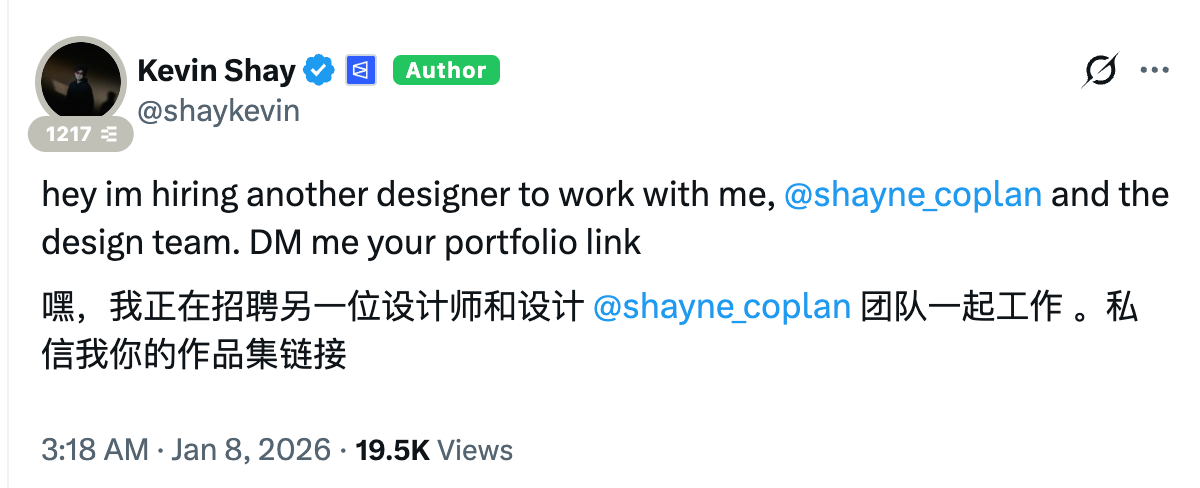
In January of this year, Polymarket's Head of Design, Kevin Shay, posted a tweet stating that he was recruiting designers. Apart from distinguishing itself from Kalshi's green and white UI, Polymarket's blue and white UI remains an important design language and iconic symbol. Its previously opened pop-up grocery store in New York also used corresponding blue and white elements in its design. In the crucial battle for brand突围, design is still a top priority for Polymarket's development.

Additionally, according to the official recruitment page, there are currently 2 design-related positions still open.
Development Engineers Continuously Recruited: Emphasizing Both Talent Acquisition and External Recruitment

As the business cornerstone of platform development, developers are also a key driving force behind Polymarket's recent business expansion. The strategy adopted by Polymarket's talent recruitment team is to emphasize both talent acquisition and external recruitment.

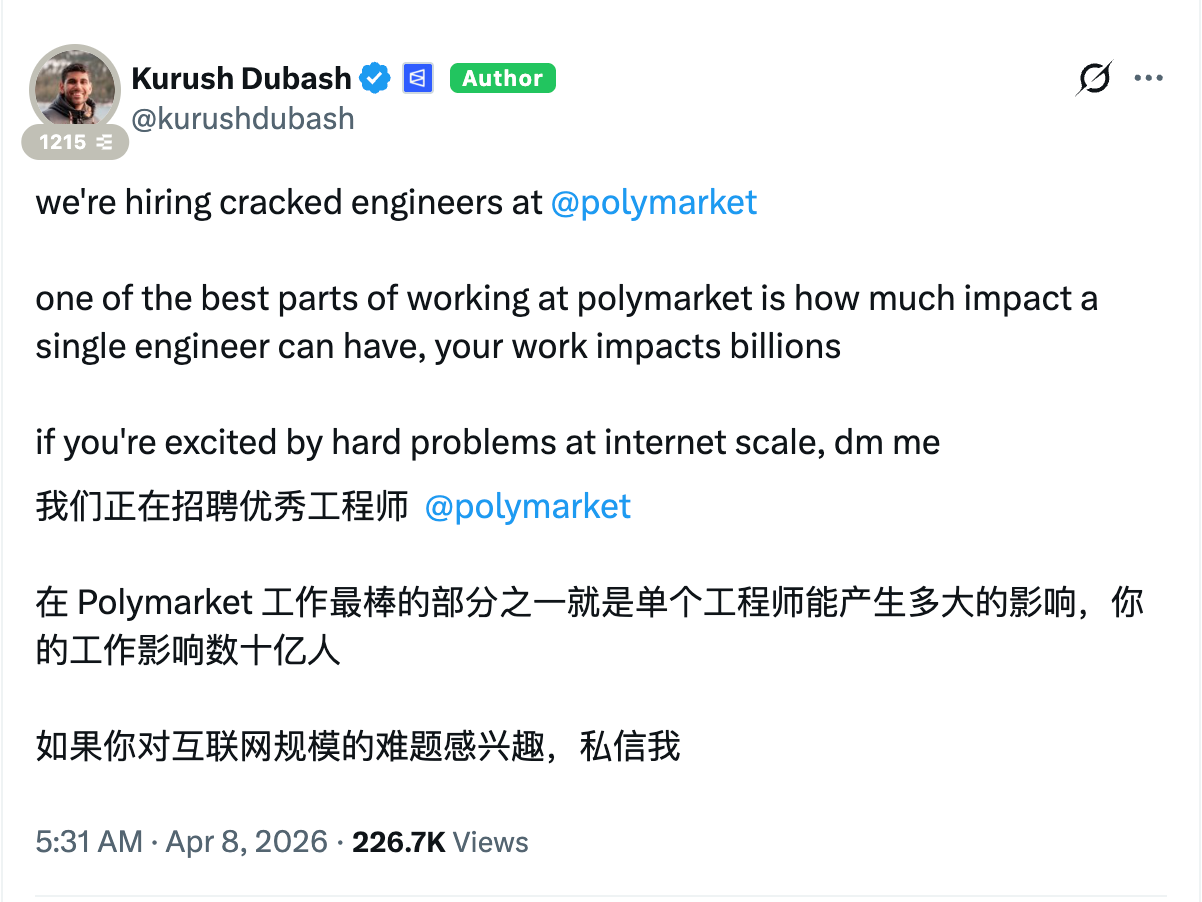
Kurush Dubash & Kunal Roy, Two Co-founders of Dome

In February, the prediction market API platform Dome was officially acquired by Polymarket. Subsequently, Dome's two co-founders, Kurush Dubash and Kunal Roy, also joined Polymarket. In April, they posted tweets recruiting top engineers, beginning to show a "person-to-person"火热 recruitment phenomenon.

It is worth mentioning that Polymarket also acquired the executive search firm Lunch in the same month; many of the executives and team members mentioned later were contacted and recruited by the leaders of this company; in March, Polymarket also acquired the DeFi infrastructure startup Brahma, and most of its team members have also been integrated into the Polymarket team.
Josh Stevens, Vice President of Engineering

On March 24th, former Aave engineer and senior vice president Josh announced that he had joined Polymarket. And just half a month later, he was already posting again on his personal account to recruit engineers. It seems that the developer gap at the rapidly developing Polymarket is much larger than outsiders might imagine.
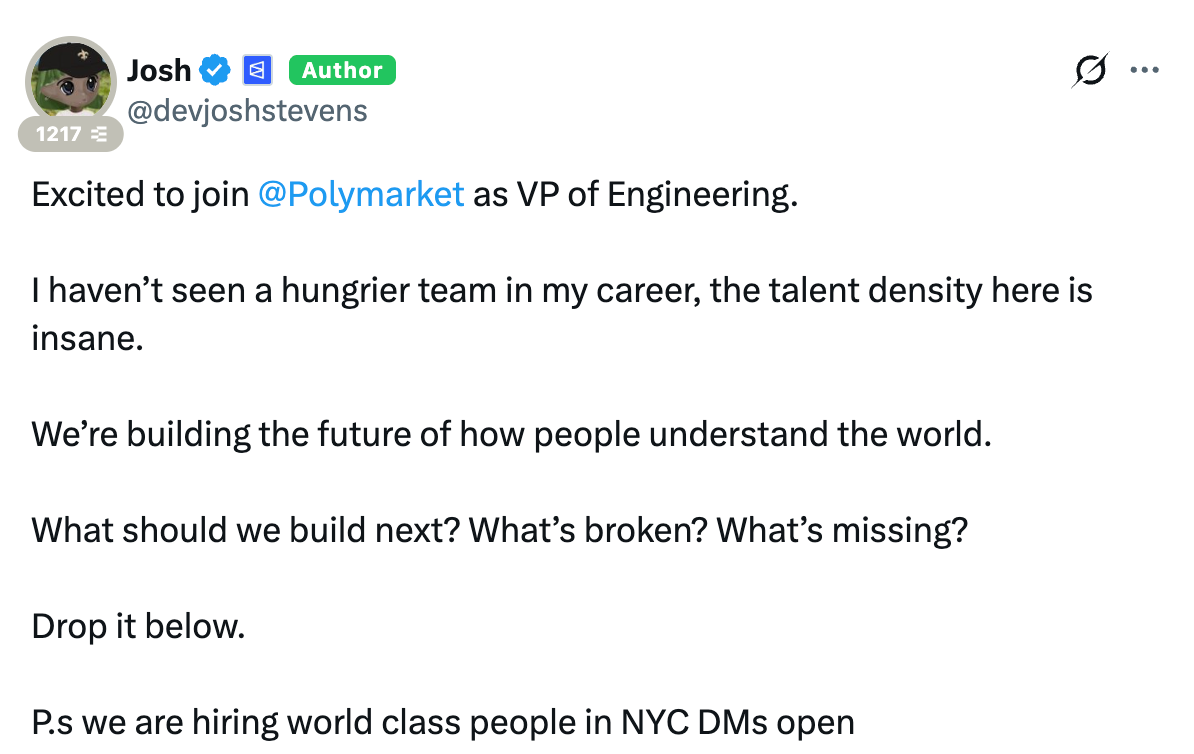
Joining announcement tweet in March
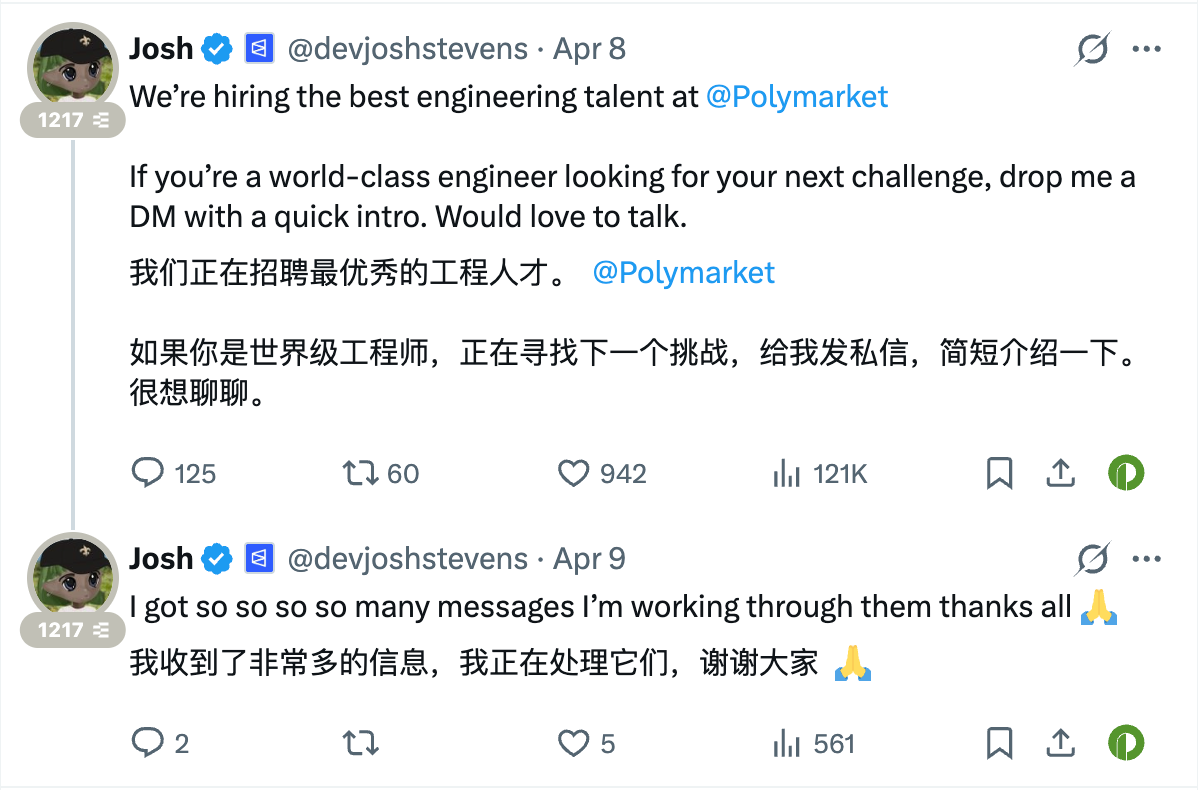
Posting recruitment information again in early April

Additionally, according to the official recruitment page information, the developer positions currently being recruited by Polymarket include Senior Backend Engineer (US Platform), C/C++ Senior Engineer (US Platform), Smart Contract Developer, Mobile AI Engineer, and Senior Platform Infrastructure Engineer. Interested friends can try applying.

Compliance, Legal, and Sports Betting Talent: Personnel Reserves for Polymarket's US Platform

Last November, by acquiring the US-compliant trading platform QCX, Polymarket finally managed to return to the US market. Facing the increasingly stringent regulatory environment in the US market and the regulatory contradictions between federal agencies and state/local courts, Polymarket has had to once again strengthen its talent reserves in legal and compliance aspects.

Matthew Lischin, Legal Counsel for Polymarket US Platform

In February 2026, after ending his 13-year tenure at RBC Capital Markets (the investment banking division of Royal Bank of Canada), Matthew Lischin finally joined Polymarket as the Head of North America Global Markets Legal Team. Public information shows that he will focus on the legal compliance of complex financial products such as equity derivatives and margin loans.

It is worth mentioning that when he posted on LinkedIn announcing his departure from RBC, Polymarket's Chief Legal Officer, Neal Kumar, left a comment to communicate. Perhaps due to this opportunity, Lischin later posted确认 joining the Polymarket US platform as Legal Counsel,直言: "The wish has finally come true!"

Ari Borod, Former Fanatics Executive Becomes President of Sports Business Development

In February 2026, after ending his 4-year tenure as Chief Commercial Officer (CBO) and other positions at the well-known sports betting platform Fanatics, Ari Borod subsequently plunged into Polymarket, the prediction market霸主 and rising star in sports betting.

Unexpectedly, due to his sensitive career experience, it also triggered a non-compete lawsuit from his former employer Fanatics. Although the lawsuit was eventually settled out of court, it must be said that in the process of the prediction market's growth, friction with traditional industries like sports betting may not only exist at the regulatory level but also at the talent争夺 level.

Public information shows that Ari Borod led the strategic transformation of Fanatics from fan merchandise to sports betting business. Earlier, he served as Chief Commercial Officer and Chief Operating Officer at The Action Network and worked at FanDuel for six years, rising from Assistant General Counsel to Vice President of Sports at Fanatics.

However, in the non-compete lawsuit filed by Fanatics in a Florida court, court documents revealed another shocking thing - Fanatics founder Michael Rubin and Fanatics Betting and Gaming CEO Matt King personally hold shares in Kalshi. It just goes to show that real business warfare is everywhere. Furthermore, even more laughably, Fanatics had previously been involved in a non-compete lawsuit for hiring Mike Hermalyn, former Senior Vice President of Growth at DraftKings. It seems因果循环,报应不爽 (karma is a cycle, retribution is not pleasant).

Institutional Liquidity Awaits Introduction: Former Coinbase Institutional Product Lead

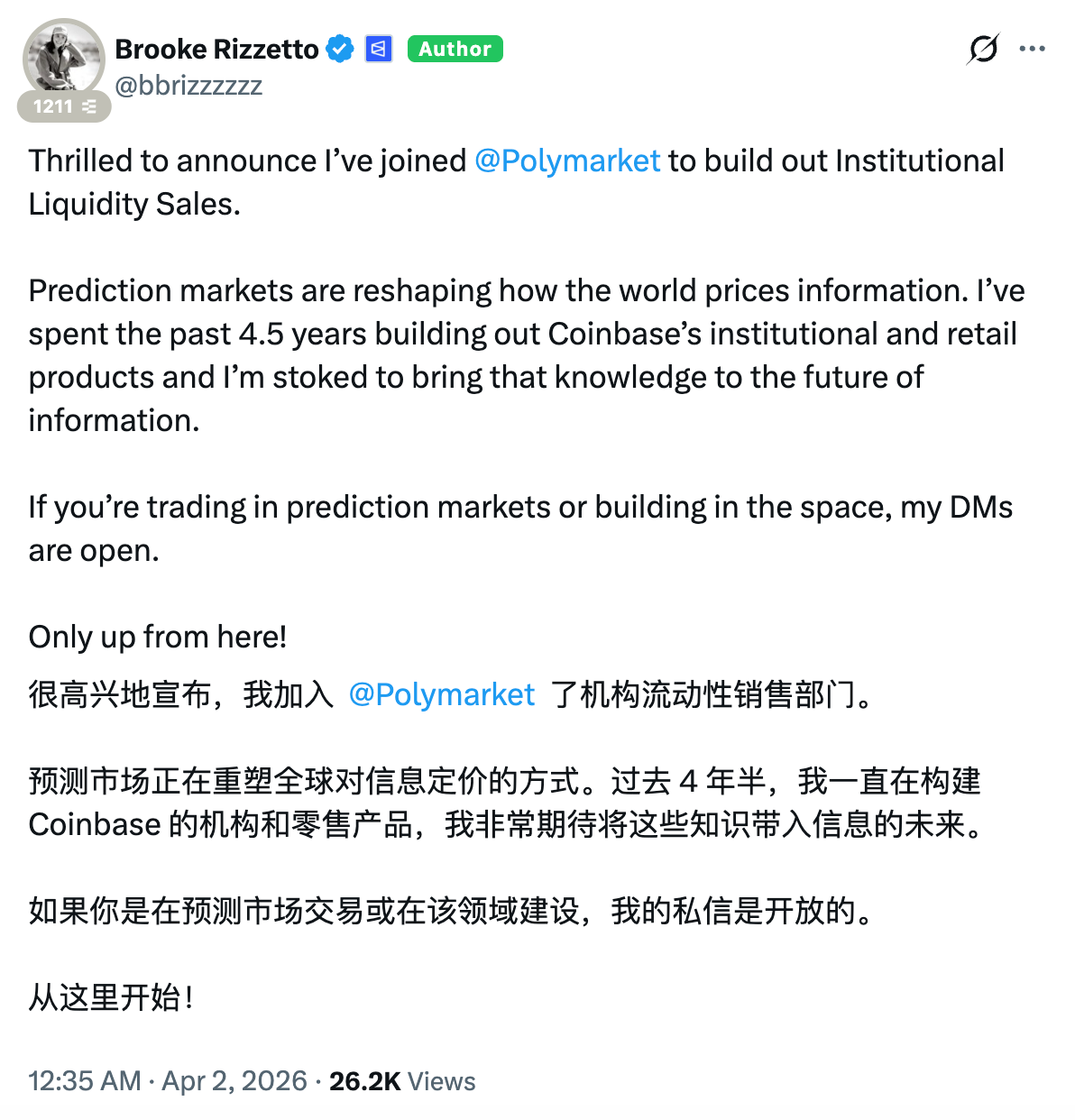
On April 2nd, former Coinbase Head of Institutional & Retail Products, Brooke Rizzetto, officially announced joining Polymarket, stating that she would later be responsible for "institutional liquidity sales." After working at Coinbase for over 4 years, Brooke Rizzetto began seeking new ways of information pricing and liquidity introduction from the prediction market赛道.
In addition to the above personnel, other team members recently joining Polymarket include former "MrBeast (YouTube's top influencer Beast Mr.)" viral marketing lead Josh Tucker, and Citadel hedge fund veteran of 8 years Mukilan Ashok,主要负责 marketing, exchange platform upgrades and other business.

Furthermore, Polymarket's Head of People Recruitment, Matthew Kendall Clark, recently pointed out in a post that they are currently recruiting Personnel Recruitment Staff and Polymarket Head of Markets. This "talent arms race" among prediction market platforms is clearly still in the land-grabbing stage, far from over.

For more information about Polymarket's recruitment, please check its official recruitment page.

Related Questions

QWhat is the valuation of Kalshi after its latest funding round in March, as mentioned in the article?

AKalshi was valued at $22 billion after its latest funding round in March.

QWhich two key strategies is Polymarket using to recruit developers for its platform expansion?

APolymarket is using talent acquisition and external recruitment as its key strategies to recruit developers.

QWho was hired as the President of Sports Business Development at Polymarket, and what controversy was associated with this hire?

AAri Borod was hired as the President of Sports Business Development, and his hiring led to a non-compete lawsuit from his former employer, Fanatics, which was eventually settled out of court.

QWhat specific role will Brooke Rizzetto, formerly of Coinbase, take on at Polymarket?

ABrooke Rizzetto will be responsible for institutional liquidity sales at Polymarket.

QWhich two companies did Polymarket acquire to support its talent recruitment and platform development efforts?

APolymarket acquired Dome, a prediction market API platform, and Brahma, a DeFi infrastructure startup, to support its talent recruitment and platform development.

Related Reads

Will the Fed Definitely Raise Interest Rates in September? How Will Crypto and U.S. Stocks Withstand the Pressure?

The market's expectation for a September Fed rate hike surged dramatically in early August, jumping from under 50% to over 80% within a week. This shift followed a contentious July FOMC meeting, where a 9-3 vote to hold rates revealed growing dissent from hawkish members advocating for an immediate hike to combat persistent inflation. The primary catalyst for this repricing is rising oil prices, driven by renewed geopolitical tensions around the Strait of Hormuz, which threaten global supply. Energy costs directly influence inflation metrics, making the upcoming July CPI report (due August 12th) a critical data point. If it shows inflation reaccelerating, the probability of a September hike will solidify. For Bitcoin and crypto assets, this is typically bearish news. Bitcoin continues to behave as a high-beta, liquidity-sensitive risk asset. A rate hike raises the opportunity cost of holding non-yielding assets and could drive capital toward money markets, pressuring crypto prices in the short term. However, historical patterns suggest that if a hike is perceived as the end of a tightening cycle rather than the start, any negative price impact may be brief. U.S. stocks, particularly crypto-linked equities like Coinbase and growth-oriented tech stocks, are also vulnerable. Higher rates increase discount rates in valuation models, putting pressure on high-multiple companies. This coincides with a pivotal tech earnings season where investor focus has shifted from massive AI capital expenditure to tangible revenue and cash flow generation. Companies with negative cash flow and weak growth narratives could face heightened volatility if borrowing costs rise in September. In summary, a September Fed hike has evolved into a mainstream market scenario. Key factors to watch are oil prices, the July CPI report, and Fed communications, which will determine the final decision and its impact on volatile crypto and equity markets.

marsbit4m ago

Will the Fed Definitely Raise Interest Rates in September? How Will Crypto and U.S. Stocks Withstand the Pressure?

marsbit4m ago

A 'Overlooked' Market Event: Joint US-Japan-South Korea Intervention, Rare US Treasury Involvement, and Bessent's Quiet 'Market Rescue'?

Summary: The United States, Japan, and South Korea executed their largest coordinated foreign exchange intervention in nearly 30 years. The action targeted depreciation pressure on the Japanese yen and South Korean won. This move is seen as a significant effort by the US to stabilize the financial markets of its key allies and prevent the spillover of risks. Key details: * Japan reportedly intervened on July 30 using approximately 8.45 trillion yen (about $52.8 billion). South Korean authorities also intervened that day, selling dollars to support the won. * Notably, the US Treasury Department intervened directly in yen markets for the first time in roughly 30 years. The New York Fed, reportedly acting on behalf of the Treasury, sold euros to buy yen via Goldman Sachs and Morgan Stanley on July 31. Analysts view the use of the euro-yen pair as a way to alleviate yen pressure without adding selling pressure to the US dollar. * Prior to the action, the New York Fed conducted "rate checks" on both USD/JPY and EUR/JPY, a newer signaling tool that falls between verbal and physical intervention. The intervention is interpreted as going beyond traditional currency stabilization. Analysts, such as Michael Hartnett of Bank of America, suggest it resembles a "Price Keeping Operation" for the AI era. The core US objectives are perceived to be: 1. Preventing rapid yen depreciation from triggering a sharp rise in Japanese government bond yields. 2. Containing financial stress from spreading across Asian markets like South Korea and Japan. 3. Reducing the risk of disorderly capital flows impacting the US bond market. This coordinated action underscores the importance of Japan and South Korea as critical partners in the US semiconductor and AI supply chain. Stabilizing their financial markets is seen as vital to mitigating risks to the broader tech industry and the US market itself. The intervention coincides with market pressures, including the KOSDAQ index hitting a low since October 2022. While seen as a move to control volatility, some analysts caution it may not fundamentally reverse existing market trends.

marsbit8m ago

A 'Overlooked' Market Event: Joint US-Japan-South Korea Intervention, Rare US Treasury Involvement, and Bessent's Quiet 'Market Rescue'?

marsbit8m ago

Will the Federal Reserve Definitely Raise Interest Rates in September? How Will Cryptocurrencies and US Stocks Bear the Pressure?

In early August 2024, market expectations for a September Federal Reserve rate hike surged dramatically, from below 50% to over 80%, driven by renewed inflation concerns. This shift followed a contentious July FOMC meeting where a 9-3 vote to hold rates revealed a growing hawkish faction advocating for an immediate hike, citing prolonged above-target inflation. The key catalyst is escalating conflict near the Strait of Hormuz, which has pushed oil prices up approximately 20% in July, threatening to reignite inflation. The next critical data point is the July CPI report on August 12th; a hot reading could solidify hike expectations. For crypto assets, particularly Bitcoin, this represents near-term pressure. Bitcoin continues to exhibit high-beta, risk-on characteristics, making it sensitive to tightening liquidity and higher opportunity costs. However, historical precedent suggests that if a hike is perceived as the cycle's end rather than its start, the negative impact may be brief, with markets quickly pivoting to anticipate future rate cuts. U.S. stocks, especially crypto-linked equities like Coinbase and high-valuation tech stocks, face amplified volatility. Higher rates increase discount rates in valuation models, pressuring growth stocks. This coincides with a pivotal tech earnings season where investor focus has shifted from massive AI capital expenditures to demonstrable revenue and cash flow generation. Companies with negative cash flows and weak growth narratives could see severe pressure if a September hike materializes, as financing costs would rise. Key indicators to watch include oil prices, upcoming inflation data, and Fed commentary at events like the Jackson Hole symposium.

Odaily星球日报8m ago

Will the Federal Reserve Definitely Raise Interest Rates in September? How Will Cryptocurrencies and US Stocks Bear the Pressure?

Odaily星球日报8m ago

Trading

Spot
活动图片





