Derive [DRV] gains 40% on Upbit news – THIS zone marks next major hurdle

ambcryptoPublished on 2026-07-14Last updated on 2026-07-14

Abstract

Derive (DRV) surged approximately 40% following news of its upcoming listing on the South Korean exchange Upbit, with trading in KRW, BTC, and USDT pairs set to begin on July 14th. The announcement triggered aggressive buying, raising the price from $0.1147 to a peak of $0.19, though it later settled near $0.1471. Market capitalization reached roughly $109.64 million, and 24-hour trading volume spiked by over 1744% to $9.38 million. Technical indicators like the RSI hitting 84.43 prompted early profit-taking, suggesting overheated momentum. The key challenge for DRV is to prove sustained demand beyond the initial listing hype. Maintaining support above $0.131 will be crucial to confirm continued buyer interest, while metrics like holder growth, stable volumes, and exchange flows will determine if the rally can evolve into a stronger, long-term market foundation or follow a typical post-listing reversal pattern.

Derive [DRV] will enter one of Asia’s largest crypto markets after Upbit announced KRW, Bitcoin [BTC], and Tether [USDT] trading pairs. Trading will begin on 14th of July, expanding access following Derive’s migration from Lyra Finance.

The listing opens the protocol to South Korea’s active retail market and could attract broader global participation. Greater accessibility could deepen liquidity and strengthen price discovery across multiple trading pairs.
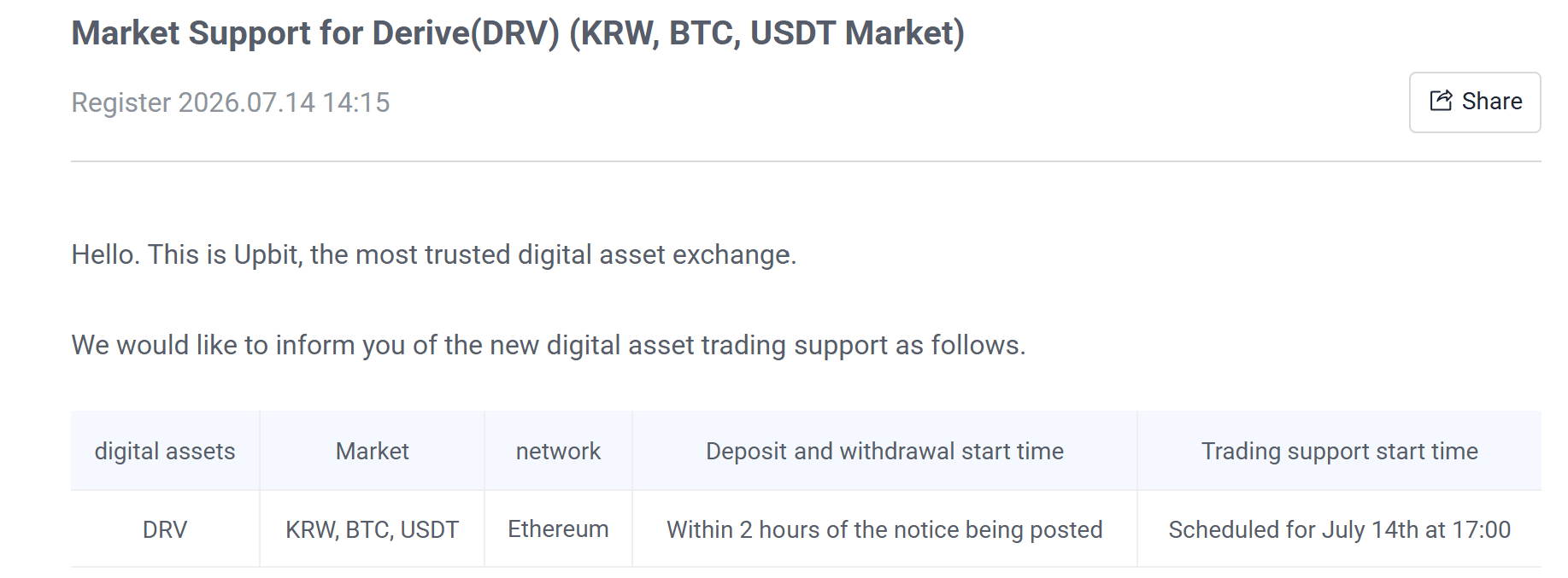
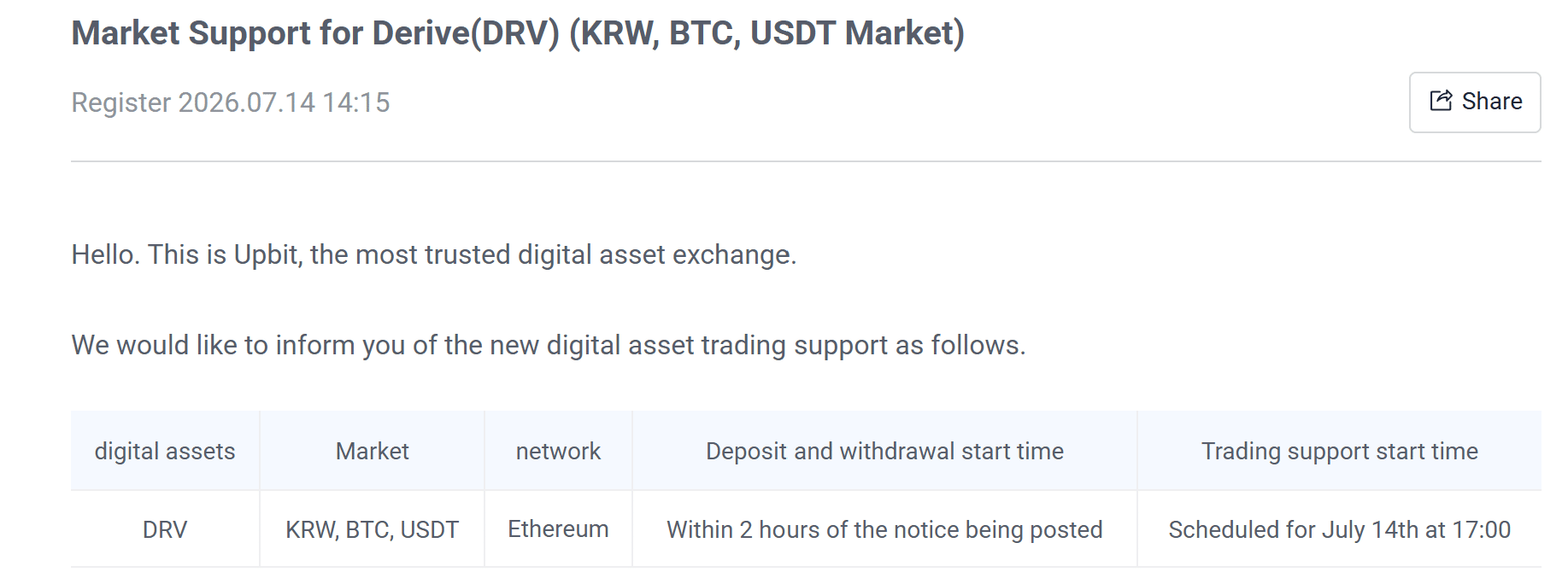
Source: UPbit

Derive has continued expanding its on-chain options and perpetual futures ecosystem following its 2024 rebranding.

However, it is unlikely that simply receiving additional Exchange support will help to create long-term demand.

Traders must deliver stronger volumes, deeper order books, and consistent participation. Those metrics will reveal whether broader accessibility strengthens Derive’s market position beyond its initial listing.

Why did DRV rally?

The announcement quickly changed DRV’s market dynamics. Rather than waiting for trading to begin, buyers aggressively repriced the token in anticipation of stronger liquidity and broader market participation.

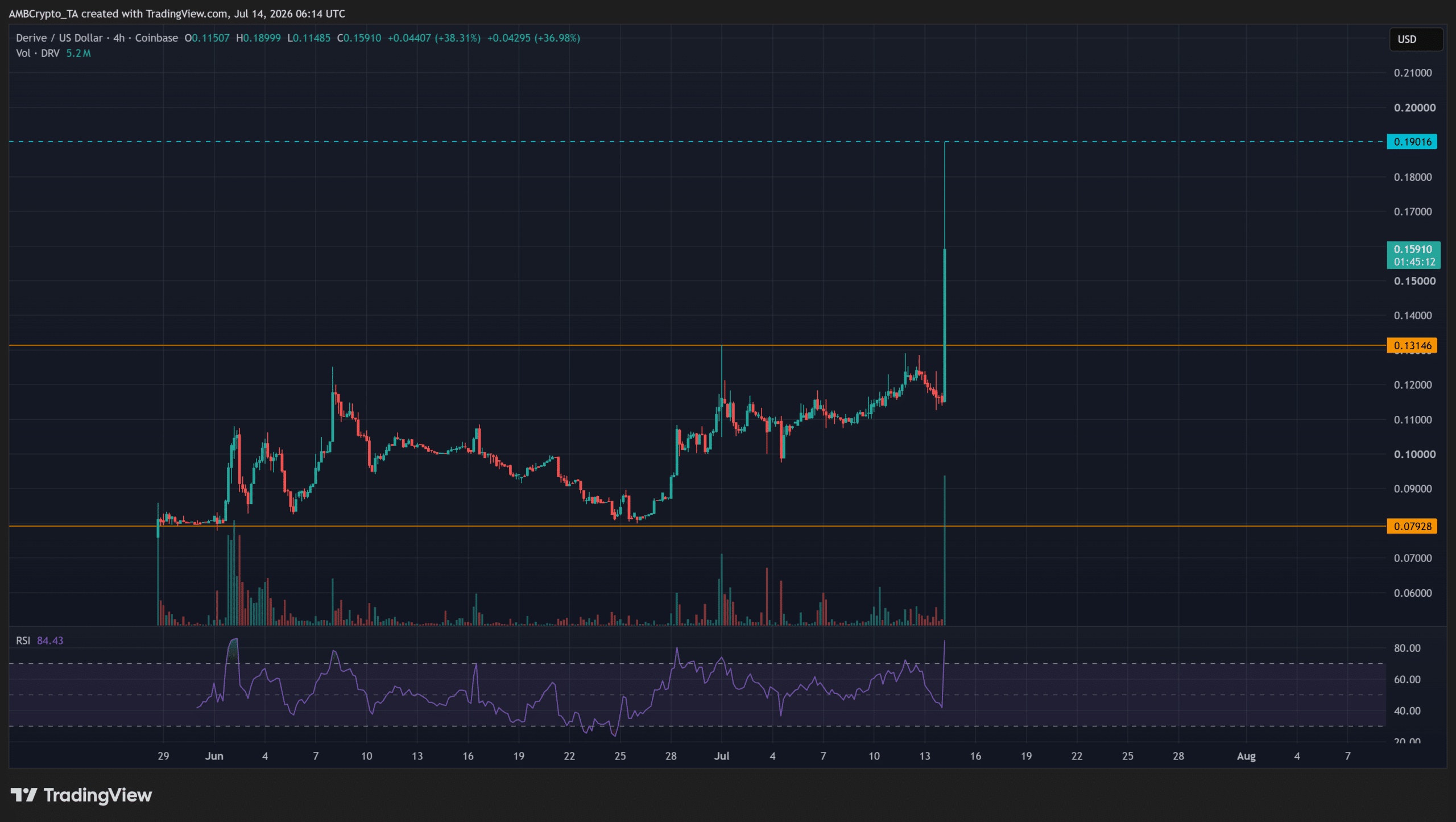
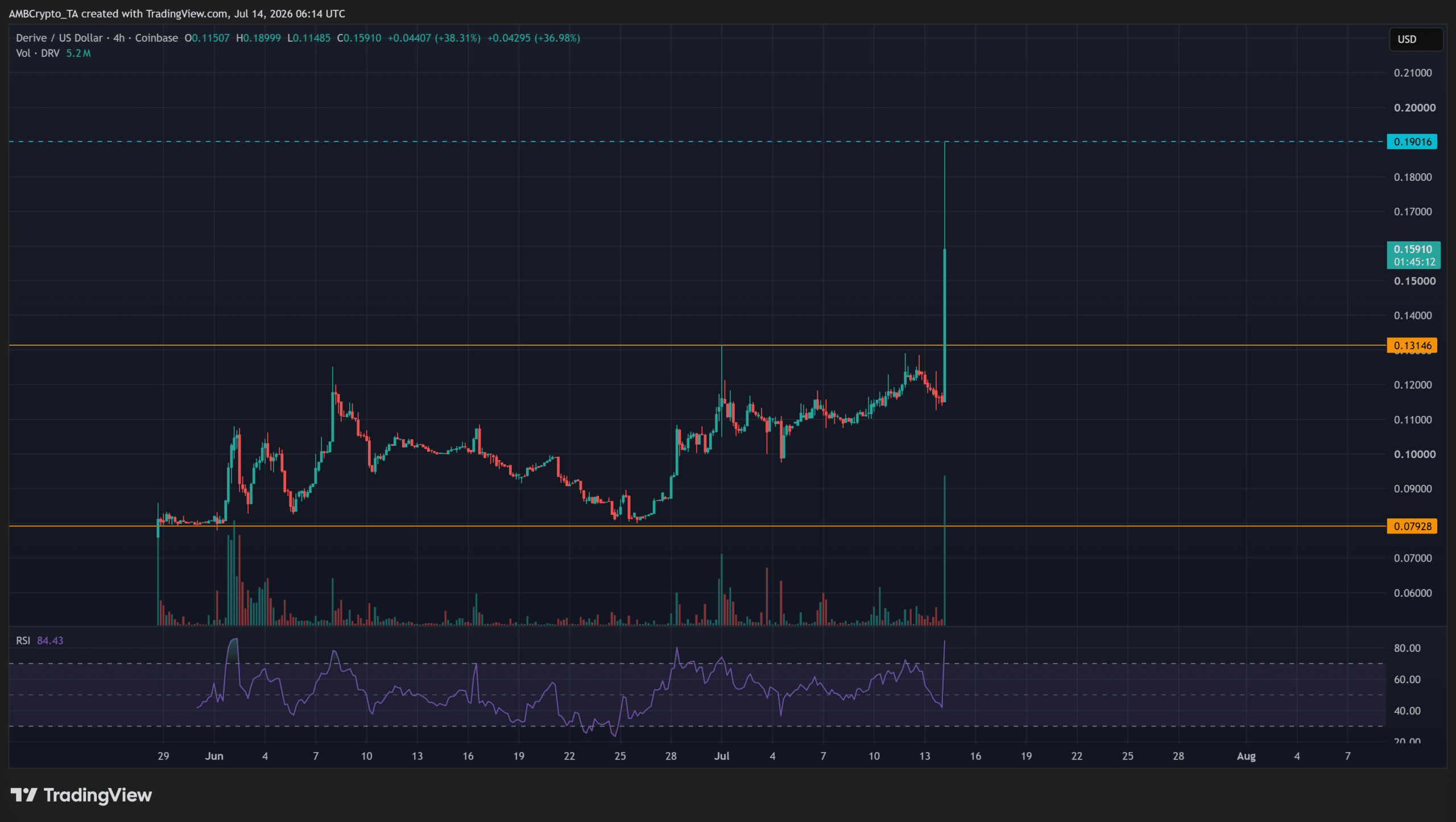
The price rose by approximately 40%, or from $0.1147 to $0.19, before falling to $0.1486. Meanwhile, market capitalization rose to approximately $109.64 million.

Notably, 24-hour trading volume grew by 1744.3% to $9.38 million. These developments suggested that the rally attracted fresh capital instead of isolated buying.
Source: DRV/USD on TradingView

However, the Relative Strength Index (RSI) reached 84.43.

As a result, it prompted early profit-taking as momentum became overheated.

That reaction implied that traders were locking in gains rather than abandoning the breakout completely. At the press time, the token was trading near $0.1471.

Still, holding above $0.131 would confirm buyers continue absorbing supply, whereas losing that level would suggest speculative demand is fading.

Can DRV build on the listing rally?

Early investor enthusiasm for the token has been evident in recent price action. The next challenge is proving that demand extends beyond the listing catalyst.

In many cases, speculative buying by short-term traders drives early price movement. However, sustained price appreciation requires continued investment over time after the immediate hype from the listing wears off.

Rising holder growth would indicate investors are accumulating rather than flipping tokens. Meanwhile, stable trading volumes and improving market depth would suggest liquidity is becoming more resilient.

More importantly, exchange net flows will also reveal whether buyers continue absorbing supply or early participants dominate selling.

Together, those indicators will determine whether DRV develops a stronger market foundation or follows the familiar pattern of post-listing reversals.


Final Summary

  • Derive [DRV] is set to gain broader liquidity and market access as Upbit prepares to open KRW, BTC, and USDT trading.
  • Derive now turns its focus from securing a major exchange listing to proving the rally reflects lasting demand.


Related Questions

QWhy did DRV's price rally by approximately 40%?

AThe price rallied by approximately 40% following the announcement of DRV's upcoming listing on Upbit. Buyers aggressively repriced the token in anticipation of stronger liquidity and broader market participation from the new trading pairs.

QWhat are the new trading pairs for Derive (DRV) on Upbit and when does trading begin?

AUpbit announced KRW, Bitcoin (BTC), and Tether (USDT) trading pairs for Derive (DRV). Trading is set to begin on the 14th of July.

QWhat key price level does the article suggest buyers must hold above to confirm continued demand?

AThe article suggests that holding above $0.131 would confirm buyers continue absorbing supply, whereas losing that level would suggest speculative demand is fading.

QWhat does the article say is needed to create long-term demand for DRV beyond the initial listing hype?

AThe article states that simply receiving additional exchange support is unlikely to create long-term demand. It requires stronger trading volumes, deeper order books, consistent participation, rising holder growth, and resilient liquidity to build a stronger market foundation.

QWhat did the high RSI reading of 84.43 prompt among traders, according to the article?

AThe high RSI reading of 84.43 prompted early profit-taking as momentum became overheated, indicating traders were locking in gains.

Related Reads

In Jinjiang, Fujian, a Storage Super Unicorn Lies Quiet

In Fujian's Jinjiang, a city known for sportswear, lies a quiet semiconductor giant: Fujian Jinhua Integrated Circuit Co. (JHICC). Once a promising domestic DRAM manufacturer alongside Yangtze Memory and ChangXin Memory Technologies (CXMT), its journey was derailed in 2018 when the U.S. placed it on an Entity List and filed criminal charges for alleged trade secret theft. This halted production for years. A turning point came in February 2024 when a U.S. federal court found JHICC not guilty. However, it had lost crucial time. While CXMT soared to become a top-valued A-share company in 2024, JHICC, with an estimated valuation of 80 billion RMB, was just restarting. Its current output is primarily customized DDR4 chips, not the advanced DDR5/HBM demanded for AI, but it still benefits from the broader memory chip upcycle. JHICC's story is tied to Chen Zhengkun, a veteran engineer who left Micron to lead the venture. Founded in 2016 with state-backed funding, JHICC partnered with Taiwan's UMC to develop DRAM technology. Rapid progress was cut short by the U.S. actions, which Micron initiated, partly due to its heavy reliance on the Chinese market. Post-sanctions, Chen's team worked to rebuild the production line with reduced reliance on U.S. technology. According to its records, JHICC achieved small-scale production and revenue growth under immense pressure. It now focuses on the stable "niche" DRAM market (e.g., TVs, routers) with a monthly capacity of ~40,000 wafers, aiming for 60,000 by 2026. It holds over 1,000 patents but remains on the Entity List. For Jinjiang, investing in JHICC was a bold industrial leap. The local government provided unwavering financial and logistical support during the crisis, helping the company survive. JHICC has become the anchor for a growing local semiconductor cluster. Though its scale lags behind domestic peers, JHICC's persistence symbolizes a hard-won foothold in a global market long dominated by Samsung, SK Hynix, and Micron. Having missed one boom, it seeks a place in the new AI-driven memory supercycle.

marsbit54m ago

In Jinjiang, Fujian, a Storage Super Unicorn Lies Quiet

marsbit54m ago

Trading

Spot
活动图片




