DeFi vs. SEC: Should ‘non-custodial platforms’ be treated like exchanges?

ambcryptoPublished on 2026-04-02Last updated on 2026-04-02

Abstract

DeFi Education Fund (DEF) argues that non-custodial DeFi protocols, AMMs, and their developers should not be regulated as exchanges or intermediaries, as they don’t perform exchange functions or control user assets. They oppose SIFMA’s push for SEC regulation based on function rather than decentralization. SIFMA and Citadel Securities advocate for regulating DeFi platforms handling tokenized securities to ensure investor protection, citing risks and scams. DEF suggests Wall Street’s stance may be motivated by business interests, as DeFi disrupts traditional intermediaries. The SEC faces the challenge of balancing innovation and regulation in its upcoming framework.

DeFi regulation is back in the headlines as the crypto industry and Wall Street disagree on the proposed ‘innovation exemption’ for tokenized assets.

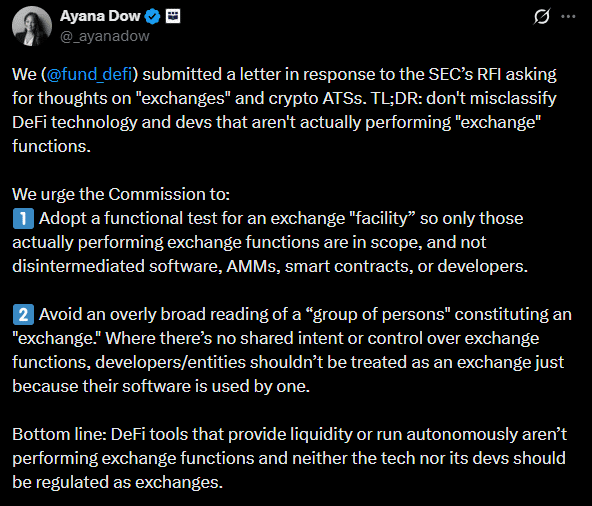
On the 1st of April, a DeFi advocacy group, the DeFi Education Fund (DEF), wrote to the SEC arguing that decentralized protocols should not be ‘misclassified as intermediaries’ like centralized traditional exchanges.

Ayan Dow, legal officer at DEF, added,

DeFi tools that provide liquidity or run autonomously aren’t performing exchange functions, and neither the tech nor its devs should be regulated as exchanges.
Source: X

According to the advocacy group, any non-custodial application does not fall within the legal definition of an intermediary or exchange. Additionally, classifying developers as intermediaries, yet they don’t control the ‘non-custodial platforms’ they’ve built, would place an overwhelming regulatory burden on them.

As such, the advocacy group pressed that any suggested DeFi regulation scope should exclude disintermediated software, automated market makers (AMMs), smart contracts, and non-controlling developers.

Wall Street opposes DeFi legal exemption

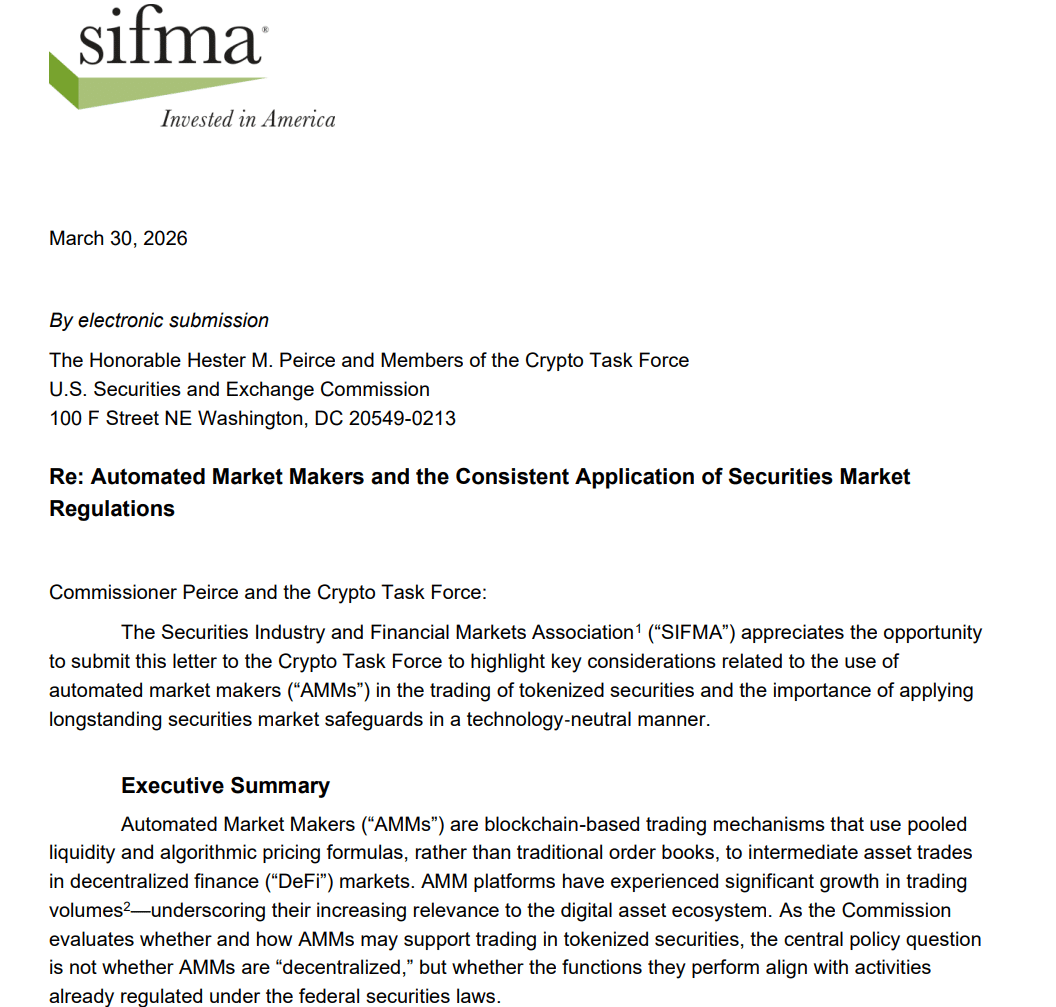
The DEF letter was also a response to SIFMA (Securities Industry and Financial Markets Association). The TradFi umbrella group recently argued that the SEC should regulate AMMs, citing risk to investor protections.

According to SIFMA, the SEC should regulate AMMs and DeFi platforms based on their functions in supporting tokenized securities trading. And not based on whether they’re decentralized, as DeFi supporters propose.

SIFMA believes the Commission should maintain technology neutrality by regulating AMMs based on their market function rather than protocol architecture.
Source: SEC

SIFMA’s stance echoed Citadel Securities’ position. Last year, Citadel called for a strict regulation of DeFi platforms that handle tokenized securities.

SIFMA and Citadel’s opposition to unregulated DeFi could be genuine concerns, given the scams and blowouts seen in the past across the sector. For Wall Street, compliance should apply to everyone handling tokenized securities.

However, Citadel gets most of its revenue from being a centralized intermediary, especially for retail platforms like Robinhood. As a result, DEF views the Wall Street opposition as motivated by the potential disruption of DeFi tech (removing intermediaries) to its business interests.

It remains to be seen how the SEC will address these competing interests while still supporting innovation in the upcoming ‘exemption’ framework for tokenized securities.


Final Summary

  • Advocacy group DeFi Education Fund (DEF) has opposed SIFMA’s push to regulate AMMs and other non-custodial DeFi platforms
  • However, SIFMA claims most ‘decentralized’ platforms pose investor protection risks.

Related Questions

QWhat is the main argument made by the DeFi Education Fund (DEF) in their letter to the SEC?

AThe DEF argues that decentralized protocols should not be misclassified as intermediaries like centralized exchanges. They state that DeFi tools providing liquidity or running autonomously are not performing exchange functions, and neither the technology nor its developers should be regulated as exchanges.

QWhy does the DEF believe that regulating developers as intermediaries would be problematic?

AThe DEF believes that classifying developers as intermediaries when they do not control the 'non-custodial platforms' they built would place an overwhelming and inappropriate regulatory burden on them.

QWhat is SIFMA's position on the regulation of Automated Market Makers (AMMs) and DeFi platforms?

ASIFMA argues that the SEC should regulate AMMs and DeFi platforms based on their function in supporting tokenized securities trading, not on whether they are decentralized. They believe regulation should be technology-neutral and based on market function.

QWhat potential conflict of interest does the DEF suggest motivates Wall Street's opposition to DeFi exemptions?

AThe DEF suggests that Wall Street firms, like Citadel Securities which earns most of its revenue as a centralized intermediary, are motivated by the potential disruption that DeFi technology (which removes intermediaries) poses to their business interests.

QWhat is the core issue that the SEC must address regarding the proposed 'innovation exemption' for tokenized assets?

AThe SEC must address the competing interests between the crypto industry, which seeks exemptions for non-custodial DeFi platforms, and traditional finance (Wall Street), which argues for function-based regulation, all while still trying to support innovation.

Related Reads

AAOI Defies Trend with Over 10% Surge, 'New Stock God' Serenity Predicts Potential to Double Again

On June 4th, despite a significant sell-off in the broader AI and semiconductor sector triggered by Broadcom's disappointing guidance, Applied Optoelectronics (AAOI) surged over 11%, showcasing a sharp divergence in market sentiment. Broadcom's warning about potential supply chain diversification by key customer Google and a weaker-than-expected outlook punctured the high-flying AI valuation narrative. This led to heavy selling in names like Broadcom (-12.6%) and Micron (-7%), with funds rotating into traditional industrial stocks. AAOI defied this trend. The stock has experienced high volatility recently, driven by bullish analyst coverage, notably from Rosenblatt which raised its price target to $220. Key catalysts include initial 800G optical module revenue from Amazon, potential certification from Oracle, and strong demand across its product portfolio. The company has reported cumulative orders for 800G/1.6T modules exceeding $324 million and is aggressively expanding manufacturing capacity in Texas, targeting an annualized run-rate of $1.4 billion for its module business by Q3 2027. However, AAOI's fundamentals present a mixed picture. Its Q1 2026 results missed expectations, showing a GAAP net loss, and Q2 guidance points to merely breakeven adjusted EPS. Risks include a delayed 800G production ramp to the second half of the year and high dependence on a few key cloud customers. Recent stock sales by company executives near price highs also noted. The article suggests AAOI's rally reflects a market beginning to differentiate within the AI ecosystem. While Broadcom's issues prompted a reassessment of custom ASIC and customer concentration risks, funds flowing into AAOI indicate a belief that the "physical bottleneck" narrative for optical connectivity—where supply remains tight—remains intact and is somewhat decoupled from the current sector weakness. The sustainability of AAOI's premium valuation now hinges on the successful execution of its production plans and upcoming quarterly results.

marsbit8m ago

AAOI Defies Trend with Over 10% Surge, 'New Stock God' Serenity Predicts Potential to Double Again

marsbit8m ago

Worried about AI's Self-Evolution, Anthropic Intends to Stop Training?

In early 2026, Anthropic signaled a significant shift in its public narrative regarding AI development timelines and safety. In June, its Anthropic Institute published a detailed article, "When AI builds itself," presenting internal data suggesting accelerating AI self-improvement. Key figures included over 80% of merged code being written by Claude and a 52x speedup in certain optimization tasks. The article outlined three future scenarios, with the most speculative being full recursive self-improvement (RSI), where AI autonomously builds better successors. Anthropic stated RSI is "possible" and may arrive faster than most institutions are prepared for. This narrative pivot followed a series of strategic moves. In January, CEO Dario Amodei wrote about a powerful self-improvement feedback loop. In February, Anthropic revised its Responsible Scaling Policy, removing a core commitment to pause training if capabilities outstripped safety controls, citing the risk of falling behind competitors. This change coincided with reported pressure from the US Department of Defense. By May, Anthropic's valuation had soared to $965 billion. Anthropic's stance was mirrored by other industry leaders. DeepMind CEO Demis Hassabis adjusted his AGI timeline to "by 2029" and admitted to using provocative language like "foothills of the singularity" to create urgency. OpenAI also released a model claiming a key role in its own creation process. The article's carefully calibrated tone—presenting dramatic data alongside qualifying footnotes—exemplifies a balancing act between signaling technological acceleration and managing commercial, regulatory, and safety imperatives. External experts offered contrasting interpretations of the same data, from warnings of catastrophic risk akin to Chernobyl to skepticism that current automation merely handles "grunt work," not genius. The coordinated narrative shift among top labs highlights the complex interplay between perceived technical inflection points and strategic communication aimed at investors, regulators, and the public.

marsbit11m ago

Worried about AI's Self-Evolution, Anthropic Intends to Stop Training?

marsbit11m ago

Trading

Spot
Futures
活动图片