"DeFi No Longer Exists," Only On-Chain Finance: Andre Cronje

cryptonews.ruPublished on 2026-08-13Last updated on 2026-08-13

Abstract

Andre Cronje, founder of the DeFi platform Flying Tulip and creator of the Fantom network, argues that "DeFi no longer exists" in its original form. He states that most decentralized finance protocols have lost true decentralization, immutability, and the ability to operate without intermediaries, evolving instead into what he calls "on-chain finance" or "open finance." Cronje contends that companies now act as intermediaries, making decisions and performing curator roles, which mirrors traditional finance. Cronje has raised this issue for months, noting that debates among developers about emergency mechanisms like kill switches further dilute DeFi's core principles. He is not alone in this view; the European Central Bank has also questioned the decentralization of major DAOs, finding that a small number of token holders control most governance power in protocols like Aave and MakerDAO. Despite this shift, Cronje acknowledges that genuine DeFi innovation still exists in small niches. The total value locked in DeFi has fallen significantly, from $167 billion in October 2025 to $75 billion at the time of writing.

According to Andre Cronje, founder of the DeFi platform Flying Tulip and creator of the Fantom network, most decentralized finance (DeFi) protocols have lost genuine decentralization.

"I don't think DeFi exists anymore outside of these very small niches," Cronje told Cointelegraph during a Chain Reaction broadcast on X Spaces.

He argued that "real DeFi" must be decentralized, immutable, and function without intermediaries: "That statement actually isn't true for almost any other protocol running today."

Cronje has been raising this issue for several months. Earlier this year, he stated that a significant portion of DeFi "is no longer DeFi" in the strict sense, as developers debate the need for kill switches and other emergency governance mechanisms to protect users from exploits.

The total value locked (TVL) in DeFi has more than halved over the last 10 months — from $167 billion in early October 2025 to $75 billion at the time of writing, according to DefiLlama.
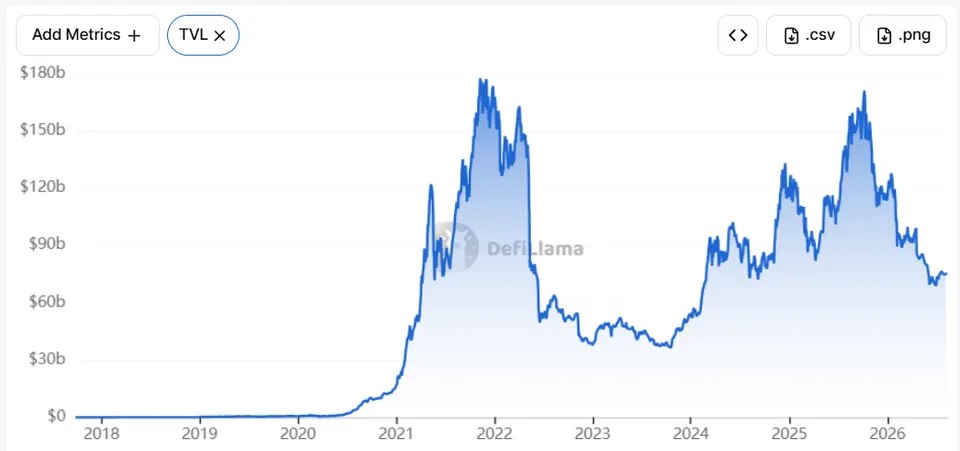
DeFi TVL, all-time chart. Source: DefiLlama

Cronje is not alone in his views. The European Central Bank has also questioned whether decentralized autonomous organizations (DAOs) are decentralized enough to remain outside the scope of regulation. In a March working paper, the ECB examined Aave, MakerDAO, Ampleforth, and Uniswap and found that the top 100 governance token holders controlled over 80% of the supply in each protocol. The conclusion is based on asset distribution snapshots from November 2022 and May 2023.

The authors of the ECB paper stated that these findings call into question the inherent decentralization of DAOs and the question of whether such organizations should remain outside the scope of the EU's Markets in Crypto-Assets Regulation (MiCA) as "fully decentralized" services.

Related: Wintermute to Direct $100,000,000,000 Billion Towards AI and High-Frequency Trading Amid TradFi Expansion: Report

DeFi Has Moved Away From Decentralization

Cronje argued that DeFi has moved away from its inherent decentralization and evolved into a new financial paradigm called "on-chain finance" or "open finance." In support of this view, he said:

"We moved away from [DeFi] a long time ago. Because now your intermediary is a company: it makes decisions, performs curation functions, and sits on the risk committee. All of these are traditional elements familiar to us from the banking sector."

At the same time, Cronje stated that real DeFi still has a place, adding that he still sees genuine innovation in some DeFi protocols.

Cronje is one of the most respected founders in the DeFi space. The Sonic blockchain he created claims to be the fastest network based on the Ethereum Virtual Machine: in testnet, it achieved "true" finality in 720 milliseconds.

Cronje previously founded Yearn.finance and the Keep3r network.

Magazine: Why Ethereum Developers Want to Implement 'One-Click Staking' for Institutional Investors

end-content

Related Questions

QAccording to Andre Cronje, what has been lost by most DeFi protocols?

AAccording to Andre Cronje, most decentralized finance (DeFi) protocols have lost genuine decentralization.

QWhat name does Andre Cronje suggest for the new financial paradigm that DeFi has evolved into?

AAndre Cronje suggests that DeFi has evolved into a new financial paradigm he refers to as 'on-chain finance' or 'open finance'.

QWhat is the main argument of the ECB's working paper regarding DAOs mentioned in the article?

AThe ECB's working paper argued that in several major DeFi protocols (Aave, MakerDAO, etc.), the top 100 governance token holders controlled over 80% of the supply. This calls into question the inherent decentralization of DAOs and whether they should remain outside the scope of the EU's MiCA regulation.

QWhat does Andre Cronje identify as intermediaries in many modern DeFi protocols?

AAndre Cronje identifies companies as the intermediaries in many modern DeFi protocols, as they make decisions, perform curator functions, and sit on risk committees—elements familiar from traditional banking.

QWhat are some of Andre Cronje's notable previous projects mentioned in the article?

AAndre Cronje's notable previous projects mentioned in the article include founding Yearn.finance and creating the Keep3r network.

Related Reads

Arca Chief Investment Officer: How Should Tokens Be Valued Once Protocols Start Earning Money?

Title: Arca CIO: How Should Tokens Be Valued When Protocols Start Making Money? Summary: For over a decade, Arca has argued that digital assets should be valued based on fundamentals and future cash flows, just like traditional investments. While tokens are not stocks, basic investment principles still apply. Many decentralized protocols (e.g., Hyperliquid, Aave) are now generating significant, real revenue with high margins. However, protocol revenue alone does not automatically translate to token value. Unlike equity holders who have a legal claim on company assets and future cash flows (via dividends, buybacks, or acquisitions), token holders often lack a clear, enforceable path to receive value from protocol profits. Therefore, the critical link between protocol economics and token economics is even more important. A credible mechanism must exist for value to eventually flow to token holders, with token buybacks being one clear, direct method. Capital allocation is now a key issue for profitable protocols. Like growing companies, protocols should reinvest profits when returns on investment are high. However, this reinvestment only delays value capture; it cannot replace it indefinitely. Investors must believe that eventually, surplus capital will be returned. For example, two protocols with identical revenues should not trade at the same valuation multiple if one has a credible buyback mechanism and the other does not. As the market increasingly accepts this valuation framework, a major opportunity exists. Protocols with strong fundamentals and value-capture mechanisms may see their valuation multiples expand significantly as the historical discount for token-based assets narrows. Crypto investment is finally maturing into fundamental analysis, focusing on revenue growth, margins, competitive advantages, reinvestment returns, and credible paths for profit distribution to token holders.

marsbit1h ago

Arca Chief Investment Officer: How Should Tokens Be Valued Once Protocols Start Earning Money?

marsbit1h ago

Trading

Spot
活动图片