Data: 90% of Crypto Protocols Generate Revenue, But Less Than 1% Disclose Market Maker Terms

marsbitPublished on 2026-04-15Last updated on 2026-04-15

Abstract

Survey of 150 major crypto protocols reveals that while 91% generate on-chain revenue, only 8% publish investor reports, and less than 1% disclose market maker agreements. The data indicates a significant communication gap rather than a lack of available information, as third-party platforms cover 72% of protocols. DeFi protocols, particularly DEXs and lending platforms, lead in transparency, while L1 and infrastructure projects lag despite larger market capitalizations. Only 13 protocols have adopted the Token Transparency Framework since its introduction in June 2025. Additionally, 38% of protocols feature active value accumulation mechanisms, which correlate with approximately 19% higher annual returns compared to governance-only tokens. The findings highlight a structural disconnect between institutional investor expectations and current disclosure practices in the crypto industry.

Author: Novora

Compiled by: Deep Tide TechFlow

Deep Tide Intro: Among 150 leading protocols, 91% generate on-chain revenue, but only 8% publish investor reports, and less than 1% disclose market maker terms. The data is all on-chain, and third-party platforms also cover it, but protocols simply aren't packaging it for institutional view. This is not a data availability issue, but more of a communication gap.
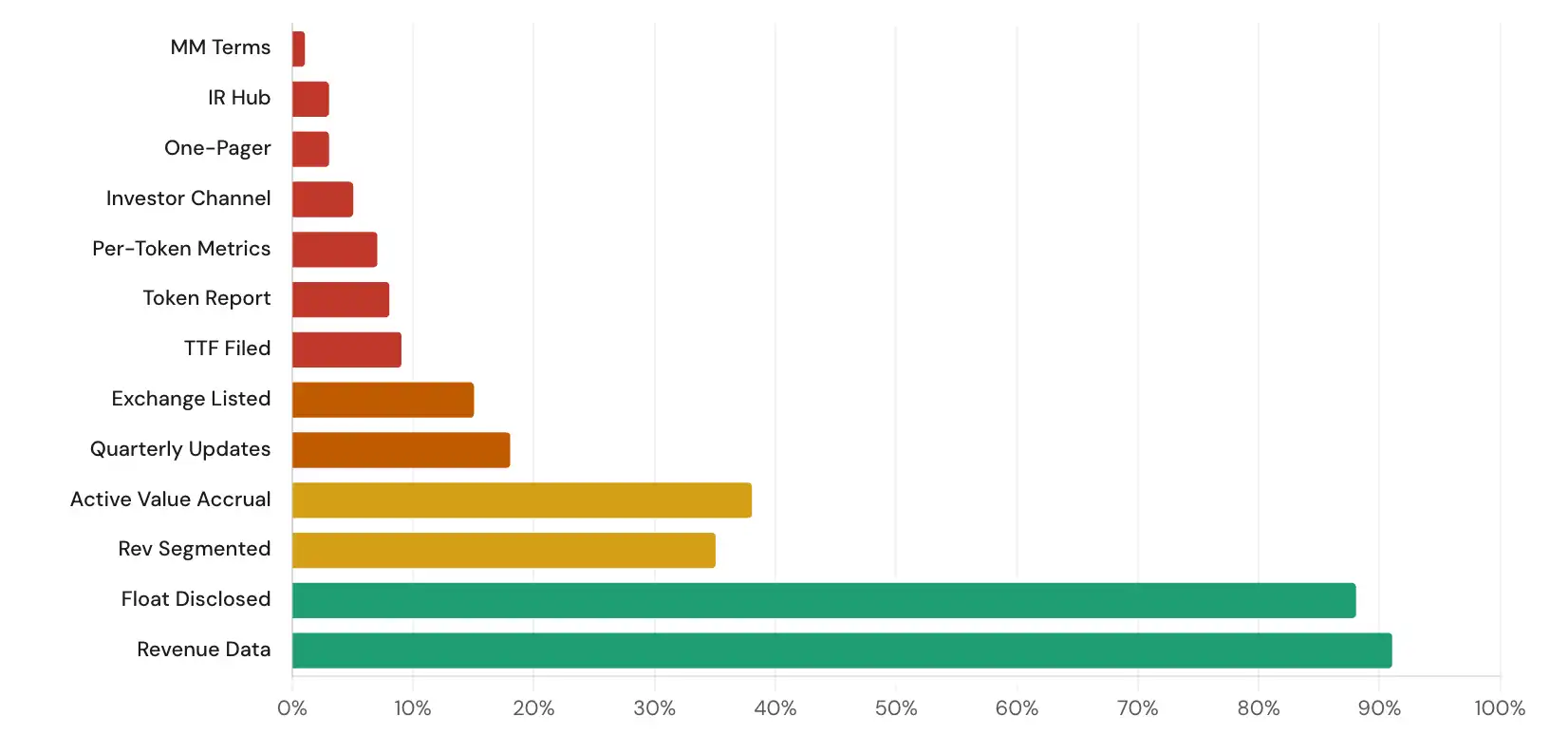
Disclosure Rate

We evaluated 13 disclosure metrics across 150+ protocols. The gap between what traditional markets require for disclosure and what crypto protocols voluntarily provide is structural, not accidental.

Less than 1% of protocols disclose market maker terms. In traditional stock markets, market maker agreements are standard disclosure items filed with exchanges. In crypto, Meteora was the only protocol in our entire 150+ dataset that publicly disclosed information about its market making arrangements, via its 2025 Annual Token Holder Report.
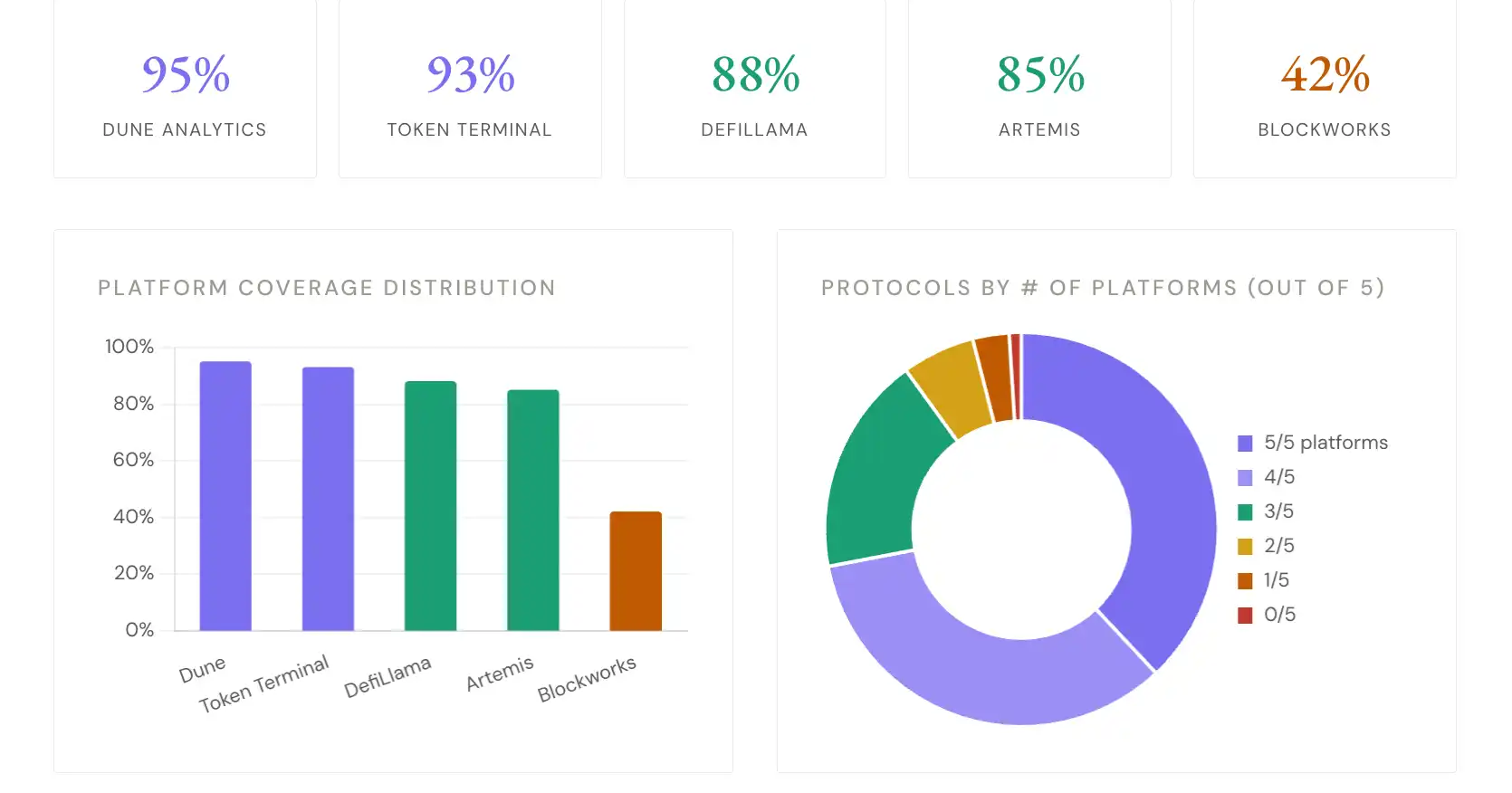
Third-Party Data Coverage

We evaluated 5 major data platforms. Coverage reflects whether each protocol has a dedicated profile containing meaningful data beyond basic price information.

72% of protocols are covered by 4 or more platforms. Third-party data infrastructure has matured significantly. The data exists. The issue is not data availability, but that protocols are not leveraging this data in structured investor communications.
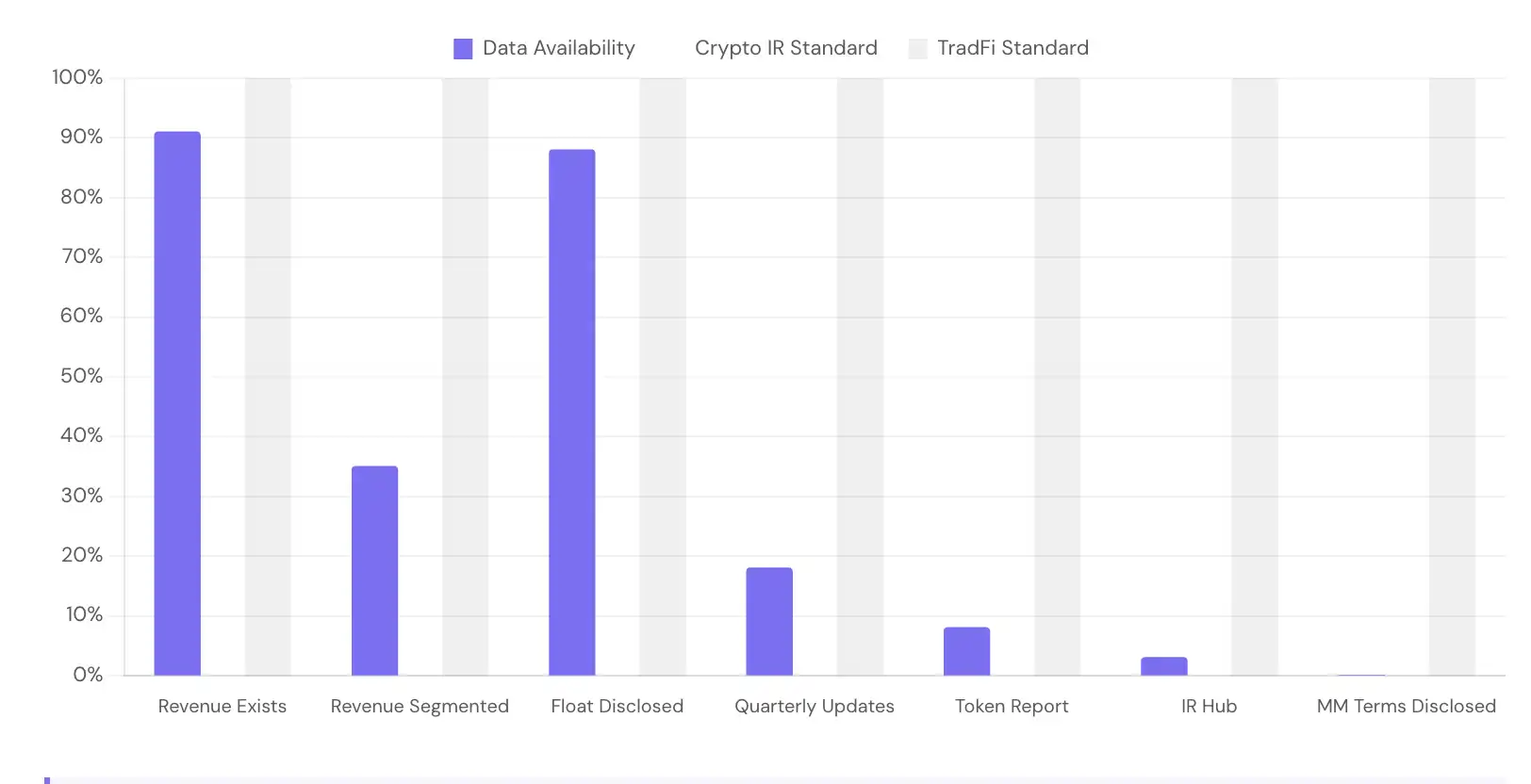
The Transparency Paradox

Revenue exists on-chain. Reports exist nowhere. This chart shows the disconnect between data availability and investor communication.

91% of protocols generate trackable revenue. 8% publish token holder reports. The data is there. It's on-chain, indexed by third-party platforms, and publicly verifiable. But fewer than one in ten protocols package this data into a format usable by institutional investors. This is the investor relations gap defining the industry.
Industry Breakdown

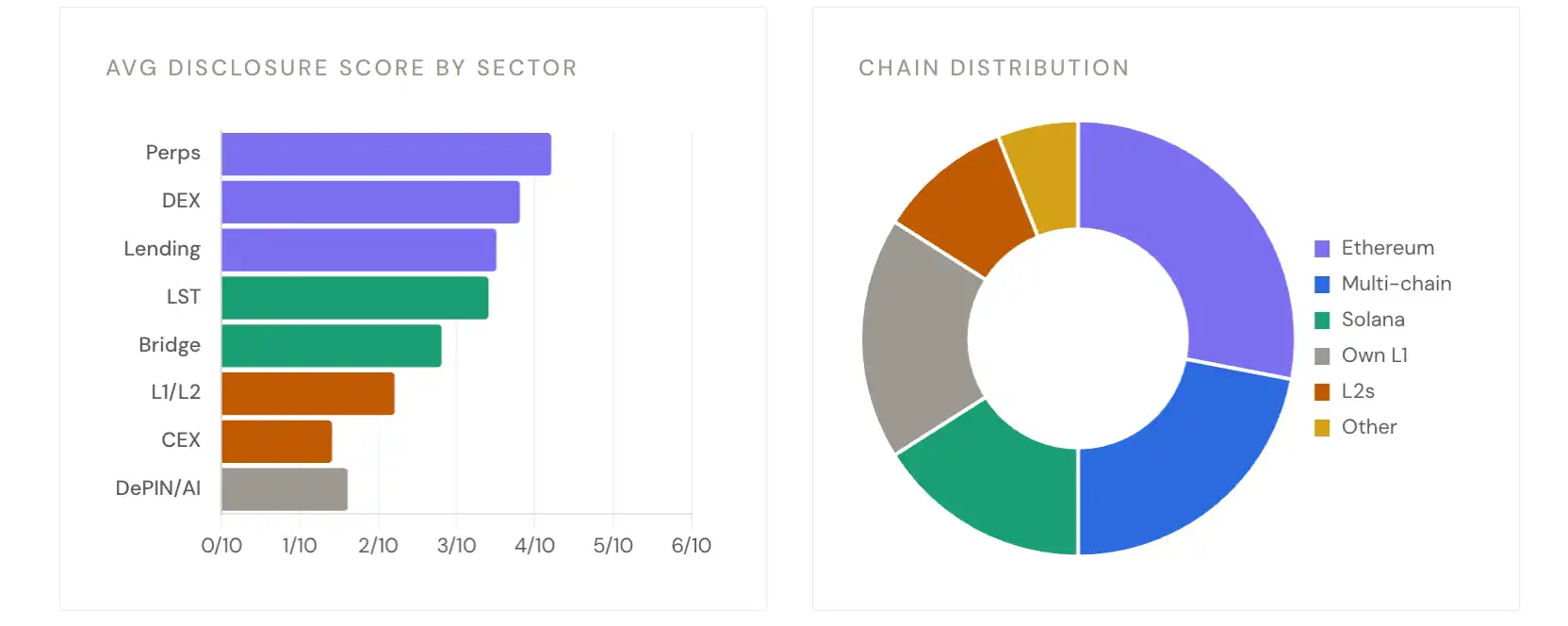
Disclosure practices vary dramatically by industry. DeFi protocols, particularly DEXs and lending, lead in transparency. L1 and infrastructure protocols, despite larger market caps, lag behind.

Token Transparency Framework

Blockworks launched the Token Transparency Framework (TTF) in June 2025, filed jointly with Jito to the SEC. 13 protocols have filed. Here's who they are and what this means.

TTF adoption is at 9%, up from 0% in June 2025. The 13 filers are heavily skewed towards Solana (6/13) and revenue-generating DeFi protocols. Zero L1s, zero L2s, zero infrastructure protocols have filed. The framework was submitted to the SEC with bipartisan support from Pantera, Theia, and L1D. But adoption is still growing slowly.
Active Value Accrual

38% of protocols have some form of active value accrual: a mechanism to return economic value to token holders, beyond just governance rights. But "value accrual" is not one thing. We identified six different models in the dataset.

The alpha is not in the mechanism itself. It's in the revenue. Any active accrual model outperformed governance-only tokens by approximately 19 percentage points on a 1-year return basis. But within the active group, daily revenue size was the differentiating factor. Governance-only tokens averaged a -51% return, while active accrual tokens averaged -32% over the same period. The mechanism itself matters less than the fact that a mechanism exists.

Key Findings

Six patterns emerging from evaluating all 15 metrics across 150+ protocols.

Six Numbers on the State of Crypto Investor Relations

The gap between institutional investor expectations and what crypto protocols provide, quantified.

Protocol Index

Each protocol evaluated in this report. Sorted alphabetically. ✓ = Disclosed/Exists. ✗ = Not Disclosed/Missing. Hover on mobile to view full row.

150+ protocols evaluated on 18 total metrics (13 disclosure + 5 platform coverage). This index represents the most comprehensive assessment of crypto investor relations practices to date. The full dataset is maintained in the Novora Investor Relations Benchmark Database, updated quarterly.

Click here for full content

Related Questions

QWhat percentage of the top 150 crypto protocols generate on-chain revenue according to the article?

A91% of the top protocols generate on-chain revenue.

QHow many protocols in the dataset publicly disclosed their market maker arrangements?

AOnly one protocol, Meteora, publicly disclosed its market maker arrangements.

QWhat is the adoption rate of the Token Transparency Framework (TTF) mentioned in the report?

AThe adoption rate of the Token Transparency Framework is 9%.

QWhat percentage of protocols release token holder reports, as stated in the article?

AOnly 8% of protocols release token holder reports.

QWhat is the performance difference in 1-year returns between governance-only tokens and tokens with active value accumulation mechanisms?

ATokens with active value accumulation mechanisms outperformed governance-only tokens by approximately 19 percentage points on a 1-year return basis.

Related Reads

Google and Amazon Simultaneously Invest Heavily in a Competitor: The Most Absurd Business Logic of the AI Era Is Becoming Reality

In a span of four days, Amazon announced an additional $25 billion investment, and Google pledged up to $40 billion—both direct competitors pouring over $65 billion into the same AI startup, Anthropic. Rather than a typical venture capital move, this signals the latest escalation in the cloud wars. The core of the deal is not equity but compute pre-orders: Anthropic must spend the majority of these funds on AWS and Google Cloud services and chips, effectively locking in massive future compute consumption. This reflects a shift in cloud market dynamics—enterprises now choose cloud providers based on which hosts the best AI models, not just price or stability. With OpenAI deeply tied to Microsoft, Anthropic’s Claude has become the only viable strategic asset for Google and Amazon to remain competitive. Anthropic’s annualized revenue has surged to $30 billion, and it is expanding into verticals like biotech, positioning itself as a cross-industry AI infrastructure layer. However, this funding comes with constraints: Anthropic’s independence is challenged as it balances two rival investors, its safety-first narrative faces pressure from regulatory scrutiny, and its path to IPO introduces new financial pressures. Globally, this accelerates a "tri-polar" closed-loop structure in AI infrastructure, with Microsoft-OpenAI, Google-Anthropic, and Amazon-Anthropic forming exclusive model-cloud alliances. In contrast, China’s landscape differs—investments like Alibaba and Tencent backing open-source model firm DeepSeek reflect a more decoupled approach, though closed-source models from major cloud providers still dominate. The $65 billion bet is ultimately about securing a seat at the table in an AI-defined future—where missing the model layer means losing the cloud war.

marsbit1h ago

Google and Amazon Simultaneously Invest Heavily in a Competitor: The Most Absurd Business Logic of the AI Era Is Becoming Reality

marsbit1h ago

Computing Power Constrained, Why Did DeepSeek-V4 Open Source?

DeepSeek-V4 has been released as a preview open-source model, featuring 1 million tokens of context length as a baseline capability—previously a premium feature locked behind enterprise paywalls by major overseas AI firms. The official announcement, however, openly acknowledges computational constraints, particularly limited service throughput for the high-end DeepSeek-V4-Pro version due to restricted high-end computing power. Rather than competing on pure scale, DeepSeek adopts a pragmatic approach that balances algorithmic innovation with hardware realities in China’s AI ecosystem. The V4-Pro model uses a highly sparse architecture with 1.6T total parameters but only activates 49B during inference. It performs strongly in agentic coding, knowledge-intensive tasks, and STEM reasoning, competing closely with top-tier closed models like Gemini Pro 3.1 and Claude Opus 4.6 in certain scenarios. A key strategic product is the Flash edition, with 284B total parameters but only 13B activated—making it cost-effective and accessible for mid- and low-tier hardware, including domestic AI chips from Huawei (Ascend), Cambricon, and Hygon. This design supports broader adoption across developers and SMEs while stimulating China's domestic semiconductor ecosystem. Despite facing talent outflow and intense competition in user traffic—with rivals like Doubao and Qianwen leading in monthly active users—DeepSeek has maintained technical momentum. The release also comes amid reports of a new funding round targeting a valuation exceeding $10 billion, potentially setting a new record in China’s LLM sector. Ultimately, DeepSeek-V4 represents a shift toward open yet realistic infrastructure development in the constrained compute landscape of Chinese AI, emphasizing engineering efficiency and domestic hardware compatibility over pure model scale.

marsbit1h ago

Computing Power Constrained, Why Did DeepSeek-V4 Open Source?

marsbit1h ago

Trading

Spot
Futures
活动图片





