Crypto’s CLARITY Act Sits At 50-50 For 2026 Passage, Galaxy Says

bitcoinistPublished on 2026-04-23Last updated on 2026-04-23

Abstract

Galaxy Digital estimates a 50-50 chance that the CLARITY Act, a key U.S. crypto market structure bill, will be passed into law in 2026. The bill, which passed the House with bipartisan support, is now in the Senate Banking Committee. A planned markup was delayed until May, and Galaxy warns that if it slips past mid-May, the odds of passage drop sharply. Key unresolved issues include stablecoin rewards language, protections for software developers, and SEC commissioner vacancies. The report emphasizes that the bill is strong on policy but faces a tight legislative calendar and significant procedural steps. Failure to pass it by May could delay crypto legislation indefinitely, especially with midterm elections potentially shifting priorities.

The crypto industry’s most important US market structure bill is entering a narrowing window in Washington, with Galaxy Digital putting the odds of the CLARITY Act becoming law this year at roughly 50-50. The firm’s central argument is not that one issue alone threatens the bill, but that too many unresolved questions still need to be settled in sequence, on a calendar that is quickly tightening.

In a research note published April 22, Galaxy said the Digital Asset Market Clarity Act of 2025 is now in “endgame stage” after passing the House in July 2025 with bipartisan support and spending months in Senate negotiations. The immediate focus is the Senate Banking Committee, which had been expected to announce a markup for the last week of April. But that timeline appears to be slipping. According to Galaxy, Sen. Thom Tillis, a key negotiator on stablecoin rewards language, called on Monday for delaying the markup until May.

May Could Be The Last Chance For Crypto’s CLARITY Act

Galaxy framed the bill’s prospects in unusually blunt terms: “In our view, the odds of CLARITY being signed into law in 2026 are roughly 50-50, and possibly lower, though others at Galaxy are more optimistic. The uncertainty stems not from any single issue but from the number of unresolved questions that must be settled, in sequence, under severe time pressure.”

The report argues that a markup in early or mid-May would still leave a viable path, but not much margin for error. “If the markup slips past mid-May, the probability of enactment in 2026 drops sharply,” Galaxy wrote. “The remaining legislative calendar simply does not easily accommodate the full five-step process described above, particularly given the competing demands on floor time.” In the firm’s view, a July floor vote is still theoretically possible, but only with “extraordinary political will and coordination.”

The procedural burden is significant. From committee markup, the bill would still need to clear a 60-vote Senate floor threshold, then be reconciled with the Agriculture Committee’s version, then reconciled again with the House-passed CLARITY Act, before reaching the president’s desk. Galaxy said each step consumes time that the Senate may not have in abundance, especially with Iran military authorization debates, the unresolved DHS funding standoff, and a backlog of nominations competing for floor space.

The best-known sticking point remains stablecoin rewards language, where banks and crypto firms have been fighting over whether exchanges can offer incentives tied to stablecoin holdings and usage. Galaxy said a compromise being negotiated by Tillis and Sen. Angela Alsobrooks would still ban rewards paid “solely for holding” a stablecoin while allowing narrower, activity-based incentives tied to payments, transfers, or platform usage. But the text has not yet been released, and until it is, the committee’s 48-hour notice clock cannot start.

Galaxy also made clear that stablecoin yield is only part of the problem. The note highlighted several other live issues in Senate negotiations, including the Blockchain Regulatory Certainty Act’s protections for noncustodial software developers, ethics provisions related to government officials’ crypto holdings, concerns over Section 505’s impact on SEC exemptive relief for tokenization, and the political question of SEC commissioner vacancies. None of those is necessarily fatal on its own. Together, they create a far more fragile timeline.

Notably, US Senator Bernie Moreno is sharing a similar position like Galaxy Digital. When was asked about the timeline for crypto market structure legislation, he said: “I think we’re going to get it done by the end of May.” But the Ohio Republican also warned last month that if the Clarity Act isn’t passed by May, crypto legislation could be off the table for the foreseeable future.

The report is broadly favorable on the substance of the legislation. Galaxy called CLARITY “a strong bill both on technical terms and as a policy matter,” arguing that it would establish jurisdictional boundaries between the SEC and CFTC, define pathways for tokens to be treated as non-securities once sufficiently decentralized, and create the kind of durable legal framework that institutional capital has long lacked.

It also warned that the post-midterm outlook could be materially worse. A change in control of either chamber, Galaxy said, would likely produce different committee chairs, different priorities, and a much less hospitable path for crypto legislation.

That is why the near-term milestones now matter so much. Galaxy said the next signals to watch are the release of Tillis’s revised stablecoin text, Chairman Tim Scott’s markup announcement, the size and bipartisan character of any committee vote, and whether Senate leadership allocates floor time before the July 4 recess.

At press time, the total crypto market cap stood at $2.58 trillion.
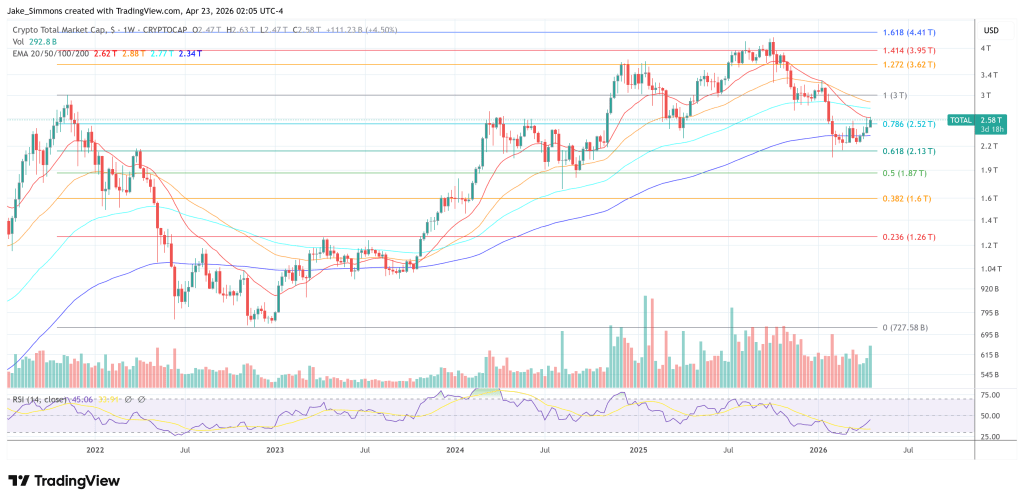
Total crypto market cap rises above the 0.786 Fib, 1-week chart | Source: TOTAL on TradingView.com

Related Questions

QWhat are the odds of the CLARITY Act being signed into law in 2026 according to Galaxy Digital?

AGalaxy Digital puts the odds of the CLARITY Act becoming law in 2026 at roughly 50-50.

QWhich Senate committee is the immediate focus for the CLARITY Act's progress?

AThe immediate focus is the Senate Banking Committee.

QWhat is the key sticking point in the negotiations, as mentioned by Galaxy?

AThe key sticking point is the stablecoin rewards language, specifically whether exchanges can offer incentives tied to stablecoin holdings and usage.

QAccording to the report, what is the consequence if the committee markup slips past mid-May?

AIf the markup slips past mid-May, the probability of the CLARITY Act being enacted in 2026 drops sharply.

QWhat did Senator Bernie Moreno say about the timeline for passing the crypto market structure legislation?

ASenator Bernie Moreno said, 'I think we’re going to get it done by the end of May,' but also warned that if it isn't passed by May, crypto legislation could be off the table for the foreseeable future.

Related Reads

The Value Distribution of Stablecoins

**Summary: The Value Distribution of Stablecoins** The article argues that stablecoins are evolving from mere trading tools into broader channels for dollar access. It divides the stablecoin ecosystem into four layers to analyze how value is distributed: 1. **Issuance Layer:** Mints stablecoins, holds reserve assets, and captures the spread between reserve yield and user costs (e.g., Tether, Circle). This layer currently earns the largest profit margin. 2. **Infrastructure Layer:** Connects stablecoins to the traditional financial system, handling fiat on/off-ramps, banking integration, compliance (KYC/AML), and asset management (e.g., Bridge, BVNK). This is the "unglamorous" but critical work, building the essential bridges between crypto and real-world finance. 3. **Acquiring/Distribution Layer:** Integrates stablecoins into merchant systems, manages payment flows, and provides enterprise financial software (e.g., Stripe, Coinbase). They act as the access point for businesses. 4. **Application Layer:** The end-users and businesses that ultimately use stablecoins for payments, settlements, or as a store of value. They benefit from convenience but have little pricing power. The core thesis is that while the issuance layer currently dominates profits, the often-overlooked **infrastructure layer holds significant long-term potential**. The real challenge and barrier to mass adoption is not the on-chain transfer of stablecoins (which is simple), but the complex "last mile" integration into existing business workflows, banking systems, and regulatory frameworks across different countries. Companies in this layer are currently in a "land grab" phase, investing heavily to build networks, secure bank partnerships, and establish compliance pathways. While their position is currently pressured by the profitable issuers above and distribution platforms below, the article suggests that if stablecoins become a default financial rail for businesses, the infrastructure providers who have done the hard work of integration will ultimately gain strong pricing power and become entrenched, essential players.

marsbit4h ago

The Value Distribution of Stablecoins

marsbit4h ago

The Value Distribution of Stablecoins

The Value Distribution of Stablecoins The article argues that stablecoins are evolving from a mere trading tool into a broad "dollar channel." It analyzes the industry's value chain through four layers: 1. **Issuance Layer (e.g., Tether, Circle):** The top layer that mints stablecoins, holds reserve assets, and captures the thickest interest rate spread. 2. **Infrastructure Layer (e.g., Bridge, BVNK):** Connects stablecoins to the traditional financial system, handling critical but complex "dirty work" like fiat on/off-ramps, banking integration, compliance (KYC/AML), and cross-border settlement. 3. **Acquiring/Distribution Layer (e.g., Stripe, Coinbase):** Embeds stablecoins into merchant systems, manages payment flows, and integrates with enterprise software. 4. **Application Layer:** End-users and businesses that ultimately use stablecoins for payments, settlement, or storing value. The author posits that while the issuance layer currently captures the most profit, the most overlooked and potentially critical layer is infrastructure. The core challenge for stablecoin adoption isn't the on-chain transfer (which is simple), but bridging the gap between blockchain and the real-world financial system. This involves solving practical problems for businesses: fiat conversion, reconciliation, tax handling, and user onboarding. Infrastructure companies are currently in a difficult "land-grab" phase—building networks, securing banking relationships, and achieving compliance country-by-country. They face pressure from both the profitable issuance layer above and distribution platforms below. However, the author suggests this layer is building a crucial moat. Once stablecoins become a default business rail, the infrastructure players who have done the hard work of integration may gain significant, durable value and pricing power.

链捕手4h ago

The Value Distribution of Stablecoins

链捕手4h ago

How to Do Research Well: Deliberately Practice the Real Skills That Matter

No one truly teaches you how to do research. You're often given a desk, a pre-selected problem, and vague instructions to "create something new." Consequently, many people reverse-engineer the job based on visible outputs—papers, posts, announcements—learning only how to *appear* like a researcher rather than how to *become* one. True research capability is built from stacking small, trainable skills, nearly all of which can be developed through deliberate practice. **Pick Your Own Problem:** Most researchers absorb problems from advisors or trends, lacking the underlying reasoning. Choosing a problem you genuinely care about, as John Schulman advises, leads to original work. Develop "taste" like a muscle: predict experiment outcomes, guess paper results from methods, and track which findings remain important over time. **Upgrade Your Inputs:** Relying on shared reading lists (arXiv hot lists, filtered group chats) leads to unoriginal conclusions. Undervalued old literature often holds crucial insights (e.g., MoE, LSTM, backpropagation). Richard Sutton's "The Bitter Lesson" or Claude Shannon's 1952 talk on creative thinking are more predictive than lengthy modern surveys. Breadth matters as much as depth: draw from neuroscience, mechanism design, hardware knowledge, and honest statistics. Read papers directly, especially appendices and limitations sections. **Write Everything Down:** As Paul Graham noted, writing exposes flaws in seemingly mature ideas. Writing is the cheapest defense against self-deception. Following Feynman's principle, Darwin programmatically wrote down facts contradicting his theory to combat memory bias. Maintain a detailed log of hypotheses, setups, predictions, results, and updated understandings. Reviewing past logs fosters essential humility.

marsbit6h ago

How to Do Research Well: Deliberately Practice the Real Skills That Matter

marsbit6h ago

Trading

Spot
Futures
活动图片





