Crypto’s CLARITY Act Sits At 50-50 For 2026 Passage, Galaxy Says

bitcoinistPublished on 2026-04-23Last updated on 2026-04-23

Abstract

Galaxy Digital estimates a 50-50 chance that the CLARITY Act, a key U.S. crypto market structure bill, will be passed into law in 2026. The bill, which passed the House with bipartisan support, is now in the Senate Banking Committee. A planned markup was delayed until May, and Galaxy warns that if it slips past mid-May, the odds of passage drop sharply. Key unresolved issues include stablecoin rewards language, protections for software developers, and SEC commissioner vacancies. The report emphasizes that the bill is strong on policy but faces a tight legislative calendar and significant procedural steps. Failure to pass it by May could delay crypto legislation indefinitely, especially with midterm elections potentially shifting priorities.

The crypto industry’s most important US market structure bill is entering a narrowing window in Washington, with Galaxy Digital putting the odds of the CLARITY Act becoming law this year at roughly 50-50. The firm’s central argument is not that one issue alone threatens the bill, but that too many unresolved questions still need to be settled in sequence, on a calendar that is quickly tightening.

In a research note published April 22, Galaxy said the Digital Asset Market Clarity Act of 2025 is now in “endgame stage” after passing the House in July 2025 with bipartisan support and spending months in Senate negotiations. The immediate focus is the Senate Banking Committee, which had been expected to announce a markup for the last week of April. But that timeline appears to be slipping. According to Galaxy, Sen. Thom Tillis, a key negotiator on stablecoin rewards language, called on Monday for delaying the markup until May.

May Could Be The Last Chance For Crypto’s CLARITY Act

Galaxy framed the bill’s prospects in unusually blunt terms: “In our view, the odds of CLARITY being signed into law in 2026 are roughly 50-50, and possibly lower, though others at Galaxy are more optimistic. The uncertainty stems not from any single issue but from the number of unresolved questions that must be settled, in sequence, under severe time pressure.”

The report argues that a markup in early or mid-May would still leave a viable path, but not much margin for error. “If the markup slips past mid-May, the probability of enactment in 2026 drops sharply,” Galaxy wrote. “The remaining legislative calendar simply does not easily accommodate the full five-step process described above, particularly given the competing demands on floor time.” In the firm’s view, a July floor vote is still theoretically possible, but only with “extraordinary political will and coordination.”

The procedural burden is significant. From committee markup, the bill would still need to clear a 60-vote Senate floor threshold, then be reconciled with the Agriculture Committee’s version, then reconciled again with the House-passed CLARITY Act, before reaching the president’s desk. Galaxy said each step consumes time that the Senate may not have in abundance, especially with Iran military authorization debates, the unresolved DHS funding standoff, and a backlog of nominations competing for floor space.

The best-known sticking point remains stablecoin rewards language, where banks and crypto firms have been fighting over whether exchanges can offer incentives tied to stablecoin holdings and usage. Galaxy said a compromise being negotiated by Tillis and Sen. Angela Alsobrooks would still ban rewards paid “solely for holding” a stablecoin while allowing narrower, activity-based incentives tied to payments, transfers, or platform usage. But the text has not yet been released, and until it is, the committee’s 48-hour notice clock cannot start.

Galaxy also made clear that stablecoin yield is only part of the problem. The note highlighted several other live issues in Senate negotiations, including the Blockchain Regulatory Certainty Act’s protections for noncustodial software developers, ethics provisions related to government officials’ crypto holdings, concerns over Section 505’s impact on SEC exemptive relief for tokenization, and the political question of SEC commissioner vacancies. None of those is necessarily fatal on its own. Together, they create a far more fragile timeline.

Notably, US Senator Bernie Moreno is sharing a similar position like Galaxy Digital. When was asked about the timeline for crypto market structure legislation, he said: “I think we’re going to get it done by the end of May.” But the Ohio Republican also warned last month that if the Clarity Act isn’t passed by May, crypto legislation could be off the table for the foreseeable future.

The report is broadly favorable on the substance of the legislation. Galaxy called CLARITY “a strong bill both on technical terms and as a policy matter,” arguing that it would establish jurisdictional boundaries between the SEC and CFTC, define pathways for tokens to be treated as non-securities once sufficiently decentralized, and create the kind of durable legal framework that institutional capital has long lacked.

It also warned that the post-midterm outlook could be materially worse. A change in control of either chamber, Galaxy said, would likely produce different committee chairs, different priorities, and a much less hospitable path for crypto legislation.

That is why the near-term milestones now matter so much. Galaxy said the next signals to watch are the release of Tillis’s revised stablecoin text, Chairman Tim Scott’s markup announcement, the size and bipartisan character of any committee vote, and whether Senate leadership allocates floor time before the July 4 recess.

At press time, the total crypto market cap stood at $2.58 trillion.
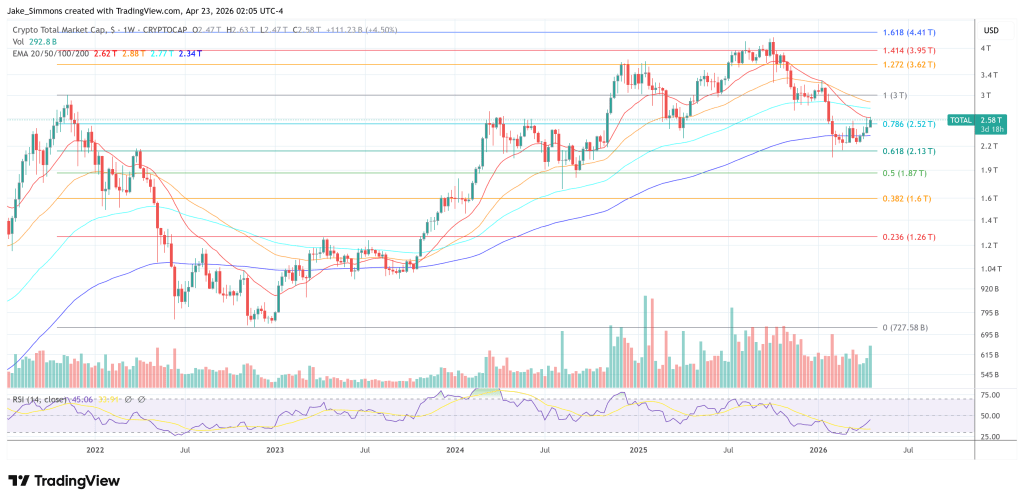
Total crypto market cap rises above the 0.786 Fib, 1-week chart | Source: TOTAL on TradingView.com

Related Questions

QWhat are the odds of the CLARITY Act being signed into law in 2026 according to Galaxy Digital?

AGalaxy Digital puts the odds of the CLARITY Act becoming law in 2026 at roughly 50-50.

QWhich Senate committee is the immediate focus for the CLARITY Act's progress?

AThe immediate focus is the Senate Banking Committee.

QWhat is the key sticking point in the negotiations, as mentioned by Galaxy?

AThe key sticking point is the stablecoin rewards language, specifically whether exchanges can offer incentives tied to stablecoin holdings and usage.

QAccording to the report, what is the consequence if the committee markup slips past mid-May?

AIf the markup slips past mid-May, the probability of the CLARITY Act being enacted in 2026 drops sharply.

QWhat did Senator Bernie Moreno say about the timeline for passing the crypto market structure legislation?

ASenator Bernie Moreno said, 'I think we’re going to get it done by the end of May,' but also warned that if it isn't passed by May, crypto legislation could be off the table for the foreseeable future.

Related Reads

STRC Breaks Below $95: Why Does It Continue to Depeg? Is There Default Risk?

"STRC Falls Below $95: Why the Persistent Depegging and Is There Default Risk?" The article discusses the recent decline in the price of STRC, a perpetual preferred stock issued by Strategy (MSTR) designed to trade around a $100 par value. As of publication, STRC traded at $94.65, raising market concerns. STRC is described as a high-yield cash flow product, offering an 11.50% annual dividend paid monthly. Its "preferred" status grants it priority over common stock for dividends and in liquidation. Key reasons cited for the price depegging include: 1. **Bitcoin's Price Drop:** MSTR's assets are heavily tied to Bitcoin (BTC), which fell over 21% from its recent high, pressuring all Strategy-related products. 2. **Competitive Pressure:** Rival Strive Asset Management's similar product, SATA, offers daily dividends and has maintained its $100 par value with a ~13% yield. In response, Strategy has proposed changing STRC's dividend frequency from monthly to bi-weekly, pending shareholder vote. 3. **Technical Selling:** A break below $100 may have triggered algorithmic selling and stop-losses, exacerbating the decline. Regarding default risk, the analysis suggests it is currently low. Strategy founder Michael Saylor confirmed the June 2026 dividend rate remains at 11.50% with no cuts or suspensions. The company's massive reserve of 843,706 BTC provides a significant backstop for its obligations. Industry opinions are mixed. Some analysts view the BTC holdings as reliable support for dividends, while critics like Peter Schiff warn of potential dividend cuts leading to price crashes and lawsuits. Others highlight inflation risk and the company's ability to reduce dividends without a formal default. In summary, STRC's drop is attributed to BTC volatility, competition, and technical factors. While immediate default risk appears contained, the product faces challenges from market conditions and competitive dynamics.

marsbit1h ago

STRC Breaks Below $95: Why Does It Continue to Depeg? Is There Default Risk?

marsbit1h ago

AI Trading Cools, South Korean Stocks Plunge 1.8%, Spot Gold Rises 1%, Bitcoin Dives

A sell-off in AI-related stocks, triggered by Broadcom's disappointing earnings forecast, sent shockwaves through global markets. South Korea's KOSPI led Asia's decline, plunging 1.8% as the risks from concentrated chip stock gains and surging leveraged investments came to the fore. The tech-heavy Nasdaq 100 futures fell 0.5% following Broadcom's 14% after-hours plunge, which signaled a slower-than-expected transition to AI clients. This pullback extended Wall Street's weakness, halting the S&P 500's nine-day rally amid hawkish Fed signals and renewed Middle East tensions. South Korean authorities convened an emergency meeting, pledging "immediate measures" against market volatility and warning of record-high stock margin debt. The adjustment rippled across assets: Bitcoin fell to around $64,000, its lowest since February, while safe-haven gold rose 1% on bargain hunting. Oil prices dipped on Middle East ceasefire news. Market analysts noted the sell-off was driven by profit-taking after massive gains, particularly in chip stocks like Samsung and SK Hynix, which now dominate the KOSPI. Wall Street banks are divided on Korea's outlook, with Goldman Sachs raising its target while Citigroup and others warn of overvaluation and a potential bubble. Bridgewater's Ray Dalio noted that great technological shifts often create bubbles. Meanwhile, Fed officials' hints at potential future rate hikes added to the cautious mood ahead of key U.S. jobs data.

华尔街日报1h ago

AI Trading Cools, South Korean Stocks Plunge 1.8%, Spot Gold Rises 1%, Bitcoin Dives

华尔街日报1h ago

Trading

Spot
Futures
活动图片





