Crypto Users Hit By 1,400% Surge In Impersonation Scams, Research Shows

bitcoinistPublished on 2026-01-14Last updated on 2026-01-14

Abstract

Impersonation scams surged by 1,400% in 2025, causing billions in losses as criminals used AI tools, voice cloning, and fake customer-support schemes. The average scam amount increased by over 600%, with AI-enabled methods proving several times more profitable. Scammers impersonated exchange staff and celebrities using deepfakes and sophisticated social engineering, making operations more efficient and harder to trace. One high-profile case stole nearly $16 million. Total on-chain crypto scam losses for 2025 are estimated between $14 billion and $17 billion.

Impersonation scams exploded in 2025, growing by about 1,400% and driving some of the biggest losses seen in crypto fraud to date. According to analysis by Chainalysis, scammers used AI tools, voice cloning and fake customer-support schemes to scale up attacks, pushing total scam losses on chain into the low-double-digit billions.

Impersonation Scams Jump Dramatically

Reports have disclosed that the rise was not just in the number of cases but in how much each case cost victims. The average amount taken in impersonation schemes rose by over 600% compared with the prior year, a jump that turned many small cons into large heists. Chainalysis highlights the role of automated tooling and commercially available phishing services that let scammers run scams like factories.
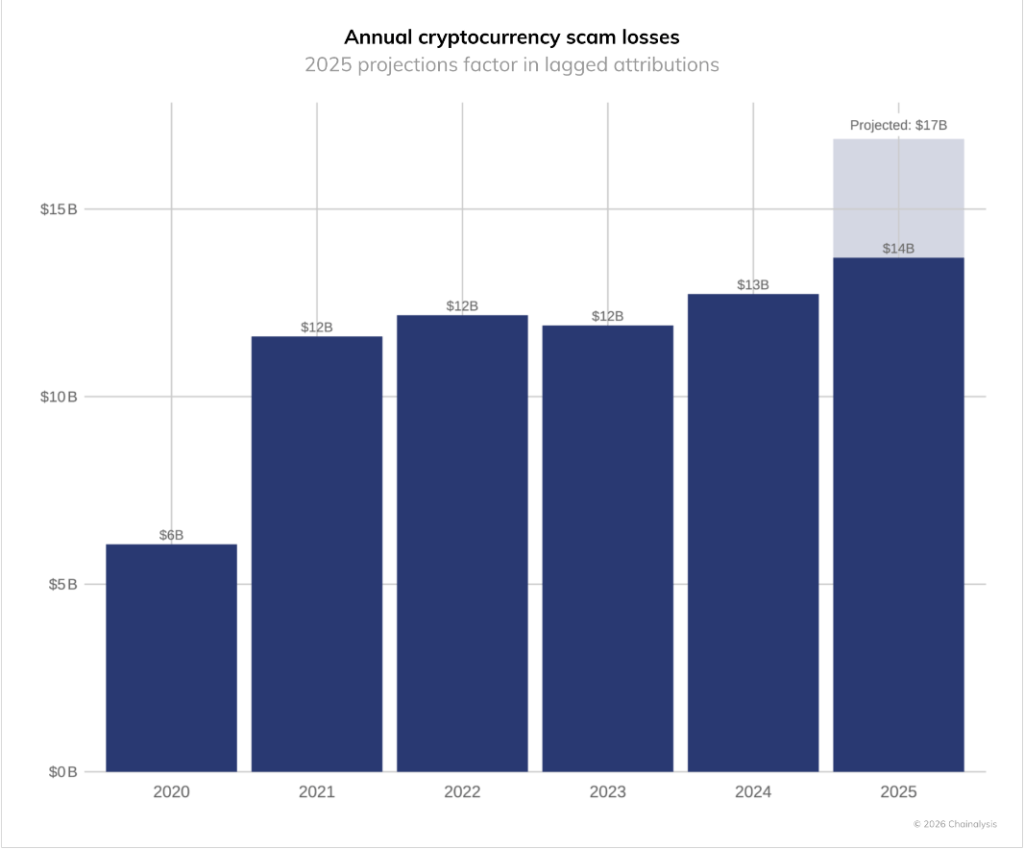
Source: Chainalysis

Criminals Used AI And Deepfakes

Fraudsters leaned heavily on AI techniques in 2025. Based on reports, AI-generated voice and face clones, paired with very believable messages, helped criminals impersonate exchange staff, celebrities or close contacts. These methods increased both reach and success rates. Industry writeups and analysts show that AI-enabled scams were several times more profitable than older approaches.

BTCUSD currently trading at $94,929. Chart: TradingView

A High-Profile Example Shows The Risk

One public example involved scammers posing as a major exchange and clearing nearly $16 million from victims in a single operation. That case became a headline because it showed how quickly an impersonation scam can turn into a mass theft when it uses polished fake identities and coordinated social engineering. Financial news outlets and industry trackers used that case to illustrate the shift in tactics.

Operations Became Industrialized

Based on Chainalysis data, scam groups now resemble small businesses. They outsource parts of the fraud chain — writing scripts, buying deepfake clips, and hiring money movers. This setup made fraud more efficient and harder to disrupt. One analysis found AI-assisted schemes were about 4.5 times more profitable than traditional scams, a gap that attackers exploited to level up operations quickly.

Estimates of total crypto scam losses for 2025 vary by outlet, but multiple sources put the number well into the billions. Some trackers reported $14 billion in funds stolen on chain, while Chainalysis noted the figure could be as high as $17 billion once more data is tallied. The difference reflects how quickly new incidents were discovered and how some thefts moved off public rails.

Featured image from Unsplash, chart from TradingView

Related Questions

QWhat was the percentage increase in impersonation scams in 2025 according to the research?

AImpersonation scams grew by about 1,400% in 2025.

QWhich company provided the analysis on the surge in crypto impersonation scams?

AThe analysis was provided by Chainalysis.

QWhat technologies did scammers heavily rely on to scale up their attacks in 2025?

AScammers heavily relied on AI tools, voice cloning, and fake customer-support schemes to scale up their attacks.

QHow much more profitable were AI-enabled scams compared to traditional approaches according to one analysis?

AOne analysis found that AI-assisted schemes were about 4.5 times more profitable than traditional scams.

QWhat is the estimated range of total crypto scam losses for 2025 as mentioned in the article?

AEstimates vary, with some sources reporting $14 billion and Chainalysis noting the figure could be as high as $17 billion once more data is tallied.

Related Reads

Understanding Hash in One Article: The "Browser Miner" on Ethereum

Hash is an Ethereum-based ERC-20 token described as a "browser-minable post-quantum token." Its key features include enabling browser-based GPU mining without specialized hardware, a fixed supply cap of 21 million tokens, immutable and permissionless smart contracts with no team allocation or pre-mining, and an emphasis on post-quantum security using Keccak256 hashing. The mining mechanism is a simplified on-chain proof-of-work where miners solve unique challenges tied to their wallet address. Key design elements prevent answer theft, with epochs resetting every 100 blocks (~20 minutes) and a per-block minting limit. Emission follows a Bitcoin-like halving schedule every 100,000 mints, starting at 100 tokens per mint. Projections suggest all tokens could be mined within approximately 294 days if a target rate of one mint per minute is sustained. Hash emphasizes "post-quantum" security by leveraging hash-based primitives like Keccak256, which are considered more resistant to quantum attacks compared to elliptic-curve cryptography. While not a fully post-quantum asset, it aligns with Ethereum's broader post-quantum research narrative. The project completed its Genesis sale at $0.03 and began trading on Uniswap, with its price reaching around $0.19. The initial circulating supply is small, with 5% sold in Genesis and 5% allocated to liquidity. The majority (47.6% of total supply) is allocated to early-stage mining, leading to a front-loaded emission schedule. This structure, combined with low initial liquidity, makes Hash a high-volatility, high-risk project dependent on sustained miner participation and market demand to absorb new supply.

marsbit7m ago

Understanding Hash in One Article: The "Browser Miner" on Ethereum

marsbit7m ago

OpenAI's Largest Internal Wealth Creation: 600 People Cash Out a Total of $6.6 Billion, 75 Take Home the Maximum $30 Million Each

A Wall Street Journal report reveals OpenAI's unprecedented pre-IPO wealth creation. In a single employee stock sale last October, over 600 current and former employees sold shares, collectively cashing out approximately $6.6 billion. Due to high investor demand, the company tripled the individual sale cap to $30 million, with about 75 employees selling the maximum amount. This event represents the largest such transaction in tech industry history for a private company. OpenAI's valuation was $500 billion for this tender offer. Employees with over two years of tenure were eligible, allowing many post-ChatGPT hires their first liquidity event. The company's stock has reportedly grown over 100-fold in seven years. Following a restructuring, employees collectively hold about 26% of OpenAI. The scale of executive wealth is also staggering. In court testimony related to Elon Musk's lawsuit, President and co-founder Greg Brockman confirmed his OpenAI stake is worth around $30 billion. Analysis indicates about 165 current and former employees hold a combined ~$164.9 billion in equity, averaging nearly $1 billion per person in paper wealth. OpenAI's per-employee stock-based compensation is estimated to be 34 times the average of major tech firms before their IPOs. OpenAI continues its rapid ascent, closing a $122 billion funding round at an $852 billion valuation in March. With monthly revenue hitting $2 billion, over 900 million weekly ChatGPT users, and plans for a potential trillion-dollar IPO in late 2026, this wealth-creation engine shows no signs of stopping.

链捕手29m ago

OpenAI's Largest Internal Wealth Creation: 600 People Cash Out a Total of $6.6 Billion, 75 Take Home the Maximum $30 Million Each

链捕手29m ago

Trading

Spot
Futures
活动图片