Crypto saw capital exit in Q1 – Can $10B stablecoin surge drive Q2 rebound?

ambcryptoPublished on 2026-04-07Last updated on 2026-04-07

Abstract

The crypto market experienced a significant bearish trend in Q1 2026, marked by a 20.8% drop in total market capitalization and capital outflows, as evidenced by a 1.6% decline in USDT's market cap. However, recent data suggests a potential reversal in Q2. Stablecoin activity has surged, with USDT issuance on Ethereum increasing by nearly 2.6% monthly and Circle minting $3.25 billion USDC on Solana in just one week—the largest weekly issuance of 2026. Ethereum’s stablecoin supply change reached $10.3 billion, the highest among L1 networks. These inflows indicate investors are redeploying capital, possibly due to Ethereum’s relative undervaluation (down 57% from its 2025 peak) and growing institutional involvement in DeFi. This stablecoin momentum may lay the foundation for a Q2 rally.

So far, the 2026 cycle has been a bear market.

Notably, one clear signal is when stablecoin market caps drop alongside crypto prices. In Q1, USDT fell 1.6%, showing that money was leaving crypto instead of sitting on the sidelines like it would in a bull market, where investors hold dry powder for the next risk-on move.

The result? The total crypto market dropped 20.8% over the same period, confirming the bearish trend.

Investors weren’t chasing dips. Instead, they were exiting. TOTAL2 (market cap ex-BTC) fell 19.17%, meaning capital didn’t rotate into altcoins either, which only adds to the bearish picture.
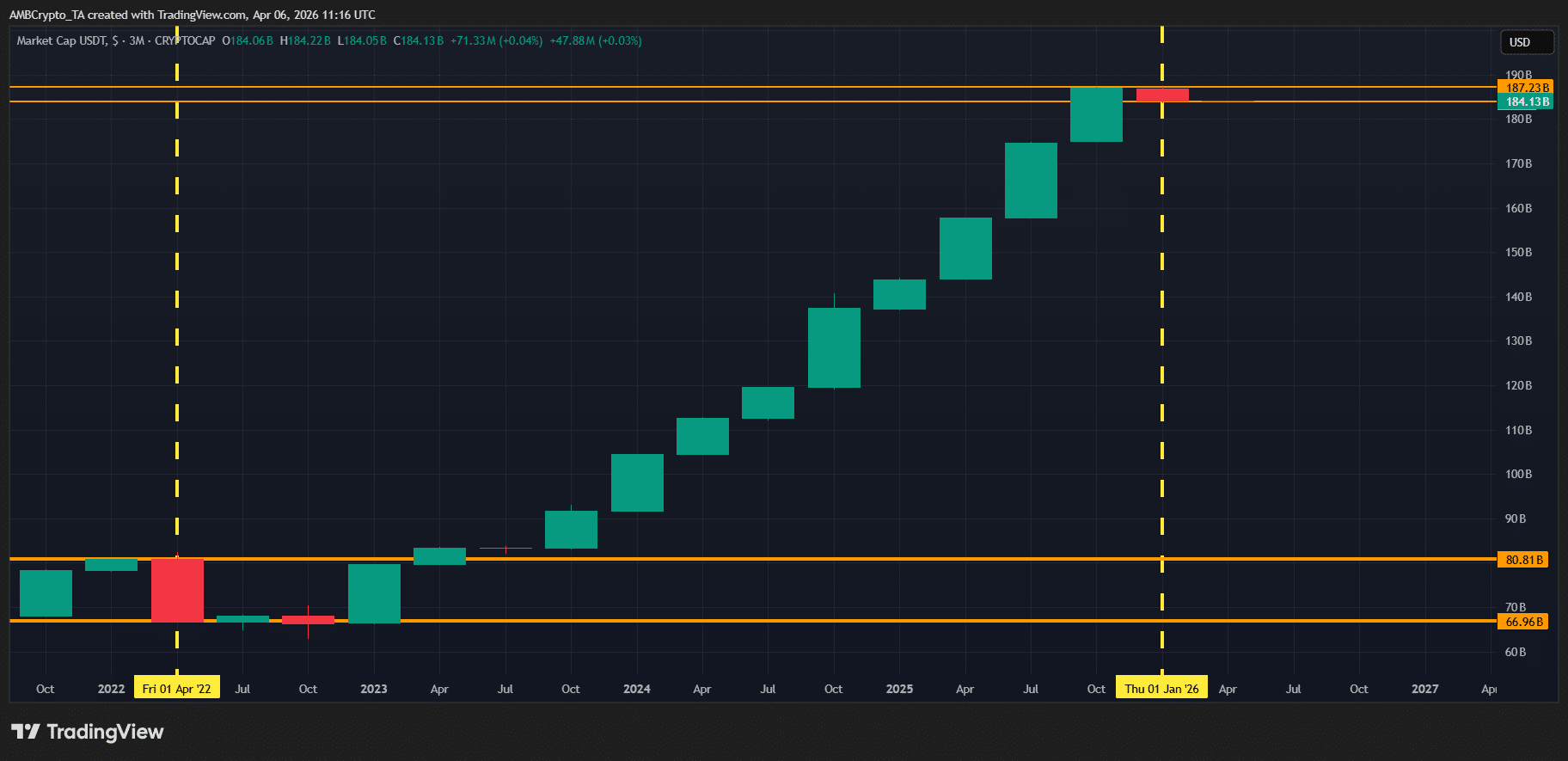
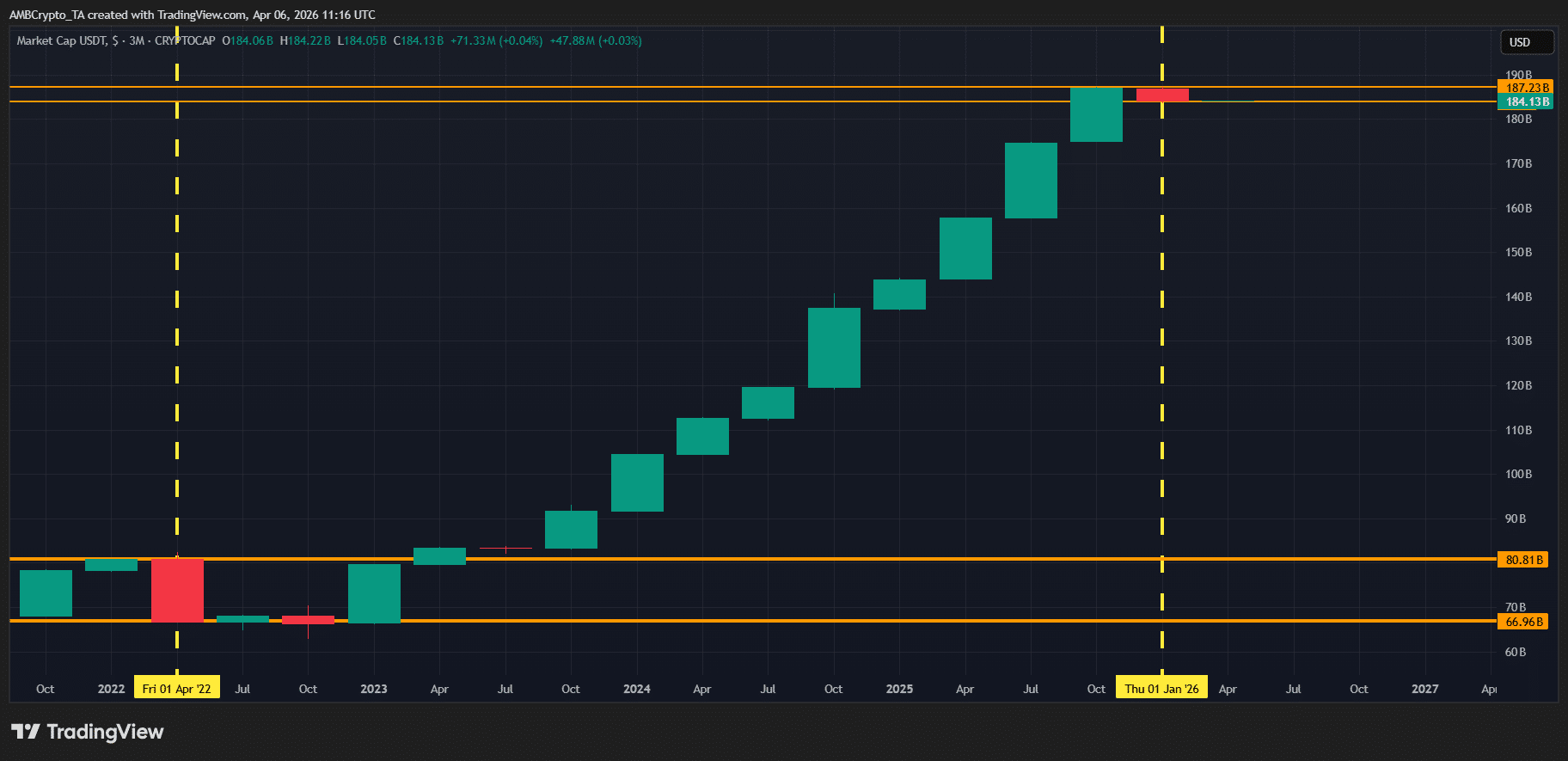
Source: TradingView (USDT)

In essence, stablecoins played a central role in defining crypto’s Q1 trend.

According to AMBCrypto, this is where the recent 10x Research report becomes relevant.

It highlights that USDT issuance on Ethereum [ETH] has recently outpaced Tron [TRX], with a near 2.6% monthly jump in volume on ETH. That closes the gap with TRX, which is now just 1% higher, signaling that liquidity is starting to flow into high-cap networks, consistent with the total crypto market cap rising 1.6% so far in April.

From a technical standpoint, this combination of rising market cap and stablecoin inflows is significant.

When stablecoins move back into major networks, it suggests that investors are redeploying capital. This kind of flow often forms a base for price support, and we’re already seeing it in action.

ETH has rallied 1.87% from its $2.1k open, reinforcing that this setup is gaining traction.

Naturally, the question arises: With stablecoins back in play, could this momentum be laying the foundation for a broader Q2 rally, potentially reversing the bearish trend from Q1?

Stablecoin flows hit major networks, market eyes potential rally base

Apart from serving as a hedge or a bridge, stablecoins often act as an early signal for market activity.

A striking example is the recent activity around Solana [SOL].

Circle minted $3.25 billion USDC on Solana in just 7 days, the largest weekly issuance of 2026. This sudden influx of liquidity into the network naturally raises questions about investor intent and market positioning.

But it doesn’t stop there.

According to Artemis Terminal, monthly stablecoin supply changes on Ethereum have reached a staggering $10.3 billion, the largest among all L1 networks. This “coordinated” increase in stablecoin supply across major networks suggests that investors are actively redeploying capital.
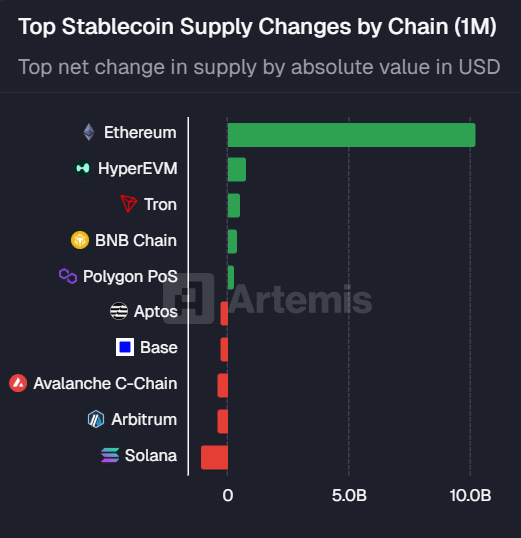
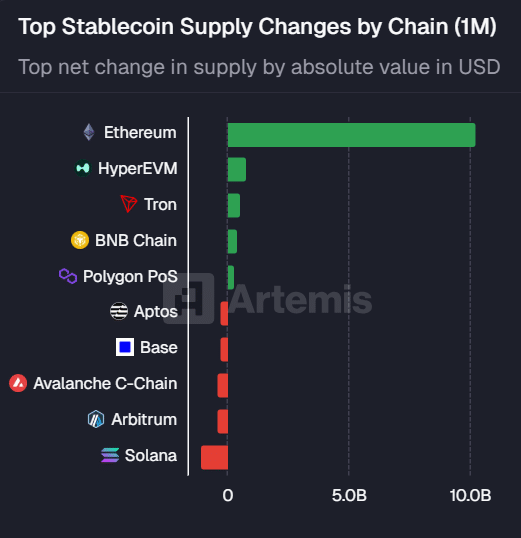
Source: Artemis Terminal

Consequently, the critical question now becomes: Do these issuers have insight into opportunities or risks that the broader market hasn’t priced in yet?

According to the 10x Research report, Ethereum’s relative undervaluation appears to be driving much of this influx.

From a technical standpoint, Ethereum has dropped 57% from its August 2025 peak, making it look relatively cheap, especially when compared to Bitcoin, which is down roughly 42% over the same period.

This is particularly significant given that BTC dominance continues to face resistance around 60%.

Adding to this, Wall Street’s integration into DeFi is gaining momentum, bringing institutional capital to the market.

Taken together, these factors suggest that Ethereum and other high-cap L1s may be positioning for early Q2 momentum, with stablecoin flows acting as a leading indicator of where capital may move next.


Final Summary

  • Rising USDT issuance on ETH and large USDC minting on SOL indicate capital is redeploying.
  • With ETH down 57%, BTC dominance under pressure, and Wall Street entering DeFi, stablecoin inflows may act as a leading indicator for Q2 momentum.


Related Questions

QWhat was the overall trend of the crypto market in Q1 2026, and what key metric confirmed this trend?

AThe crypto market was in a bear market in Q1 2026. This trend was confirmed by a 20.8% drop in the total crypto market cap over the period.

QHow did the behavior of stablecoins, specifically USDT, differ in the Q1 bear market compared to a typical bull market?

AIn the Q1 bear market, the stablecoin USDT's market cap fell by 1.6%, indicating that money was leaving the crypto ecosystem. In a bull market, investors typically hold stablecoins as 'dry powder' on the sidelines, waiting to deploy it for the next risk-on move.

QWhat recent development in stablecoin issuance on Ethereum suggests a potential shift in market sentiment?

ARecent data shows that USDT issuance on Ethereum has recently outpaced Tron, with a near 2.6% monthly jump in volume on ETH. This signals that liquidity is starting to flow back into high-cap networks.

QWhat was the significant USDC activity on the Solana network, and why is it notable?

ACircle minted $3.25 billion USDC on Solana in just 7 days, which was the largest weekly issuance of 2026. This massive and sudden influx of liquidity raises questions about investor intent and is a significant signal of market activity.

QAccording to the article, what are the three main factors suggesting Ethereum may be positioning for early Q2 momentum?

AThe three factors are: 1) Ethereum's relative undervaluation, being down 57% from its peak. 2) Bitcoin dominance facing resistance around 60%. 3) Wall Street's integration into DeFi, which is bringing institutional capital to the market.

Related Reads

Stuck Polymarket: The Real Test After Riding the Traffic Boom Has Arrived

Polymarket, a leading prediction market platform, is facing significant technical challenges as its growth outpaces its current infrastructure on Polygon. Users are experiencing laggy transactions, unresponsive orders, and delayed confirmations, severely impacting the trading experience. In response, DeFi Engineering VP Josh Stevens outlined a comprehensive engineering overhaul. The plan includes reducing on-chain data delays, fixing order cancellation issues, rebuilding the central limit order book (CLOB), improving website performance, and developing a unified SDK and API. A major revelation was the ongoing "chain migration," indicating a potential move away from Polygon. The core issue is that Polymarket has evolved from a simple prediction market into a high-frequency trading platform, making Polygon's limitations—such as block space, gas fees, and block time—a ceiling for further growth. The migration is not just a simple chain switch but a fundamental rebuild of its trading system to support more complex products like perpetual contracts (Perps). This announcement has sparked competition among chains like Solana, Sui, and Algorand, all vying to host Polymarket. For Polygon, losing this key application, which contributes significantly to its gas fee revenue, would be a major setback. The real test for Polymarket is no longer attracting users but proving it can provide a stable, reliable trading environment that retains them.

Odaily星球日报1h ago

Stuck Polymarket: The Real Test After Riding the Traffic Boom Has Arrived

Odaily星球日报1h ago

Lowering Expectations for BTC's Next Bull Market

The author, Alex Xu, explains his decision to significantly reduce his Bitcoin holdings (from full to ~30% of his portfolio) during the current bull cycle, citing a lowered long-term outlook for BTC's price appreciation in the next cycle. He outlines six key reasons for this reduced expectation: 1. **Diminished Growth Drivers:** The narrative of exponential user adoption has largely played out with institutional ETF adoption. The next major growth phase—adoption by sovereign national reserves or central banks—seems unlikely in the near future. 2. **Personal Opportunity Cost:** More attractive investment opportunities have emerged in other assets, such as undervalued companies. 3. **Industry-Wide Contraction:** The broader crypto industry is struggling, with most Web3 business models (SocialFi, GameFi, DePIN) failing. This overall萧条 (depression) reduces the fundamental demand and consensus for Bitcoin. 4. **Strain on Major Buyer:** MicroStrategy, a major corporate buyer of BTC, faces rising financing expenses for its debt, which could slow its purchasing rate and create significant marginal pressure on the market. 5. **Increased Competition from Gold:** The emergence of "tokenized gold" has closed the functional gap (portability, divisibility) between physical gold and Bitcoin, offering a strong competitor in the non-sovereign store-of-value space. 6. **Security Budget Concerns:** The block reward halving continues to exacerbate the long-standing issue of funding Bitcoin's network security, with new fee source explorations like Ordinals and L2s largely failing. The author's decision to hold a significant (though reduced) position reflects a cautious, not bearish, outlook. He remains open to increasing his exposure if the fundamental reasons for his skepticism change or if new positive catalysts emerge.

marsbit1h ago

Lowering Expectations for BTC's Next Bull Market

marsbit1h ago

Trading

Spot
Futures
活动图片




