Crypto rules are ‘not a favor,’ says SEC, but CLARITY Act still waits

ambcryptoPublished on 2026-07-03Last updated on 2026-07-03

Abstract

SEC Chairman Paul Atkins defended the agency's push for clear crypto market regulations, stating that providing regulatory clarity is "not a favor" but a necessary requirement for markets to function. He emphasized the SEC's "historic steps" to modernize rules in response to calls to make the U.S. a crypto capital. Despite issuing staff guidance on topics like asset classification and ETFs, the SEC acknowledges past missteps that broke trust and aims to rebuild it through an orderly process for handling numerous filings. However, such guidance, lacking a foundation in codified law, remains vulnerable to legal challenges. Lasting clarity for the industry is seen as dependent on the passage of the CLARITY Act, a comprehensive crypto market structure bill. Although the bill has cleared a key committee, it still awaits a Senate floor vote. With the EU's MiCA framework now active, industry groups are urging the U.S. to pass the CLARITY Act to prevent innovation from moving overseas.

U.S Securities and Exchange Commission (SEC) Chairman Paul Atkins has dismissed criticism of the President Trump Administration’s push for clear crypto market rules.

In a recent speech, Atkins maintained that the regulator is still making “historic steps” to modernize rules.

Over the past year, we have moved purposefully to answer President Trump’s call to make America the crypto capital of the world. We are taking historic steps to modernize our rules and regulations to facilitate markets moving on-chain

AD

He added,

After years of obscurity, we’ve delivered long-hauled certainty for digital asset issuers. This is not a favor to the industry; it’s what markets require to function: clear rules for the road without preference.

As the key regulators of the crypto market, as proposed under the CLARITY Act, the SEC and CFTC have made efforts to align their efforts and oversight in the sector.

In fact, the SEC has issued several staff guidance offering clarity on crypto asset classification, ETF framework, etc.

Industry pushes for CLARITY Act’s Senate vote

Interestingly, the agency has doubled down to offer more clarity in the sector.

In a separate interview with Bloomberg, the SEC’s Head of Investment Management, Brian Daly, echoed the same stance. For him, the move is aimed at rebuilding trust.

We did a bad job with crypto, broke trust, but we are looking to get back to a good place and make an orderly process to deal with the 200(!) ETF filings they get every month, including novel stuff like prediction markets.

Still, if the SEC’s guidance isn’t anchored in codified law and solely based on its staff’s interpretation, it can be challenged in the courts.

In fact, the regulator’s planned tokenization innovation exemption was delayed because of this. Additionally, prediction market platforms continue to face legal fights from states and traditional betting firms.

A lasting clarity could be achieved through the crypto market structure bill, the CLARITY Act, passage into law.

Unfortunately, as of writing, the bill, which cleared a key committee markup hurdle, has yet to be scheduled for a Senate floor vote.

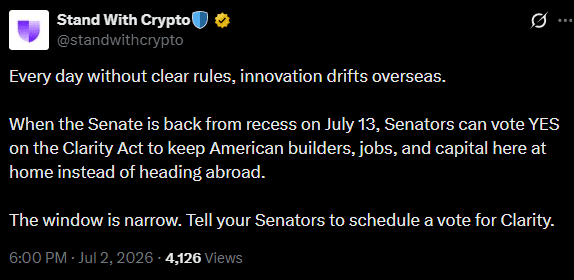
With the EU’s MiCA framework now live, the U.S government has been pressured to push for the CLARITY Act too. Coinbase-backed lobby group, Stand With Crypto, pressed,

Every day without clear rules, innovation drifts overseas. The window is narrow. Tell your Senators to schedule a vote for Clarity.
Source: X

Final Summary

  • SEC Chair Atkins said clarity for the crypto market is not a ‘favor’ but what’s required for a functioning industry.
  • But long-lasting clarity could only be offered by the passage of the CLARITY Act, whose passage is facing uncertainty.


Related Questions

QWhat is the main point made by SEC Chairman Paul Atkins regarding crypto market rules?

ASEC Chairman Paul Atkins stated that providing clear rules for the crypto market is 'not a favor' to the industry, but a requirement for markets to function properly.

QWhat are some actions the SEC has taken to provide clarity for the digital asset industry?

AThe SEC has issued several staff guidance documents offering clarity on crypto asset classification and the ETF framework, and has made efforts to modernize its rules and regulations.

QAccording to the article, what is a potential limitation of the SEC's current approach to providing guidance?

ASince the SEC's guidance is based on staff interpretation and not codified law, it can be challenged in the courts, as seen with the delayed tokenization innovation exemption.

QWhat specific legislation is highlighted as necessary for lasting clarity in the U.S. crypto market?

AThe article highlights the CLARITY Act, a crypto market structure bill, as necessary for achieving lasting clarity, but notes it has not yet been scheduled for a Senate floor vote.

QWhy is there increased pressure on the U.S. government to pass the CLARITY Act?

APressure has increased because the EU's MiCA regulatory framework is now live, and industry groups warn that without clear U.S. rules, innovation is drifting overseas.

Related Reads

Chainlink Tests Support As CCIP Moves From Hype To Usage

Chainlink's LINK token is testing key support levels as market focus shifts from the hype around its Cross-Chain Interoperability Protocol (CCIP) to assessing its real-world usage and adoption. While Chainlink maintains a strong position as core crypto infrastructure—providing oracles, data feeds, and automation—the market is increasingly demanding measurable evidence that its services, particularly CCIP, are gaining sustained traction. CCIP is central to Chainlink's long-term value proposition, aiming to solve critical cross-chain messaging and asset transfer challenges for institutions, DeFi, and multi-chain applications. The protocol's narrative is strong, but traders are now looking beyond announcements and integrations to metrics like transaction volume, value transferred, and developer adoption in production environments. Despite its utility, LINK's price action remains influenced by broader altcoin market cycles. The current support test blends technical factors with fundamental questions about CCIP's growth. If LINK holds support alongside clear evidence of increasing CCIP usage, it could reinforce its status as a leading infrastructure play. However, if support fails without corresponding usage growth, trader caution may persist. The key for Chainlink is transitioning CCIP from a promising concept into a widely used standard, turning its established market role into consistent token demand.

bitcoinist3h ago

Chainlink Tests Support As CCIP Moves From Hype To Usage

bitcoinist3h ago

Trading

Spot
活动图片