Crypto Prediction Markets Continue To Be Under Siege — Are Traders Now Fair Game For Prosecutors?

bitcoinistPublished on 2026-04-09Last updated on 2026-04-09

Abstract

U.S. federal regulators, including the CFTC and DOJ, are seeking a court order to prevent Arizona from enforcing its gambling laws against crypto prediction-market platform Kalshi. They argue that contracts tied to sports, elections, and real-world events qualify as financial derivatives ("swaps") under federal law, not state-regulated gambling. This legal action is part of a broader conflict between federal and state authorities over jurisdiction on prediction markets. Arizona and other states contend these platforms constitute illegal gambling and have initiated criminal charges. Similar legal pressures are affecting Kalshi’s rival, Polymarket, which faces lawsuits and investigations in multiple states. The outcome could either legitimize and boost U.S. prediction markets or fragment them into riskier offshore operations.

U.S. regulators are urging a court to stop Arizona from enforcing its gambling laws against crypto prediction‐market platform Kalshi.

Another Battle Over Crypto Prediction Markets

In a filing from yesterday, the Commodity Futures Trading Commission (CFTC) and the Justice Department (DOJ) commended a federal court to stop Arizona from using its gambling laws against crypto prediction‐market platform Kalshi.

The agencies are asking for a temporary restraining order and preliminary injunction to halt Arizona’s criminal case and gambling‐law enforcement.

Related Reading: Bitcoin Creator Exposed? New Investigation Points At The Real Identity Of Satoshi Nakamoto

CFTC argues that these contracts tied to sports, elections and other real‐world events qualify as swaps (financial derivatives) under U.S. law, rather than falling under state gambling statutes. The federal regulators based their arguments on the fact that since the contracts are settled on future events with economic impact, they are governed by the Commodity Exchange Act and fall under federal law rather than state authority.

Such interpretation curbs how far individual states can go in blocking or constraining these platforms, which regulators say would otherwise splinter the market into a patchwork of state‐by‐state rules.

The Arizona Lawsuit Explained

Arizona charged Kalshi with illegal gambling over sports and election markets. Arizona, along with an expanding list of other states, argue that contracts tied to sports results operate like ordinary bets and must be treated as gambling, subject to licensing rules, age limits, and consumer safeguards.

According to the court filing, Arizona first sent a cease‐and‐desist order to KalshiEx LLC and Kalshi Trading LLC in May 2025, alleging they were taking unlawful bets in breach of state law. The state then brought criminal charges against both entities for “betting and wagering” under several Arizona statutes, with an arraignment set for April 13.

On Monday, a Third Circuit (one of the 13 U.S. federal courts of appeals) ruling stated that sports event contracts on designated contract markets (DCMs) are “swaps” preempting state gambling laws. However, one judge disagreed, blasting Kalshi’s stance as a “performative sleight” designed to hide the fact that its offerings are, in substance, sports betting.

Crypto Prediction Markets Under A Coordinated State Pushback

This move follows a broader CFTC and DOJ litigation against Arizona, Connecticut, and Illinois over prediction‐market jurisdiction. Bitcoinist reported on it last week. This past month, a bipartisan Senate bill targeting sports‐style bets on platforms like Polymarket and Kalshi was introduced by Senators Adam Schiff (D-CA) and John Curtis (R-UT).

Also on March, democratic representative Seth Moulton of Massachusetts (MA-06) formally banned all his staff from participating in prediction markets. That same day, Congressman Adrian Smith (R-NE-03) and Congresswoman Nikki Budzinski (D-IL-13) from Nebraska introduced the PREDICT Act, banning members of Congress from trading on political and policy outcome markets.

Related Reading: SEC Admits Flaws In Crypto Enforment, What Went Wrong?

Kalshi’s main rival, Polymarket, is also under mounting legal fire, with a New York class action filed in February alleging it runs an unlicensed sports‐betting operation. Regulators in Nevada have launched a civil case against its parent company, and authorities in Ohio, Utah, and Iowa have likewise begun probing the platform.

Not too long ago, Argentinian authorities ordered a full national ban of Polymarket after it “predicted” inflation data back in February. On top of that, the platform faced terrible backlash recently after bettors sent death threats to Times of Israel military reporter Emanuel Fabian, following his report of an Iranian ballistic missile on March 10.

Both Kalshi and Polymarket updated their rules at the end of March to preemptively block politicians, candidates and sports insiders from trading on related markets

If the federal preemption is upheld, it will de‐risks U.S. prediction venues, potentially boosting liquidity and making them more attractive as macro and sports‐beta tools for crypto‐savvy traders. However, if states carve out sports and politics as gambling, markets may fragment offshore or into on‐chain, harder‐to‐police venues, raising operational and legal risk premia for anyone treating these contracts as serious hedging instruments.
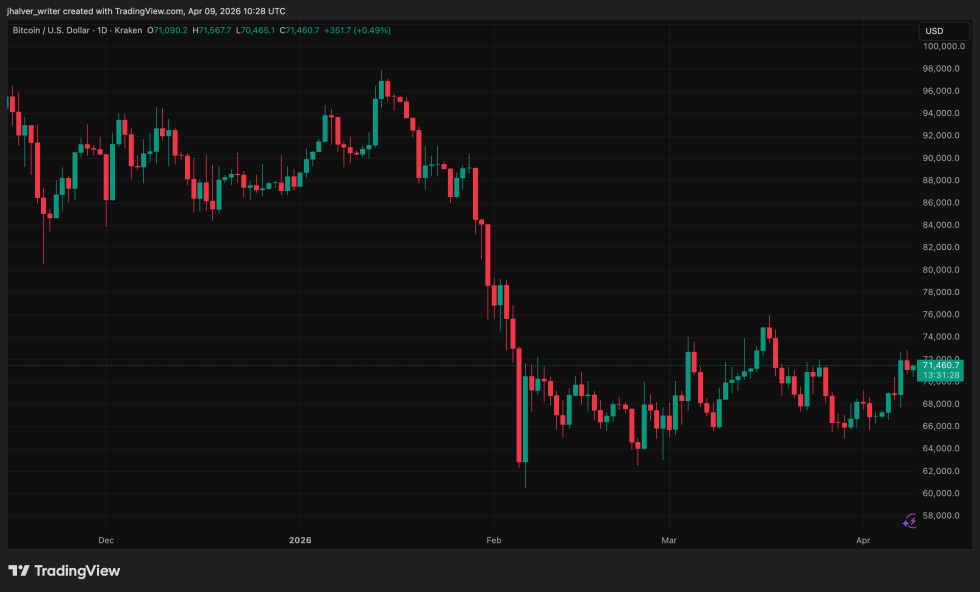
Yesterday, Bitcoin bounced back and reclaimed $72k. At the moment of writing, BTC trades for around $71k on the daily chart. Source: BTCUSD on Tradingview.

Cover image from Perplexity. BTCUSD chart from Tradingview.

Related Questions

QWhat is the main argument of the U.S. regulators (CFTC and DOJ) against Arizona's enforcement of its gambling laws on Kalshi?

AThe CFTC and DOJ argue that the contracts offered by Kalshi, which are tied to sports, elections, and other real-world events, qualify as financial derivatives (swaps) under U.S. federal law, specifically the Commodity Exchange Act. They contend that these contracts, because they are settled on future events with economic impact, fall under federal jurisdiction and preempt state gambling statutes.

QWhat specific legal measures are the federal agencies requesting from the court regarding Arizona's case against Kalshi?

AThe Commodity Futures Trading Commission (CFTC) and the Justice Department (DOJ) are asking the court for a temporary restraining order and a preliminary injunction to halt Arizona's criminal case and its enforcement of gambling laws against Kalshi.

QAccording to the article, what was the recent ruling by the Third Circuit court regarding sports event contracts on designated contract markets (DCMs)?

AA recent Third Circuit ruling stated that sports event contracts on designated contract markets (DCMs) are considered 'swaps,' which preempts state gambling laws. However, one judge dissented, calling Kalshi's stance a 'performative sleight' designed to disguise what is essentially sports betting.

QBesides Kalshi, which other major prediction market platform is facing significant legal challenges, and what are some examples?

AKalshi's main rival, Polymarket, is also under significant legal pressure. A New York class action lawsuit was filed in February alleging it runs an unlicensed sports-betting operation. Regulators in Nevada have launched a civil case against its parent company, and authorities in Ohio, Utah, and Iowa are probing the platform. It was also completely banned in Argentina.

QWhat are the two potential future scenarios for U.S. prediction markets outlined at the end of the article, depending on the legal outcome?

AIf federal preemption is upheld, it would de-risk U.S. prediction venues, potentially boosting their liquidity and attractiveness as trading tools. Conversely, if states successfully classify these markets as gambling, the markets may fragment and move offshore or into on-chain venues that are harder to police, thereby raising operational and legal risks for traders.

Related Reads

20 Billion Valuation, Alibaba and Tencent Competing to Invest, Whose Money Will Liang Wenfeng Take?

DeepSeek, an AI startup founded by Liang Wenfeng, is reportedly in talks with Alibaba and Tencent for an external funding round that could value the company at over $20 billion. This marks a significant shift, as DeepSeek had previously relied solely on funding from its parent company,幻方量化 (Huanfang Quantitative), and had resisted external investment. The potential valuation would place DeepSeek among the top-tier AI model companies in China, comparable to competitors like MoonDark (valued at ~$18 billion) and ahead of recently listed firms like MiniMax and Zhipu. The funding—which could range from $600 million (for a 3% stake) to $2 billion (for 10%)—is seen as a move to secure resources for model development, retain talent, and support infrastructure needs, particularly as competition in inference models and AI agents intensifies. Both Alibaba and Tencent are eager to invest, not only for financial returns but also to integrate DeepSeek into their broader AI ecosystems. However, DeepSeek’s leadership is cautious about maintaining independence and may prefer financial investors over strategic ones to avoid being locked into a specific tech ecosystem. Alternative options, such as state-backed funds, offer longer-term capital and policy support but may come with slower decision-making and potential constraints on global expansion. With competing AI firms accelerating their IPO plans, DeepSeek’s window for securing optimal terms may be narrowing. The final decision will reflect a trade-off between capital, resources, and strategic independence.

marsbit44m ago

20 Billion Valuation, Alibaba and Tencent Competing to Invest, Whose Money Will Liang Wenfeng Take?

marsbit44m ago

After Losing 97% of Its Market Value, iQiyi Attempts to Use AI to Forcefully Extend Its Lifespan

After losing 97% of its market value since its 2018 peak, iQiyi is aggressively pivoting to AI in a desperate attempt to survive. At its 2026 World Conference, CEO Gong Yu announced an "AI Artist Library" with over 100 virtual performers and a new AIGC platform, "NaDou Pro," promising faster production and lower costs. This shift comes as the company faces severe financial distress: its market cap sits near delisting thresholds at $1.36 billion, with significant losses, declining membership revenue, and depleted cash flow. The AI strategy has sparked controversy. Top actors have issued legal threats against unauthorized digital replicas, while in Hengdian, over 134,000 background actors are seeing their already scarce job opportunities vanish as AI replaces them for background roles. iQiyi's move represents a fundamental shift from being a high-cost content buyer to a landlord" to becoming a "platform capitalist" that transfers production risk to creators. This contrasts with competitors like Douyin (TikTok's Chinese counterpart), which is investing heavily in *real* actor-led short dramas, betting that authentic human connection retains users better than AI-generated content. The article draws a parallel to the 1920s transition to "talkies," which made cinema musicians obsolete but ultimately enriched the art form. In contrast, iQiyi's AI drive is framed not as an artistic evolution but as a cost-cutting measure that could degrade storytelling, replacing genuine human emotion with algorithmically calculated stimulation and potentially numbing audiences' capacity for empathy. The core question remains: can a company focused solely on financial survival preserve the art of storytelling?

marsbit47m ago

After Losing 97% of Its Market Value, iQiyi Attempts to Use AI to Forcefully Extend Its Lifespan

marsbit47m ago

Only a 50% Chance of Passing This Year, Can the CLARITY Bill Succeed Before the Midterm Elections?

The CLARITY Act, which passed the House in July 2025 with strong bipartisan support (294-134), faces a critical juncture in the Senate. The Senate Banking Committee is expected to hold a markup soon, but key issues remain unresolved, including stablecoin yield provisions, DeFi regulations, and securing full Republican committee support. Other contentious points involve the Blockchain Regulatory Certainty Act (BRCA), ethics amendments for government officials, and SEC-related matters. The legislative calendar is tight, with limited time before the midterm elections. If the committee markup is delayed beyond mid-May, the chances of passage in 2026 drop significantly. Senator Cynthia Lummis has warned that failure this year could delay comprehensive crypto market structure legislation until 2030 or later. Galaxy estimates the probability of the CLARITY Act becoming law in 2026 is only about 50%. The bill provides crucial regulatory clarity by defining jurisdictional boundaries between the SEC and CFTC, establishing a path for decentralization, and bringing digital commodity intermediaries under federal regulation. Its passage is seen as vital before potential power shifts in the next Congress, which could bring less favorable leadership to key committees. The timeline is compressed, and the bill must compete for floor time with other priorities like Iran authorization and DHS appropriations. Key hurdles include finalizing the stablecoin yield compromise text, addressing law enforcement concerns about BRCA, and navigating political dynamics around SEC nominations. The outcome of the Banking Committee markup and the level of bipartisan support will be critical indicators of its future success.

marsbit1h ago

Only a 50% Chance of Passing This Year, Can the CLARITY Bill Succeed Before the Midterm Elections?

marsbit1h ago

Trading

Spot
Futures
活动图片