Crypto nears its ‘Netscape moment’ as industry approaches inflection point

cointelegraphPublished on 2025-12-09Last updated on 2025-12-09

Abstract

The cryptocurrency industry is approaching its "Netscape moment," driven by advancements in blockchain infrastructure and the rise of regulated investment products, according to Paradigm co-founder Matt Huang. This inflection point mirrors the early internet's mass adoption phase, where ease of use and institutional accessibility became key catalysts. Onchain systems enable open, programmable finance, while regulated products like ETFs attract traditional investors by offering familiar, compliant access. Analysts note over 200 crypto ETPs may launch soon, broadening participation. Despite concerns about speculation and memecoin dominance on some networks, experts argue that centralized platforms and ETFs expand the onchain economy rather than threaten it. The true risk lies in slowed technological progress; continued innovation in functionality and market structures is essential for long-term value creation.

The cryptocurrency industry is approaching its “Netscape moment,” as steady progress in blockchain infrastructure and the rise of regulated investment products drive a new wave of institutional adoption, according to Paradigm co-founder Matt Huang.

The crypto sector is “facing its ‘Netscape’ or ‘iPhone’ moment,” Huang wrote Sunday in a post on X. “It’s working bigger than ever before, far beyond our wildest dreams. Both the institutional parts and the cypherpunk parts.”

Netscape launched the first easy-to-use web browser for mainstream users in 1994 before going public with a successful initial public offering (IPO) in August 1995, marking the first building block that triggered the internet’s mass adoption.

However, Microsoft saw the large-scale interest and capitalized on it on it by freely bundling Internet Explorer as a pre-installed component of the Windows operating system, outcompeting Netscape to become the most widely used internet browser.
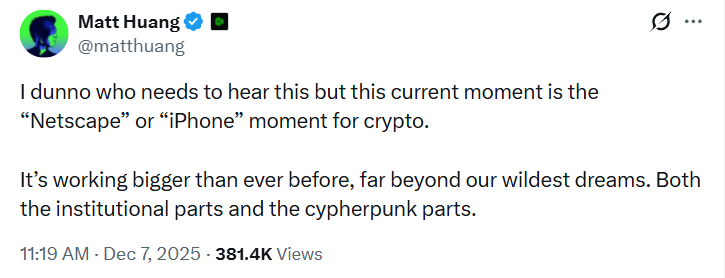
Source: Matt Huang

Onchain usability meets regulated access

In the crypto world, Bitcoin’s (BTC) peer-to-peer model and decentralized finance (DeFi) have enabled a new vision of an open, programmable financial system that cuts out intermediaries.

At the same time, centralized platforms and traditional investment vehicles are attracting a growing share of new capital because they are easier to use and fit within familiar regulatory frameworks.

About 200 crypto-based exchange-traded products (ETPs) could launch on the market in the next year, with 155 awaiting approval as of Oct. 22, according to Bloomberg’s senior ETF analyst, Eric Balchunas.

Crypto ETPs provide easier access to altcoins for traditional investors on brokerage platforms that don’t have an account on a centralized cryptocurrency exchange.
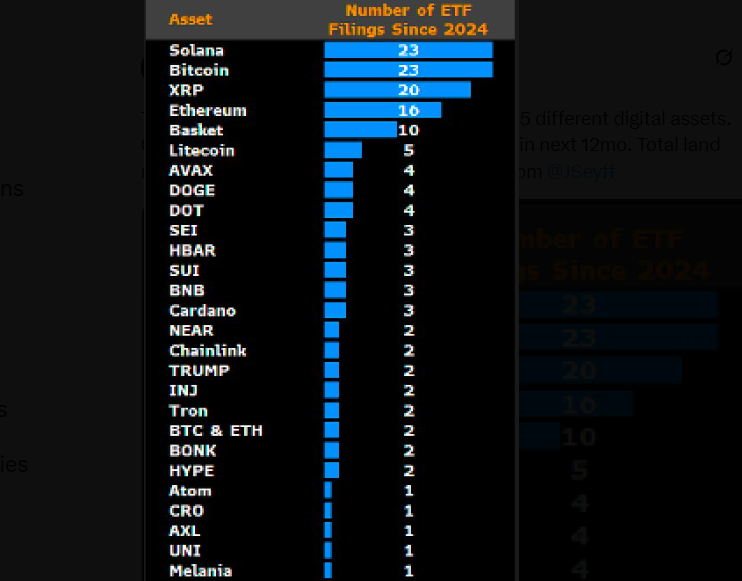
Source: Eric Balchunas

Related: Prediction markets emerge as speculative ‘arbitrage arena’ for crypto traders

Onchain products are becoming easier to use, while “regulated” investment vehicles are making crypto more accessible, signaling that the industry may be at the tipping point ahead of mass adoption, Lacie Zhang, market analyst at Bitget Wallet, told Cointelegraph.

“ETFs and similar products legitimize digital assets but don’t replace what onchain systems uniquely offer, such as direct ownership, programmable settlement, and real-time transfers.”

She added that regulated access points tend to pull more liquidity onto underlying networks by drawing in institutional capital and new participants, rather than “displacing onchain activity.”

Related: Bitcoin now settles Visa-scale volumes, but most is for wholesale, not coffee

Despite some concerns about centralization, the rise of centralized finance (CeFi) platforms and ETFs is an “expansion of the onchain economy,” not an inherent threat, according to Marcin Kazmierczak, co-founder of RedStone, a blockchain oracle solutions provider.

“The Netscape moment isn’t about onchain versus CeFi. It’s about the broader crypto ecosystem finally attracting capital that actually stays around long-term,” he told Cointelegraph, adding that the two ecosystems are “not adversarial.”

Netscape moment or dot-com bubble repeat?

However, the crypto industry may still risk a market crash akin to the dot-com bubble, considering that the majority of revenue is derived from speculative memecoin trading for some blockchain networks.

On Solana, memecoin trading accounted for 62% of the network’s decentralized app revenue in June, and the majority of its $1.6 billion in revenue for the first half of 2025.

To reach its true potential, the developers need to focus on advancing the industry’s real-world utility, as the only “real risk” to the industry is a “slowdown in technological development,” according to Edwin Mata, lawyer, co-founder and CEO of tokenization platform Brickken.

“What matters is that onchain environments continue creating functionality, automation, and new market structures, because that is where fundamental value is produced,” he told Cointelegraph.

Magazine: Solana vs Ethereum ETFs, Facebook’s influence on Bitwise — Hunter Horsley

Related Reads

USDC Begins Nested Issuance, Coinbase Launches Custom Stablecoin Branding Service

Coinbase has launched its "Custom Stablecoins" platform, enabling businesses to offer branded stablecoins. The first client is Flipcash, a social payments app, which has introduced USDF. USDF is a Solana-based stablecoin, pegged 1:1 to USDC, and is designed to serve as a stable pricing and settlement unit for Flipcash's user-created community currencies. This move shifts the focus of stablecoins from being standalone assets or investment products to becoming embedded payment and settlement components within broader applications. For businesses like Flipcash, the core need is not to become a stablecoin issuer, but to integrate stable, reliable digital cash functionality—handling pricing, payments, and settlements—without managing the complex underlying infrastructure of issuance, reserves, on-chain contracts, fiat on-ramps, and compliance. Coinbase's platform provides this infrastructure as a service, positioning the exchange as a stablecoin infrastructure provider. While USDC remains the foundational reserve asset, the branded token (e.g., USDF) offers applications a tailored, user-facing financial tool. This development highlights a potential path for stablecoins to become ubiquitous backend utilities in social, gaming, and e-commerce applications, though it also brings significant regulatory and operational complexities associated with handling real user funds.

链捕手58m ago

USDC Begins Nested Issuance, Coinbase Launches Custom Stablecoin Branding Service

链捕手58m ago

Detained for 37 Days: The First Wave of People Who Got Rich from 'AI Gateways' Are Starting to Go to Jail

A prominent AI proxy service operator was reportedly detained for 37 days and is now on bail pending trial, highlighting the legal risks in China's booming but unregulated AI intermediary market. These services act as "AI scalpers," providing domestic users with access to restricted overseas models (like OpenAI, Claude) by bundling APIs, handling payments, and bypassing network blocks, all for a fee. Their controversial profitability stems from practices like bulk-registering accounts to resell free credits, exploiting refund policies, overcharging for tokens, substituting cheaper models, and illegally selling user conversation data. Major figures, including cryptocurrency entrepreneurs, are now entering this space. Legally, these operations face severe risks. Their core model often involves unauthorized API access and operating without required telecom licenses, potentially constituting illegal business operations. They fail to meet data security obligations for the vast amounts of user data they process, risking charges for failing to fulfill network security duties. Crucially, the unauthorized collection and sale of user data, which can include personal and commercial secrets, easily meets the threshold for the crime of infringing on personal information. The case underscores a critical juncture for the AI industry. While proxies lower access barriers, they expose user data to unsecured middlemen and undermine the business models of AI developers, forcing them to divert resources to security and distorting market value perceptions. The article argues that the industry's sustainable future depends on building trust, protecting data, and fostering compliant competition, moving away from its current "wild growth" phase.

marsbit1h ago

Detained for 37 Days: The First Wave of People Who Got Rich from 'AI Gateways' Are Starting to Go to Jail

marsbit1h ago

Putting Markets On-Chain: Canton Network Quietly Becomes the New Backbone of Institutional Finance

**Title: Letting the Market Itself Go On-Chain: Canton Network Quietly Becomes the New Backbone for Institutional Finance** **Summary:** The Canton Network, a blockchain platform designed for institutional finance, is gaining significant traction. A key sign of its maturity was Visa's recent entry as a super-validator, a proposal approved in just three days—highlighting prior, extensive collaboration between traditional finance and crypto. Unlike public chains like Ethereum that prioritize transparency and asset onboarding, Canton focuses on enabling confidential, compliant business operations for regulated institutions. Its core design features built-in **data visibility control**, meaning transaction details are only shared between direct counterparties. This privacy is fundamental, allowing competing institutions (like banks Goldman Sachs, JPMorgan, and BNP Paribas, all validators) to interact on the same network without exposing sensitive positions or strategies. Developed by Wall Street veterans at Digital Asset, Canton has taken a slow, deliberate approach to onboard real financial activity. It now handles over **$9 trillion monthly** in transaction volume, primarily from real-world institutional use cases like **tokenized repo agreements**, Treasury settlements, and collateral mobility. Major live applications include **JPM Coin** for institutional payments and **DTCC's tokenized U.S. Treasuries** project. Canton's native token, **CC**, is framed as a "network utility asset" with zero pre-mine or VC allocations. Its value is intended to be driven by the volume of real financial activity on the network. Looking ahead, Canton aims to become the invisible foundational layer for global finance—enabling atomic settlement (where payment and asset delivery occur simultaneously), 24/7 capital flows, and the native issuance and settlement of various asset classes, from corporate bonds to potentially equities. The main challenges are no longer technical but involve navigating fragmented global regulations and integrating with legacy financial systems.

marsbit1h ago

Putting Markets On-Chain: Canton Network Quietly Becomes the New Backbone of Institutional Finance

marsbit1h ago

Trading

Spot
Futures
活动图片