Crypto Morning Brief: Michael Selig Officially Assumes Role as US CFTC Chairman, Uniswap 'UNIfication Proposal' Passes

深潮Published on 2025-12-23Last updated on 2025-12-23

Abstract

Crypto Morning Brief: Michael Selig has been officially sworn in as Chairman of the U.S. CFTC. He emphasized the agency’s growing role in shaping practical regulatory standards for digital asset markets. In other news, Uniswap’s “UNIfication” proposal has passed with over 69 million votes. The proposal will activate a fee mechanism, burn 100 million UNI tokens from the foundation treasury, and introduce a fee discount auction system. Since the vote began, UNI’s price has risen over 25%. Spot gold hit a new all-time high, surpassing $4,450 per ounce. Federal Reserve Governor Milan noted that the need for a 50-basis-point rate cut has diminished, though he warned that policy rates must adjust to reflect a declining neutral rate. Elsewhere, Espresso opened eligibility checks for its $ESP airdrop, with token claims starting in early 2026. Hyperliquid responded to transparency criticisms, asserting its full on-chain verifiability. Polymarket plans to launch its own Ethereum L2. Japanese firm Metaplanet approved issuing dividend-preferred shares and holds over 30,800 BTC. JPMorgan is considering offering crypto trading services to institutional clients. Coinbase acquired prediction market startup The Clearing Company. Trump Media purchased an additional 150 BTC, raising its total holdings to 11,241 BTC.

Author: Deep Tide TechFlow

Yesterday's Market Dynamics

Spot Gold Rises to $4450/Ounce This Morning, Hitting Another Record High

According to Jinshi Data, spot gold rose to $4450 per ounce this morning, setting another historical high, with a daily increase of 0.15%.

Michael Selig Has Officially Been Sworn In as US CFTC Chairman

According to Cryptobriefing, Michael Selig, a pro-Bitcoin figure, has officially been sworn in as Chairman of the US Commodity Futures Trading Commission (CFTC), following his confirmation by the US Senate.

In a statement, Selig noted that the CFTC is entering a significant period of transformation, driven by increased retail participation and the emergence of new products and platforms. He stated that the agency will play a larger role in establishing practical regulatory standards for the digital asset market while maintaining the stability and security of the US derivatives market. Selig emphasized: "We are at a unique moment where various new technologies, products, and platforms are emerging, retail participation in commodity markets is at an all-time high, and Congress is about to send digital asset market structure legislation to the President, solidifying the US's position as the 'crypto capital.'"

Prior to joining the CFTC, Selig served as Chief Legal Counsel of the US Securities and Exchange Commission (SEC) Crypto Working Group and Senior Advisor to Chairman Paul Atkins.

Fed Governor Milan: The Need for a 50 Basis Point Rate Cut Has Weakened

Federal Reserve Governor Milan stated that with the recent progress in monetary policy adjustments, the necessity for the 50 basis point rate cut he previously advocated has diminished. Milan pointed out that there have been some abnormal fluctuations in recent inflation data, partly related to the government shutdown. These anomalous signals suggest that the Fed's policy stance should shift towards a more accommodative direction. He emphasized that he does not currently see a risk of the economy falling into recession in the short term but believes that the neutral interest rate level has clearly shifted downward, and monetary policy must reflect this structural change. If policy rate is not consistently lowered to align with the new neutral level, it could instead increase the risk of the economy falling into recession. Additionally, regarding his own term, Milan admitted he is uncertain whether he will remain. He stated: If no successor is confirmed by the end of January, I will assume that I will continue to serve by default.

Uniswap's "UNIfication" Fee Switch Proposal Has Reached the 40 Million Vote Threshold for Passage, Will Take Effect This Week

According to Cointelegraph, Uniswap's fee switch proposal "UNIfication" has reached the 40 million vote threshold for passage and will take effect this week.

As of Monday, the proposal had received nearly 69 million affirmative votes, with voting ending on Thursday (Christmas Day). After the proposal passes, there will be a two-day timelock period, after which the Uniswap v2 and v3 fee switches will be activated on the Unichain mainnet, triggering UNI token burns.

The proposal will burn 100 million UNI tokens from the Uniswap Foundation treasury and implement a protocol fee discount auction system to increase liquidity provider yields. These changes are expected to significantly improve the supply and demand dynamics of the UNI token and enhance its long-term holding value.

Since voting began, the UNI price has risen over 25% and is currently trading at $6.19.

Espresso: Eligibility Check for ESP Airdrop Now Open, Token Claiming to Begin in Early 2026

According to an official announcement, the blockchain infrastructure Espresso Foundation has officially launched the $ESP token registration portal. Users can now connect their wallets to check if they are eligible for the Espresso airdrop. The token claiming page will open in early 2026.

Previous news indicated that Espresso completed a $28 million Series B funding round in 2024, led by a16z.

Hyperliquid Responds to Transparency Concerns, Emphasizes On-Chain Solvency is Fully Verifiable

Hyperliquid issued an official statement responding to multiple criticisms raised in a recent article about its platform. The statement emphasized that Hyperliquid is built on on-chain transparency, the platform is fully solvent, and every dollar is traceable and verifiable. Officials pointed out that critics overlooked the existence of HyperEVM USDC, incorrectly claiming the system was missing $362 million.

The statement clarified that testnet functions are only for the test environment and cannot be executed on the mainnet; the platform has no privileged users or fee exemptions; the CoreWriter function was misunderstood and cannot arbitrarily mint tokens or move user funds.

Hyperliquid stressed that as the only major perpetual contract platform with fully transparent state and transactions, anyone can run a node to verify the on-chain state, and every order, trade, and liquidation can be checked in real-time, a transparency advantage that other major trading platforms lack.

Sources: Polymarket Plans to Launch Its Own L2

Polymarket trader PredictTrader (@polymarketbet) summarized information recently disclosed by Polymarket team member Mustafa on social media, with key points as follows:

  1. Polymarket plans to migrate away from Polygon and intends to launch its own Ethereum L2 service, POLY. Launching POLY is the "top priority."

  2. Polymarket plans to abandon all third-party vendors (GoldSky, Alchemy, etc.).

  3. This week, Polymarket will launch 5-minute markets.

Japan's Largest Bitcoin-Holding Company Metaplanet Approves Issuance of Dividend-Preferred Shares

According to Cointelegraph, Japan's largest corporate Bitcoin holder, Metaplanet, approved a comprehensive overhaul of its capital structure on Monday, allowing it to raise funds from institutional investors by issuing dividend-preferred shares. The approved proposals include reclassifying capital reserves, doubling the authorized number of Class A and Class B preferred shares, and modifying the dividend structure to introduce floating and periodic dividends. Class A preferred shares will adopt a monthly floating dividend mechanism, while Class B preferred shares will offer quarterly dividends and be open to international institutional investors. It is reported that Metaplanet currently holds approximately 30,823 Bitcoins, valued at $2.75 billion, making it the largest corporate Bitcoin holder in Asia. The company also announced it will trade on the US over-the-counter market through American Depositary Receipts, further expanding its global market presence.

JPMorgan Considers Providing Cryptocurrency Trading Services for Institutional Clients

According to Bloomberg, Wall Street giant JPMorgan is evaluating the possibility of providing cryptocurrency trading services for its institutional clients. People familiar with the matter revealed that the bank's markets division is exploring products and services to expand its cryptocurrency business scope, potentially including spot and derivative trading.

Coinbase Acquires Prediction Market Startup The Clearing Company

According to The Block, Coinbase has reached an agreement to acquire prediction market startup The Clearing Company, with the transaction expected to be finalized in January 2026. This acquisition is part of Coinbase's "all-in-one exchange" strategy, aiming to deepen its presence in the event trading space. The Clearing Company team will join Coinbase to help expand its prediction market products. The startup was founded this year and received $15 million in seed funding in August, with investors including Coinbase Ventures.

Trump Media Spends $13.44 Million to Acquire an Additional 150 BTC

According to Arkham monitoring data, approximately 9 minutes ago, Trump Media, owned by Donald Trump, spent $13.44 million to acquire an additional 150 BTC. Trump Media's Bitcoin holdings now total 11,241 BTC, worth approximately $1 billion.

Market Trends
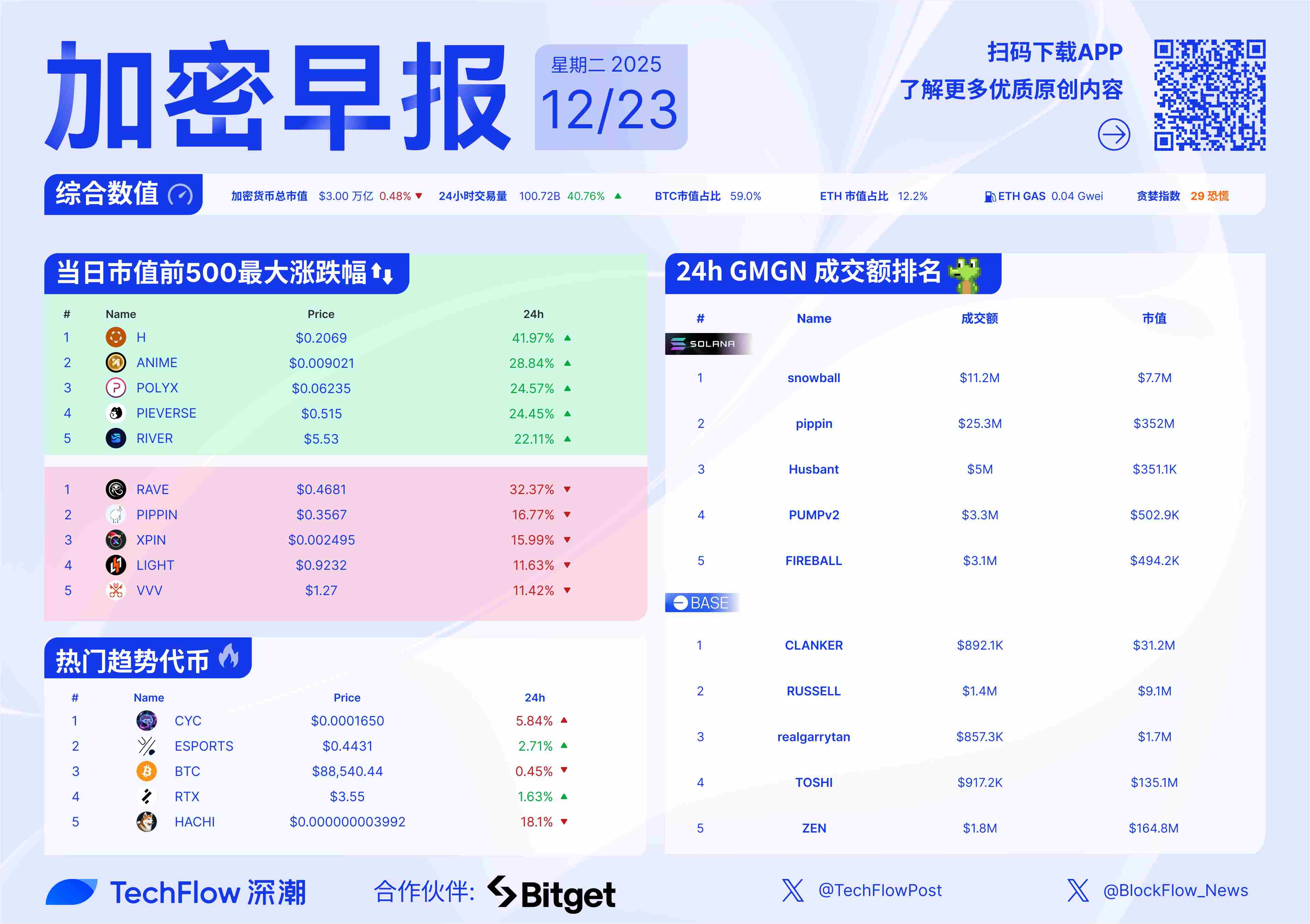
Recommended Reading

20x in 2 Days: A Quick Look at the Automated Market Making Mechanism of the New Meme Coin Snowball

This article details Snowball, a new type of Meme coin that uses an automated market making mechanism to convert transaction fees into buying pressure and liquidity, preventing developers from directly running away with funds. Snowball's mechanisms include: automatic token buybacks, increasing liquidity pool depth, and burning tokens to create deflation, with its creator fee ratio fluctuating with market capitalization. This mechanism relies on sustained growth in trading volume to maintain its snowball effect but may face challenges in the current sluggish market environment.

Coinbase 2026 Crypto Market Outlook: Deep Financial Integration, Innovating with Cautious Optimism

This article discusses how the crypto industry is at a critical stage of deep integration with the core of finance. It primarily explores the outlook for the 2026 crypto market, including analyses of market structure, tokenization, technological changes, and regulatory dynamics, and proposes key directions for future development. Additionally, the article mentions specific crypto industry trends, such as the rapid growth of stablecoins, the potential of prediction markets, and the composability of crypto derivatives.

Interpreting Messari's 100,000-Word Annual Report (Part 1): Why Did Market Sentiment Collapse Completely in 2025?

Based on Messari's annual report "The Crypto Theses 2026," this article analyzes the reasons for the complete collapse of crypto market sentiment in 2025. Although there was no systemic crash, sentiment fell to a historical low. The report points out that this phenomenon reflects a deep-seated misalignment between market participants and market structure, particularly the pressure exerted by monetary system imbalances on savers. Furthermore, the report explores the establishment of Bitcoin (BTC) as "real money" and its impact on other Layer 1 blockchains.

Tracking 118 Coins Launched in 2025: 85% Are Below Their Launch Valuation

This article analyzes data from Token Generation Events (TGEs) launched in 2025, finding that 85% of tokens currently have valuations below their issuance valuation, with the median token's fully diluted valuation down 71% and market capitalization down 67%. The crypto market is undergoing a transition from retail speculation-driven to institutionally dominated ecosystems. Stablecoin payments are increasingly centralized, with significant growth in trading volume and number of transactions. Additionally, the AI agent economy and crypto finance sector also demonstrate potential and challenges for future development.

1,000 Wallets Contribute 85% of Trading Volume: Stablecoin Payments Are More Centralized Than You Think

This article analyzes the use of stablecoins in blockchain payments, focusing on the trading patterns of the two main stablecoins, USDT and USDC, on the Ethereum network. Using data filtering methods and label classification techniques, the article explores stablecoin payment adoption rates, distribution of transaction types, drivers of payments, and future trends.


Related Questions

QWho has been sworn in as the new chairman of the U.S. Commodity Futures Trading Commission (CFTC)?

AMichael Selig has been officially sworn in as the new chairman of the U.S. Commodity Futures Trading Commission (CFTC).

QWhat is the 'UNIfication' proposal for Uniswap and what is its main purpose?

AThe 'UNIfication' proposal is a fee switch mechanism for Uniswap that has passed its voting threshold. Its main purposes are to burn 100 million UNI tokens from the Uniswap Foundation treasury and implement a protocol fee discount auction system to increase liquidity provider yields, thereby improving the token's supply and demand dynamics.

QWhich company, reported as the largest corporate Bitcoin holder in Japan, has approved issuing dividend-preferred shares?

AMetaplanet, the largest corporate Bitcoin holder in Japan, has approved issuing dividend-preferred shares to raise funds from institutional investors.

QAccording to the article, which major Wall Street bank is considering offering cryptocurrency trading services to its institutional clients?

AJPMorgan is considering offering cryptocurrency trading services, including potential spot and derivatives trading, to its institutional clients.

QWhat significant action did Trump Media take regarding its Bitcoin holdings, as mentioned in the report?

ATrump Media spent $13.44 million to acquire an additional 150 BTC, increasing its total Bitcoin holdings to 11,241 BTC, valued at approximately $1 billion.

Related Reads

KOL's Perspective: Why Is SOL Set to Rise from This Point?

**Summary: Why SOL is Positioned for Growth at This Level** The article argues that SOL is poised for an upward move from its current price point, citing several key factors. Primarily, SOL has just broken out of a 4-month consolidation phase. This breakout signals a return of risk appetite to the broader crypto market, as SOL is seen as a key indicator of overall crypto health. The token's ownership has reportedly shifted from short-term traders and tourists to long-term accumulators, leading to low volume. Any meaningful increase in trading activity could thus trigger significant upward momentum. Fundamental strengths include strong institutional adoption, integration with DeFi and RWAs (Real-World Assets), and the potential benefits from the Clarity Act. Despite its high volatility—having dropped 70% from its all-time high but still up 12x from its bear market low—SOL is highlighted as one of the few tokens from the last cycle to reach new highs. It boasts a robust ecosystem of applications, users, and protocols. Future catalysts include the expected influx of AI developers following the Miami Accelerate conference, which focused on AI on Solana. Furthermore, Solana is positioned as the premier chain for memecoin activity, a trend expected to continue and drive network usage and fees. The article concludes that recent price action reflects a healthy transfer to long-term holders, setting the stage for growth.

marsbit21m ago

KOL's Perspective: Why Is SOL Set to Rise from This Point?

marsbit21m ago

Those Pre-Bitcoin PoW Protocols Have Recently Been Reimplemented

This article details a recent surge in replicating pre-Bitcoin Proof-of-Work (PoW) protocols, specifically focusing on Hal Finney's 2004 RPOW (Reusable Proofs of Work). Within five days in May 2026, multiple independent builders in the Bitcoin/cypherpunk community launched projects inspired by this early electronic cash proposal. The initiative began with Fred Krueger's `rpow2.com`, a centralized but auditable system that replaced RPOW's original IBM 4758 hardware with Ed25519 signatures. Initially a faithful replica, it later adopted Bitcoin-like features (21M supply cap, difficulty adjustment) and a controversial 5.24% founder allocation. This sparked rapid forks, including `rpow4.com` which incorporated full Bitcoin parameters, a prediction market (`rpowmarket.com`), and a DEX (`rpow2swap.com`). Concurrently, Mike In Space created a prototype of Wei Dai's 1998 b-money proposal (`b-money.replit.app`), pushing the historical exploration even further back. The article contrasts these centralized, server-dependent experiments with Bitcoin's core innovation of decentralized, trustless consensus. It also highlights a parallel development: the `HASH` project on Ethereum, which uses smart contract hooks to enable a purely fair-launch, browser-mineable PoW token with 0% allocations to team or VCs. The collective activity is framed as a meme-driven, educational exploration of cypherpunk history rather than a serious financial movement, with all projects heavily disclaiming any investment value.

marsbit26m ago

Those Pre-Bitcoin PoW Protocols Have Recently Been Reimplemented

marsbit26m ago

South Korean Exchanges 'Battle' Regulators, Challenging the Boundaries of Enforcement and Legislation

South Korea's cryptocurrency industry is engaged in a rare, direct confrontation with regulators. The Financial Intelligence Unit (FIU), the primary anti-money laundering (AML) watchdog, has recently imposed heavy penalties on major exchanges like Upbit and Bithumb for alleged violations involving unregistered overseas VASPs and AML procedures. However, exchanges are now actively challenging these actions in court and through industry associations. In a significant shift, the Seoul Administrative Court ruled in favor of Upbit's operator, Dunamu, overturning part of an FIU-ordered business suspension. The court found the FIU's penalty criteria and justification insufficiently clear. Similarly, the court suspended the enforcement of a six-month business suspension against Bithumb pending a final ruling, citing potential irreversible harm to the exchange. Beyond legal battles, the industry is contesting proposed legislative amendments. The Digital Asset eXchange Alliance (DAXA) strongly opposes a draft rule that would mandate Suspicious Transaction Reports (STRs) for all crypto transfers over 10 million KRW (~$6,800). DAXA argues this "poison pill" clause violates legal principles and would overwhelm the STR system, increasing reports from 63,000 to an estimated 5.45 million annually for major exchanges, thereby crippling effective AML monitoring. This conflict highlights a structural tension in South Korea's crypto governance: comprehensive digital asset laws are still developing, while regulators rely heavily on AML enforcement. The industry's move from passive compliance to active legal and legislative challenges signifies a new phase, pressing for clearer rules and more proportionate enforcement. While short-term disputes may intensify, this clash could ultimately lead to a more mature and sustainable regulatory framework for South Korea's vibrant crypto market.

marsbit1h ago

South Korean Exchanges 'Battle' Regulators, Challenging the Boundaries of Enforcement and Legislation

marsbit1h ago

After 50x Storage Surge, Justin Sun Always Looks to the Next Decade

Sun Yuchen, known for his controversial stunts like a $30 million lunch with Warren Buffett (canceled due to a kidney stone) and eating a $6.2 million duct-taped banana, is often overshadowed by a significant fact: his decade-long track record of spotting major investment trends. In 2016, he famously advised young people to invest in Bitcoin, Nvidia, Tesla, and Tencent instead of buying property. A hypothetical $20,000 investment in Nvidia and Tesla from that list would now be worth over 50 million RMB. His latest major call was on November 6, 2025, predicting a "50x storage opportunity" tied to the AI boom, which materialized with Sandisk's stock surging nearly 50-fold by 2026. Looking ahead, Sun now focuses on the next frontier: Physical AI. He identifies four key areas: 1. **Embodied AI/Robotics**: He sees this reaching its "iPhone moment," with companies like UBTech and Galaxy General leading in commercialization. 2. **Drones**: Viewed as the first commercially viable form of Physical AI, revolutionizing sectors from warfare (e.g., AeroVironment's Switchblade) to logistics. 3. **Spatial Computing**: Beyond VR, it's about AI understanding physical space, a foundational technology for robotics and autonomous systems, exemplified by Apple's Vision Pro. 4. **Space Exploration**: After a 2025 suborbital flight with Blue Origin, Sun advocates for space as the ultimate frontier, discussing blockchain's potential role in space asset management and data transactions. His investment philosophy involves betting on entire, inevitable trends rather than single companies. For robotics, he sees Tesla (the body/manufacturer) and Nvidia (the brain/AI platform) as complementary plays. In defense drones, he highlights companies making tanks obsolete (AeroVironment) and those augmenting fighter jets (Kratos). For space, he participated in Blue Origin's flight and anticipates SpaceX's potential IPO to redefine the sector's valuation. Sun Yuchen's vision frames the next two decades not as a revolution in information flow (like the internet), but in the fundamental operation of the physical world through AI-powered robots, autonomous systems, and spatial intelligence, ultimately extending human and AI activity into space. While many still focus on conventional assets, he continues to look toward the next technological horizon.

marsbit2h ago

After 50x Storage Surge, Justin Sun Always Looks to the Next Decade

marsbit2h ago

Trading

Spot
Futures

Hot Articles

How to Buy US

Welcome to HTX.com! We've made purchasing Talus Network (US) simple and convenient. Follow our step-by-step guide to embark on your crypto journey.Step 1: Create Your HTX AccountUse your email or phone number to sign up for a free account on HTX. Experience a hassle-free registration journey and unlock all features.Get My AccountStep 2: Go to Buy Crypto and Choose Your Payment MethodCredit/Debit Card: Use your Visa or Mastercard to buy Talus Network (US) instantly.Balance: Use funds from your HTX account balance to trade seamlessly.Third Parties: We've added popular payment methods such as Google Pay and Apple Pay to enhance convenience.P2P: Trade directly with other users on HTX.Over-the-Counter (OTC): We offer tailor-made services and competitive exchange rates for traders.Step 3: Store Your Talus Network (US)After purchasing your Talus Network (US), store it in your HTX account. Alternatively, you can send it elsewhere via blockchain transfer or use it to trade other cryptocurrencies.Step 4: Trade Talus Network (US)Easily trade Talus Network (US) on HTX's spot market. Simply access your account, select your trading pair, execute your trades, and monitor in real-time. We offer a user-friendly experience for both beginners and seasoned traders.

4.5k Total ViewsPublished 2025.12.11Updated 2025.12.11

How to Buy US

Discussions

Welcome to the HTX Community. Here, you can stay informed about the latest platform developments and gain access to professional market insights. Users' opinions on the price of US (US) are presented below.

活动图片