Author: Deep Tide TechFlow
Yesterday's Market Dynamics
US Releases Important Economic Data
According to Jinshi Data, US initial jobless claims for the week ending December 13 were 224,000, compared to an expectation of 225,000.
According to Jinshi Data, the US November unadjusted CPI year-on-year was 2.7%, compared to an expectation of 3.1%.
Hassett: Latest CPI Report Surprisingly Good, Fed Has Significant Room for Rate Cuts
According to Jinshi Data, on Thursday, White House National Economic Council Director Hassett welcomed the November CPI report, stating that the US economy is exhibiting high growth and falling inflation. He said: "I'm not saying we're declaring victory on prices, but this is a surprisingly good CPI report." Hassett stated that wage growth is outpacing price growth, US taxpayers will see large refunds next year, and the government will help lower mortgage rates. He said: "The Fed has significant room for rate cuts." Hassett is a leading candidate to replace Powell as the next Fed Chair. He also suggested that the Fed should be more transparent in the future. "I think the Fed has to double down on transparency. Whoever leads the Fed should lay all the cards on the table so we can figure out what's really happening at that institution."
US SEC Releases Regulatory FAQ Related to Crypto Assets and Distributed Ledger Technology
According to an official announcement, the US SEC's Division of Trading and Markets released Frequently Asked Questions (FAQs) on activities related to crypto assets and Distributed Ledger Technology (DLT), aiming to provide compliance guidance for market participants. The content covers the following core areas:
-
Broker-Dealer Responsibilities: Non-security crypto assets are not subject to Securities Exchange Act Rule 15c3-3. However, if they are "crypto asset securities," brokers can establish "control" under this rule to meet compliance requirements. The SEC has no objection to assets in non-paper form.
-
Customer Asset Protection: If a crypto asset is not a product registered under the Securities Act, SIPC (Securities Investor Protection Corporation) will not provide protection. The SEC suggests treating non-security crypto assets as "financial assets" and placing them in a "securities account" under UCC Article 8 to strengthen the independence of customer assets during clearing and bankruptcy.
-
Dual Asset Trading Pairs: National Securities Exchanges (NSE) and Alternative Trading Systems (ATS) can offer paired trading of "crypto securities/non-security assets," provided they meet regulatory requirements and disclose relevant information in detail on Form ATS or ATS-N.
-
Transfer Agents and DLT: If a transfer agent provides security transfer services for a crypto asset issuer, and the asset is a registered security under Section 12, it must register with the SEC. The SEC does not object to using blockchain as the primary ledger, provided it meets federal regulations for record-keeping and supervision.
-
Clearing, Settlement, and ETPs: When a registered broker operates an ATS, it can clear customer trades within its own account ledger; the SEC does not mandate registration as a clearing agency. For ETPs referencing crypto assets, the SEC does not object to their operation referencing the 2006 no-action letter for commodity ETPs.
Bitwise Files S-1 with US SEC, Proposes Spot Sui ETF
According to an official filing, Bitwise has filed a Form S-1 with the US SEC, proposing a spot Bitwise Sui ETF aimed at tracking the value of Sui held by the Trust (net of fees). The Trust's Sui will be custodied by Coinbase Custody, with plans to stake a portion of the assets.
Tether CEO: Will Eventually Launch a Pear Operating System
Stablecoin company Tether yesterday announced the launch of PearPass, a peer-to-peer (P2P) password manager designed to eliminate the risk of users' encrypted information being leaked to the cloud. The company's CEO, Paolo Ardoino, shared a community analysis article on platform X and stated: "Will eventually launch a Pear Operating System (Pear OS)".
Uniswap Founder: Final Governance Vote Submitted for Unification Proposal, Proposes Burning 100 Million UNI Tokens and Enabling Fee Switch
According to Uniswap founder Hayden Adams, the Unification proposal has been submitted for a final governance vote. Voting will begin on December 19 at 10:30 PM ET and end on December 25.
If the proposal passes, after a 2-day timelock, the following measures will be executed: Burn 100 million UNI tokens; Activate the fee switch for versions v2 and v3 on the mainnet, beginning the burning of UNI tokens, including Unichain fees; Uniswap Labs will align with Uniswap governance through a contractual agreement, which is legally binding under Wyoming DUNA law.
Hong Kong Economic Times: Standard Chartered Hong Kong Launches Tokenized Deposit Service
According to the Hong Kong Economic Times, Standard Chartered Bank (Hong Kong) and Ant International, under the framework of the Hong Kong Monetary Authority's DLT regulatory sandbox and Ensemble project, have tokenized Ant International's HKD, RMB, and USD accounts through Ant International's blockchain treasury management platform "Whale Platform".
The report stated that this tokenized solution was co-developed, allowing Ant International business entities to adopt a new treasury management model, accelerating the shift to this new model and enabling 24/7 real-time transfers of HKD, RMB, and USD funds.
Mahesh Kini, Global Head of Cash Management Business at Standard Chartered, said that as companies' reliance on instant liquidity increases, the market demand for real-time and 24/7 treasury management is growing rapidly.
Forward Industries Announces Its Tokenized Stock is Live on Solana Blockchain
According to Businesswire, Nasdaq-listed Solana treasury company Forward Industries announced that its SEC-registered stock is now live on the Solana blockchain via the Superstate platform. It is reported that eligible investors can also use the company's tokenized stock as collateral to borrow stablecoins, thereby gaining on-chain liquidity while maintaining investment exposure to the underlying equity.
NYSE Parent Intercontinental Exchange in Talks to Invest in Crypto Payments Company MoonPay
According to Bloomberg, Intercontinental Exchange Inc., the parent company of the New York Stock Exchange, is in talks to invest in crypto payments company MoonPay Inc. Sources revealed that MoonPay is close to completing a new funding round targeting a valuation of approximately $5 billion. This investment would be part of that funding round.
Listed Company VivoPower Partners with Korea's Lean Ventures to Acquire Ripple Equity
According to CoinDesk, Nasdaq-listed company VivoPower (VVPR), through its digital assets division Vivo Federation, has partnered with Korean asset management company Lean Ventures to plan raising $300 million to acquire equity in Ripple Labs, serving Korean institutional and qualified retail investors.
At the current XRP price, this investment would indirectly provide exposure to approximately 450 million XRP tokens, worth about $900 million. VivoPower has received approval from Ripple to purchase the first tranche of preferred shares and is negotiating additional acquisitions with existing institutional holders.
Solana-based DePIN Project Fuse Energy Completes $70 Million Series B Funding Round Led by Lowercarbon and Balderton
According to SolanaFloor, the Solana-based DePIN project Fuse Energy announced the completion of a $70 million Series B funding round. This round was led by Lowercarbon Capital and Balderton Capital, valuing the company at $5 billion.
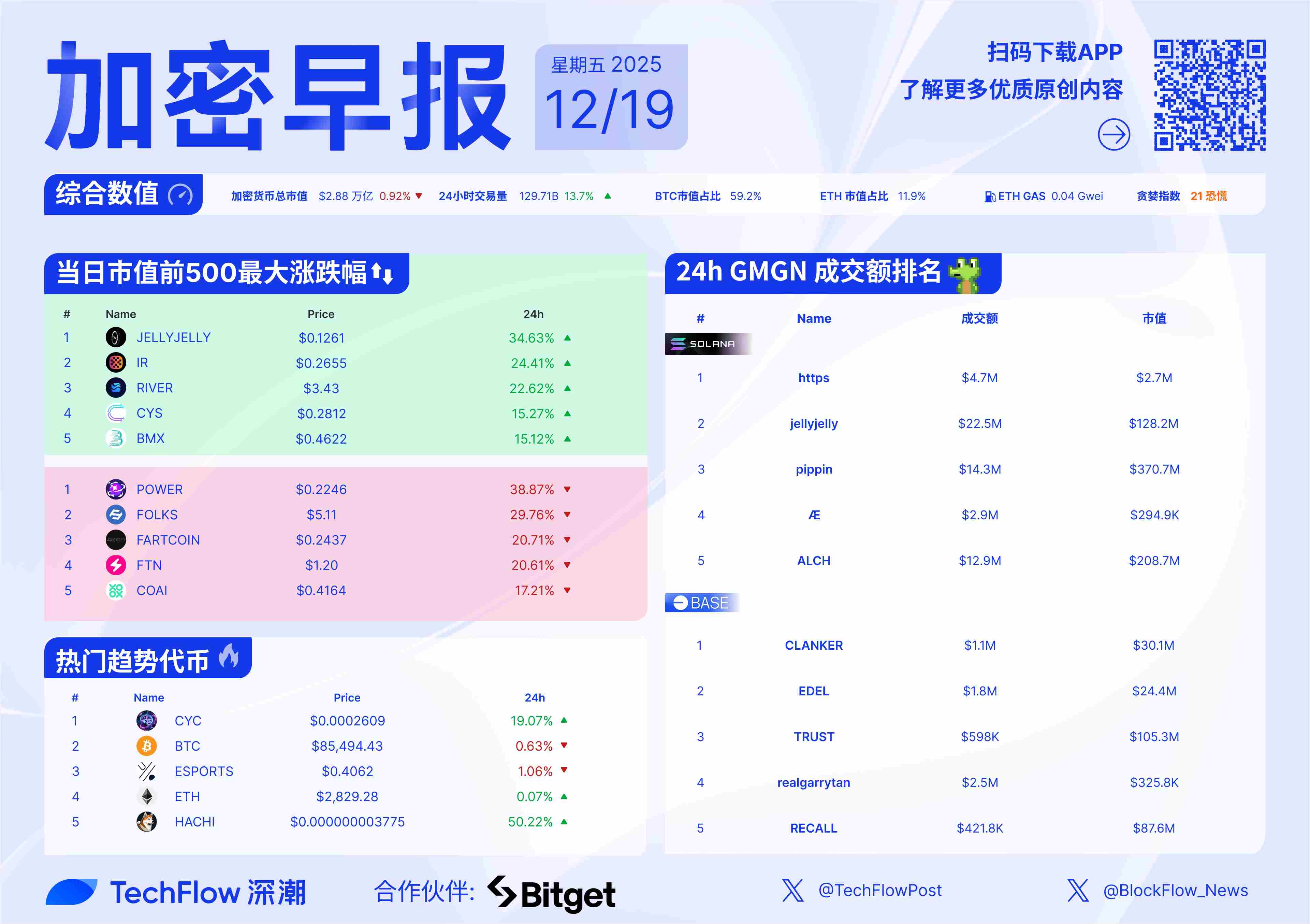
Market Trends
Recommended Reading
After Profiting $580K, I'm Shorting ETH Again with $1 Million
This article analyzes the current state of the cryptocurrency market, particularly the price volatility of Ethereum (ETH) and investment strategies. The author details the reasons for shorting ETH, the dynamics of marginal buyers and sellers in the market, and the impact of strategies by major market participants like Tom Lee on the ETH market. The article also discusses the relationship between the maturation of the cryptocurrency market and the value of technology products and assets.
From AI to Labubu, From Gold to Crypto: Why Are Speculative Bubbles Everywhere Globally?
This article explores the phenomenon of speculative bubbles worldwide, particularly the economic risks in hot areas like artificial intelligence (AI), cryptocurrency, and others. It analyzes historical speculative bubbles, compares them to the current irrational exuberance in markets, and points out the potential economic consequences of these bubbles.
NY Times: The Untold Story Behind Trump's Embrace of Crypto
This article discusses a New York Times piece revealing the Trump administration's support for cryptocurrency and its effects, including policy relaxation, market volatility, an innovation boom, and potential risks. It details the rise and fall of crypto enterprises, the risks of leveraged trading, and the development trend of asset tokenization, while also analyzing the Trump family's business布局 in the cryptocurrency space.
Frontline Report | Web3 Lawyer Deciphers Latest Changes in US Stock Tokenization!
This article details how US stock tokenization is a key item on the US financial infrastructure agenda. While it won't fundamentally change how Wall Street operates in the short term, its development is gradually shifting from "whether it's compliant" to "how to implement it." The article provides a detailed interpretation of the latest progress in US stock tokenization, including regulatory reforms by Nasdaq and DTCC, the SEC's regulatory stance, and the specific implementation paths of tokenization technology.
The On-Chain Evolution of Private Credit: From Ledger to Investable Product
This article explains that tokenized private credit is the fastest-growing category, growing from less than $50,000 to about $2.4 billion, showing its potential among on-chain assets. Tokenized private credit is divided into "representative" and "distributive" models; the former only records loan information, while the latter enables the on-chain transfer of assets. Movable private credit assets not only provide liquidity but also enable faster settlement, higher transparency, and more flexible custody methods.