Crypto Libra Scandal: New Evidence Exposes Payments From Lobbyist To President Milei

bitcoinistPublished on 2026-03-19Last updated on 2026-03-19

Abstract

New forensic evidence and leaked court documents reveal that Mauricio Novelli, a lobbyist for the cryptocurrency Libra (LIBRA), made thousands of dollars in payments to Argentine President Javier Milei and his inner circle since 2021. The payments, initially around $2,000 monthly during Milei's time as a congressman, increased to $4,000 routed through his sister after he became president. Prosecutors found that Novelli financed these transactions by selling cryptocurrencies like USDT for cash. Additional documents suggest a coordinated effort to leverage Milei’s influence to promote Libra, including a proposed $5 million package for his endorsement. Milei’s public promotion of the token in February 2025 led to a 1,300% price surge followed by a crash, causing significant investor losses and triggering legal and congressional investigations. Opposition lawmakers are now accusing Milei of being a "necessary participant" in a premeditated crypto scam, though the presidency maintains he acted in "good faith."

New forensic reports and leaked court documents show years of dollar payments from crypto Libra (LIBRA) lobbyist Mauricio Novelli to Javier Milei and his inner circle, well before the memecoin collapsed.

Dollar Payments For A Crypto Scandal

Thirteen months after Argentina and the entire crypto world was shaken by the accusations of insider trading against the President of Argentina, Javier Milei, new uncovered evidence shows references to thousands of dollars Novelli had paid the libertarian since 2021, back when he was a congressman, for teaching classes and promoting Novelli’s investment consulting firm, Argentinian outlet La Nación reported yesterday.

A selfie of Novelli and Milei, taken in 2024. Source: La Nación.

Messages and audios recovered by prosecutors reveal that Novelli financed the payouts with crypto, mainly selling USDT and other assets for cash and then delivering physical dollars labeled as the “usual” amount for Milei and associated influencers: monthly payments of around $2,000 during Milei’s time as deputy, later rising to $4,000 routed to his sister and chief of staff, Karina Milei, once he became president in 2023.

A Long List Of New LIBRA Case Findings

The new evidence comes from the forensic analysis of Novelli’s phone and it adds to the long list of revelations regarding the case that have been exposed since last week. On March 14, local outlet El Destape reported the finding of a document that show coordinated calls and messages between Milei, Karina Milei, strategist Santiago Caputo and Libra promoters in the minutes before and after Milei posted the Libra smart contract on X in February 2025. A seized “5 million memo” from Novelli’s notes app describes a potential USD 5 million package (tokens or cash) for Milei’s social‐media promotion and political backing of Libra, framing him as a central “asset” in the project, though no signed contract has surfaced.

A memo outlining a public statement intended to quell the scandal also surfaced. Written in Spanish and dated February 16, 2025, the statement was likely a narrative designed for Milei to share on his social media or to use later in the interview he was scheduled to have the following day with Jonatan Viale, Argentinian outlet Clarín claims.

Additional documents reveal multiple agreements between Novelli and U.S. entrepreneur Hayden Mark Davis, detailing a strategy to leverage Milei’s image and online reach to legitimize Libra.

When Crypto Turmoil Turns Into High Political Stakes

In February 2025, Milei promoted the $LIBRA token on X as a project to fund Argentinian entrepreneurs, triggering a 1,300% spike and then a violent crash that left late buyers nursing heavy losses of as much as $100 million. The episode sparked criminal complaints, a congressional inquiry and allegations that the president used his office to pump a high‐risk crypto asset.
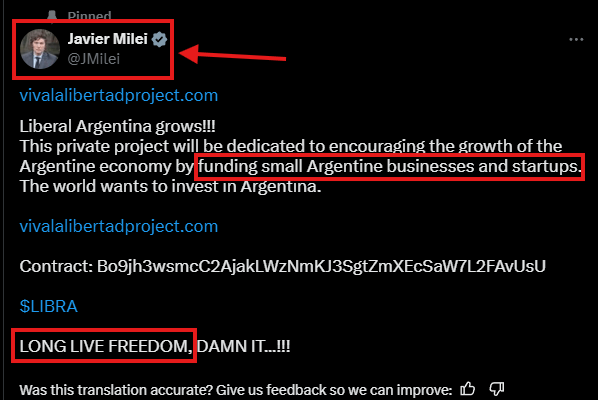
Milei’s original X’s post promoting the cryptocurrency. Source: The Kobeissi Letter.

Opposition deputies in Argentina’s lower house have called a new press conference and are moving to reactivate the special Libra commission in Congress after the latest leaks, now accusing Milei of being a “necessary participant” in a premeditated crypto scam. Representative Maximiliano Ferraro (CC), chairman of the Investigative Committee, stated:

We want to be very clear. Nothing will save them. This evidence confirms the president’s political responsibility and his deliberate involvement. We believe they will have to answer to the courts and this Congress.

The presidency maintains its line that Milei only shared Libra “in good faith” and was not fully informed about the project’s details, while officials dismiss media leaks as biased parts of a flawed case file. The Libra affair hits just as Argentina tries to present itself as a crypto hub, with policymakers debating how far to go in formalizing digital‐asset rules and bank participation.

For traders, the lesson is clear: politically branded tokens like Libra carry extreme risk, while more established crypto and stablecoin rails are likely to remain the preferred instruments for hedging local macro volatility.
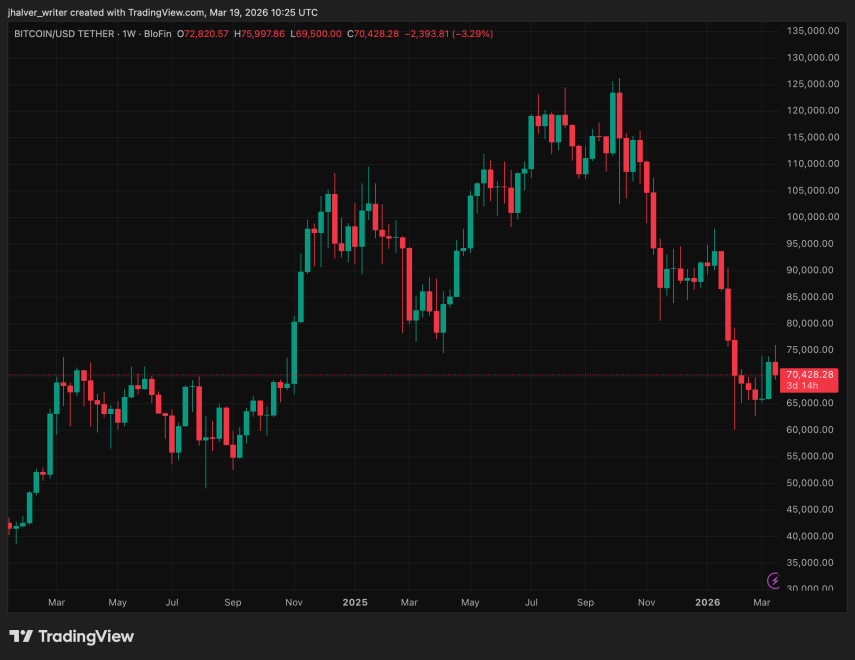
At the moment of writing, BTC’s trades for $70k on the daily chart. Source: BTCUSDT on Tradingview

Cover image from Perplexity, BTCUSD chart from Tradingview

Related Questions

QWhat new evidence has been uncovered regarding payments from Mauricio Novelli to Javier Milei?

ANew forensic reports and leaked court documents show years of dollar payments from crypto Libra lobbyist Mauricio Novelli to Javier Milei and his inner circle, dating back to 2021. These payments were for teaching classes and promoting Novelli's investment consulting firm.

QHow were the payments from Novelli to Milei's circle financed and delivered?

AProsecutors found that Mauricio Novelli financed the payouts by selling USDT and other crypto assets for cash. He then delivered physical dollars, which were labeled as the 'usual' amount. Monthly payments were around $2,000 during Milei's time as a deputy and later rose to $4,000, routed to his sister Karina Milei once he became president.

QWhat was the content of the '5 million memo' found in Novelli's notes?

AThe seized '5 million memo' from Novelli's notes app described a potential USD 5 million package, which could be in tokens or cash, for Milei's social-media promotion and political backing of Libra. It framed Milei as a central 'asset' in the project, though no signed contract has been found.

QWhat were the consequences of President Milei promoting the $LIBRA token on social media?

AWhen President Milei promoted the $LIBRA token on X in February 2025, it triggered a 1,300% price spike followed by a violent crash. This resulted in late buyers suffering heavy losses of as much as $100 million, sparking criminal complaints, a congressional inquiry, and allegations that the president used his office to pump a high-risk crypto asset.

QHow has the Argentine presidency responded to the allegations in the Libra scandal?

AThe presidency maintains that Milei only shared information about Libra 'in good faith' and was not fully informed about the project's details. Officials have dismissed the media leaks as biased parts of a flawed case file.

Related Reads

U.S. Stock Market Trend: Nasdaq Plunges 3.5% Intraday Before a Remarkable Recovery, All Eyes on CPI Tomorrow

"US Stock Market Trends: Nasdaq Plunges 3.5% Before Dramatic Recovery, Eyes on Tomorrow's CPI" On Tuesday, US markets experienced a wild swing. The Nasdaq initially surged nearly 0.7% before plummeting to a 3.5% intraday loss following a post by Donald Trump on Truth Social. He stated that Iran had shot down a US Apache helicopter in the Strait of Hormuz and that the US "must...respond." The index, however, staged a remarkable recovery in the final two hours, closing down only 0.97%, as subsequent remarks from Trump and Vice President Vance suggested a potential Iran deal within days. The S&P 500 fell 0.26%, while the Dow Jones gained 0.17%, supported by its non-tech components. This incident marked the first loss of a US military asset since tensions with Iran escalated in late February. Despite the event, crude oil prices fell sharply (WTI -3.93%) due to expectations of a near-term deal, OPEC+ plans to increase output, and fears that strong jobs data could lead to Fed rate hikes. Market attention is now laser-focused on the May CPI data release Wednesday morning. This report is seen as critical evidence for whether hot job growth is fueling inflation and will heavily influence expectations for the Federal Reserve's upcoming meeting. A hotter-than-expected reading could trigger further sell-offs, particularly in tech, while a cooler print could spark a significant rebound. The article notes a clear sector rotation, with money flowing out of tech (Nasdaq down over 5% in a week) into defensive sectors like healthcare and consumer staples. Other assets like gold and Bitcoin also remain under pressure. The overarching sentiment is one of "war fatigue," with markets desperately awaiting concrete results from the prolonged Iran negotiations rather than reacting to each new headline.

marsbit9m ago

U.S. Stock Market Trend: Nasdaq Plunges 3.5% Intraday Before a Remarkable Recovery, All Eyes on CPI Tomorrow

marsbit9m ago

Second Only to GPUs and Memory: MLCCs Are Becoming the Next Billion-Dollar Windfall for AI Computing Power

After GPU and memory, MLCC (Multi-Layer Ceramic Capacitors) is emerging as the next critical component in AI compute, potentially a multi-billion-dollar market. The article highlights a significant, industry-wide price increase for MLCCs, driven not by inventory cycles but by a fundamental, structural demand surge from AI and automotive sectors. AI servers require exponentially more MLCCs than traditional servers—from 2,000 to over 350,000 units per high-end AI rack—primarily to stabilize power for increasingly powerful, low-voltage GPUs. A key AI server's MLCC cost can reach thousands of dollars, making it the third-largest cost component after GPUs and memory. This demand is compounded by the automotive shift to EVs and advanced ADAS. Supply, however, struggles to keep up. Manufacturing high-end MLCCs involves extreme precision and faces six major barriers: proprietary technology, long customer certification cycles (12-18 months for AI), high capital intensity, patent thickets, specialized talent, and massive scale. Industry capacity grows at only ~10% annually, creating a persistent supply-demand gap projected to last until 2030. Three companies dominate this high-end market. **Murata** (40% global share) is the stable leader. **Samsung Electro-Mechanics** offers the highest growth elasticity with aggressive expansion. **Taiyo Yuden** is the purest MLCC play. While their current P/E ratios appear high, they are expected to compress rapidly as earnings surge, powered by significant pricing power and operational leverage. Key risks include a potential slowdown in AI capex, high valuations, competition from Chinese manufacturers in lower tiers, yen appreciation, and consumer electronics weakness. The article concludes that MLCCs are transforming from a commoditized component into a strategic, capacity-constrained asset essential for the AI-powered future.

marsbit39m ago

Second Only to GPUs and Memory: MLCCs Are Becoming the Next Billion-Dollar Windfall for AI Computing Power

marsbit39m ago

The First to Bring an AI OS to 1.4 Billion People Might Actually Be WeChat?

WeChat has introduced a significant AI update, allowing mini-program developers to integrate their services with WeChat AI. Developers can choose an "automatic mode," where WeChat AI autonomously analyzes and operates mini-programs without additional coding, or a "development mode" for creating customized skills. This move effectively transforms WeChat's vast ecosystem—including millions of mini-programs, WeChat Pay, and official accounts—into an execution layer for AI. The technical documentation reveals that WeChat's approach aligns with industry standards like MCP (Model Context Protocol) and incorporates practical lessons from AI-agent development. Key design principles include a clear "attention weight" system for API calls and a "fact + action" response structure to ensure reliable operations. Unlike Apple's Siri, which struggles with third-party app integration, WeChat's centralized control over mini-program code provides a "God's-eye view," enabling seamless AI orchestration across services. This development revives the concept of "WeChat OS," where the app could function as a natural-language-operated platform for daily tasks—from booking flights to ordering food—all within a chat interface. While challenges remain in areas like payment security and user trust, WeChat's existing service network and massive user base position it uniquely to advance AI agents from conversation to actionable assistance, potentially making complex tasks feel effortless for its 1.432 billion monthly active users.

marsbit1h ago

The First to Bring an AI OS to 1.4 Billion People Might Actually Be WeChat?

marsbit1h ago

Trading

Spot
Futures
活动图片





