Crypto Industry Bands Together To Demand Clear Betting Market Laws

bitcoinistPublished on 2026-02-18Last updated on 2026-02-18

Abstract

A new advocacy effort led by The Digital Chamber’s Prediction Markets Working Group is pushing for clearer federal regulation of crypto prediction markets in the U.S. The group supports the CFTC’s stance that such markets should fall under federal oversight rather than state-level enforcement. Recent legal actions highlight the tension: state regulators, like in Nevada, are treating these platforms as unlicensed gambling operations, while companies like Polymarket and Kalshi argue they offer derivative-like contracts under federal jurisdiction. The conflict is moving through courts, with both sides preparing legal arguments, and future regulatory proposals may shape the outcome.

A new, organized push is under way to shape how crypto prediction markets are treated in the US. A blockchain advocacy group has launched a unit aimed at guiding policy, pressing regulators, and backing industry players through legal fights and public research.

Industry Sets Legal Strategy

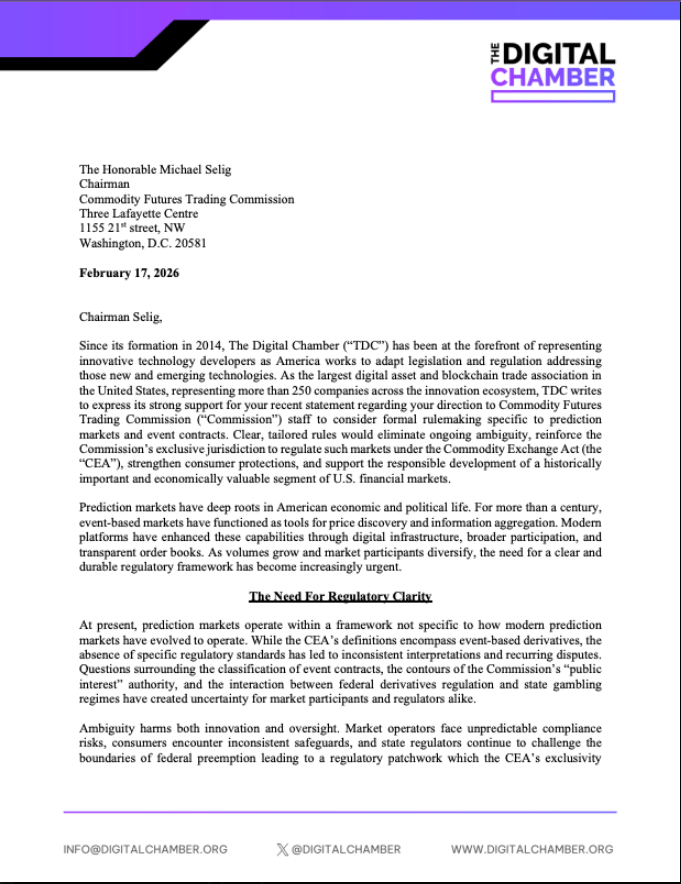
According to the group’s announcement, the first move was a letter praising the Commodity Futures Trading Commission and its chair for arguing that federal oversight should cover many event contracts.

The Prediction Markets Working Group, created by the blockchain advocacy group, The Digital Chamber, called for clearer rules and an end to what it described as enforcement-first regulation.

The group plans to meet with regulators, file policy ideas, publish studies and join court fights through friend-of-the-court briefs to press its view that a single federal regulator should be the lead voice on these crypto markets.

The regulator’s recent public comments were framed as support for that approach. CFTC Chairman Mike Selig has said the agency has overseen similar contracts for many years, and industry backers see that as a foundation for wider federal authority.

Tests On The Ground

Reports note that litigation and enforcement are already testing the theory. A major crypto US platform was hit with state action this week, accused of offering unlicensed wagering.

Kalshi faces a civil case brought by a state gaming regulator seeking to stop certain markets that the regulator calls gambling.

Rival platforms have felt the squeeze too; one has moved to federal court to try to head off state bans. Polymarket sued a state to argue federal oversight takes precedence.

The platforms argue their contracts behave like derivatives and should be treated as such, while state officials keep saying these products look a lot like bets.

As of today, the market cap of cryptocurrencies stood at $2.31 trillion. Chart: TradingView

States Push Back

That tension is clear along state lines. Nevada Gaming Control Board, which enforces strict gambling rules in its jurisdiction, has been among the most aggressive.

Reports say a governor in another state called these markets gambling that harms people, signaling political heat. Utah Governor Spencer Cox criticized federal arguments and framed the issue as one of public safety.

Meanwhile a platform chose to take its fight to the federal courts in a state that has been moving toward enforcement. Massachusetts figures into that legal push.

Image: Flowcarbon

What Comes Next

The next stretch will likely be shaped by filings and court rulings as much as by rulemaking. Industry lawyers are preparing to press federal primacy; state officials are planning to press their gambling statutes.

Legal briefs and amicus filings will try to persuade judges about what these crypto contracts really are. Regulators could also respond with formal rule proposals, and those would change the tone of the debate.

Featured image from The Center for Public Justice, chart from TradingView

Related Questions

QWhat is the main goal of the newly formed Prediction Markets Working Group?

AThe main goal is to guide policy, press regulators, and back industry players through legal fights and public research to advocate for clearer rules and a single federal regulator for crypto prediction markets.

QWhich US regulatory body did the working group praise in its first move, and why?

AThe working group praised the Commodity Futures Trading Commission (CFTC) and its chair for arguing that federal oversight should cover many event contracts, seeing it as a foundation for wider federal authority.

QWhat legal action did the state of Nevada take against crypto prediction markets, according to the article?

AThe Nevada Gaming Control Board, which enforces strict gambling rules, has been among the most aggressive in taking action against these markets, with one major US platform facing a civil case from a state gaming regulator.

QHow are crypto prediction market platforms arguing their products should be classified and regulated?

AThe platforms argue that their contracts behave like derivatives and should be treated as such under federal oversight, rather than being classified as gambling and regulated by state laws.

QWhat is the current market capitalization of cryptocurrencies as mentioned in the article?

AAs of the date of the article, the market capitalization of cryptocurrencies stood at $2.31 trillion.

Related Reads

Breaking: OpenAI Undergoes Major Reorganization, President Brockman Assumes Command

OpenAI has announced a major internal reorganization just months before its anticipated IPO. The company is merging its three flagship product lines—ChatGPT, Codex, and the API platform—into a single, unified product organization. The most significant leadership change involves co-founder and President Greg Brockman moving from a background technical role to take full, permanent control over all product strategy. This follows the indefinite medical leave of AGI Deployment CEO Fidji Simo. Additionally, ChatGPT's longtime lead, Nick Turley, has been reassigned to enterprise products, with former Instagram executive Ashley Alexander taking over consumer offerings. The consolidation, internally framed as a strategic move towards an "Agentic Future," aims to break down internal silos and create a cohesive "Super App." This planned desktop application would integrate ChatGPT's conversational abilities, Codex's coding power, and a rumored internal web browser named "Atlas" to autonomously perform complex user tasks. The reorganization occurs amid significant internal and external pressures. OpenAI has recently seen a wave of high-profile departures, including Sora co-lead Bill Peebles and other senior technical leaders, leading to concerns about a thinning executive bench. Externally, rival Anthropic recently secured funding at a staggering $900 billion valuation, surpassing OpenAI's own. Google's upcoming I/O developer conference also poses a competitive threat. Analysts suggest the dramatic restructure is a pre-IPO move to present a clearer, more focused narrative to Wall Street—streamlining operations and demonstrating decisive leadership under Brockman to counter internal turbulence and intense market competition.

marsbit1h ago

Breaking: OpenAI Undergoes Major Reorganization, President Brockman Assumes Command

marsbit1h ago

Two Survival Structures of Market Makers and Arbitrageurs

Market makers and arbitrageurs represent two distinct survival structures in high-frequency trading. Market makers primarily use limit orders (makers) to profit from the bid-ask spread, enjoying high capital efficiency (nominally 100%) but bearing inventory risk. This "inventory risk" arises from passive, fragmented, and discontinuous order fills in the limit order book (LOB). This risk, while a potential cost, can also contribute to excess profit if managed within control boundaries, allowing for mean reversion. Market makers essentially sell "time" (uncertainty over execution timing) to the market for price control and low fees. In contrast, cross-exchange arbitrageurs typically use market orders (takers) to exploit price differences or funding rates, resulting in lower nominal capital efficiency (requiring capital on both exchanges) and higher transaction costs. Their risk exposure stems from asymmetries in exchange rules (e.g., minimum order sizes), execution latency, and infrastructure risks (e.g., ADL, oracle drift). These exposures are active, exogenous gaps that primarily erode profits rather than contribute to them. Arbitrageurs essentially sell "space" (capital sunk across venues) for localized, immediate certainty. Both strategies engage in a trade-off between execution friction and residual risk. Optimal systems allow for temporary, controlled risk exposure rather than enforcing zero exposure at all costs. Their evolution converges towards hybrid models: arbitrageurs may use maker orders to reduce costs, while market makers may use taker orders or hedges for risk management. Ultimately, both use different forms of risk exposure—market makers exposing inventory, arbitrageurs immobilizing capital—to extract marginal, hard-won certainty from the market.

链捕手1h ago

Two Survival Structures of Market Makers and Arbitrageurs

链捕手1h ago

Who Will Define the Rules of the AI Era? Anthropic Discusses the 2028 US-China AI Landscape

This article, based on Anthropic's analysis, outlines the intensifying systemic competition between the U.S./allies and China for AI leadership by 2028. It argues that access to advanced computing power ("compute") is the critical bottleneck, where the U.S. currently holds a significant advantage through chip export controls and allied innovation. However, China's AI labs remain competitive by exploiting policy loopholes—via chip smuggling, overseas data center access, and "model distillation" attacks to copy U.S. model capabilities—keeping them close to the frontier. The piece presents two contrasting scenarios for 2028. In the first, decisive U.S. action to tighten compute controls and curb distillation locks in a 12-24 month AI capability lead, cementing democratic influence over global AI norms, security, and economic infrastructure. In the second, policy inaction allows China to achieve near-parity through continued access to U.S. technology, enabling Beijing to promote its AI stack globally and integrate advanced AI into its military and governance systems, altering the strategic balance. Anthropic contends that maintaining a decisive U.S. lead is essential for shaping safe AI development and governance. The core recommendation is for U.S. policymakers to urgently close compute and model access loopholes while promoting global adoption of the U.S. AI technology stack to secure a lasting strategic advantage.

marsbit3h ago

Who Will Define the Rules of the AI Era? Anthropic Discusses the 2028 US-China AI Landscape

marsbit3h ago

Trading

Spot
Futures

Hot Articles

How to Buy PUSH

Welcome to HTX.com! We've made purchasing Push Protocol (PUSH) simple and convenient. Follow our step-by-step guide to embark on your crypto journey.Step 1: Create Your HTX AccountUse your email or phone number to sign up for a free account on HTX. Experience a hassle-free registration journey and unlock all features.Get My AccountStep 2: Go to Buy Crypto and Choose Your Payment MethodCredit/Debit Card: Use your Visa or Mastercard to buy Push Protocol (PUSH) instantly.Balance: Use funds from your HTX account balance to trade seamlessly.Third Parties: We've added popular payment methods such as Google Pay and Apple Pay to enhance convenience.P2P: Trade directly with other users on HTX.Over-the-Counter (OTC): We offer tailor-made services and competitive exchange rates for traders.Step 3: Store Your Push Protocol (PUSH)After purchasing your Push Protocol (PUSH), store it in your HTX account. Alternatively, you can send it elsewhere via blockchain transfer or use it to trade other cryptocurrencies.Step 4: Trade Push Protocol (PUSH)Easily trade Push Protocol (PUSH) on HTX's spot market. Simply access your account, select your trading pair, execute your trades, and monitor in real-time. We offer a user-friendly experience for both beginners and seasoned traders.

3.5k Total ViewsPublished 2024.03.29Updated 2025.04.02

How to Buy PUSH

Discussions

Welcome to the HTX Community. Here, you can stay informed about the latest platform developments and gain access to professional market insights. Users' opinions on the price of PUSH (PUSH) are presented below.

活动图片