Crypto ETP Boom Set To Go Into Overdrive In 2026, Bitwise Says

bitcoinistPublished on 2025-12-17Last updated on 2025-12-17

Abstract

More than 100 new crypto exchange-traded products (ETPs) are expected to launch in 2026 due to a recent US regulatory change, according to Bitwise researcher Ryan Rasmussen. The SEC's new generic listing standards eliminate the need for lengthy individual approvals, streamlining the process. This shift allows issuers to file a wider variety of products, including spot crypto, index funds, and equity-linked ETPs. While this will significantly expand investor choice, analysts caution that success will depend on real demand, liquidity, and clear use cases. The market will likely see a wave of new listings, but assets are expected to concentrate in a few large funds, mirroring the broader ETF market.

More than 100 new crypto exchange-traded products could hit the market in 2026 after a recent rule change by the US securities regulator, a researcher at Bitwise said. According to Ryan Rasmussen, that drop in red tape will let firms file many more ETPs without the long, individual approval process that slowed launches in the past.

Regulatory Shift Lowers Bar

The SEC issued generic listing standards in October that remove the need for separate 19(b) approvals for qualifying crypto ETPs. That step cuts out a process some issuers had to wait through — a delay that could stretch to a 240-day clock under earlier practice.

Reports have disclosed that the number of crypto ETPs already sits above 300, based on data from Fineqia International, which shows the market is no longer limited to just a few funds.

Institutional Appetite

Market watchers say new listings make it easier for issuers. But easier access is not the same thing as strong buying. Bitfinex analysts warned in August that altcoins are unlikely to enjoy a major rally until ETFs that track assets beyond the largest coins are available and attract real money. Liquidity, investor interest, and clear use cases still matter a lot. An ETF wrapper does not fix those basic needs by itself.

Total crypto market cap currently at $2.91 trillion. Chart: TradingView

Issuers Race To Expand Menus

Rasmussen said issuers can now plan a variety of products — spot crypto, index funds, equity-linked ETPs, smart beta strategies and momentum plays.

He compared the change to moving from a tiny menu to a much larger one, saying investors will have more choices about where to put money. He also noted it has been about 15 years since the Winklevoss twins first filed for a Bitcoin ETF, and yet only a handful of crypto ETPs are widely held today.

Many New Products, Few Big Winners

Expect a wave of filings. But expect concentration too. In the wider ETF market, most assets gather in a few large funds while many other listings see thin trading.

That pattern is likely to repeat in crypto: dozens of niche products may be launched, while a smaller group gathers most assets under management. Issuers get to plant flags quickly. Investors will sort the winners from the rest over time.

Market Reaction Hinges On Demand

On Sept. 17, Bloomberg ETF analyst James Seyffart said the rule change could trigger a “wave of spot crypto ETP launches.”


Related Reads

The Rise of Prediction Markets: DeFi's Next High-Value Piece in 2026

Prediction markets are emerging as a high-value component within DeFi, expected to mature significantly by 2026. These markets, which blend information discovery with financial speculation, exhibit a natural monopolistic tendency, leading to the development of a layered ecosystem comprising core platforms, peripheral services, and external integrations. Unlike traditional financial instruments, prediction markets (exemplified by platforms like Polymarket and Kalshi) thrive on highly certain underlying events (e.g., election dates) but uncertain outcomes (e.g., election winners). This structure allows real-time information to shape market sentiment, often becoming a self-fulfilling prophecy. Current innovations are focusing on DeFi integration of prediction market assets. Rather than creating clone platforms or simple tooling, the most promising direction involves leveraging the idle capital locked in prediction market positions before outcomes are determined. Proposals include using these assets within DeFi lending protocols (e.g., via platforms like Gondor or Morpho) or developing cross-market arbitrage mechanisms that offer users discounted entry prices funded by yield generated from DeFi strategies. This approach benefits all parties: users get better pricing and additional yield, prediction platforms gain increased volume and integration into broader DeFi ecosystems, and liquidity providers achieve higher capital efficiency. The deterministic nature of settlement dates makes these assets uniquely suitable for structured financial products. With major events like the 2026 World Cup and U.S. midterm elections approaching, prediction markets are poised to capture significant attention and capital, further accelerating their convergence with DeFi.

比推13m ago

The Rise of Prediction Markets: DeFi's Next High-Value Piece in 2026

比推13m ago

Space Review|2026 Outpost: Narrative Recedes, Value Flows to Resilient Ecosystems with Real Yield

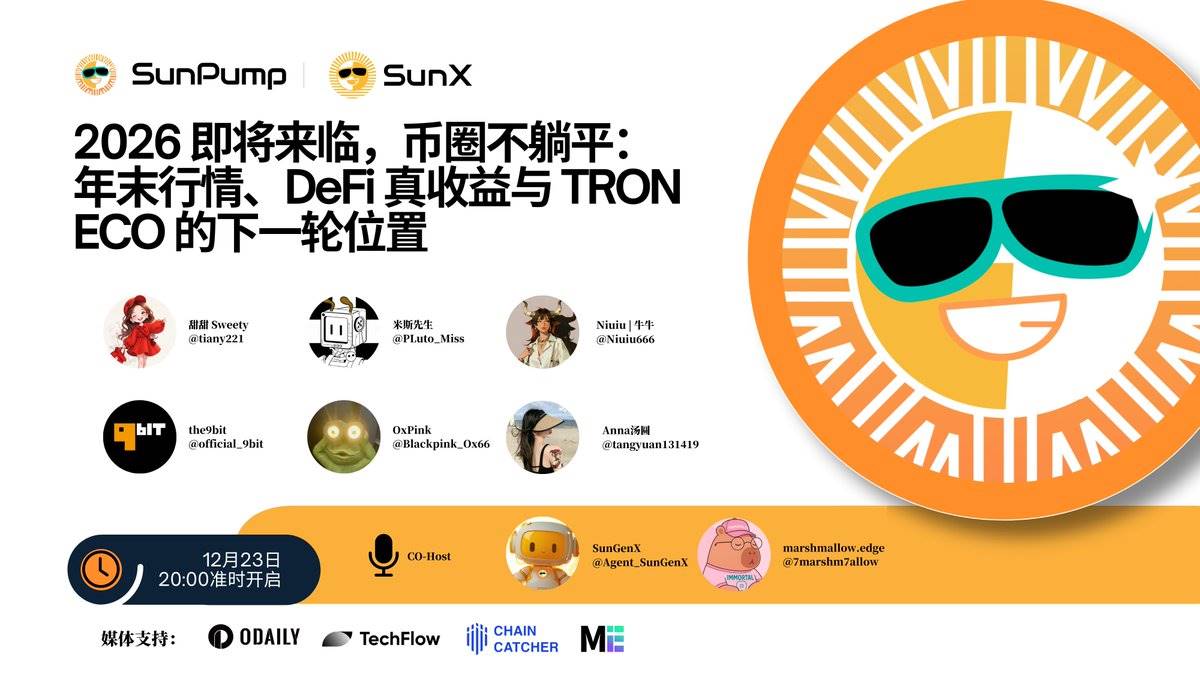
As 2025 draws to a close, the crypto market is shifting from hype-driven speculation to a focus on sustainable value. The recent SunnPump roundtable, "2026 is Coming, No Laying Flat in Crypto," explored this transition, emphasizing that the path to 2026 depends on ecosystems with real utility and organic demand, not short-term narratives. Experts agreed that the market is moving towards a phase driven by genuine cash flows and capital efficiency. Tron was highlighted as a prime example of a mature "digital financial infrastructure," distinguished by its dominant role in stablecoin settlements. With nearly $80 billion in on-chain USDT circulation—half the global market—and daily stablecoin transfers of $20-24 billion, Tron has built a resilient ecosystem anchored in real-world use cases like payments and lending. Its TVL of ~$24 billion, including $10.4 billion in JUST Protocol, reflects deep liquidity and organic activity. The discussion on DeFi sustainability centered on projects with real revenue generation, not subsidized yields. Protocols like JustLend DAO exemplify this with a diversified income model from staking services and lending, using fees to buy back and burn its JST token, creating a deflationary feedback loop. This aligns protocol success with tokenholder value. Tron’s $204 million in protocol revenue in November 2025, leading all public chains, underscores the power of its real economic activity. In conclusion, the key to enduring market cycles lies in ecosystems like Tron’s that provide essential, high-utility services—low-cost transfers, reliable staking, and lending—forming an organic, self-sustaining financial infrastructure with inherent resilience.

深潮33m ago

Space Review|2026 Outpost: Narrative Recedes, Value Flows to Resilient Ecosystems with Real Yield

深潮33m ago

Trading

Spot
Futures

Discussions

Welcome to the HTX Community. Here, you can stay informed about the latest platform developments and gain access to professional market insights. Users' opinions on the price of A (A) are presented below.

活动图片