Crypto Continues to Expand in Asia as Thailand Clears Path for Digital Asset Derivatives

bitcoinistPublished on 2026-02-13Last updated on 2026-02-13

Abstract

Thailand's Cabinet has approved amendments to the Derivatives Act, allowing digital assets like Bitcoin to serve as underlying instruments for regulated derivatives contracts. The Securities and Exchange Commission (SEC) will update licensing and supervision rules to enable crypto-linked futures and options on platforms such as the Thailand Futures Exchange. This move aims to enhance crypto's recognition as an investable asset class, expand investor access, and improve risk management tools. The reform aligns with Thailand's growing crypto market, valued at $3.19 billion as of August 2025, and supports plans for future crypto ETFs. The SEC will implement safeguards to address volatility and protect investors.

Thailand has taken a further step toward integrating crypto into its mainstream financial system, after the Cabinet approved changes that allow digital assets to underpin regulated derivatives contracts. The move positions the country among a growing number of Asian markets adapting crypto-linked financial products.

On Feb. 10, Thailand’s Cabinet endorsed a Finance Ministry proposal to expand the scope of assets permitted under the Derivatives Act B.E. 2546 (2003). The amendment enables digital assets, including cryptos such as Bitcoin, to serve as underlying instruments for futures and options traded on regulated platforms.

The Securities and Exchange Commission (SEC) will now amend the Derivatives Act and draft supporting regulations to govern participation, licensing, and supervision.
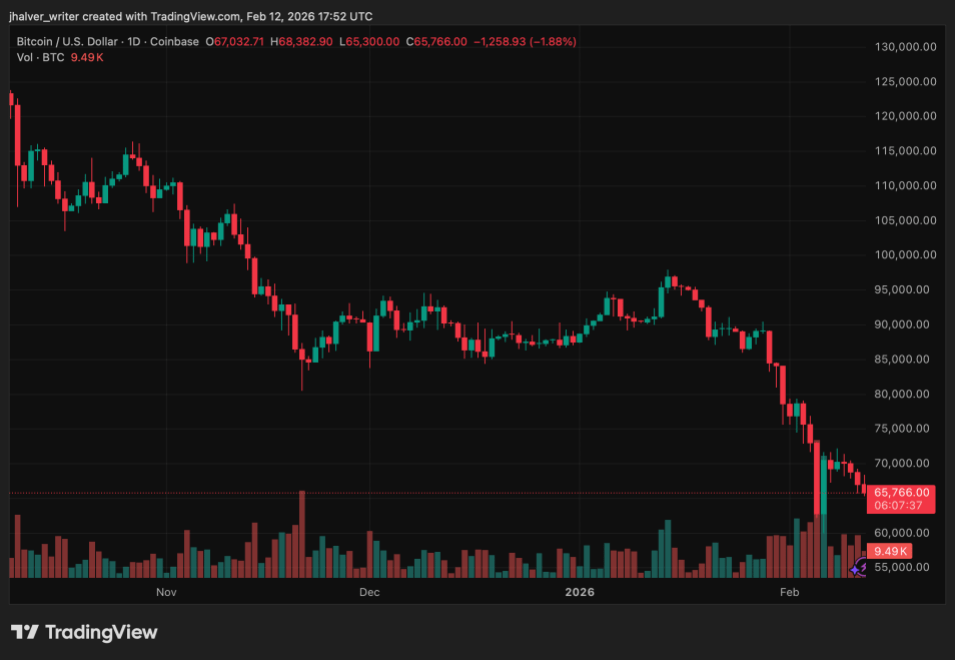
BTC's price trends to the downside on the daily chart. Source: BTCUSD on Tradingview

Thailand Integrates Crypto Into Regulated Derivatives Market

Under the revised framework, digital assets will be recognized as permissible underlying assets for derivatives products listed on exchanges such as the Thailand Futures Exchange (TFEX).

The SEC said it will revise derivatives business licenses to allow digital asset operators to offer crypto-linked contracts and will review supervisory standards for exchanges and clearinghouses.

SEC Secretary-General Pornanong Budsaratragoon said the expansion is intended to strengthen the recognition of cryptocurrencies as an investment asset class, broaden investor access, and enhance risk management tools.

The regulator will also work with TFEX to determine contract specifications that account for the volatility and risk characteristics of digital assets. Officials indicated that supervisory safeguards and investor protection measures will remain central as the market evolves.

In addition to cryptocurrencies, the amendment reclassifies carbon credits, enabling the introduction of physically delivered futures contracts alongside cash-settled products. The measure aligns with Thailand’s draft Climate Change Act and its broader carbon-neutrality objectives.

Growing Institutional Focus and Market Expansion

Thailand’s latest reform builds on a regulatory framework introduced in 2018, when the country enacted rules governing digital asset businesses. Oversight has since expanded to include stricter operational requirements and investor protection measures, while crypto payments remain prohibited by the central bank.

The SEC’s broader 2026 capital markets roadmap includes plans to introduce crypto exchange-traded funds (ETFs), subject to legal amendments. Officials have indicated that crypto ETFs could launch later this year.

Thailand’s domestic crypto market has also grown steadily. As of August 2025, the SEC valued the market at approximately $3.19 billion, with average daily trading volumes near $95 million. Active accounts rose to 230,000, reflecting increased participation from retail investors, foreign entities, and domestic institutions.

Industry participants say integrating crypto into the derivatives market could improve liquidity and provide hedging tools, but some have cautioned that capital requirements and disclosure standards must keep pace to manage systemic risk.

Cover image from ChatGPT, BTCUSD chart from Tradingview

Related Questions

QWhat recent regulatory change did Thailand's Cabinet approve regarding digital assets?

AThailand's Cabinet approved changes to the Derivatives Act to allow digital assets, including cryptocurrencies like Bitcoin, to serve as underlying instruments for regulated futures and options contracts.

QWhich regulatory body is responsible for amending the Derivatives Act and drafting supporting regulations for this new framework?

AThe Securities and Exchange Commission (SEC) is responsible for amending the Derivatives Act and drafting the supporting regulations to govern participation, licensing, and supervision.

QWhat are the stated goals of integrating crypto into the derivatives market, according to SEC Secretary-General Pornanong Budsaratragoon?

AThe goals are to strengthen the recognition of cryptocurrencies as an investment asset class, broaden investor access, and enhance risk management tools.

QBesides cryptocurrencies, what other asset was reclassified by this amendment, and for what purpose?

ACarbon credits were also reclassified to enable the introduction of physically delivered futures contracts, aligning with Thailand's climate change and carbon-neutrality objectives.

QWhat is the estimated value of Thailand's domestic crypto market as of August 2025, according to the SEC?

AAs of August 2025, the SEC valued Thailand's domestic crypto market at approximately $3.19 billion.

Related Reads

TechFlow Intelligence Bureau: Anthropic IPO Odds Exceed 80%, Iran Closes Strait of Hormuz Again, Triggering Oil Price Volatility

**Market Digest** **AI & Tech:** Anthropic is widely expected to announce an IPO before November 2026, raising questions about balancing its trillion-dollar valuation ambitions with its core "AI safety" mission. Brands are increasingly adopting AI-generated virtual influencers for marketing. Cloudflare introduced temporary accounts for AI agents to ease automation workflows. **Infrastructure & Hardware:** Google's IPv6 traffic surpassed 50%, marking a major internet milestone. Goldman Sachs warned that massive projected AI capital expenditure ($5.3T) is approaching credit saturation limits, potentially curbing the "AI arms race." **Space & Robotics:** SpaceX's IPO saw a historic $370M retail buying frenzy in three days. Hyundai Motor Group plans to acquire full ownership of Boston Dynamics. Elon Musk speculated about future "septillion-dollar" investments in antimatter for interstellar travel. **Energy & Geopolitics:** Iran's military announced another closure of the strategic Strait of Hormuz, accusing Israel of violating a ceasefire, causing oil market volatility. However, ship-tracking data indicated some traffic continued. Concurrently, Iran resumed crude loadings at Kharg Island, potentially releasing up to 20 million barrels to the market. **Finance & Macro:** A European CLO (collateralized loan obligation) experienced its first post-2008-crisis-era equity tranche default, raising alarms in credit markets. Nomura warned that new Federal Reserve Chair Wash's perceived hawkish debut speech could signal a significant policy shift. **The Undercurrent:** Seemingly disparate events—the Strait of Hormuz tension, the European CLO default, and warnings on AI spending—point to a tightening of global liquidity and rising marginal costs across energy, credit, and tech investment. Meanwhile, capital continues chasing grand narratives like space exploration and advanced AI, highlighting a divergence where old-world leverage frays as new-world stories grow more ambitious.

marsbit5h ago

TechFlow Intelligence Bureau: Anthropic IPO Odds Exceed 80%, Iran Closes Strait of Hormuz Again, Triggering Oil Price Volatility

marsbit5h ago

Trading

Spot
Futures
活动图片