Crypto Continues to Expand in Asia as Thailand Clears Path for Digital Asset Derivatives

bitcoinistPublished on 2026-02-13Last updated on 2026-02-13

Abstract

Thailand's Cabinet has approved amendments to the Derivatives Act, allowing digital assets like Bitcoin to serve as underlying instruments for regulated derivatives contracts. The Securities and Exchange Commission (SEC) will update licensing and supervision rules to enable crypto-linked futures and options on platforms such as the Thailand Futures Exchange. This move aims to enhance crypto's recognition as an investable asset class, expand investor access, and improve risk management tools. The reform aligns with Thailand's growing crypto market, valued at $3.19 billion as of August 2025, and supports plans for future crypto ETFs. The SEC will implement safeguards to address volatility and protect investors.

Thailand has taken a further step toward integrating crypto into its mainstream financial system, after the Cabinet approved changes that allow digital assets to underpin regulated derivatives contracts. The move positions the country among a growing number of Asian markets adapting crypto-linked financial products.

On Feb. 10, Thailand’s Cabinet endorsed a Finance Ministry proposal to expand the scope of assets permitted under the Derivatives Act B.E. 2546 (2003). The amendment enables digital assets, including cryptos such as Bitcoin, to serve as underlying instruments for futures and options traded on regulated platforms.

The Securities and Exchange Commission (SEC) will now amend the Derivatives Act and draft supporting regulations to govern participation, licensing, and supervision.
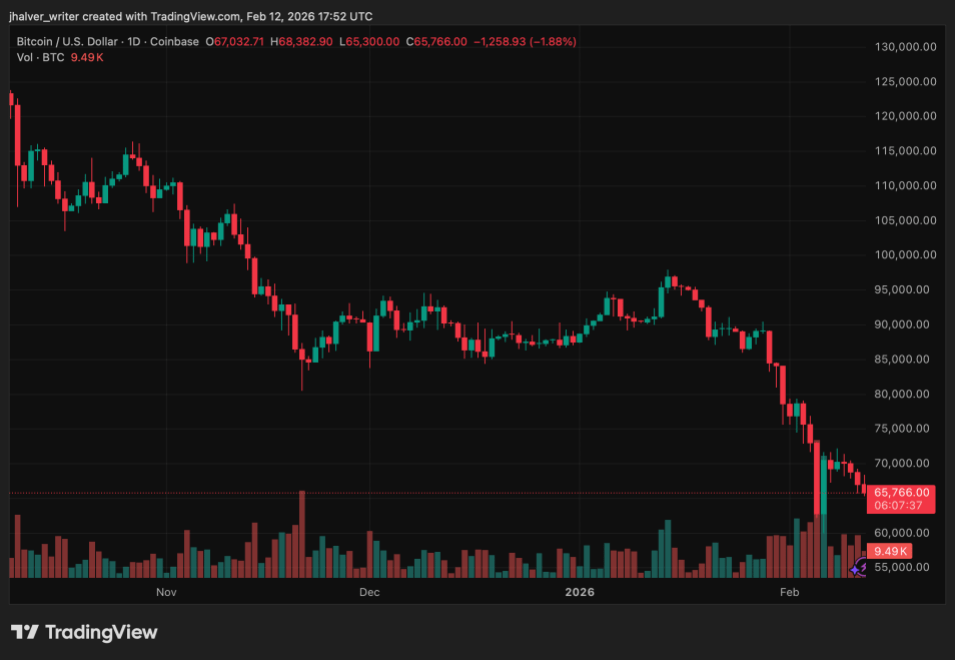
BTC's price trends to the downside on the daily chart. Source: BTCUSD on Tradingview

Thailand Integrates Crypto Into Regulated Derivatives Market

Under the revised framework, digital assets will be recognized as permissible underlying assets for derivatives products listed on exchanges such as the Thailand Futures Exchange (TFEX).

The SEC said it will revise derivatives business licenses to allow digital asset operators to offer crypto-linked contracts and will review supervisory standards for exchanges and clearinghouses.

SEC Secretary-General Pornanong Budsaratragoon said the expansion is intended to strengthen the recognition of cryptocurrencies as an investment asset class, broaden investor access, and enhance risk management tools.

The regulator will also work with TFEX to determine contract specifications that account for the volatility and risk characteristics of digital assets. Officials indicated that supervisory safeguards and investor protection measures will remain central as the market evolves.

In addition to cryptocurrencies, the amendment reclassifies carbon credits, enabling the introduction of physically delivered futures contracts alongside cash-settled products. The measure aligns with Thailand’s draft Climate Change Act and its broader carbon-neutrality objectives.

Growing Institutional Focus and Market Expansion

Thailand’s latest reform builds on a regulatory framework introduced in 2018, when the country enacted rules governing digital asset businesses. Oversight has since expanded to include stricter operational requirements and investor protection measures, while crypto payments remain prohibited by the central bank.

The SEC’s broader 2026 capital markets roadmap includes plans to introduce crypto exchange-traded funds (ETFs), subject to legal amendments. Officials have indicated that crypto ETFs could launch later this year.

Thailand’s domestic crypto market has also grown steadily. As of August 2025, the SEC valued the market at approximately $3.19 billion, with average daily trading volumes near $95 million. Active accounts rose to 230,000, reflecting increased participation from retail investors, foreign entities, and domestic institutions.

Industry participants say integrating crypto into the derivatives market could improve liquidity and provide hedging tools, but some have cautioned that capital requirements and disclosure standards must keep pace to manage systemic risk.

Cover image from ChatGPT, BTCUSD chart from Tradingview

Related Questions

QWhat recent regulatory change did Thailand's Cabinet approve regarding digital assets?

AThailand's Cabinet approved changes to the Derivatives Act to allow digital assets, including cryptocurrencies like Bitcoin, to serve as underlying instruments for regulated futures and options contracts.

QWhich regulatory body is responsible for amending the Derivatives Act and drafting supporting regulations for this new framework?

AThe Securities and Exchange Commission (SEC) is responsible for amending the Derivatives Act and drafting the supporting regulations to govern participation, licensing, and supervision.

QWhat are the stated goals of integrating crypto into the derivatives market, according to SEC Secretary-General Pornanong Budsaratragoon?

AThe goals are to strengthen the recognition of cryptocurrencies as an investment asset class, broaden investor access, and enhance risk management tools.

QBesides cryptocurrencies, what other asset was reclassified by this amendment, and for what purpose?

ACarbon credits were also reclassified to enable the introduction of physically delivered futures contracts, aligning with Thailand's climate change and carbon-neutrality objectives.

QWhat is the estimated value of Thailand's domestic crypto market as of August 2025, according to the SEC?

AAs of August 2025, the SEC valued Thailand's domestic crypto market at approximately $3.19 billion.

Related Reads

In Jinjiang, Fujian, a Storage Super Unicorn Lies Quiet

In Fujian's Jinjiang, a city known for sportswear, lies a quiet semiconductor giant: Fujian Jinhua Integrated Circuit Co. (JHICC). Once a promising domestic DRAM manufacturer alongside Yangtze Memory and ChangXin Memory Technologies (CXMT), its journey was derailed in 2018 when the U.S. placed it on an Entity List and filed criminal charges for alleged trade secret theft. This halted production for years. A turning point came in February 2024 when a U.S. federal court found JHICC not guilty. However, it had lost crucial time. While CXMT soared to become a top-valued A-share company in 2024, JHICC, with an estimated valuation of 80 billion RMB, was just restarting. Its current output is primarily customized DDR4 chips, not the advanced DDR5/HBM demanded for AI, but it still benefits from the broader memory chip upcycle. JHICC's story is tied to Chen Zhengkun, a veteran engineer who left Micron to lead the venture. Founded in 2016 with state-backed funding, JHICC partnered with Taiwan's UMC to develop DRAM technology. Rapid progress was cut short by the U.S. actions, which Micron initiated, partly due to its heavy reliance on the Chinese market. Post-sanctions, Chen's team worked to rebuild the production line with reduced reliance on U.S. technology. According to its records, JHICC achieved small-scale production and revenue growth under immense pressure. It now focuses on the stable "niche" DRAM market (e.g., TVs, routers) with a monthly capacity of ~40,000 wafers, aiming for 60,000 by 2026. It holds over 1,000 patents but remains on the Entity List. For Jinjiang, investing in JHICC was a bold industrial leap. The local government provided unwavering financial and logistical support during the crisis, helping the company survive. JHICC has become the anchor for a growing local semiconductor cluster. Though its scale lags behind domestic peers, JHICC's persistence symbolizes a hard-won foothold in a global market long dominated by Samsung, SK Hynix, and Micron. Having missed one boom, it seeks a place in the new AI-driven memory supercycle.

marsbit1h ago

In Jinjiang, Fujian, a Storage Super Unicorn Lies Quiet

marsbit1h ago

Trading

Spot
活动图片





