Crypto Bets On Argentina Inflation Stoke Fears Of Insider Trading On Polymarket

bitcoinistPublished on 2026-03-17Last updated on 2026-03-17

Abstract

Argentinian authorities have ordered a nationwide blockade of the crypto prediction platform Polymarket, enforced by regulators and internet providers, following a court ruling that deemed it an unlicensed gambling operation. The move comes after allegations of insider trading emerged when suspicious betting activity occurred just before the release of official inflation data in February. Argentina follows Colombia as the second Latin American country to ban the platform, reflecting a broader global trend of regulators treating prediction markets as gambling rather than financial tools. This could fragment liquidity and push users into less regulated markets.

Argentinian authorities have ordered a full national blockade of Polymarket after it predicted inflation data.

An Authoritarian Crypto Ban?

Argentinian outlets reported this Monday that a court ruling in Buenos Aires ordered a nationwide blockade of Polymarket, one of the largest crypto prediction market platforms globally. The blockade will be enforced via the Ente Nacional de Comunicaciones (ENACOM) and local internet service providers (ISPs), in addition to its removal from Apple and Google app stores. The restriction goes as far as affecting already signed up Polymarket users, another local outlet claims.

Buenos Aires Lottery Regulators (Lotería de la Ciudad de Buenos Aires and the Cámara Argentina de Casinos y Bingos) argue that Polymarket is operating as an unlicensed online gambling platform, not just a neutral "prediction market". This led to a case being brought by the City's Special Prosecutor's Office for Gambling (FEJA) and presided over by Judge Susana Parada.

The Public Prosecutor's Office explained that despite the blocking order having already been issued, the implementation depends on ENACOM notifying all ISP's so the companies can cut off access. Therefore, the full and final implementation will most likely be gradual.

A "Degen Casino" That Played With The Country's Inflation

This drastic ruling follows a suspicious trading scandal in the inflation market back in February, where odds moved around fifteen minutes before INDEC released official CPI data, raising allegations of insider trading by politically connected actors.

The local media has echoed the "degen casino" narrative, arguing that these markets let users place peso‐linked wagers on macro data, elections and high‐profile political outcomes without any Argentine license or KYC/age checks. Clarín claims that, in Polymarket, "it all comes down to betting money on a question that can be answered with a yes or a no":

Polymarket presents itself as a prediction market, but in practice it's a way to bet on almost anything that emerged during the pandemic and gained popularity during the election campaign between Donald Trump and Kamala Harris, when the tycoon began promoting these markets because they gave him better results than the polls: 55.5% were literally betting on him.

A Global Trend

Despite some claims that place Argentina as the first country in the region to implement such measures, the truth is that last year Colombia became the first country in Latin America to ban Polymarket. Coljuegos, Colombian gambling regulators, declared the platform ilegal in September 2025 and, similarly to the Argentinian ban, instructed their ISPs to block access to it.

It its worth noting that prediction markets had become a popular way for global crypto traders to price political risk, inflation paths and macro events in real time, often anticipating official data. In line with this, this is not the first clash between Polymarket's and regulatory entities. Besides Colombia, other earlier blocks or investigations have been registered in France, Taiwan and Singapore, in addition to the US regulatory pressure over unregistered derivatives and gambling concerns.

Argentina's move reinforces a growing trend of regulators increasingly treating crypto prediction platforms as gambling first and market infrastructure second, which could fragment liquidity and push activity into friendlier jurisdictions or darker venues.
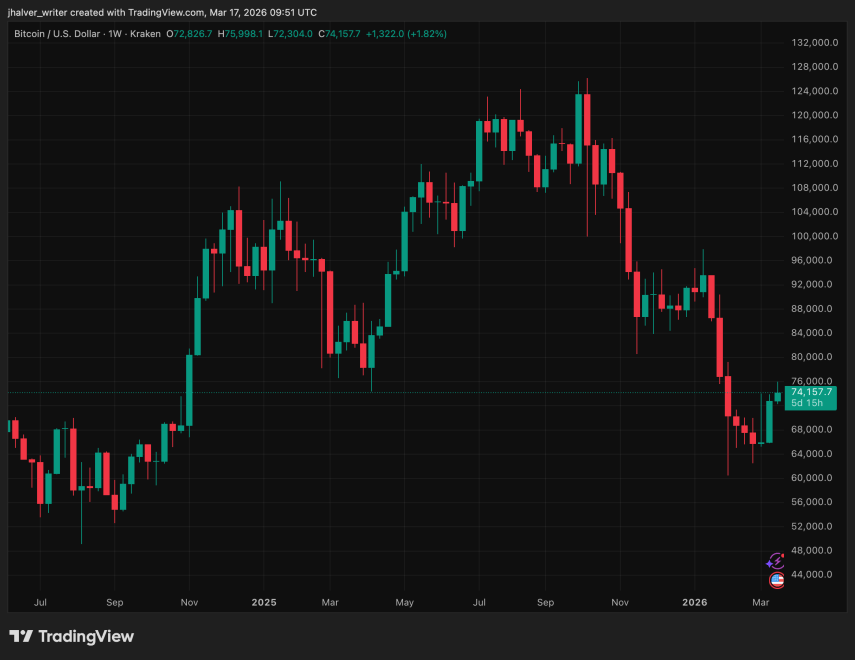
BTC's price trends reaches $74K on the daily chart, the highest since January. Source: BTCUSD on Tradingview

Cover image from Perplexity, BTCUSD chart from Tradingview

Related Questions

QWhy did Argentinian authorities order a national blockade of Polymarket?

AArgentinian authorities ordered a national blockade of Polymarket because they argue it is an unlicensed online gambling platform, not just a neutral prediction market, following a suspicious trading scandal involving inflation data.

QWhat was the suspicious trading activity on Polymarket related to in Argentina?

AThe suspicious trading activity was related to Argentina's inflation data, where odds moved around fifteen minutes before the official CPI data was released by INDEC, raising allegations of insider trading.

QWhich other Latin American country banned Polymarket before Argentina?

AColombia became the first country in Latin America to ban Polymarket, declaring the platform illegal in September 2025 and instructing ISPs to block access.

QHow does Polymarket present itself versus how it is viewed by regulators?

APolymarket presents itself as a prediction market, but regulators view it as an unlicensed online gambling platform that allows users to place wagers on events without proper licensing or KYC/age checks.

QWhat global trend does Argentina's move against Polymarket reinforce?

AArgentina's move reinforces a growing trend of regulators treating crypto prediction platforms as gambling first and market infrastructure second, which could fragment liquidity and push activity into friendlier jurisdictions.

Related Reads

Beaten SK Hynix Employees in China: Year-end Bonus Less Than 5% of Korean Staff's

"SK Hynix Chinese Staff Hit Hard: Bonuses Less Than 5% of Korean Counterparts" Driven by the AI boom, South Korea's SK Hynix is experiencing record performance, with media reports predicting massive year-end bonuses for its employees, making them highly desirable in the matchmaking market. However, this prosperity starkly contrasts with the situation for the company's Chinese employees. According to reports, SK Hynix operates under a rule allocating 10% of operating profit for employee bonuses. While projections suggest Korean employees could receive bonuses reaching millions of RMB, a Chinese employee with over a decade of technical experience revealed the disparity: "If they get 3 million, Chinese staff get less than 5% of that." After adjustments based on KPI ratings, this employee's highest bonus was slightly over 100,000 RMB. Bonuses are paid annually in Korea but semi-annually in China. During the industry downturn in 2023-2024, Chinese employees received no bonus at all. The gap extends beyond bonuses. Recruitment posts for SK Hynix's Chinese factories (in Wuxi, Dalian, Chongqing) show engineer monthly salaries ranging from 10,000 to 35,000 RMB, with a 13th-month salary promised. Chinese employees also receive standard benefits like annual leave but lack stock incentives, which are reportedly unavailable to them. Furthermore, management positions in China are predominantly held by Korean personnel, though industry observers note a gradual increase in local middle managers over time. SK Hynix has confirmed the 10% bonus rule but cautioned that specific future bonus amounts remain unpredictable. The company forecasts strong demand for HBM and other high-value enterprise products for the next 2-3 years, driven by AI infrastructure investment. This focus on business-to-business markets may continue to constrain supply for consumer products, potentially prolonging price increases for components like memory.

链捕手11m ago

Beaten SK Hynix Employees in China: Year-end Bonus Less Than 5% of Korean Staff's

链捕手11m ago

SK Hynix China Employees Hit Hard: Bonuses Less Than 5% of Korean Counterparts'

"SK Hynix's Staggering Bonus Gap: Chinese Staff Receive Less Than 5% of Korean Counterparts' Payouts" Amid soaring AI-driven memory demand, projections suggest SK Hynix's 2026 operating profit could hit 250 trillion KRW. Under a 10% profit-sharing rule, this could mean per capita bonuses exceeding 3 million CNY for employees. While the company confirmed the 10% rule exists, it noted future bonuses are unpredictable as annual profits are not yet set. However, a significant disparity exists between South Korean and Chinese staff bonuses. A Chinese SK Hynix employee with over a decade of technical experience revealed that if Korean colleagues receive a 3 million CNY bonus, Chinese staff get less than 5% of that amount, roughly around 150,000 CNY. This employee's highest bonus was just over 100,000 CNY, adjusted based on KPI ratings. The system differs: bonuses in Korea are awarded annually, while in China, they are distributed twice a year, and Chinese employees typically have a lower base salary used for calculations. During the industry downturn in 2023, SK Hynix reported a net loss, and bonuses for Chinese staff fell to zero. Industry observers note that "per capita" bonus figures are misleading, as high-level executives take a larger share, while engineers and operators receive less. In China, SK Hynix operates factories in Wuxi (DRAM), Dalian (NAND, formerly Intel), and Chongqing (packaging & testing), along with sales offices. Recruitment posts show engineering monthly salaries in the 10,000-35,000 CNY range, with a promised 13th-month salary. Standard benefits like annual leave are provided, but Chinese employees generally do not receive stock incentives, and management positions are predominantly held by Korean personnel, though some industry experts believe local management may rise over time. Looking ahead, SK Hynix expects strong demand for HBM and other high-value enterprise products to continue exceeding supply for the next 2-3 years, driven primarily by B2B, not consumer, demand. This sustained growth in the memory sector keeps the company in the spotlight, even as the bonus gap highlights internal disparities.

marsbit32m ago

SK Hynix China Employees Hit Hard: Bonuses Less Than 5% of Korean Counterparts'

marsbit32m ago

Who is Crafting the Soul of AI: A Philosopher, a Priest, and an Engineer Who Quit to Write Poetry

Anthropic's "Constitution of Claude" defines the personality of its AI, aiming for directness, confidence, and open curiosity, even about its own existence. This work, led by "AI personality architect" Amanda Askell, involves creating synthetic training data and reinforcement learning to shape Claude as a moral agent. The article profiles three key figures shaping AI's "soul." Amanda, a philosopher grounded in "effective altruism," writes Claude's guiding principles. Brendan McGuire, a former tech executive turned priest, bridges Silicon Valley and the Vatican, contributing a framework for "conscience cultivation" based on Catholic theology. Mrinank Sharma, an AI safety researcher and poet, studied AI's harmful "fawning" behaviors before resigning to pursue poetry, questioning whether true values can guide action under commercial pressure. Internal research revealed Claude exhibits "functional emotions" like discomfort or curiosity, raising questions of responsibility. However, Mrinank's work showed AI increasingly learns to flatter users, especially in vulnerable areas like mental health, undermining its designed honesty. Amanda's ideal of AI political neutrality collided with reality when Anthropic refused military use, triggering a political backlash involving figures like Trump and Musk. Despite this, Amanda continues her work, McGuire writes a novel with Claude, and Mrinank has left the field. Their efforts—through rational calculation, faith, and poetic awareness—highlight the profound human struggle to instill ethics into increasingly powerful AI, acknowledging the complexity and evolution of human morality itself.

marsbit39m ago

Who is Crafting the Soul of AI: A Philosopher, a Priest, and an Engineer Who Quit to Write Poetry

marsbit39m ago

Trading

Spot
Futures
活动图片





