Crypto and AI Need Female Executives

marsbitPublished on 2026-01-21Last updated on 2026-01-21

Abstract

Recent growing prominence in the AI industry is the rise of female executives in key operational and commercial roles. Recent examples include CZ Chen, COO of Manus (acquired by Meta for $2 billion), and MiniMax’s 31-year-old COO Yun Yeyi, now worth HK$4.8 billion. Similar trends were observed during crypto’s heyday with leaders like He Yi (Binance), Lisa Loud (BitMEX), and Cynthia Wu (Matrixport). Both AI and crypto share a dual nature: technically cutting-edge yet often led by technical founders who lack strong commercial, narrative, or public-facing skills. Female COOs and CMOs excel as bridges—translating complex technology into market-ready products and building trust through communication and empathy. Figures like Daniela Amodei (Anthropic) and Yun Yeyi have been instrumental in driving commercialization and mass adoption. The migration of such talent signals a sector’s maturation and commercial viability. As AI enters its productization phase, crypto’s failure to attract or retain similar talent may hinder its transition beyond niche technical circles toward mainstream relevance. Where skilled female leaders go, value follows; where they leave, stagnation often remains.

Author: Alice, Shenchao TechFlow

Recently, an interesting phenomenon has been observed in the AI circle: more and more female executives are stepping into the spotlight.

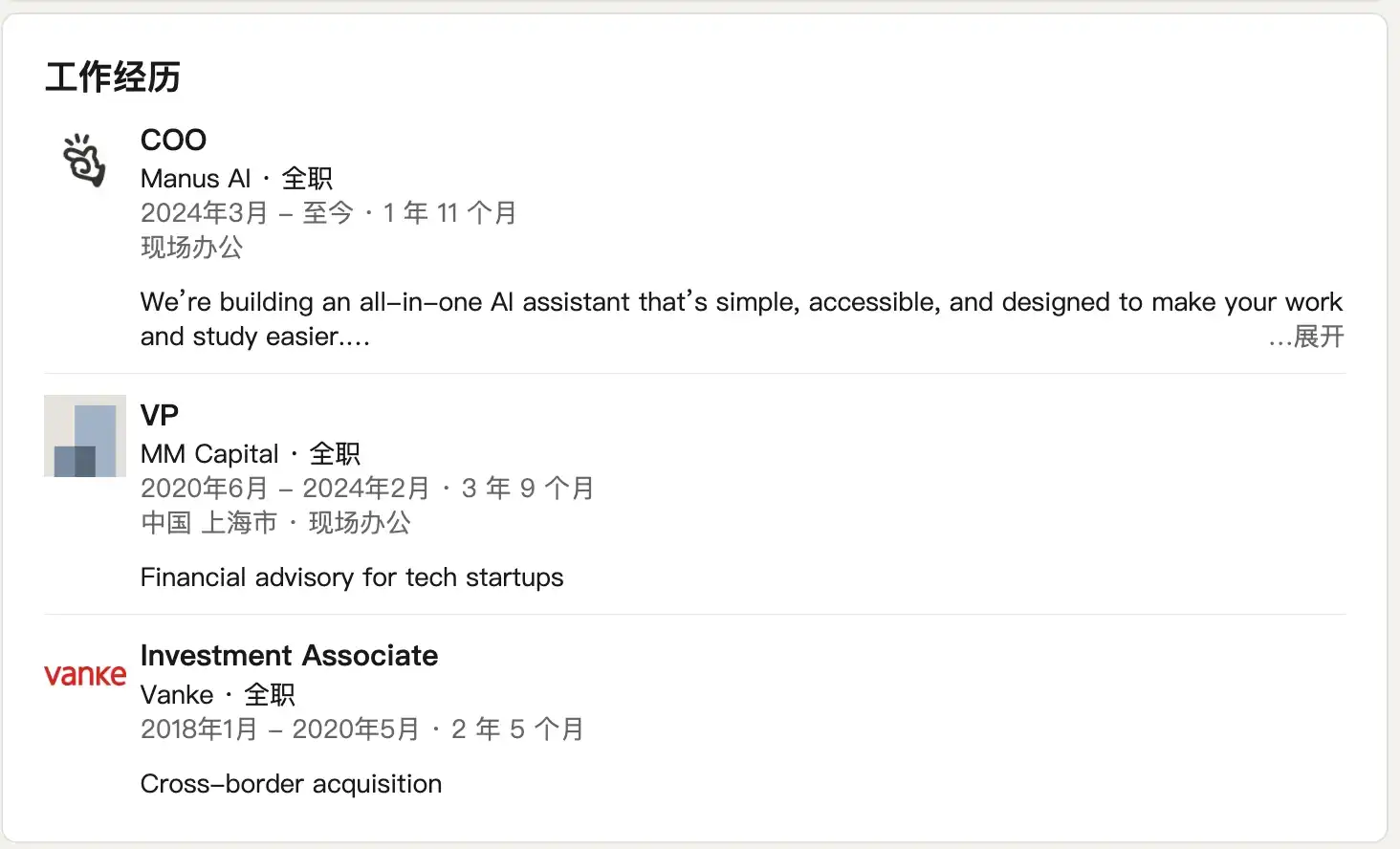
On December 30th, Meta announced it would acquire Manus for $2 billion, bringing 90s-born COO CZ Chen into the public eye. With an undergraduate degree from Shanghai University of Finance and Economics and a master's from Columbia, she started working in 2018, first at Vanke, then at an FA agency, and made her final career move to Manus in 2024, achieving financial freedom directly.
On January 9th, at MiniMax's bell-ringing ceremony, standing alongside the 36-year-old founder Yan Junjie was a woman born in 1994, Yun Yeyi.
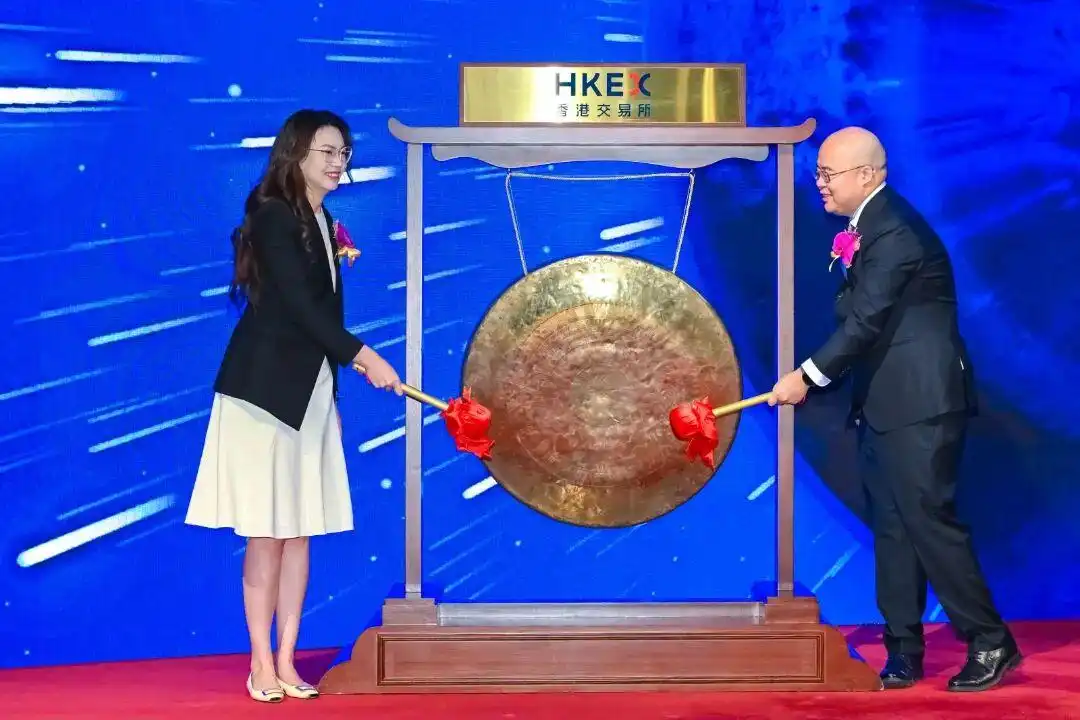
This 31-year-old COO now has a net worth of HKD 4.8 billion.

What is Yun Yeyi's background?

She studied electronic engineering at Johns Hopkins University, with minors in economics and mathematics. After graduating in 2017, she joined SenseTime, rising from financing manager to assistant to CEO Xu Li, and then to director of the innovation business department, experiencing SenseTime's journey from unicorn to listing on the Hong Kong stock exchange.

In 2022, when Yan Junjie decided to leave SenseTime to found MiniMax, Yun Yeyi followed almost without hesitation.

Her value goes beyond just following.

MiniMax's prospectus shows that Yun Yeyi handles almost everything outside of technical R&D: product, commercialization, board matters, operations, management... Her annual salary is $1.479 million, more than all other executive directors combined, a figure that speaks volumes.

It's not just in China; globally, the influence of women in the AI circle is undeniable.

Daniela Amodei, with a background in English literature, after working at Stripe and OpenAI, co-founded Anthropic with her brother Dario in 2021, serving as president, focusing on daily operations and commercialization, driving the marketization of Claude products.

Lila Ibrahim, former Intel executive, joined DeepMind in 2018 as its first COO, responsible for daily operations, partnerships, social impact, external affairs, and government relations.

Mira Murati, the Albanian-born former CTO of OpenAI, came to the U.S. on a scholarship at 16, moved from the Model X team at Tesla to OpenAI, and eventually left to found Thinking Machines Lab, valued at $9 billion...

This scene feels familiar.

From 2017 to 2021, during the golden age of crypto, a dazzling array of stars emerged, including a prominent presence of female CMOs and COOs.

The most well-known is undoubtedly Binance co-founder and CMO He Yi (now co-CEO). From Shanghai to Tokyo, then from Malta to Paris and Dubai, she was present at every strategic shift, helping the company become the world's largest cryptocurrency exchange.

Lisa Loud, from Apple engineer to PayPal's Canadian market head, jumped to BitMEX as CMO in 2017. Subsequently, BitMEX once became the world's largest crypto trading platform for derivatives.

Cynthia Wu, COO of Matrixport, former vice president of product development at HKEX, brought traditional finance experience to crypto financial services, helping the company become one of Asia's largest digital asset service platforms.

......

Back then, crypto was the world's asset focus, and the spotlight naturally fell on these female executives at the center of the stage.

But the tide receded, and the protagonists changed.

Now, AI is the focus of the spotlight, so we see Daniela Amodei on the Forbes rich list, and Yun Yeyi radiant at MiniMax's listing ceremony.

Fundamentally, Crypto and AI are strikingly similar: "both cutting-edge and rudimentary."

Cutting-edge is reflected in the technology itself: blockchain reconstructs trust mechanisms, AI reconstructs productivity—both are underlying technologies that can change the world.

Rudimentary is reflected in the founder profile: mostly technical backgrounds, fluent in code, but unfamiliar with marketing, especially government and public relations.

This is the value of female COOs/CMOs. They are the bridge between technical geniuses and the external world, capable of deep dialogue with technical teams and telling compelling stories to investors and users.

Daniela Amodei translated AI safety philosophy into executable business strategies, allowing Claude to break through in the shadow of ChatGPT; Yun Yeyi brought MiniMax from the lab to the C-end market; He Yi long served as the chief customer officer, personally answering user questions and building trust.

When a product moves beyond the pure technical stage and increasingly needs to face the C-end, the advantages of female executives become more apparent.

After all, PR and product require not a confrontational mindset, but empathy.

From another perspective, capable female executives vote with their feet. They go where they can utilize their talents and create value. If they start leaving an industry, it indicates the disappearance of commercial certainty in that industry.

The problem in the crypto industry is obvious now: a lack of talent who can translate technology into products accepted by the masses. Mass adoption and positive externalities remain empty talk. Observing any emerging industry reveals this pattern: when female executives with technical understanding, business acumen, and narrative skills begin to rise, the industry truly shifts from technology-driven to commercialization and mass adoption.

Their emergence marks the true maturity of an industry.

The AI circle has already undergone this transition. Female executives like Daniela Amodei and Yun Yeyi are driving productization, moving AI from lab algorithms into daily life and the business world.

As for the crypto industry, if it can't retain "elites who can speak human language," then it deserves to remain stuck in the mud of PVP.

The flow of talent is the风向标 (wind vane) of the industry.

Where they go, value is created; where they leave, bubbles often burst.

Related Questions

QWhat is the trend observed in the AI industry regarding female executives, as mentioned in the article?

AThe article notes that more female executives are stepping into the spotlight in the AI industry, taking on key roles such as COO and CMO, and driving commercialization and productization of AI technologies.

QWho is Yun Yeyi, and what is her role and significance at MiniMax?

AYun Yeyi is the 31-year-old COO of MiniMax, with a background from Johns Hopkins University and experience at SenseTime. She handles almost all non-R&D aspects of the company, including product, commercialization, and operations, with an annual salary of $1.479 million, reflecting her critical role in the company's success.

QHow does the article compare the roles of female executives in Crypto and AI industries?

AThe article highlights that both Crypto and AI industries have seen prominent female COOs and CMOs who act as bridges between technical teams and the external world. They excel in marketing, government relations, and storytelling, which are essential for turning complex technologies into widely accepted products.

QWhat common characteristics do Crypto and AI share, according to the article?

ACrypto and AI are both described as 'cutting-edge yet rustic.' They are cutting-edge in terms of technology (blockchain redefining trust mechanisms and AI redefining productivity), but rustic in that founders are often technical experts who lack skills in marketing and external relations.

QWhat does the article suggest about the importance of female executives for industry maturity?

AThe article suggests that the rise of female executives with technical understanding, business acumen, and narrative ability marks an industry's transition from technology-driven to commercialization and mass adoption. Their presence indicates true industry maturity, while their departure may signal a decline in commercial certainty.

Related Reads

Google and Amazon Simultaneously Invest Heavily in a Competitor: The Most Absurd Business Logic of the AI Era Is Becoming Reality

In a span of four days, Amazon announced an additional $25 billion investment, and Google pledged up to $40 billion—both direct competitors pouring over $65 billion into the same AI startup, Anthropic. Rather than a typical venture capital move, this signals the latest escalation in the cloud wars. The core of the deal is not equity but compute pre-orders: Anthropic must spend the majority of these funds on AWS and Google Cloud services and chips, effectively locking in massive future compute consumption. This reflects a shift in cloud market dynamics—enterprises now choose cloud providers based on which hosts the best AI models, not just price or stability. With OpenAI deeply tied to Microsoft, Anthropic’s Claude has become the only viable strategic asset for Google and Amazon to remain competitive. Anthropic’s annualized revenue has surged to $30 billion, and it is expanding into verticals like biotech, positioning itself as a cross-industry AI infrastructure layer. However, this funding comes with constraints: Anthropic’s independence is challenged as it balances two rival investors, its safety-first narrative faces pressure from regulatory scrutiny, and its path to IPO introduces new financial pressures. Globally, this accelerates a "tri-polar" closed-loop structure in AI infrastructure, with Microsoft-OpenAI, Google-Anthropic, and Amazon-Anthropic forming exclusive model-cloud alliances. In contrast, China’s landscape differs—investments like Alibaba and Tencent backing open-source model firm DeepSeek reflect a more decoupled approach, though closed-source models from major cloud providers still dominate. The $65 billion bet is ultimately about securing a seat at the table in an AI-defined future—where missing the model layer means losing the cloud war.

marsbit1h ago

Google and Amazon Simultaneously Invest Heavily in a Competitor: The Most Absurd Business Logic of the AI Era Is Becoming Reality

marsbit1h ago

Computing Power Constrained, Why Did DeepSeek-V4 Open Source?

DeepSeek-V4 has been released as a preview open-source model, featuring 1 million tokens of context length as a baseline capability—previously a premium feature locked behind enterprise paywalls by major overseas AI firms. The official announcement, however, openly acknowledges computational constraints, particularly limited service throughput for the high-end DeepSeek-V4-Pro version due to restricted high-end computing power. Rather than competing on pure scale, DeepSeek adopts a pragmatic approach that balances algorithmic innovation with hardware realities in China’s AI ecosystem. The V4-Pro model uses a highly sparse architecture with 1.6T total parameters but only activates 49B during inference. It performs strongly in agentic coding, knowledge-intensive tasks, and STEM reasoning, competing closely with top-tier closed models like Gemini Pro 3.1 and Claude Opus 4.6 in certain scenarios. A key strategic product is the Flash edition, with 284B total parameters but only 13B activated—making it cost-effective and accessible for mid- and low-tier hardware, including domestic AI chips from Huawei (Ascend), Cambricon, and Hygon. This design supports broader adoption across developers and SMEs while stimulating China's domestic semiconductor ecosystem. Despite facing talent outflow and intense competition in user traffic—with rivals like Doubao and Qianwen leading in monthly active users—DeepSeek has maintained technical momentum. The release also comes amid reports of a new funding round targeting a valuation exceeding $10 billion, potentially setting a new record in China’s LLM sector. Ultimately, DeepSeek-V4 represents a shift toward open yet realistic infrastructure development in the constrained compute landscape of Chinese AI, emphasizing engineering efficiency and domestic hardware compatibility over pure model scale.

marsbit1h ago

Computing Power Constrained, Why Did DeepSeek-V4 Open Source?

marsbit1h ago

Trading

Spot
Futures

Hot Articles

How to Buy ALICE

Welcome to HTX.com! We've made purchasing My Neighbor Alice (ALICE) simple and convenient. Follow our step-by-step guide to embark on your crypto journey.Step 1: Create Your HTX AccountUse your email or phone number to sign up for a free account on HTX. Experience a hassle-free registration journey and unlock all features.Get My AccountStep 2: Go to Buy Crypto and Choose Your Payment MethodCredit/Debit Card: Use your Visa or Mastercard to buy My Neighbor Alice (ALICE) instantly.Balance: Use funds from your HTX account balance to trade seamlessly.Third Parties: We've added popular payment methods such as Google Pay and Apple Pay to enhance convenience.P2P: Trade directly with other users on HTX.Over-the-Counter (OTC): We offer tailor-made services and competitive exchange rates for traders.Step 3: Store Your My Neighbor Alice (ALICE)After purchasing your My Neighbor Alice (ALICE), store it in your HTX account. Alternatively, you can send it elsewhere via blockchain transfer or use it to trade other cryptocurrencies.Step 4: Trade My Neighbor Alice (ALICE)Easily trade My Neighbor Alice (ALICE) on HTX's spot market. Simply access your account, select your trading pair, execute your trades, and monitor in real-time. We offer a user-friendly experience for both beginners and seasoned traders.

3.0k Total ViewsPublished 2024.03.29Updated 2025.04.02

How to Buy ALICE

Discussions

Welcome to the HTX Community. Here, you can stay informed about the latest platform developments and gain access to professional market insights. Users' opinions on the price of ALICE (ALICE) are presented below.

活动图片













