Crypto Allies Gain Ground In Congress After Indiana Primary Win

bitcoinistPublished on 2026-05-08Last updated on 2026-05-08

Abstract

The crypto industry's main political action committee, Fairshake, spent heavily to support the successful primary re-election of Indiana Republican Representative James Baird, a reliable ally on crypto legislation. Fairshake, backed by major firms like Coinbase and Ripple, has a massive war chest and is already directing millions toward other 2026 races. Baird's win coincides with advancing crypto bills in Congress, including the CLARITY Act, which recently overcame a key hurdle on stablecoin yield provisions. However, the legislation faces scrutiny, with some senators demanding added ethics rules before offering their support.

A war chest of $193 million. That’s what Fairshake, the crypto industry’s most powerful political action committee, reported holding as of January — and it’s spending that money fast.

Money Behind The Win

Indiana Republican James Baird cruised to victory Tuesday in his party’s primary for the state’s 4th congressional district, pulling in over 60% of the vote against challenger Craig Haggard and a handful of others.

Baird also had the backing of US President Donald Trump. But another force was working in his favor: Defend American Jobs, a Super PAC tied to Fairshake, poured roughly $514,000 into media buys supporting him ahead of the vote, according to filings with the Federal Election Commission.

Fairshake itself is bankrolled by some of the biggest names in crypto, including Coinbase and Ripple Labs. The committee spent over $130 million trying to shape the outcome of the 2024 elections. In 2026, it’s already at it again — about $10 million has been directed toward races in Illinois and Texas so far.
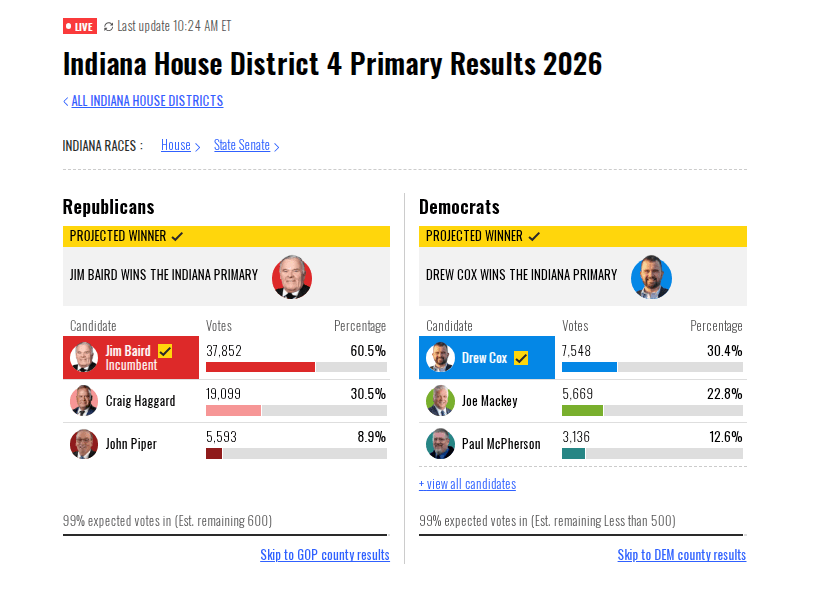
Source: NBC News

A Reliable Vote For The Industry

Baird has been in Congress since January 2019 and has built a record that crypto advocates consider dependable. He backed the GENIUS Act, which deals with stablecoin regulation, and the CLARITY Act, a bill focused on crypto market structure. For Fairshake, he was worth protecting.

“Representative Baird has been a proven leader for pro-job, pro-consumer, and pro-innovation policies in Congress,” a Fairshake spokesperson said.

“We’re proud to support leaders committed to responsible regulation that ensures the US remains the global leader in innovation.”

Baird reportedly thanked Trump publicly following his win.

BTCUSD trading at $80,137 on the 24-hour chart: TradingView

Legislation Moves Forward

The Indiana result comes as crypto-related legislation picks up momentum in Washington. Last week, Senators Thom Tillis and Angela Alsobrooks said they had finalized language in the CLARITY Act to include a compromise on stablecoin yield — a sticking point that had held up the bill for months.

The Senate Banking Committee had not yet scheduled a markup as of Wednesday, but many observers expect the stablecoin agreement to push the broader market structure legislation forward.

Trump’s relationship with the crypto industry has drawn scrutiny alongside these developments. Several senators have said they won’t support the CLARITY Act without ethics provisions attached to it.

Senator Tillis was among those who stated publicly he would not back the bill without such guardrails in place.

Featured image from MetaAI, chart from TradingView

Related Questions

QWhat is Fairshake and how much money did it report holding as of January?

AFairshake is the crypto industry's most powerful political action committee (Super PAC). It reported holding a war chest of $193 million as of January.

QHow did the crypto-linked Super PAC support James Baird in the Indiana primary?

ADefend American Jobs, a Super PAC tied to Fairshake, poured roughly $514,000 into media buys supporting James Baird ahead of the Indiana Republican primary vote.

QWhat two crypto-related bills has Representative James Baird backed in Congress?

ARepresentative James Baird has backed the GENIUS Act, which deals with stablecoin regulation, and the CLARITY Act, a bill focused on crypto market structure.

QAccording to the article, what recent development has helped move the CLARITY Act forward?

ASenators Thom Tillis and Angela Alsobrooks finalized language in the CLARITY Act to include a compromise on stablecoin yield, a sticking point that had held up the bill for months.

QWhat condition have several senators, including Thom Tillis, placed on their support for the CLARITY Act?

ASeveral senators, including Thom Tillis, have stated they will not support the CLARITY Act without ethics provisions attached to it.

Related Reads

STRC Breaks Below $95: Why Does It Continue to Depeg? Is There Default Risk?

"STRC Falls Below $95: Why the Persistent Depegging and Is There Default Risk?" The article discusses the recent decline in the price of STRC, a perpetual preferred stock issued by Strategy (MSTR) designed to trade around a $100 par value. As of publication, STRC traded at $94.65, raising market concerns. STRC is described as a high-yield cash flow product, offering an 11.50% annual dividend paid monthly. Its "preferred" status grants it priority over common stock for dividends and in liquidation. Key reasons cited for the price depegging include: 1. **Bitcoin's Price Drop:** MSTR's assets are heavily tied to Bitcoin (BTC), which fell over 21% from its recent high, pressuring all Strategy-related products. 2. **Competitive Pressure:** Rival Strive Asset Management's similar product, SATA, offers daily dividends and has maintained its $100 par value with a ~13% yield. In response, Strategy has proposed changing STRC's dividend frequency from monthly to bi-weekly, pending shareholder vote. 3. **Technical Selling:** A break below $100 may have triggered algorithmic selling and stop-losses, exacerbating the decline. Regarding default risk, the analysis suggests it is currently low. Strategy founder Michael Saylor confirmed the June 2026 dividend rate remains at 11.50% with no cuts or suspensions. The company's massive reserve of 843,706 BTC provides a significant backstop for its obligations. Industry opinions are mixed. Some analysts view the BTC holdings as reliable support for dividends, while critics like Peter Schiff warn of potential dividend cuts leading to price crashes and lawsuits. Others highlight inflation risk and the company's ability to reduce dividends without a formal default. In summary, STRC's drop is attributed to BTC volatility, competition, and technical factors. While immediate default risk appears contained, the product faces challenges from market conditions and competitive dynamics.

marsbit1h ago

STRC Breaks Below $95: Why Does It Continue to Depeg? Is There Default Risk?

marsbit1h ago

AI Trading Cools, South Korean Stocks Plunge 1.8%, Spot Gold Rises 1%, Bitcoin Dives

A sell-off in AI-related stocks, triggered by Broadcom's disappointing earnings forecast, sent shockwaves through global markets. South Korea's KOSPI led Asia's decline, plunging 1.8% as the risks from concentrated chip stock gains and surging leveraged investments came to the fore. The tech-heavy Nasdaq 100 futures fell 0.5% following Broadcom's 14% after-hours plunge, which signaled a slower-than-expected transition to AI clients. This pullback extended Wall Street's weakness, halting the S&P 500's nine-day rally amid hawkish Fed signals and renewed Middle East tensions. South Korean authorities convened an emergency meeting, pledging "immediate measures" against market volatility and warning of record-high stock margin debt. The adjustment rippled across assets: Bitcoin fell to around $64,000, its lowest since February, while safe-haven gold rose 1% on bargain hunting. Oil prices dipped on Middle East ceasefire news. Market analysts noted the sell-off was driven by profit-taking after massive gains, particularly in chip stocks like Samsung and SK Hynix, which now dominate the KOSPI. Wall Street banks are divided on Korea's outlook, with Goldman Sachs raising its target while Citigroup and others warn of overvaluation and a potential bubble. Bridgewater's Ray Dalio noted that great technological shifts often create bubbles. Meanwhile, Fed officials' hints at potential future rate hikes added to the cautious mood ahead of key U.S. jobs data.

华尔街日报1h ago

AI Trading Cools, South Korean Stocks Plunge 1.8%, Spot Gold Rises 1%, Bitcoin Dives

华尔街日报1h ago

Trading

Spot
Futures

Hot Articles

How to Buy WIN

Welcome to HTX.com! We've made purchasing WINkLink (WIN) simple and convenient. Follow our step-by-step guide to embark on your crypto journey.Step 1: Create Your HTX AccountUse your email or phone number to sign up for a free account on HTX. Experience a hassle-free registration journey and unlock all features.Get My AccountStep 2: Go to Buy Crypto and Choose Your Payment MethodCredit/Debit Card: Use your Visa or Mastercard to buy WINkLink (WIN) instantly.Balance: Use funds from your HTX account balance to trade seamlessly.Third Parties: We've added popular payment methods such as Google Pay and Apple Pay to enhance convenience.P2P: Trade directly with other users on HTX.Over-the-Counter (OTC): We offer tailor-made services and competitive exchange rates for traders.Step 3: Store Your WINkLink (WIN)After purchasing your WINkLink (WIN), store it in your HTX account. Alternatively, you can send it elsewhere via blockchain transfer or use it to trade other cryptocurrencies.Step 4: Trade WINkLink (WIN)Easily trade WINkLink (WIN) on HTX's spot market. Simply access your account, select your trading pair, execute your trades, and monitor in real-time. We offer a user-friendly experience for both beginners and seasoned traders.

5.1k Total ViewsPublished 2024.03.29Updated 2026.06.02

How to Buy WIN

Discussions

Welcome to the HTX Community. Here, you can stay informed about the latest platform developments and gain access to professional market insights. Users' opinions on the price of WIN (WIN) are presented below.

活动图片