Author | jk
May 24, Haiphong Road, Tsim Sha Tsui, Hong Kong. It's eerily quiet.
A week ago, this was "the street for account openings" for mainland investors. Temporary brokerage stalls and mobile vans were lined up, bustling with crowds. Zero-commission Hong Kong stock account openings, free stocks, support for IPO subscriptions, relaxed address proof requirements... To attract mainland clients, brokers had lowered the barriers almost to the floor.
Yet just seven days later, the door slammed shut. Now, mainland clients wanting to open a Hong Kong stock account not only have to sign a written declaration promising funds come from overseas and they've never forged documents, but even after signing, they might be met with a "not approved."
The turning point began on May 22. A synchronized regulatory crackdown from both sides landed, directly impacting millions of mainland investors who invest in overseas markets through Hong Kong brokers.
How severe is this regulatory storm? What's the real experience for mainland residents trying to open accounts in Hong Kong now? What other compliant channels exist for investing in overseas assets? Odaily Planet Daily breaks it down for readers.
1. Cross-strait Joint Action: The "Gray Channel" for Hong Kong Stock Investment Blocked Overnight
On May 22, regulatory bodies in Hong Kong and the mainland acted almost simultaneously, launching a pincer attack from north and south.
After reviewing the account opening practices of 12 securities brokerage firms, the Hong Kong Securities and Futures Commission (SFC) issued an unusually stern circular. The document pointed out significant deficiencies: inadequate due diligence on account opening documents, acceptance of suspicious or forged documents during the process, and evident weaknesses in managing cross-border agency relationships with overseas intermediaries. The SFC stated bluntly that these accounts might be used for illegal transactions, posing an unacceptable money laundering risk.
Targeting mainland investors, the SFC listed additional "three-piece" requirements in an annex to the circular: new accounts must submit a written declaration; deposits, withdrawals, and settlements can only be made through qualifying bank accounts opened in the client's own name. The core content of the written declaration includes: confirming all investment funds originate from legal sources outside mainland China, stating the account has never been closed for using suspicious documents, agreeing to notify the broker within 7 business days if circumstances change, and consenting to the disclosure of relevant information to law enforcement and regulatory agencies.
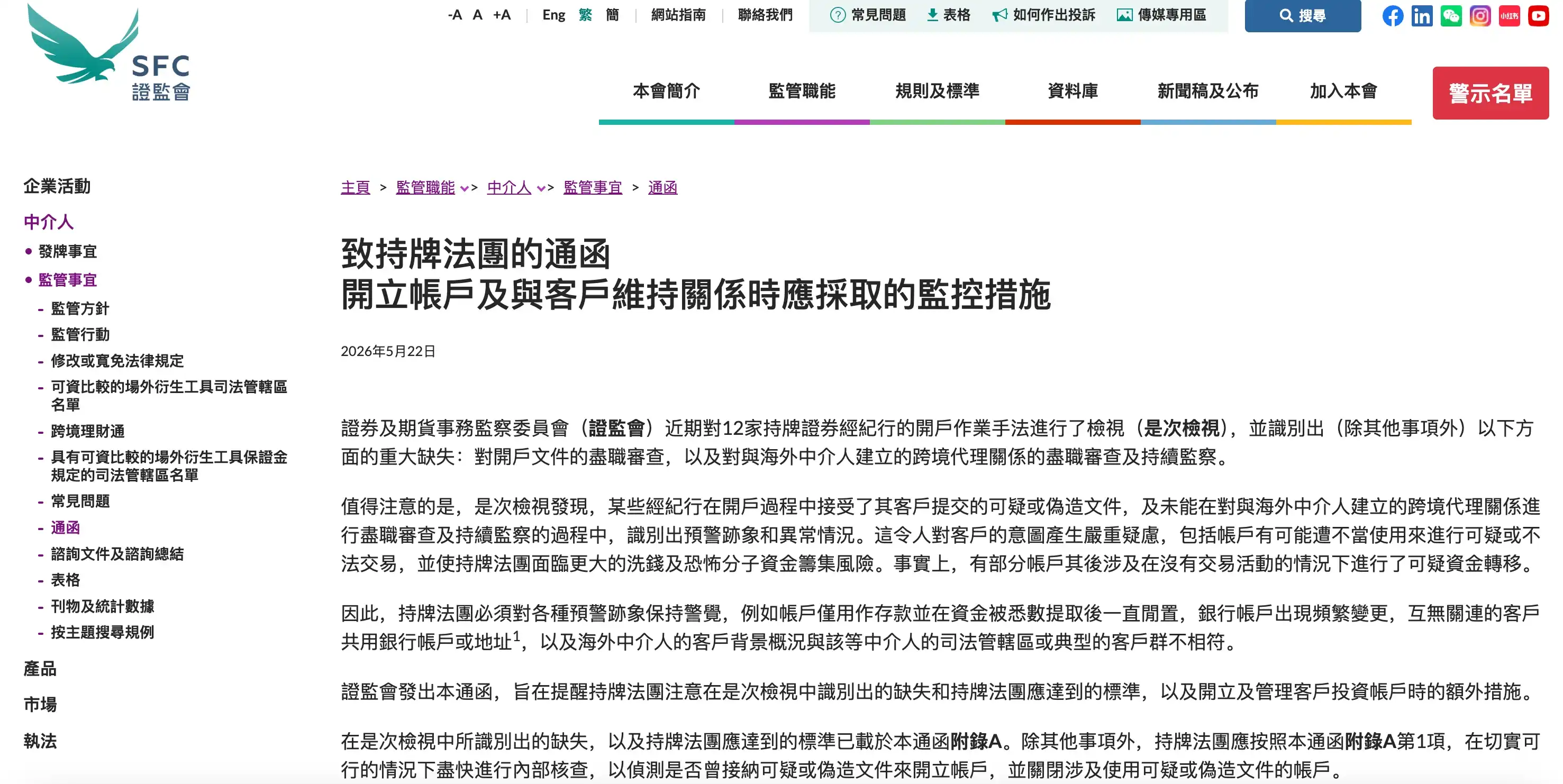
The SFC required all licensed institutions to conduct immediate self-inspections, closing accounts opened with suspicious or forged documents, as well as "dormant accounts" with zero balance or no transactions for 12 months. Senior management was explicitly named, potentially facing regulatory and enforcement actions for serious compliance failures.
Almost simultaneously, the China Securities Regulatory Commission (CSRC), jointly with eight ministries (Ministry of Industry and Information Technology, Ministry of Public Security, People's Bank of China, State Administration for Market Regulation, National Financial Regulatory Administration, Cyberspace Administration of China, State Administration of Foreign Exchange), formally issued the "Implementation Plan for Comprehensive Rectification of Illegal Cross-border Securities, Futures, and Fund Business Activities." The plan sets a 2-year concentrated rectification period. During this period, existing accounts can only sell and withdraw funds unidirectionally, with no new additions allowed. It also announced advance notices of administrative penalties against entities related to Tiger Brokers, Futu Securities, and Longbridge Securities for illegal securities business operations. The scope, intensity, and resolve behind this one-two punch are rare in recent financial regulatory history.
Two documents from different regulatory systems point to the same issue: The model where large numbers of mainland investors invested in Hong Kong and US stocks through Hong Kong brokers, which long operated in a legal gray zone, is officially declared over. This time, regulation is serious.
But to understand why the crackdown is so decisive, we must look back at just how "wide" this channel was over the past two to three years.
From 2023 to early 2025, Hong Kong and US stock markets took off, and numerous Hong Kong IPO opportunities emerged, driving a sharp surge in demand from mainland investors to open accounts. At that time, internet brokers represented by Futu, Tiger, and Longbridge aggressively penetrated the mainland user base with smooth Chinese-language app experiences, low or zero commissions, and support for direct RMB deposits. Some Hong Kong brokerage platforms didn't require address proof, or didn't perform substantial address verification, and even allowed deposits via stablecoins (USDT). Opening an account was almost just a click away.
As early as July 2016, the CSRC issued a risk warning, naming Tiger Brokers, Futu Securities, and others providing trading services for Hong Kong and US stocks. In late 2022, the CSRC launched a special rectification campaign targeting overseas brokers like Tiger and Futu. However, the rectification had limited effect; existing accounts continued normal use, and some platforms even found workarounds after the rectification to continue accepting new mainland clients.
This time, the authorities showed no mercy. The policy focus shifted from restricting new inflows to rectifying existing stock. All previously existing loopholes have been explicitly locked down by regulators.
2. "Written Declaration" in Hand, Account Opening Still Fails
As soon as the new rules were issued, the fastest movers bought tickets and flew to Hong Kong, but opening accounts wasn't smooth. Over the past week, photos titled "Written Declaration for Mainland Investors" have circulated on social media, all from mainlanders personally trying to open accounts at Hong Kong broker offline branches.
Blogger AB Kuai.Dong described a friend's firsthand experience: they went to Hong Kong specifically to apply for a US/Hong Kong stock account at a Uni-Broker branch, were required to sign the "Written Declaration for Mainland Investors," filled out all materials, waited over an hour, and were still told "account opening review failed." Blogger Simon recorded a similar experience: a friend tried a walk-in opening, signed the declaration, waited over an hour, and ultimately also didn't pass.
Judging from the declaration texts shared by multiple accounts, the content highly aligns with the SFC circular annex requirements, indicating brokers rapidly implemented the new rules after issuance.
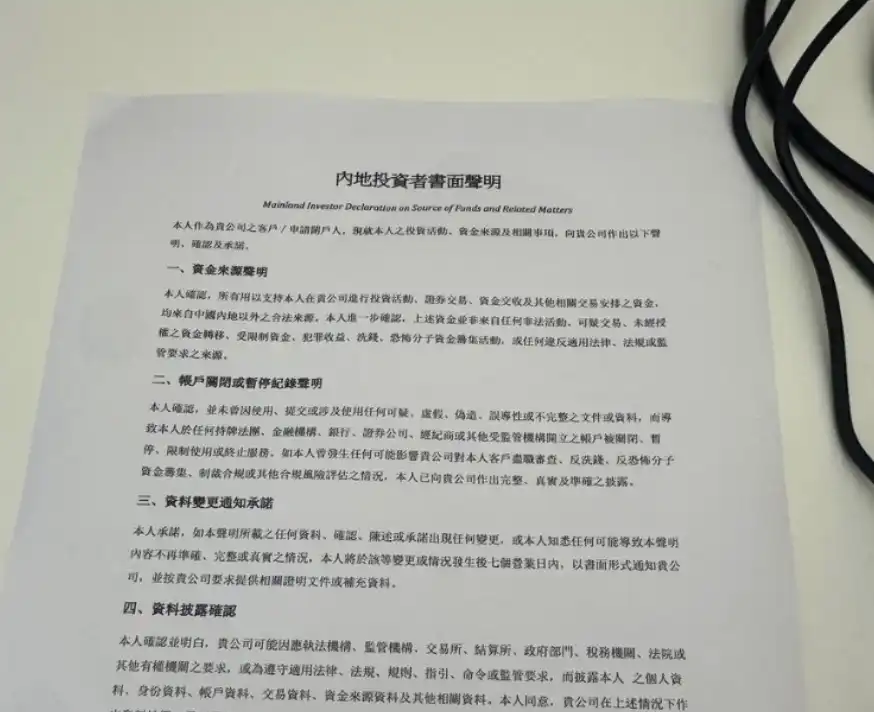
Notably, signing doesn't guarantee account opening, but refusing to sign definitely prevents it. Blogger Li Zhi gave a straightforward interpretation: by having clients sign this declaration, brokers are essentially doing two things: first, shifting compliance responsibility—if something goes wrong, they can say "the client declared the funds legal themselves"; second, screening clients—because most mainlanders trading Hong Kong/US stocks through Hong Kong brokers are, legally speaking, in a gray zone. This declaration requires them to confirm in black and white that funds come from overseas, acting as a barrier itself.
A May 27 report by Caixin also confirmed this phenomenon, widespread across almost all Hong Kong broker account openings: Since May 26, opening investment accounts through Hong Kong bank channels offline has new requirements for client-provided documents, requiring a declaration on the legality of fund sources. A Hong Kong foreign bank staffer also confirmed to Caixin reporters the existence of this new signing requirement.
Reportedly, the new document is named "Cross-border Disclosure Statement (Applicable to Investment Account Opening Business)." According to documents shown by clients, the declaration's core content is: The individual opening the investment account must confirm "all funds used to support investment activities and related settlements originate from legal sources outside mainland China"; it also reminds mainland residents that investment account services are only suitable for investors located in Hong Kong (e.g., living or working there), and they should ensure fund sources are legal and compliant.
The document further clarifies that, to comply with relevant Hong Kong regulatory requirements, banks may request clients to provide relevant supporting documents. Failure to provide may result in refusal of service, and existing services may also be terminated. Notably, it's not just new accounts affected. An official customer service representative from a Chinese bank confirmed to Caixin reporters that mainland investors who opened investment accounts between May 23 and 25, 2026 also need to sign the new version of the cross-border declaration, with no transitional buffer given by the policy.
3. Who Can Still Open Accounts? An Overview of Remaining Compliant Channels
This tightening directly closed the mainland access for major internet brokers, but not all channels are shut.
Brokers That Have Completely Stopped Accepting New Mainland Clients: Futu Securities, Tiger Brokers, Longbridge Securities, Huasheng Securities. All four have closed new account opening channels. Some existing accounts can still trade normally, but according to regulations, they can only sell unidirectionally, awaiting full clearance after the 2-year transition period.
Hong Kong Licensed Brokers Still Offering Limited Access to Mainland Residents (As of article publication date, the situation remains dynamic):
Uni-Broker is currently one of the few Hong Kong brokers still supporting direct account opening for mainland users. It holds Hong Kong SFC Type 1, 4, and 9 licenses, and its US subsidiary is registered with the SEC and regulated by FINRA, boasting a relatively complete compliance system. However, judging from the latest social media feedback, after the new rules, Uni-Broker has significantly tightened account review for mainland residents. Failed walk-in opening cases have increased substantially. Whether one passes largely depends on whether the applicant genuinely meets the "funds from outside mainland" condition.
Fosun Wealth and Chief Securities are two other remaining options for mainland users.
Some bloggers claim Fosun's latest official update states its adjusted account opening policy is: no longer requiring address proof, but applicants must use a VPN or be physically present in Hong Kong to apply; users using Hong Kong virtual bank cards like ZA Bank, Tianxing Bank, HSBC, etc., must show a Hong Kong location during account opening. Odaily has verified with Fosun's official sources. This account opening policy is a rumor; account opening still needs to comply with the aforementioned compliance policies.
For users with overseas status (international students, work visa holders, overseas permanent residents, etc.), conditions are relatively relaxed but still require proof that funds originate from overseas.
Opening an account is just the first step. How to get money into the account is also a core constraint of the new rules.
The SFC circular clearly states that deposits, withdrawals, and settlements for mainland investor accounts can only be conducted through bank accounts opened in the client's own name at licensed banks in Hong Kong or other qualifying jurisdictions. Using third-party or unknown-source channels to transfer funds is explicitly blocked. This means methods like using money changers for forex, friends transferring on one's behalf, or USDT deposits to bypass foreign exchange controls are no longer viable from a compliance perspective.
In practical terms, the prerequisite for smooth deposits is holding a real-name bank card from Hong Kong. Hong Kong virtual banks like ZA Bank and Tianxing Bank support FPS (Faster Payment System), enabling normal deposits to brokerage accounts; some brokers (like Uni-Broker) also support binding ZA Bank through their eDDA (electronic Direct Debit Authorization) quick deposit feature. Therefore, for users without a Hong Kong bank account, securing a Hong Kong card before opening a securities account has become an unavoidable step in the complete process.
In summary, after May 2026, the compliant paths for ordinary mainland investors to invest in Hong Kong and US stocks have narrowed significantly but aren't completely closed. Based on the current situation, several paths remain viable.
The Most Stable Path: Compliant Identity, Compliant Fund Channel, and Hong Kong Bank Account. International students, overseas work visa holders, Hong Kong/Macau residents holding overseas documentation, meeting the "funds from outside mainland" condition, can still open accounts at licensed brokers like Uni-Broker, Chief Securities, Fosun, etc. Tourists face a certain risk of failure, especially regarding the fund source issue.
Policy-Compliant Channels: Stock Connect (Southbound), QDII, Cross-boundary Wealth Management Connect. This is the direction regulators explicitly hope to guide funds towards. Although product varieties are limited and quotas have caps, they are fully compliant. Funds from affected mainland investors are expected to gradually shift to these channels.
On-chain Paths: Platforms like Hyperliquid, xStocks offer technological alternatives. For users who meet these platforms' account opening requirements, this is also an option. However, it must be noted that such on-chain products have clear boundaries in terms of compliance. Recently, many projects providing crypto products for Hong Kong stocks have explicitly announced in response to recent Hong Kong regulations that they will no longer offer such products. Additionally, most products in this category do not accept registrations from mainland China users, making them more suitable for users residing overseas.
Conclusion: Significantly Tightened, But Opportunities Still Exist
This tightening is a concentrated release of long-accumulated contradictions. The disorderly expansion of Hong Kong brokers into the mainland client base over the past few years undoubtedly brought substantial user growth but also left significant compliance risks, including forged documents, unclear fund sources, abuse of dormant accounts. The synchronized strike from regulators on both sides sends a clear signal to the market: The gravy train of this gray channel has ended.
For mainland investors who still need to allocate to Hong Kong and US stocks, the road ahead won't be easier, but compliant choices still exist. Which path to take depends on one's personal status, risk tolerance, and self-assessment of compliance boundaries. Regardless, before signing any written declaration, one should be clear: once signed, legal responsibility falls upon oneself.
(Odaily Note: This article synthesizes information from the official Hong Kong SFC circular, mainland CSRC announcements, Caixin, Yicai, and other media reports, as well as firsthand social media information. It is for informational reference only and does not constitute investment advice.)






