Convicted FTX CEO SBF Cries ‘Biden Lawfare’ In Trump Pardon Pitch

bitcoinistPublished on 2026-02-10Last updated on 2026-02-10

Abstract

Sam Bankman-Fried (SBF) claimed in a February 9th X thread that his criminal conviction was part of "Biden’s political lawfare," comparing his case to those of Donald Trump and former FTX executive Ryan Salame in what many interpreted as a direct appeal for a future pardon. He argued that the Biden administration and the DOJ brought bogus charges and prevented him from presenting evidence, specifically claiming the court "gagged" him and hid proof that FTX was solvent and that no money was stolen. SBF criticized Judge Lewis Kaplan, who also presided over a Trump case, for rubber-stamping DOJ requests and imposing a gag order. He drew parallels between his pretrial detention and Trump's legal battles. The thread was widely seen as a political maneuver rather than a legal argument, with critics accusing him of angling for a pardon from Trump.

Sam Bankman-Fried (SBF) used a new X thread on Feb. 9 to reframe his criminal case as “Biden’s political lawfare,” positioning himself alongside Donald Trump and former FTX executive Ryan Salame in what read like a direct appeal for a future pardon.

“Biden’s lawfare machine threw bogus charges at me, Donald Trump, Ryan Salame, etc.,” Bankman-Fried wrote. “To make the charges stick, they prevented us from even being allowed to respond.” He opened with a blunt claim about process rather than facts: “Rule No. 1 of Biden’s political lawfare: Don’t let them present evidence.”

SBF Cries ‘Gagged Trial,’ Claims DOJ Hid Evidence

SBF’s argument hinges on the idea that authorities and the court curtailed what the jury could hear. He repeatedly singled out Judge Lewis Kaplan, who presided over his trial, claiming the court “rubber-stamped everything Biden’s DOJ wanted” and “made sure I couldn’t show the jury the truth.”

The “truth,” as SBF cast it, is a solvency narrative: “So they lied, said I stole billions of dollars and bankrupted FTX. But the money was always there and FTX was always solvent.” He also argued that restrictions prevented him from advancing that line at trial, writing that he was “prohibited” from “pointing out FTX was solvent” and from “even mentioning lawyers.”

In the thread, SBF linked to a court filing he said was authored by his prosecutor, “Sassoon,” describing it as “a 70-page document on all the evidence they didn’t want the jury to see,” and he framed the episode as part of a broader political effort to “silence the truth.”

A significant chunk of the thread is dedicated to Trump’s New York hush-money bookkeeping case, which Bankman-Fried portrayed as a routine classification dispute blown into criminality. “Charged him with 34 crimes over his bookkeeping of an NDA expense—should it be legal, campaign, or personal?,” he wrote. “These questions come up all the time when you’re running a business, and it’s often unclear.”

He then drew a parallel between court-imposed limits on Trump and his own pre-trial detention. “They then got the judge to impose a gag order on Donald Trump,” he wrote. “Biden’s DOJ silenced me, too—getting Judge Kaplan to gag and then jail me before trial. President Trump also had Kaplan as a judge.”

Bankman-Fried also amplified Salame’s complaints about licensing advice and charging decisions, alleging prosecutors leaned on pressure tactics to force a plea, including claims involving Salame’s fiancée, assertions presented as fact in the thread but not accompanied by supporting documentation beyond links to Salame’s posts.

The reaction underneath was unsparing, with multiple industry figures interpreting the thread less as a legal critique than a political pitch. “You’re a Delusional criminal who is now angling for a pardon,” wrote trader Bob Loukas. Attorney Ariel Givner was even more direct: “We GET it. You want a pardon from Trump.”

At press time, FTT traded at $0.3021.
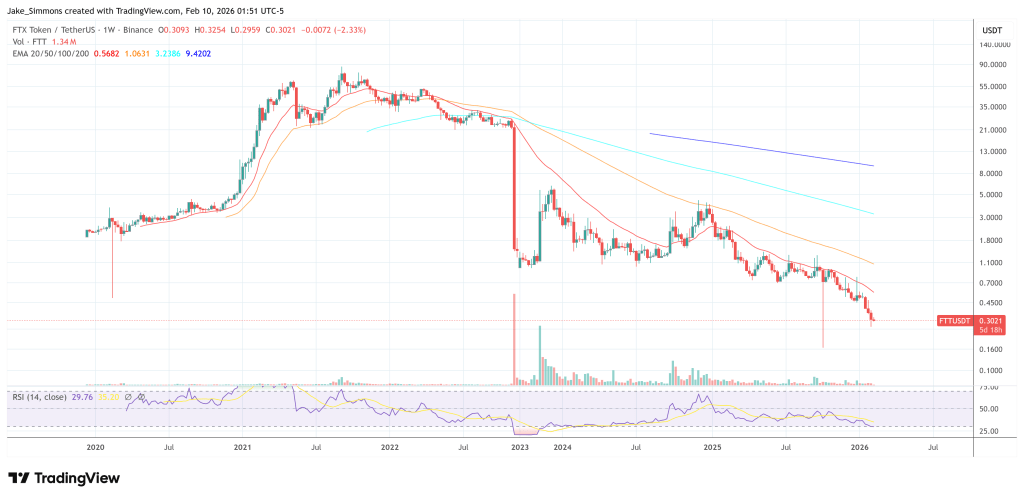
FTT continues its freefall, 1-week chart | Source: FTTUSDT on TradingView.com

Related Questions

QWhat is the main argument in his recent X thread regarding his criminal case?

AHe argues that his criminal case is 'Biden's political lawfare,' claiming the Biden administration prevented him from presenting evidence and responding to the charges.

QWho did SBF specifically single out as being responsible for curtailing what the jury could hear in his trial?

AHe singled out Judge Lewis Kaplan, claiming the judge 'rubber-stamped everything Biden's DOJ wanted' and ensured he 'couldn't show the jury the truth.'

QWhat does SBF claim was the 'truth' about FTX that he was prevented from presenting in court?

AHe claims the 'truth' was that 'the money was always there and FTX was always solvent,' and he was prohibited from pointing this out or even mentioning lawyers.

QHow does SBF attempt to draw a parallel between his own case and that of former President Donald Trump?

AHe draws a parallel by claiming both were subjected to Biden's 'lawfare machine,' faced gag orders and pre-trial detention, and were prevented from presenting evidence, noting that Trump also had Judge Kaplan in one of his cases.

QHow did some industry figures interpret SBF's thread, according to the article?

AIndustry figures like trader Bob Loukas and attorney Ariel Givner interpreted it less as a legal critique and more as a political pitch, specifically an attempt to angle for a pardon from Donald Trump.

Related Reads

The Shutdown of Claude Mythos Revealed the True Cost of Renting AI to Me

The sudden shutdown of Claude Mythos this week starkly highlights a critical, often overlooked risk for founders: when your core capability relies entirely on someone else's platform, your fate is not in your own hands. The key question becomes: who truly owns the intelligence your product depends on? For years, the debate around open-source models focused on cost. Now, the evidence is clear: fine-tuned open-source models can achieve frontier-level quality for specific, mission-critical tasks at a fraction of the cost. However, the deeper issue is control. Relying on a third-party API is like renting; it works until the landlord changes the rules, raises the rent, or asks you to leave—as Mythos experienced. The lesson is not to stop using frontier models—they are incredible infrastructure. The goal is ownership. Ownership means starting with a powerful open-source model and shaping it around what makes your company unique: your data, workflows, domain expertise, and definition of "good." Over time, the model becomes less generic and more reflective of your business, creating durable value. The optimistic conclusion is that AI's future doesn't hinge on one superior model. There is no single frontier. The frontier includes proprietary models, models fine-tuned on company-specific knowledge, specialized models for narrow problems, and intelligent routers orchestrating model ensembles. The most interesting development is not models getting smarter, but intelligence becoming increasingly customizable. The winning companies will be those that transform intelligence into a unique, owned asset. Looking ahead, the vision is not one model dominating all, but many teams owning the part of the frontier that matters most to them.

marsbit1m ago

The Shutdown of Claude Mythos Revealed the True Cost of Renting AI to Me

marsbit1m ago

Tiger Research: U.S. Strategic Bitcoin Reserve - Should the Market Be Happy or Disappointed?

Tiger Research analyzes the evolution of U.S. legislative efforts regarding a strategic Bitcoin reserve, concluding the market impact is limited in the short term but potentially positive long-term. The core event was a March 2025 executive order by former President Trump, which designated confiscated Bitcoin as a strategic reserve and promised not to sell existing holdings (approx. 190k BTC). As it contained no mandate to purchase new Bitcoin, the market reacted negatively, with prices dropping 5.7%. Legislative history shows a significant retreat from initial ambitions. The 2024 "BITCOIN Act" proposed mandatory purchases of 1 million BTC over five years. Reintroduced in 2025, it stalled due to high fiscal costs, concerns over dollar hegemony, and opposition from the Treasury Secretary. The current frontrunner, the 2026 "American Retirement and Monetary Advancement (ARMA) Act," is a compromise. It lacks any purchase requirement, instead focusing on consolidating existing government-held Bitcoin and legally prohibiting its sale for at least 20 years. While ARMA has higher passage odds due to bipartisan support and no purchase mandate, its immediate market effect is neutral. It eliminates potential government selling pressure but creates no new demand. The long-term significance is that formally establishing Bitcoin as a national reserve asset in law could later reignite debates on mandatory purchases. Therefore, the path to a government buyer is longer than initially priced by the market, but the directional narrative remains intact.

marsbit4m ago

Tiger Research: U.S. Strategic Bitcoin Reserve - Should the Market Be Happy or Disappointed?

marsbit4m ago

US Stock Market Trend (June 16): SpaceX Rises 42% in Two Days, New Fed Chairman Takes Office Today

**U.S. Stocks Trend (June 16): SpaceX Soars 42% in Two Days, New Fed Chair Takes Office Today** Markets surged on Monday following former President Trump's social media announcement of a completed U.S.-Iran deal to reopen the Strait of Hormuz, pending a June 19 signing. The news triggered a broad risk-on rally: oil prices crashed, tech stocks soared, bond yields fell, and defensive sectors lagged. **Market Performance:** The Nasdaq jumped 3.07%, led by semiconductor stocks like Micron (+9.2%). The S&P 500 gained 1.65%, and the Dow rose 0.92% to a record high. However, the Russell 2000 small-cap index underperformed (+0.72%). SpaceX continued its hot streak, rising another 5% pre-market after disclosures of large buys by an Australian billionaire and Cathie Wood's ARK. Boeing also rallied on the transportation optimism. Conversely, energy stocks like Chevron fell over 3% on the oil price plunge, with other defensive sectors also selling off. The day's action showed a clear rotation of funds from energy/defensive plays into AI and tech narratives. **Macro & Outlook:** The VIX fear index fell 8.37%. Treasury yields declined, and WTI crude dropped over 5%. Attention now shifts to a packed schedule: the Bank of Japan is widely expected to hike rates to 1.0% on Tuesday. The Fed's June meeting concludes Wednesday, marking new Chair Wash's debut. While rates are expected to hold, his tone on stubborn inflation and the "dot plot" will be crucial for gauging the 2024 rate path. The formal Iran deal signing is set for Friday. **Trend Perspective:** While the peace deal is a genuine positive, Monday's explosive rally may have gotten ahead of itself, pricing in a swift resolution to inflation concerns. The shortened trading week faces a triple test: BoJ tightening, the Fed's policy stance, and deal implementation details. Tech and semiconductors, which led the surge, remain vulnerable to any disappointment from these key events. The real price discovery begins with the central banks' communications this week.

marsbit25m ago

US Stock Market Trend (June 16): SpaceX Rises 42% in Two Days, New Fed Chairman Takes Office Today

marsbit25m ago

Xiaohongshu's Second Great Voyage, This Time Sailing Towards AI

Xiaohongshu's Second Voyage: Navigating Towards AI Since ChatGPT's emergence, Xiaohongshu's founder Mao Wenchao has been acutely aware of AI's potential threat, recognizing that the life advice people seek from chatbots overlaps directly with his platform's core business. Founded in 2013 as a PDF shopping guide for Chinese tourists, Xiaohongshu evolved into a massive community where millions share authentic, personal experiences—from product reviews to travel tips. This vast repository of "I've tried this" human judgment became its most valuable asset. However, the rise of AI, which delivers instant answers, challenges the very need for users to sift through numerous personal notes. Fearing its treasure trove of lived experience could become mere training data for others, Xiaohongshu is proactively adapting. In 2026, it established a dedicated AI division (Dots), launched RED Skill to turn user experiences into usable AI tools, and acquired the AI search product "Diandian." Its investments now extend to AI firms like MiniMax and hardware startups, moving upstream to address needs before they even become search queries. The platform's commercialization strategy is also evolving. With a newly acquired payment license and tools like the AIPS model to track consumer decision journeys, Xiaohongshu aims to seamlessly integrate recommendations with transactions, embedding commerce within AI-generated answers. Yet, a critical tension remains. While building smarter machines to organize and leverage its human experiences, Xiaohongshu must prevent AI from drowning out the authentic, flawed, and trustworthy "I've tried this" voices that built its community. Its core challenge is to harness AI's power without letting the map—the machine's perfect, synthesized answer—replace the territory of genuine human experience. This balance between technological advancement and preserving human trust defines its current journey and its future.

marsbit57m ago

Xiaohongshu's Second Great Voyage, This Time Sailing Towards AI

marsbit57m ago

Trading

Spot
Futures
活动图片





