‘Congress must pass the Clarity Act’ – U.S. Treasury Secretary’s plea decoded

ambcryptoPublished on 2026-04-09Last updated on 2026-04-09

Abstract

U.S. Treasury Secretary Scott Bessent urges Congress to pass the Digital Asset Market Clarity Act, arguing that clear federal rules are essential to prevent the relocation of crypto development to jurisdictions like Abu Dhabi and Singapore. He warns that regulatory uncertainty in the U.S. makes the risks of operating there outweigh the benefits. The call is supported by Senator Cynthia Lummis, who believes the act would serve as a "safe harbor" for innovation. However, prediction market Polymarket indicates the odds of the bill passing by 2026 have recently dropped to 57%. Despite this, key industry figures, including Coinbase's Chief Policy Officer, express confidence that legislative progress will be made.

The discussion around the CLARITY Act is intensifying day by day, and in a recent turn of events, U.S. Treasury Secretary Scott Bessent has also stepped in.

Urging Congress, Secretary Bessent has demanded the passage of the Digital Asset Market Clarity Act. Introduced in 2025, the bill is still finding common ground with both the crypto industry and the banking community, but consensus remains elusive.

Remarking on the same, Bessent said,

Congress must pass the Clarity Act. Senate floor time is scarce, and now is the time to act.

U.S. Treasury Secretary Scott Bessent’s point of argument

As reported by The Wall Street Journal, the Secretary drew comparisons with other countries, calling for clear federal rules for digital assets. This, in turn, he believes, would enable widespread developments and efficient investment, crucial for the largest economy by nominal GDP to prevail.

Comparing the U.S. with other countries, Bessent added,

A growing share of crypto development relocated to places ​with clear rules, such as Abu Dhabi and Singapore. Abroad, firms knew ​when and how to register, what standards to meet, and how to operate.

Highlighting the risks in the U.S., he summed it up best when he said,

The benefits of domiciling in the U.S. rarely outweighed the risks.

Needless to say, this isn’t the first time Bessent has stepped in to highlight the importance of clear rules in the digital assets space. Back in February, he had underlined that the bill would provide “great comfort to the market” in times of volatility.

Market conditions and others in support

Echoing similar sentiments, Senator Cynthia Lummis also noted,

We have the Administration, the momentum, and we’ve made bipartisan progress.

Lummis believes that the law is a one-pot solution for “developers, validators, and node operators.” And, once approved, the Act would work as “a safe harbor” to keep innovations anchored in the U.S.

All this comes on the heels of the crypto market fluctuating between $2 trillion and $3 trillion – thanks to increased volatility.

Polymarket odds

Meanwhile, the Polymarket odds for the passage of the CLARITY Act stood at 57% at the time of publication. However, if looked at carefully, the odds have dropped by 9% from their previous high, seen just weeks ago.
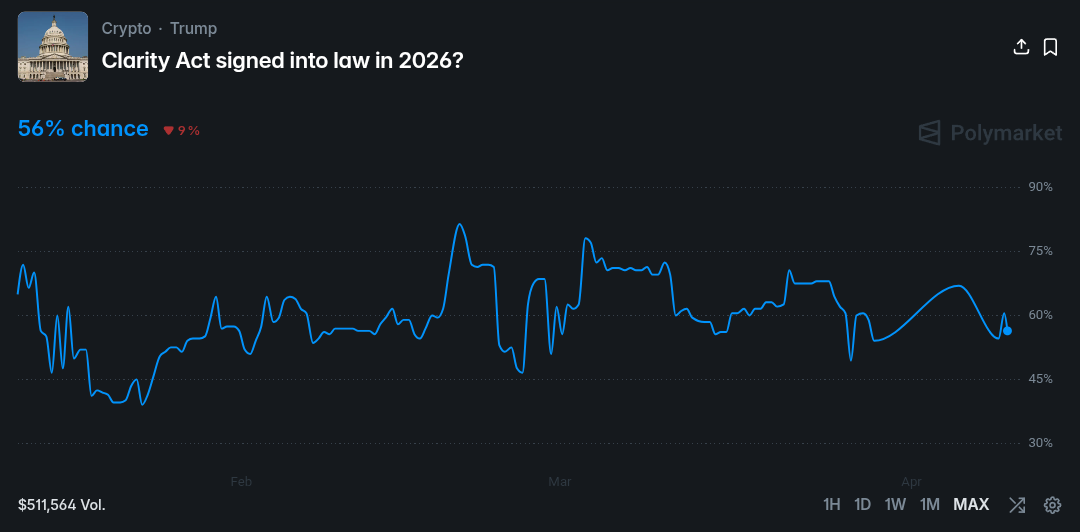
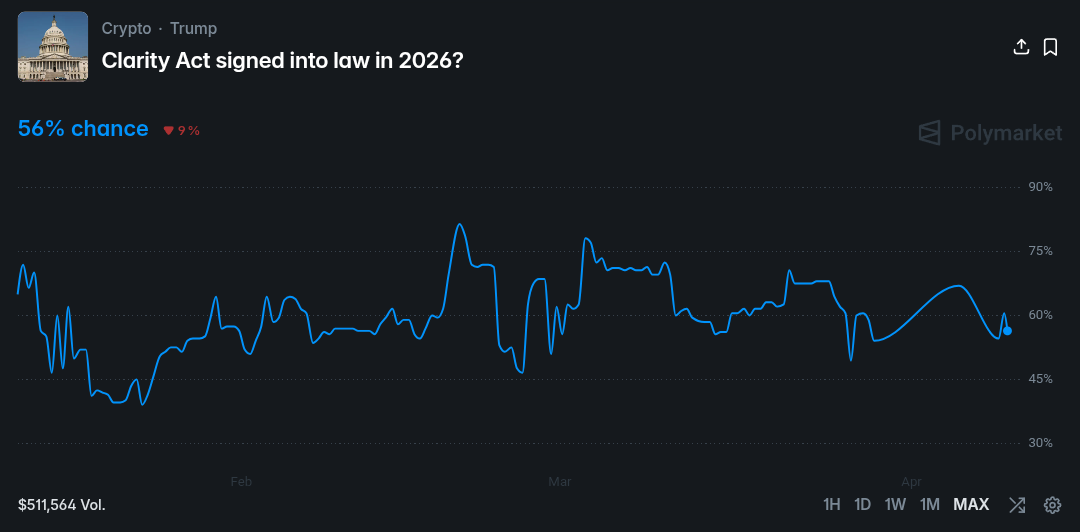
Source: Polymarket

At the same time, Coinbase’s Chief Policy Officer (CPO) also added to the ongoing demand when he noted,
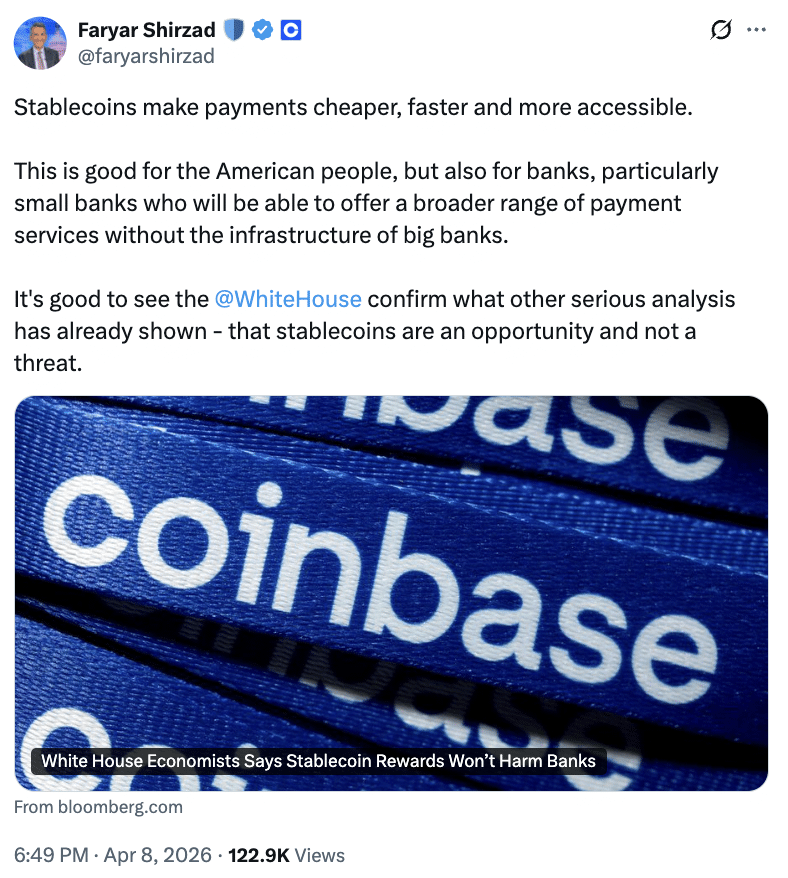
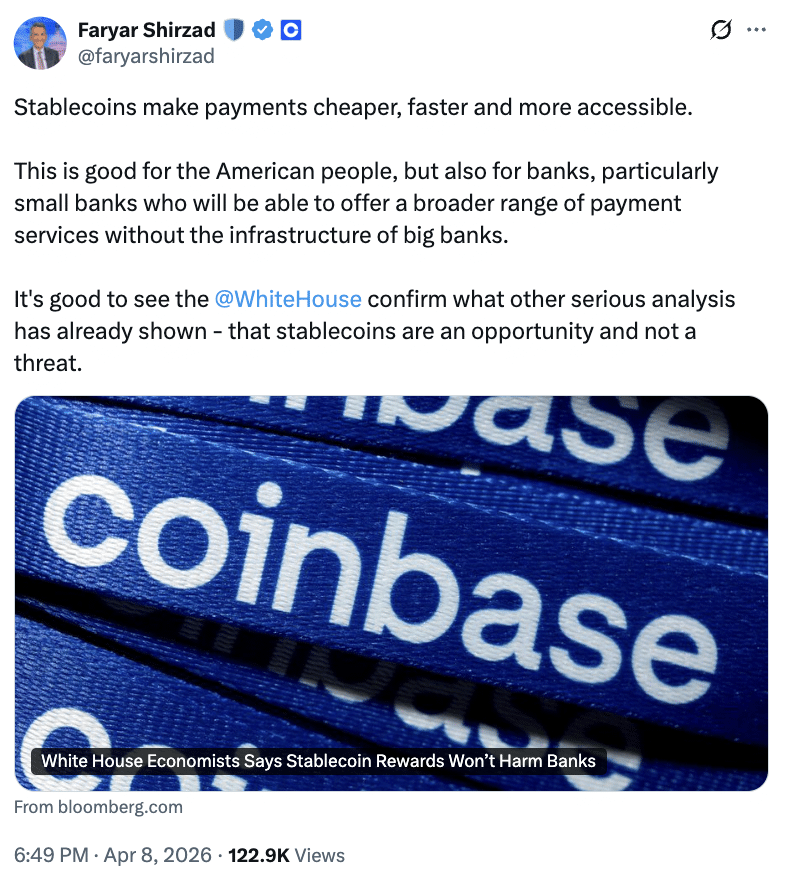
Source: X

This marks an interesting plot twist as Coinbase had recently stepped back from a recent compromise met on the CLARITY Act.

However, after the subtle threats between the White House and Coinbase, Coinbase’s CLO, Paul Grewal, turned bullish on the Act and put it best when he noted,

I’m very confident we’re going to see progress.

What’s more?

Additionally, a new report from the White House’s Council of Economic Advisers also highlighted that letting stablecoins offer yield isn’t a major threat to banks.

Thus, with so much optimism and understanding, it remains to be seen whether the CLARITY Act will be approved this year or get locked up in legislative headwinds.


Final Summary

  • The discussions around the CLARITY Act are heating up with Secretary Bessent now urging Congress to pass the Act.
  • Polymarket odds drop below 60%, adding more uncertainty to the passage of the bill by 2026.

Related Questions

QWhat is the main demand made by U.S. Treasury Secretary Scott Bessent in the article?

AScott Bessent demanded that Congress pass the Digital Asset Market Clarity Act to establish clear federal rules for digital assets.

QAccording to Bessent, why are some crypto firms relocating to places like Abu Dhabi and Singapore?

ABecause these locations have clear rules, where firms know when and how to register, what standards to meet, and how to operate.

QWhat are the current Polymarket odds for the passage of the CLARITY Act, and how have they changed recently?

AThe Polymarket odds stand at 57%, which is a 9% drop from their previous high seen just weeks ago.

QWhich U.S. Senator expressed support for the CLARITY Act, and what did they call it?

ASenator Cynthia Lummis expressed support, calling the Act a 'one-pot solution' for developers, validators, and node operators, and a 'safe harbor' to keep innovations in the U.S.

QWhat was the stance of Coinbase's Chief Legal Officer, Paul Grewal, on the CLARITY Act after recent developments?

APaul Grewal turned bullish on the Act and expressed confidence, stating, 'I’m very confident we’re going to see progress.'

Related Reads

The Value Distribution of Stablecoins

**Summary: The Value Distribution of Stablecoins** The article argues that stablecoins are evolving from mere trading tools into broader channels for dollar access. It divides the stablecoin ecosystem into four layers to analyze how value is distributed: 1. **Issuance Layer:** Mints stablecoins, holds reserve assets, and captures the spread between reserve yield and user costs (e.g., Tether, Circle). This layer currently earns the largest profit margin. 2. **Infrastructure Layer:** Connects stablecoins to the traditional financial system, handling fiat on/off-ramps, banking integration, compliance (KYC/AML), and asset management (e.g., Bridge, BVNK). This is the "unglamorous" but critical work, building the essential bridges between crypto and real-world finance. 3. **Acquiring/Distribution Layer:** Integrates stablecoins into merchant systems, manages payment flows, and provides enterprise financial software (e.g., Stripe, Coinbase). They act as the access point for businesses. 4. **Application Layer:** The end-users and businesses that ultimately use stablecoins for payments, settlements, or as a store of value. They benefit from convenience but have little pricing power. The core thesis is that while the issuance layer currently dominates profits, the often-overlooked **infrastructure layer holds significant long-term potential**. The real challenge and barrier to mass adoption is not the on-chain transfer of stablecoins (which is simple), but the complex "last mile" integration into existing business workflows, banking systems, and regulatory frameworks across different countries. Companies in this layer are currently in a "land grab" phase, investing heavily to build networks, secure bank partnerships, and establish compliance pathways. While their position is currently pressured by the profitable issuers above and distribution platforms below, the article suggests that if stablecoins become a default financial rail for businesses, the infrastructure providers who have done the hard work of integration will ultimately gain strong pricing power and become entrenched, essential players.

marsbit6h ago

The Value Distribution of Stablecoins

marsbit6h ago

The Value Distribution of Stablecoins

The Value Distribution of Stablecoins The article argues that stablecoins are evolving from a mere trading tool into a broad "dollar channel." It analyzes the industry's value chain through four layers: 1. **Issuance Layer (e.g., Tether, Circle):** The top layer that mints stablecoins, holds reserve assets, and captures the thickest interest rate spread. 2. **Infrastructure Layer (e.g., Bridge, BVNK):** Connects stablecoins to the traditional financial system, handling critical but complex "dirty work" like fiat on/off-ramps, banking integration, compliance (KYC/AML), and cross-border settlement. 3. **Acquiring/Distribution Layer (e.g., Stripe, Coinbase):** Embeds stablecoins into merchant systems, manages payment flows, and integrates with enterprise software. 4. **Application Layer:** End-users and businesses that ultimately use stablecoins for payments, settlement, or storing value. The author posits that while the issuance layer currently captures the most profit, the most overlooked and potentially critical layer is infrastructure. The core challenge for stablecoin adoption isn't the on-chain transfer (which is simple), but bridging the gap between blockchain and the real-world financial system. This involves solving practical problems for businesses: fiat conversion, reconciliation, tax handling, and user onboarding. Infrastructure companies are currently in a difficult "land-grab" phase—building networks, securing banking relationships, and achieving compliance country-by-country. They face pressure from both the profitable issuance layer above and distribution platforms below. However, the author suggests this layer is building a crucial moat. Once stablecoins become a default business rail, the infrastructure players who have done the hard work of integration may gain significant, durable value and pricing power.

链捕手6h ago

The Value Distribution of Stablecoins

链捕手6h ago

Trading

Spot
Futures
活动图片





