Comics Illustration: Helping You Understand China's New Regulations on Outbound Investment

marsbitPublished on 2026-06-01Last updated on 2026-06-01

Abstract

Summary: Understanding China's New Regulations on Overseas Investment The State Council has announced new regulations on overseas investment, effective July 1, 2026. The core message is not a prohibition on international investment, but a call for both companies and individuals to operate with strong regulatory awareness. Here are the key points: 1. **Scope is Broad:** The rules apply not only to companies but also to other organizations and individual residents. 2. **Definition of Investment is Wide:** It encompasses not just capital transfers but also asset contributions, obtaining equity or rights, financing, providing guarantees, and direct or indirect acquisition of rights related to overseas entities or assets. 3. **Companies Must Plan Comprehensively:** Beyond simple ownership charts, firms need clear plans covering the investing entity, required approvals or filings, fund transfer paths, and compliance with technology, data, and security reviews. 4. **Individuals Should Prioritize Compliance:** Before focusing on returns, individuals must first assess their eligibility, understand legal channels for capital outflow, know what they are acquiring, and identify responsible parties in case of issues. 5. **Penalties are Significant:** Violations can result in fines and potentially restrictions on future overseas investment activities. In essence, overseas investment remains possible, but it must be approached with regulatory compliance as a fundamental priority, no...

Author: Liu Honglin, Mankun Blockchain

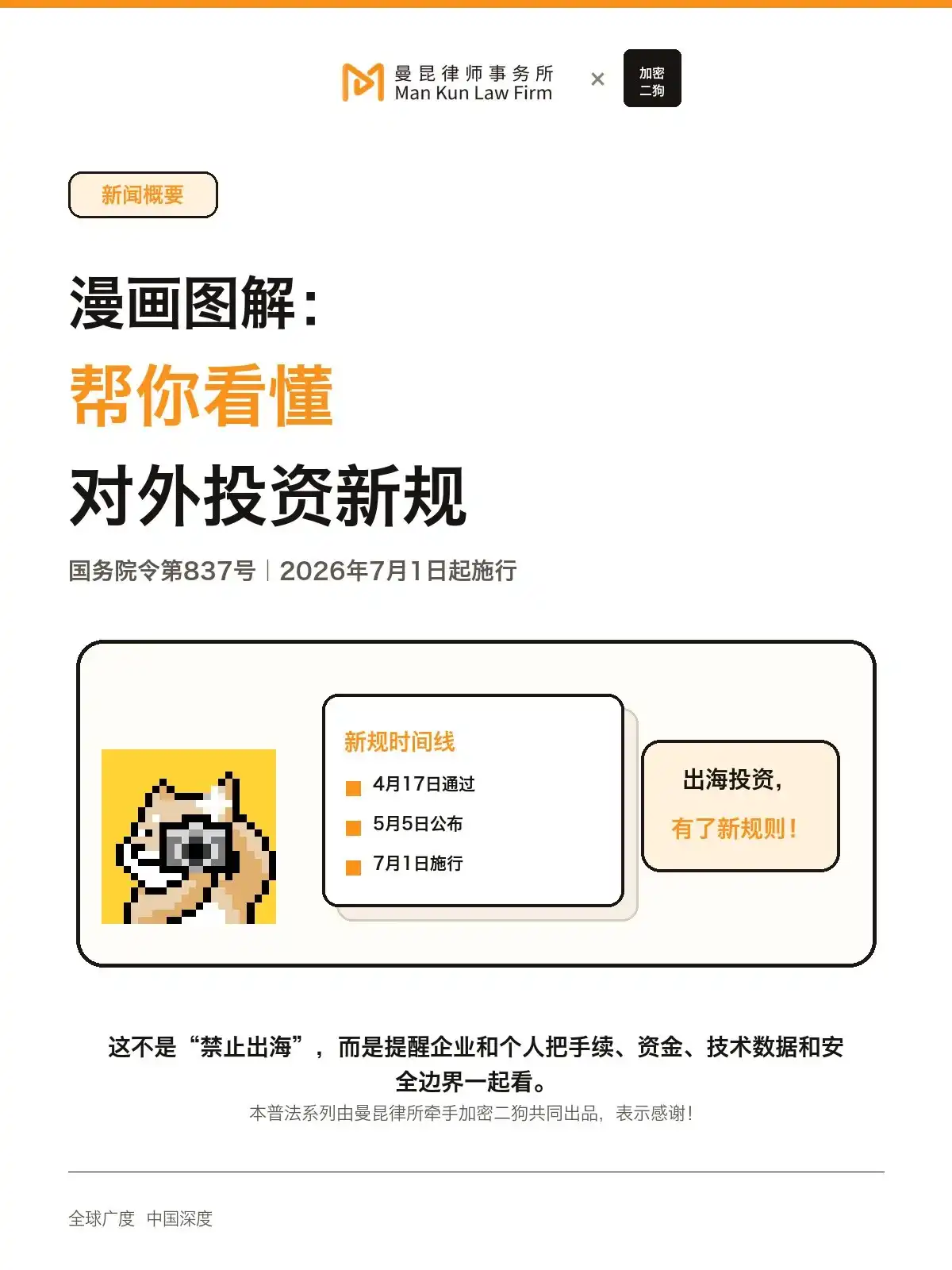
The State Council has promulgated the "State Council Regulations on Outbound Investment," which will take effect from July 1, 2026.

This is not simply a matter of "cannot go overseas."

More accurately, it serves as a reminder to enterprises and individuals: outbound investment must follow rules.

To understand this new regulation, keep the following points in mind first:

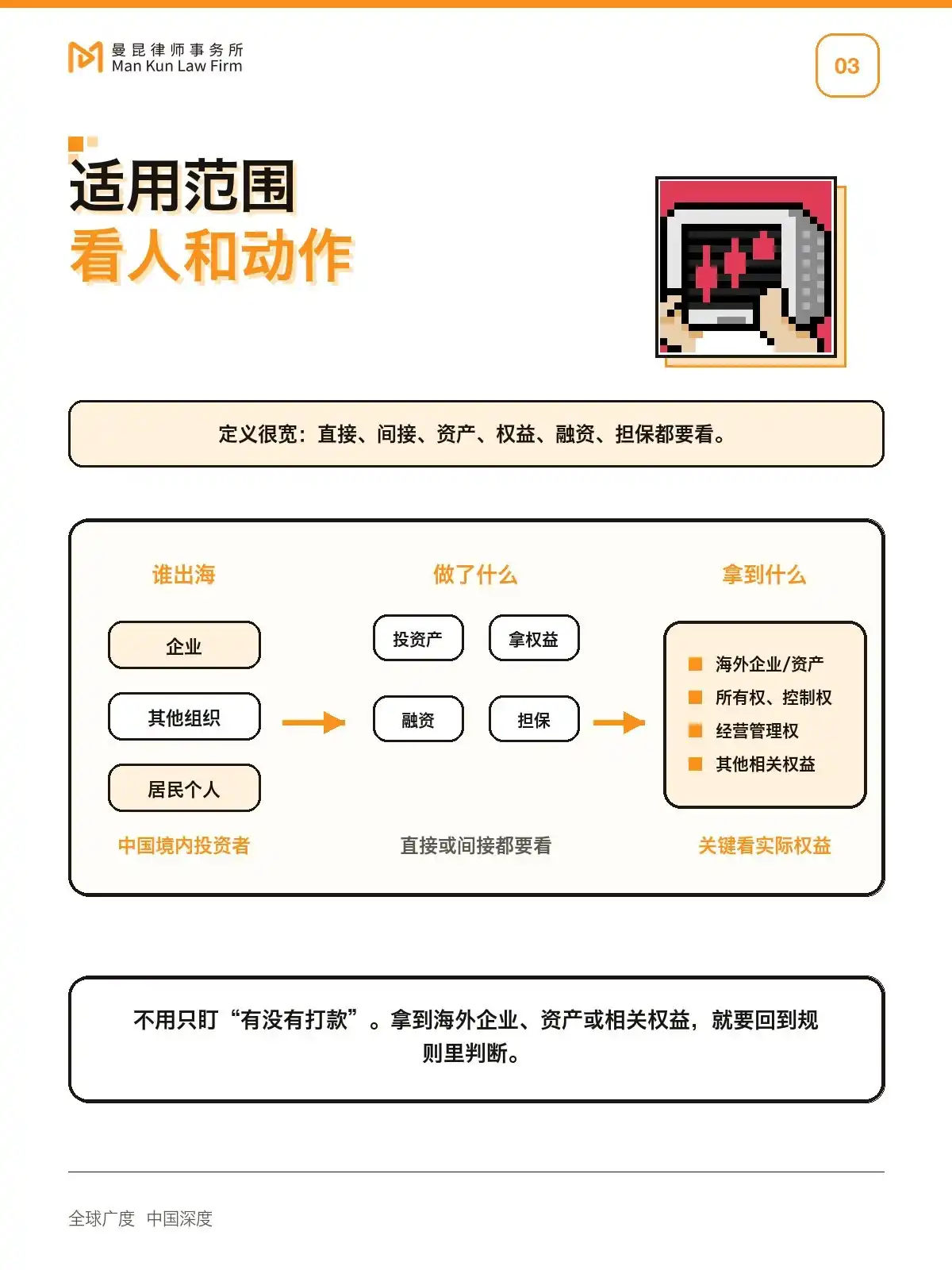
1️⃣ It's not just enterprises that are regulated. The scope of investors includes domestic enterprises, other organizations, and resident individuals.

2️⃣ It's not just about transferring money. Acquiring assets, obtaining equity rights, providing financing or guarantees, and directly or indirectly acquiring rights and interests related to overseas enterprises or assets all require assessment.

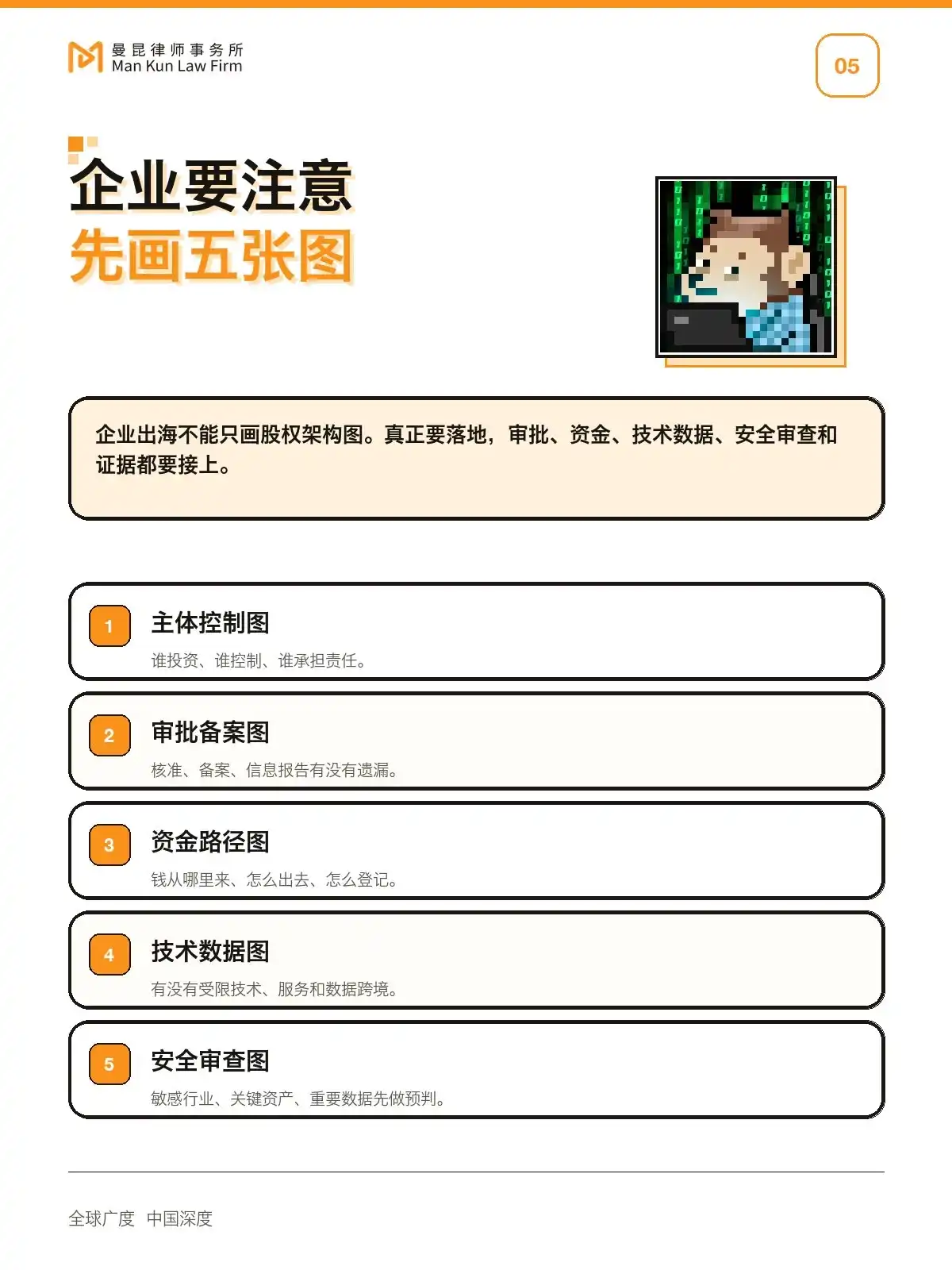
3️⃣ Enterprises shouldn't just draw equity structure charts. They also need to clearly chart the entities, approval/filing procedures, fund flow paths, technology, data, and security reviews.

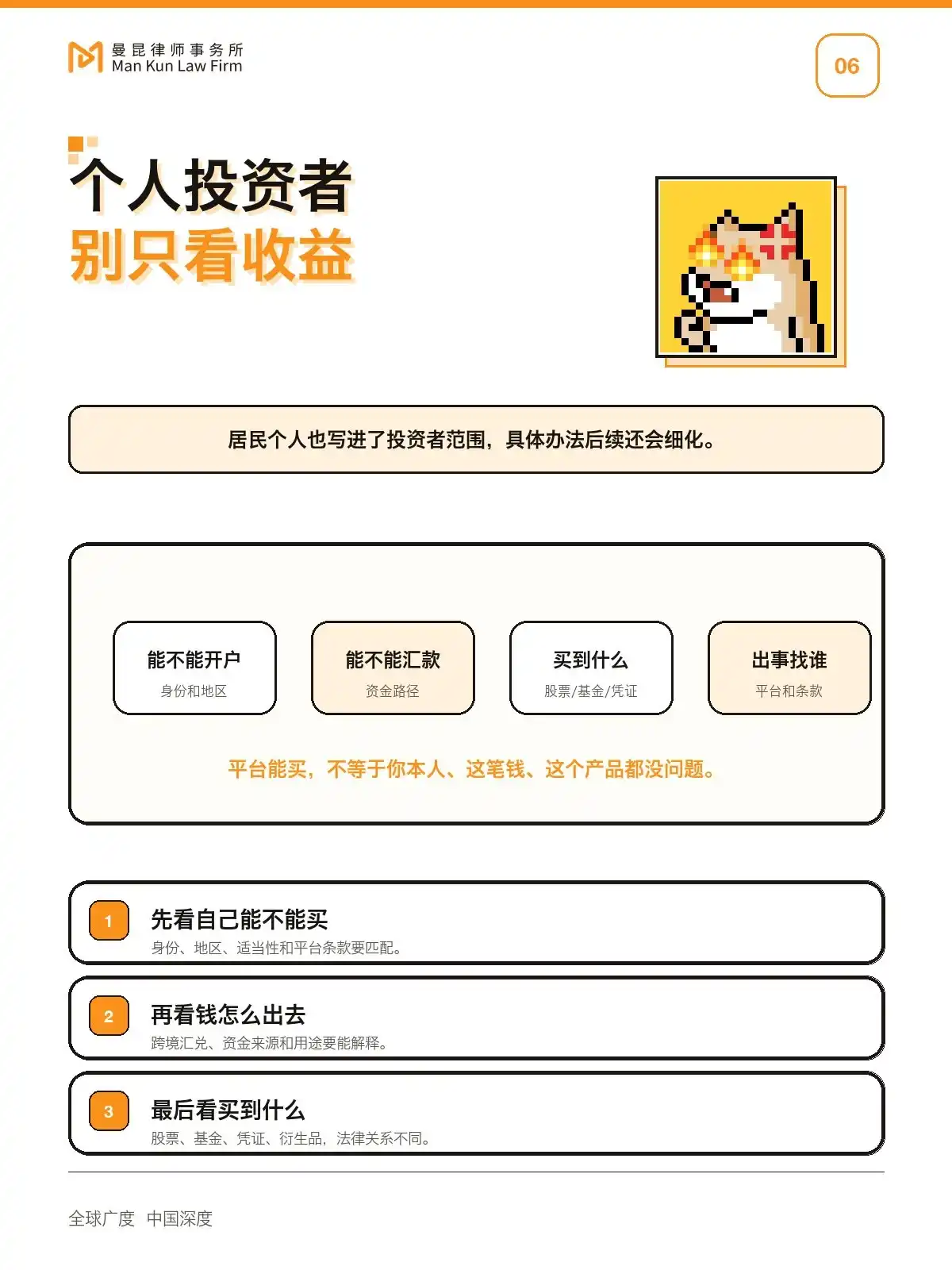
4" Individuals shouldn't just look at returns. First, consider whether you are eligible to invest, how the funds will go out, what you are actually buying, and whom to turn to if something goes wrong.

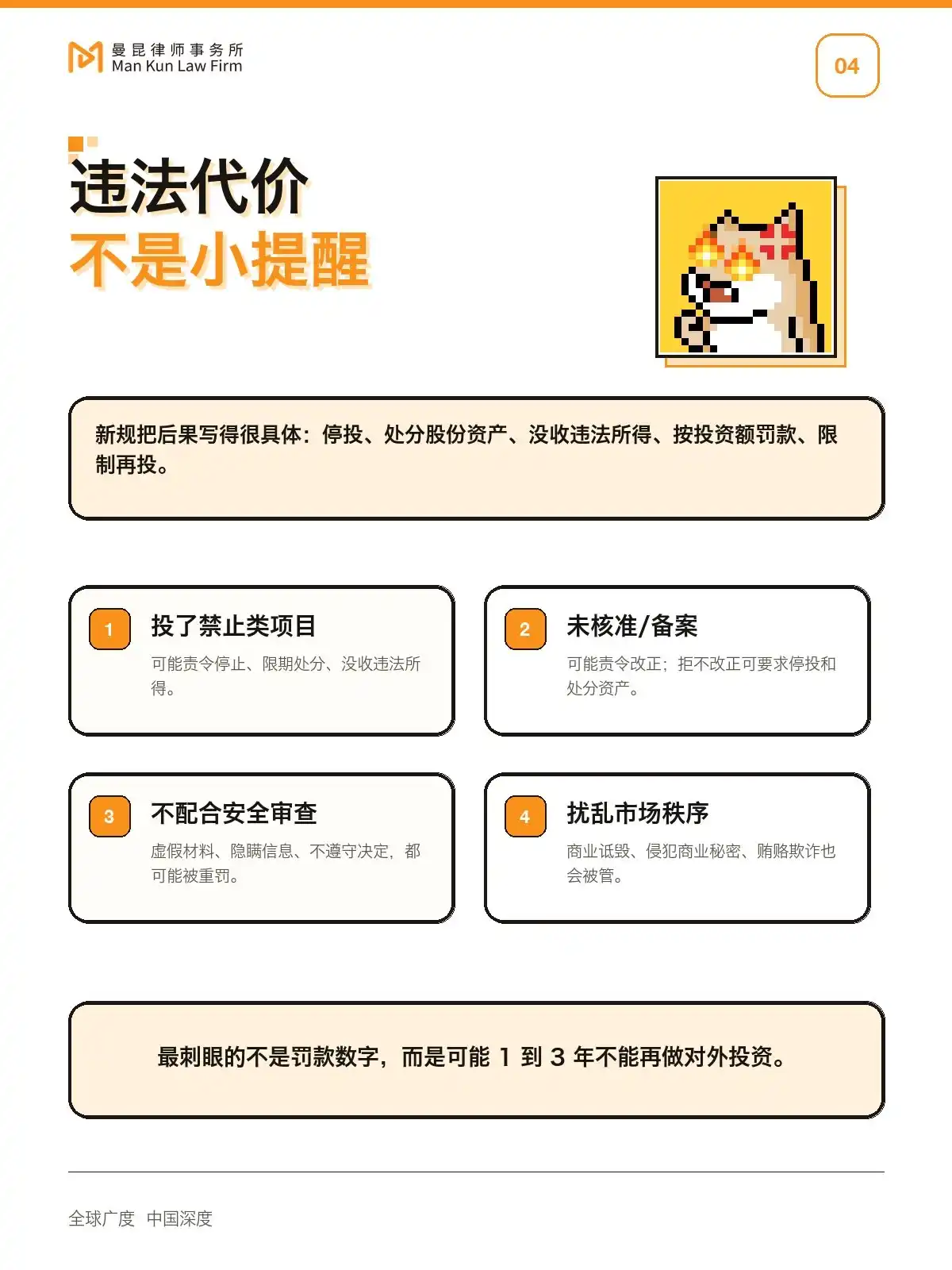
5️⃣ The price of non-compliance is not light. Beyond fines, there may be restrictions on continuing outbound investment activities.

In a nutshell: Outbound investment is not prohibited, but it cannot be pursued solely based on commercial opportunities.

The above is for general information sharing only and does not constitute legal advice or investment recommendations.

Related Questions

QWhat is the core message of China's new regulations on outward investment according to the article?

AThe core message is that outward investment is not prohibited, but it must be conducted with a strong awareness of and compliance with the rules. The regulations emphasize that decisions cannot be based solely on commercial opportunities.

QWho is covered as 'investors' under these new regulations?

AThe regulations cover not only domestic enterprises but also other domestic organizations and resident individuals. All are explicitly included within the scope of investors subject to the rules.

QWhat are some of the forms of outward investment mentioned that require consideration under the new rules?

AThe rules apply not just to monetary transfers. Activities like investing assets, acquiring equity interests, providing financing, offering guarantees, and obtaining rights related to overseas entities or assets, either directly or indirectly, all fall under consideration.

QWhat additional requirements do enterprises need to prepare for besides their corporate ownership structure charts?

AEnterprises must also clearly outline and prepare documentation related to the involved entities, the processes for obtaining necessary approvals or filings, the paths for fund transfers, and considerations for technology, data, and security reviews.

QWhat are the potential consequences for violating these regulations?

ABeyond financial penalties, violators may face restrictions or prohibitions on their ability to continue engaging in outward investment activities in the future.

Related Reads

SpaceX, OpenAI, Anthropic: The Three AI Giants Racing for IPO, Which One Is Worth Betting On?

SpaceX, OpenAI, and Anthropic are poised for historic IPOs within weeks, potentially raising a combined $180 billion—a sum exceeding the entire internet bubble's fundraising. The hosts of the Limitless Podcast argue this isn't just individual company financing but an unprecedented capital concentration for AI infrastructure, driven by an insatiable need for compute, data centers, power, and chips. SpaceX's IPO is notable for reportedly changing market index rules to allow faster inclusion, potentially funneling trillions in passive retirement funds into its stock, despite its unproven space-based data center business model. In contrast, Anthropic demonstrates explosive growth, with ARR reportedly hitting $45 billion and approaching profitability, fueled by strong enterprise adoption of products like Claude Code. Google's separate $80 billion raise highlights the immense capital pressure, even for giants. The discussion acknowledges bubble risks but leans optimistic. The hosts contend the massive spending is building essential physical infrastructure for the next technological era. A key bottleneck isn't capital but the real-world limits of chip manufacturing and construction speed. As long as demand for AI compute outstrips supply, this investment cycle represents a foundational build-out rather than a purely financial bubble. All three companies are seen as foundational bets on the future, with Anthropic often cited as the most immediately compelling due to its proven revenue trajectory.

marsbit2h ago

SpaceX, OpenAI, Anthropic: The Three AI Giants Racing for IPO, Which One Is Worth Betting On?

marsbit2h ago

From 'Old Guys' to 'New Favorites': How AI Is Revaluing Old Infrastructure from Dell to Nokia?

From "Vintage Tech" to "New AI Darlings": How AI Revalues Old Infrastructure One year ago, tech giants like Dell, Nokia, Cisco, and Western Data were seen as slow-growth, low-valuation stories, far from the AI spotlight dominated by players like Nvidia. Now, these legacy tech stocks are gaining market attention, sparking debate on whether this is genuine industry revaluation or a temporary narrative. As AI moves from model parameters to real-world data centers, the market is recognizing companies with proven delivery and infrastructure capabilities. This shift marks a change in the AI investment thesis: from pure model and GPU focus to the complex systems engineering required for deployment. Companies like Dell, HPE, and Corning are being revalued not for being "sexy" AI innovators, but for their decades of accumulated expertise in supply chains, enterprise delivery, and infrastructure—assets that have become critical in the AI buildout phase. The revaluation is unfolding across three key infrastructure lines: 1. **Servers & System Integration:** Dell and HPE are emerging as crucial system integrators or "general contractors" for AI data centers, translating GPU orders into complete, deployable server racks integrated with power, cooling, and networking. 2. **Networking & Connectivity:** AI's scale demands robust high-speed connections. Corning (fiber optics), Nokia (AI-RAN, 6G), and Cisco (data center switches) are gaining importance for enabling efficient data transfer within and between AI clusters. 3. **Storage:** Beyond high-speed memory (HBM/DRAM), the AI data explosion is driving demand for high-capacity hard drives (HDDs) from companies like Western Digital and Seagate to handle training data, logs, and cold storage cost-effectively. For this revaluation to be substantive and not just a narrative, three criteria are key: 1) Concrete AI-related order and revenue growth (e.g., Dell's AI server sales), 2) Upward revisions to company financial guidance, and 3) Sustainable improvements in profit quality, not just top-line revenue spikes. In essence, AI's transition to a real construction phase is re-pricing "old assets" against "new demand." The opportunity, however, is selective. Only those legacy firms that are demonstrably integrated into the capital expenditure chains of data center and enterprise AI deployment are likely to experience a true "logic re-rating" rather than just a temporary valuation bounce.

marsbit2h ago

From 'Old Guys' to 'New Favorites': How AI Is Revaluing Old Infrastructure from Dell to Nokia?

marsbit2h ago

Trading

Spot
Futures
活动图片