Coinbase Stock Slides 4.3% as Nevada Gaming Regulator Targets Unlicensed Sports Betting Contracts

bitcoinistPublished on 2026-02-05Last updated on 2026-02-05

Abstract

Coinbase shares declined 4.3% as Nevada gaming regulators filed a civil complaint against the company, alleging its prediction market products constitute unlicensed sports betting. The state seeks to halt these markets, arguing they fall under Nevada's gambling laws rather than federal derivatives regulation. Coinbase, which partners with CFTC-regulated Kalshi, maintains the products are legal derivatives. The action adds to regulatory pressures on Coinbase, which has seen an 11-session stock decline amid legal uncertainties and a recent data breach. The company is challenging similar state-level actions in other jurisdictions, claiming exclusive CFTC oversight.

Coinbase shares continued their recent decline after Nevada regulators moved to block the crypto exchange’s prediction market products, adding another layer of legal uncertainty for the company.

The enforcement action highlights a growing conflict between state gaming authorities and platforms offering event-based contracts that resemble sports betting, even when those products operate under federal oversight.

On Monday, the Nevada Gaming Control Board filed a civil enforcement complaint against Coinbase Financial Markets in Carson City. Regulators are seeking a temporary restraining order and a permanent injunction to stop Coinbase from offering prediction markets tied to sports and elections within the state.

The board argues that these contracts amount to unlicensed gambling under Nevada law and should fall under state gaming authority rather than federal derivatives regulation.
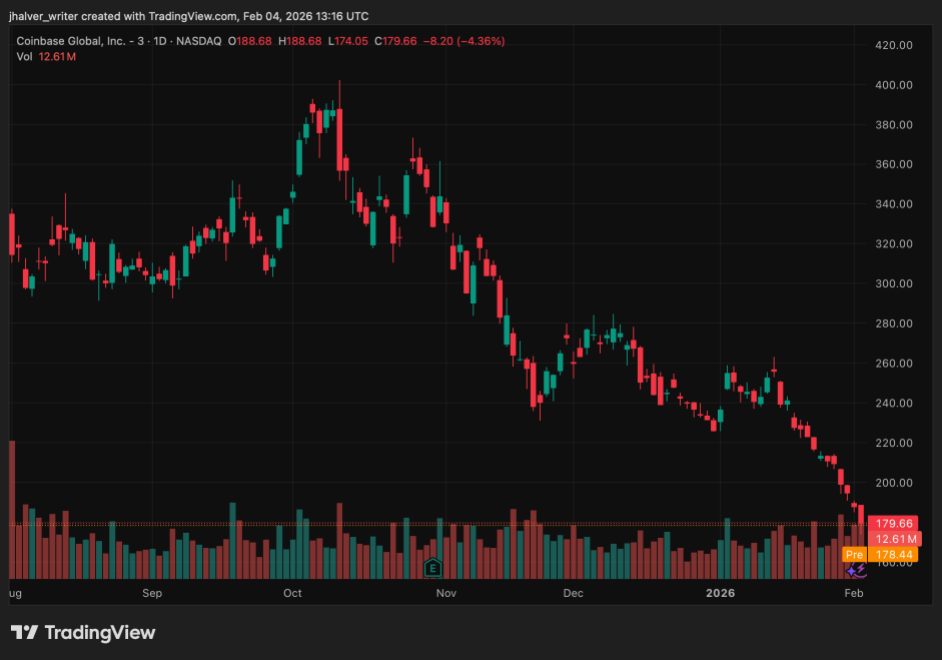
COIN's price trends to the downside on the daily chart. Source: COINUSD on Tradingview

Nevada Challenges Coinbase’s Prediction Markets

Coinbase launched its US prediction markets last month through a partnership with Kalshi, a Commodity Futures Trading Commission-regulated designated contract market.

The exchange maintains that these event-based contracts are federally regulated derivatives, not gambling products. Nevada officials disagree, saying contracts linked to sporting outcomes and elections constitute wagering activity and therefore require state gaming licenses.

In its filings, the board also raised concerns about age restrictions, noting that Coinbase allows users aged 18 and older to trade event contracts, below Nevada’s legal gambling age of 21.

Regulators said the platform’s continued operation creates ongoing harm and gives Coinbase an unfair advantage over licensed sportsbooks that must meet strict compliance, tax, and location requirements.

The action against Coinbase follows similar moves by Nevada against other prediction market platforms. A state court recently granted a temporary restraining order blocking Polymarket from offering event-based contracts to Nevada residents.

Legal Pressure Weighs on Coinbase Stock

The Nevada lawsuit has added to broader pressure on Coinbase shares. The stock fell 4.36% on Wednesday, extending its losing streak to eleven consecutive sessions and pushing it to its lowest level since April.

Investor sentiment has been weighed down by regulatory risks and a recent disclosure of an insider-related data breach affecting roughly 30 clients.

Coinbase has pushed back against state-level actions elsewhere, filing federal lawsuits against gaming regulators in Connecticut, Michigan, and Illinois. The company argues that prediction markets fall exclusively within the CFTC’s jurisdiction and that state enforcement efforts unlawfully restrict federally regulated products.

Cover image from ChatGPT, COINUSD chart on Tradingview

Related Questions

QWhy did the Nevada Gaming Control Board file a complaint against Coinbase?

AThe Nevada Gaming Control Board filed a complaint because it argues that Coinbase's prediction market products tied to sports and elections constitute unlicensed gambling under Nevada law and should be regulated by the state gaming authority, not as federal derivatives.

QWhat is the impact of the Nevada enforcement action on Coinbase's stock?

AThe Nevada lawsuit contributed to a 4.36% decline in Coinbase's stock on Wednesday, extending its losing streak to eleven consecutive sessions and pushing it to its lowest level since April.

QHow does Coinbase defend its prediction market products against state regulators?

ACoinbase maintains that its event-based contracts are federally regulated derivatives overseen by the CFTC, not gambling products, and it has filed federal lawsuits arguing that state enforcement efforts unlawfully restrict these federally regulated products.

QWhat specific concerns did Nevada regulators raise about Coinbase's platform besides licensing?

ANevada regulators raised concerns about age restrictions, noting that Coinbase allows users aged 18 and older to trade, which is under Nevada's legal gambling age of 21, and that it gives Coinbase an unfair advantage over licensed sportsbooks that must meet strict compliance requirements.

QHas Nevada taken similar actions against other prediction market platforms besides Coinbase?

AYes, the Nevada Gaming Control Board has taken similar action against other platforms. A state court recently granted a temporary restraining order blocking Polymarket from offering event-based contracts to Nevada residents.

Related Reads

Bitcoin Withdrawals Continue: 8 Years of Storage in a Coldcard Cold Wallet Ended in Zero

Coldcard Hardware Wallet Hacked: Losses Mount Due to Vulnerable Seed Generation A critical vulnerability in Coldcard hardware wallets has led to a continued wave of fund thefts. According to Galaxy Research, the total stolen has reached 1,367.05 BTC (approx. $88.6 million) from 4,585 addresses, a significant increase from the initial 594.5 BTC reported on July 30, 2026. Most of the stolen funds remain on the attackers' addresses. The issue is not with the current firmware, which Coinkite has updated, but with seed phrases generated on vulnerable devices between March 2021 and the release of fixed firmware versions. Due to a programmer error, devices switched from using a hardware random number generator to the software-based Yasmarang generator, which was initialized with publicly accessible data like the chip's serial number. This made the seed phrases predictable through offline brute-force attacks, meaning wallets remain at risk until funds are moved to a new wallet generated with the patched firmware. Affected devices include Mk2/Mk3 with firmware 4.0.1–4.1.9 (and up to 5.0.3), Mk4/Mk5 up to version 5.6.0, and Q models up to 1.5.0Q. The only exceptions are seeds created with a high-entropy method like at least 50 independent dice rolls or a strong unique BIP-39 passphrase. All other owners must generate a new seed on the fixed firmware and transfer their assets. A case highlighting the human impact involves a 39-year-old long-term investor who lost 2 BTC (approx. $130,000) in minutes. He had accumulated the Bitcoin over eight years through physical labor, viewing it as a financial lifeline and a retirement plan in a country suffering from hyperinflation. His story underscores that even conservative "buy and hold in cold storage" strategies can be compromised by such underlying technical flaws. From a technical perspective, this incident echoes historical failures where weak random number generators undermined cryptographic security, challenging the assumption that offline storage is automatically foolproof.

cryptonews.ru5h ago

Bitcoin Withdrawals Continue: 8 Years of Storage in a Coldcard Cold Wallet Ended in Zero

cryptonews.ru5h ago

Trading

Spot
活动图片





